


Outsourced HR Services for Small Businesses Without Breaking the Budget

Updated: Aug 3

Not every small business needs a full-time HR department. However, every employer needs reliable ways to hire employees, manage payroll and timekeeping, communicate workplace expectations, address employee concerns, and follow applicable employment requirements.
For many small-business owners, the challenge is not recognizing that HR support is valuable. The challenge is finding professional HR services that fit the company’s current needs and budget.
This is where outsourced HR services can help.
Outsourcing allows a business to purchase specific HR expertise, project support, or ongoing guidance without immediately hiring a full-time HR employee. When the arrangement is carefully designed, a company can focus its budget on the services that matter most.
Outsourced HR is not automatically inexpensive, and it cannot guarantee legal compliance, employee retention, or business growth. Those claims in the original article were too broad. An outside HR provider can help identify risks, improve processes, support managers, and strengthen the employee experience, but business leadership remains responsible for workplace decisions.
The key is choosing the right service model, defining the scope clearly, and avoiding unnecessary expenses.
This guide explains how small businesses can use outsourced HR services without breaking the budget, what those services may include, and how to determine whether an HR provider offers real value.
What Are Outsourced HR Services?
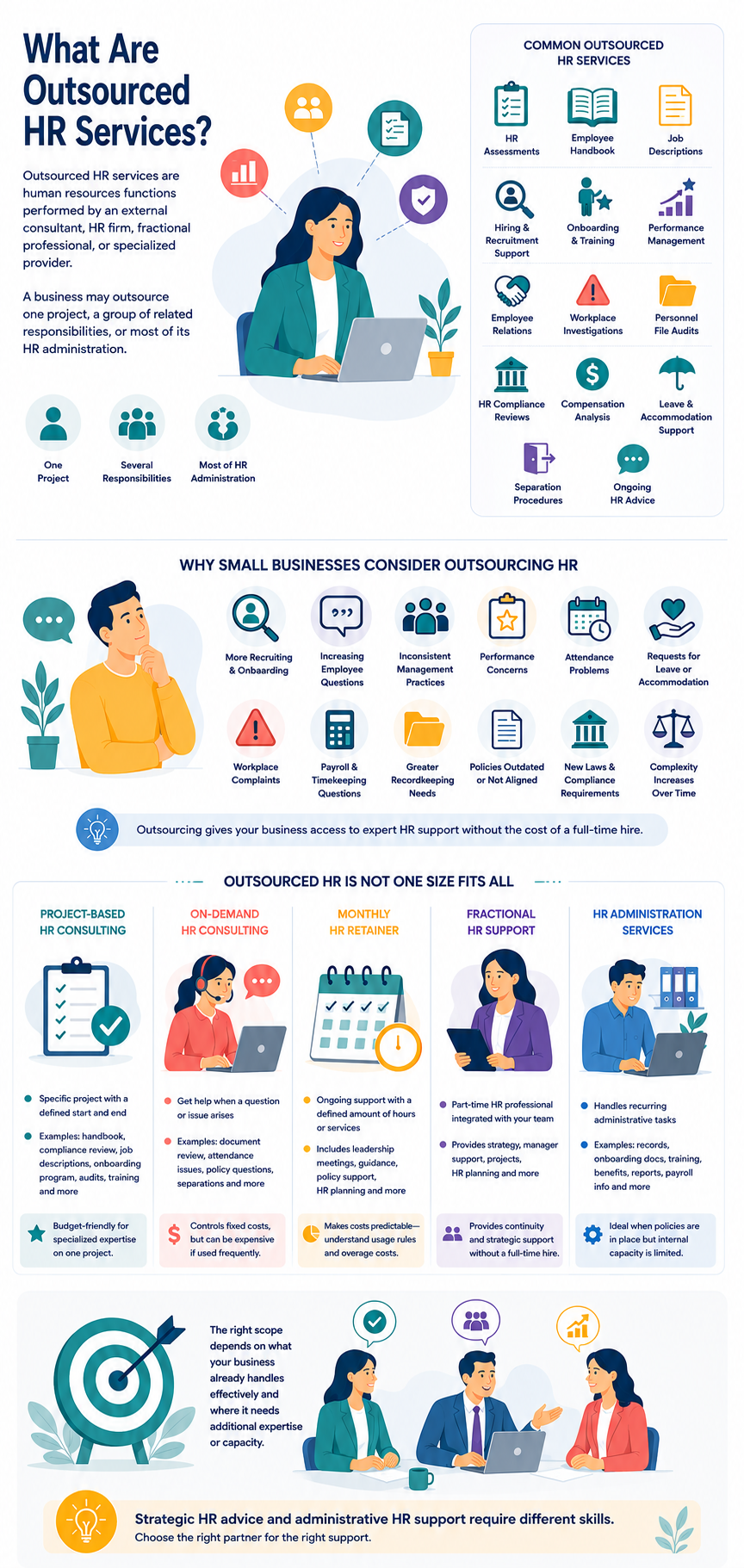
Outsourced HR services are human resources functions performed by an external consultant, HR firm, fractional professional, or specialized provider.
A business may outsource one project, a group of related responsibilities, or most of its HR administration.
Common outsourced HR services for small businesses include:
HR assessments
Employee handbook development
Job descriptions
Hiring-process design
Recruitment support
New-hire onboarding
Manager training
Performance-management systems
Employee-relations guidance
Workplace investigations
Personnel-file audits
HR compliance reviews
Compensation analysis
Leave and accommodation support
Employee separation procedures
Ongoing HR advice
The right scope depends on what the business already handles effectively and where it needs additional expertise or capacity.
Why Small Businesses Consider Outsourcing HR
Most small-business owners do not begin by building an HR department. In the early stages, the owner, office manager, bookkeeper, or payroll administrator may handle employee matters.
That arrangement may be practical when the company has only a few employees. As the workforce grows, HR responsibilities tend to become more frequent and complex.
The business may begin experiencing:
More recruiting and onboarding
Increasing employee questions
Inconsistent management practices
Performance concerns
Attendance problems
Requests for leave or accommodation
Workplace complaints
Payroll and timekeeping questions
Greater recordkeeping needs
Policies that no longer reflect current practices
New federal, state, or local requirements
Outsourcing can give the business access to experienced HR assistance without committing to a full-time position before the workload justifies one.
Outsourced HR Is Not One Standard Service
“Outsourced HR” describes several different arrangements. Understanding the differences can prevent a business from purchasing more support than it needs.
Project-Based HR Consulting
Project-based HR consulting is designed for a specific assignment with a defined beginning and end.
Examples include:
Creating an employee handbook
Conducting an HR compliance review
Developing job descriptions
Building an onboarding program
Creating a performance-review system
Conducting a personnel-file audit
Training managers
Supporting a workplace investigation
This model can be budget-friendly when the business needs specialized expertise for one project but can manage daily employee matters internally.
The service agreement should identify the final deliverables, timeline, number of revisions, client responsibilities, and additional services that are not included.
On-Demand HR Consulting
On-demand HR consulting gives the business access to an HR professional when a question or employee issue arises.
The business may pay an hourly rate, purchase a block of hours, or use a limited monthly service.
On-demand support may be appropriate when HR questions are occasional rather than continuous.
Examples include:
Reviewing a corrective-action document
Discussing an attendance problem
Preparing for a difficult employee conversation
Reviewing a job description
Answering a policy question
Planning an employee separation
This model can control fixed costs, but it may become expensive if the company requires frequent assistance. It can also encourage reactive HR management if the provider is contacted only after a problem has escalated.
Monthly HR Retainer
A monthly retainer generally provides a defined amount or category of ongoing support.
Depending on the agreement, it may include:
Regular leadership meetings
Employee-relations guidance
Manager coaching
Policy support
Document review
HR planning
A set number of service hours
Priority response times
A retainer can make costs more predictable. However, the business should understand whether unused time carries forward, what happens when usage exceeds the allowance, and which services require a separate fee.
Fractional HR Support
A fractional HR professional serves the company on a recurring, part-time basis.
The individual may act as a fractional HR manager, director, or senior advisor. This model is different from occasional on-demand consulting because the professional typically becomes more integrated into the organization.
Fractional HR support may include:
Participating in leadership meetings
Developing HR strategy
Supporting managers
Reviewing employment decisions
Managing major HR projects
Monitoring HR priorities
Planning for workforce growth
Serving as an ongoing HR contact
Fractional HR can be useful when a business needs continuity and strategic support but not a full-time senior HR employee.
It is not necessarily the least expensive model. Businesses should compare the expected hours, scope, availability, and expertise with the cost of other options.
HR Administration Services
Some providers focus on recurring administrative work, such as:
Maintaining personnel records
Coordinating onboarding documents
Tracking required training
Managing benefits enrollment
Preparing routine reports
Coordinating payroll information
Maintaining HR calendars
Administrative support may be appropriate when the company has established policies but lacks internal capacity to maintain the process.
Strategic HR advice and administrative HR support require different skills. Confirm which type of service the provider offers.
A PEO Is Different From an HR Consultant
A professional employer organization, commonly called a PEO, may provide payroll, benefits administration, workers’ compensation support, and certain HR services through a contractual arrangement.
A PEO is not the same as a project-based consultant or fractional HR advisor.
The IRS cautions that outsourcing payroll or related tax responsibilities to a third party does not necessarily eliminate the client employer’s tax responsibilities. Except in certain arrangements, the employer may remain responsible if the third party does not perform required duties. IRS Employer’s Tax Guide
Before selecting a PEO, understand:
Which entity processes payroll
Which entity files tax returns
How benefits are administered
How workers’ compensation is handled
Which HR services are included
Which decisions remain with the business
How the arrangement can be terminated
What happens to benefits and payroll if the relationship ends
Start With an HR Needs Assessment
The most effective way to control outsourced HR costs is to understand what your business actually needs.
Do not begin by purchasing the largest package a provider offers.
Review your current HR practices and ask:
Which HR responsibilities are working well?
Which projects remain unfinished?
Where are managers struggling?
What employee issues occur repeatedly?
Which responsibilities create the greatest risk?
How much time does leadership spend on HR?
Which tasks require specialized knowledge?
Which duties could remain internal?
What business changes are planned?
Which problems need immediate attention?
An initial HR assessment can help organize priorities. The business can then purchase services based on actual needs instead of assumptions.
Prioritize High-Risk HR Issues First
If your budget is limited, begin with HR matters that could create the greatest financial, operational, or employee impact.
Priorities may include:
Payroll and timekeeping errors
Unpaid wages
Employee misclassification
Workplace safety concerns
Serious employee complaints
Harassment or discrimination concerns
Leave or accommodation requests
Missing required documents
Inconsistent disciplinary practices
Improper termination procedures
Outdated policies
The U.S. Department of Labor identifies pay, recordkeeping, workplace notices, and certain leave and child-labor requirements among the responsibilities that may apply to small businesses. State and local rules may provide additional protections. Department of Labor small-business guidance
An HR consultant can help identify concerns and implement practical procedures. Legal questions should be referred to qualified employment counsel when necessary.
Keep Routine Work Internal When It Makes Sense
Not every HR task requires a senior consultant.
Your business may be able to manage routine responsibilities internally, including:
Collecting standard forms
Scheduling interviews
Maintaining calendars
Entering approved payroll changes
Filing routine documents
Coordinating training dates
Sending standard employee communications
Tracking completed acknowledgments
The outside provider can focus on higher-value work, such as:
Designing processes
Reviewing difficult decisions
Coaching managers
Conducting investigations
Updating policies
Evaluating compliance risks
Planning workforce strategy
Dividing the work appropriately can reduce consulting costs while giving the internal team access to expertise when needed.
Create Repeatable HR Processes
A recurring HR problem becomes expensive when the business must ask the same question repeatedly.
Outsourced HR creates more value when the provider builds reusable tools.
Examples include:
Hiring checklists
Interview guides
Onboarding checklists
Manager documentation templates
Leave-request procedures
Performance-review forms
Complaint-reporting procedures
Separation checklists
Annual HR calendars
Personnel-file indexes
A well-designed process allows managers and internal staff to handle routine situations more consistently without contacting the consultant for every step.
The goal should be to increase the organization’s capability—not make it permanently dependent on the provider.
Build a Practical Employee Handbook
An employee handbook can be a valuable foundational project, but it should be tailored to the business.
Avoid paying for a lengthy handbook filled with policies that do not apply to your workforce. At the same time, avoid inexpensive generic templates that may be outdated or written for another state or industry.
A practical handbook may address:
Equal employment opportunity
Harassment prevention
Complaint reporting
Reasonable accommodations
Attendance
Timekeeping
Overtime
Meal and rest periods
Paid time off
Leaves of absence
Workplace conduct
Confidentiality
Remote work
Information security
Safety
Corrective action
Separation from employment
The EEOC notes that clear, updated, and consistently enforced policies can help employees understand workplace expectations and may help prevent certain workplace problems. EEOC employee-policy guidance
A handbook is only useful when it reflects actual practices, employees receive it, and managers follow it.
Improve Hiring Without Outsourcing Every Step
A business does not necessarily need to outsource the entire recruitment process.
An HR consultant can help create the structure while managers continue making hiring decisions.
Budget-conscious hiring support may include:
Updating job descriptions
Improving job postings
Creating screening criteria
Developing structured interview questions
Training managers
Designing candidate evaluation forms
Creating offer-letter templates
Building an onboarding checklist
Once those tools are established, the company may be able to manage future hiring internally.
If the business is hiring many employees quickly or filling specialized positions, more extensive recruitment support may be justified.
Strengthen Onboarding to Protect Your Hiring Investment
Hiring an employee requires time, advertising, interviews, paperwork, training, and manager attention. Disorganized onboarding can weaken that investment.
A consultant can help create a standardized onboarding process that includes:
Required employment documents
Payroll setup
Policy acknowledgments
Equipment and systems access
Job training
Safety instruction
Performance expectations
Manager check-ins
30-, 60-, or 90-day reviews
After the process is built, internal staff can usually coordinate most of the steps.
Outsourced HR cannot guarantee that employees will remain with the company. However, clear expectations and organized onboarding can address preventable misunderstandings that sometimes contribute to early turnover.
Use Manager Training to Reduce Recurring Problems
Managers influence attendance, performance, morale, communication, and employee relations.
A single practical training session can sometimes provide more long-term value than repeated calls about individual problems.
Useful manager-training topics include:
Interviewing
Performance feedback
Documentation
Attendance management
Policy enforcement
Employee complaints
Harassment prevention
Reasonable accommodations
Leave requests
Timekeeping
Conflict resolution
When to involve HR
Manager training should use examples relevant to the business. Generic presentations may be less effective if supervisors cannot connect the material to their daily responsibilities.
Use HR Technology Carefully
HR software can improve efficiency, but it can also create unnecessary expenses.
Before purchasing a new system, determine:
Which problem the technology will solve
Whether current software already includes the feature
How many employees will use it
Whether implementation fees apply
Whether support and training cost extra
Whether data can be exported
Whether the price increases with headcount
How the vendor protects employee information
Who will maintain the system
Technology does not replace sound HR judgment or clear processes. Automating a poor process usually makes the poor process faster rather than better.
Ask your HR provider whether technology is truly necessary or whether a well-designed checklist, secure shared system, or existing payroll feature could meet the need.
Compare Cost Based on Total Value
When comparing HR providers, do not evaluate price alone.
Consider:
Scope of services
Experience level
Industry knowledge
State-specific knowledge
Response time
Availability
Quality of deliverables
Manager support
Confidentiality practices
Technology fees
Travel charges
Revision limits
Cancellation terms
Services excluded from the agreement
A lower hourly rate may not save money if the provider takes longer, produces generic materials, or requires extensive correction.
A more experienced consultant may charge a higher rate but complete a project more efficiently and create tools the business can continue using.
Understand Common HR Pricing Models
Outsourced HR pricing may be structured in several ways.
Hourly rate
You pay for the time used. This can work well for occasional questions or limited projects.
Ask whether time is billed in minimum increments and whether emails, phone calls, travel, or preparation are billable.
Fixed project fee
You pay an agreed amount for a defined deliverable.
This can provide budget certainty, but the scope must be clear. Determine how revisions, delays, and requests outside the original project will be handled.
Monthly retainer
You pay a recurring monthly amount for specified services or access.
Confirm the number of included hours, response times, rollover rules, and overage rates.
Per-employee pricing
The fee is based on workforce size.
This model may be predictable, but costs rise as the company grows. Review what services are included for each employee.
Service packages
The provider offers different levels of support.
Packages can be convenient, but the business may pay for services it does not use. Compare the package with a customized scope.
Watch for Hidden or Unexpected Costs
Before signing an agreement, ask about:
Setup fees
Technology charges
Travel expenses
Rush fees
After-hours support
Additional locations
Additional handbook states
Employee investigation fees
Training materials
Legal review
Payroll implementation
Benefits administration
Background checks
Contract termination fees
Data-export charges
Request a written proposal that clearly separates included services from optional services.
Budget surprises often occur when the parties use broad phrases such as “complete HR support” without defining what that means.
Set a Monthly HR Budget
A small business can control costs by setting a realistic HR budget and assigning priorities.
Your budget may include:
Routine HR consulting
High-priority projects
Manager training
Employment-law support
HR technology
Recruiting
Background checks
Payroll services
Benefits administration
Workplace safety
Required training
Separate expected expenses from contingency funds.
For example, you may budget for a handbook project and monthly consulting while maintaining a smaller reserve for an investigation or urgent employee-relations matter.
A predictable budget helps the business avoid delaying important HR work until a problem becomes more expensive.
Decide What Requires an HR Consultant and What Requires an Attorney
HR consultants and employment attorneys perform related but different roles.
An HR consultant may help with:
Policy implementation
Manager coaching
Documentation
HR processes
Training
Employee relations
Investigations
Workforce planning
An employment attorney may be needed for:
Legal advice
Litigation
Agency charges
High-risk terminations
Complex wage disputes
Legal interpretation
Settlement agreements
Privileged investigations
Threatened claims
A good outsourced HR provider should recognize when legal counsel is appropriate.
Your budget should not assume that an HR consultant’s fee includes legal services unless the provider is qualified and the agreement specifically includes them.
Outsourced HR Does Not Eliminate Employer Responsibility
The original article stated that outsourced HR “ensures” compliance and protects businesses from costly legal issues. That does not ring true as an absolute claim.
An HR provider can help strengthen practices, but the business remains responsible for many decisions and obligations.
Leadership must still:
Provide accurate information
Follow established procedures
Pay employees correctly
Maintain required records
Respond to concerns
Provide a safe workplace
Make employment decisions
Monitor third-party performance
Involve legal counsel when necessary
Even outsourcing payroll does not automatically remove employer responsibility. IRS guidance generally warns that employers remain responsible if a third-party payroll provider fails to perform required federal tax duties, subject to specific exceptions. IRS Form 941 instructions
Outsourcing should improve your ability to manage responsibilities—not create the impression that those responsibilities no longer exist.
Measure Whether Outsourced HR Is Providing Value
You should be able to identify whether the engagement is helping your business.
Depending on the services purchased, useful measures may include:
Fewer payroll corrections
Faster completion of onboarding
Updated policies and documents
Improved manager response times
Fewer unresolved employee concerns
More consistent performance documentation
Reduced leadership time spent on routine HR
Completion of required training
Better organization of employee records
Shorter time to fill positions
Lower new-hire turnover
Completion of planned HR projects
Not every HR benefit can be reduced to a financial number. However, the provider should help establish clear goals and report progress.
Questions to Ask an Outsourced HR Provider
Before selecting a provider, ask:
What services do you recommend based on our needs?
Which work can remain internal?
What is included in the price?
What costs extra?
Who will serve as our main contact?
What are your response times?
Do you have experience in our industry?
Which states do you support?
How do you protect confidential employee information?
How will you learn our policies and culture?
How do you handle urgent employee matters?
When do you recommend legal counsel?
What deliverables will we own?
Can we export our documents and data?
How can we change the scope?
How can we end the agreement?
How will we measure results?
The provider should be willing to explain its limitations as clearly as its capabilities.
Red Flags in Low-Cost HR Services
A low price is not always a bargain.
Be cautious if a provider:
Guarantees legal compliance
Claims it can eliminate employment risk
Promises to stop all employee turnover
Uses identical documents for every client
Cannot explain the service scope
Provides no written agreement
Avoids discussing confidentiality
Offers legal advice without proper qualifications
Charges unexpected technology or setup fees
Provides access only to generic templates
Cannot describe relevant experience
Has no process for urgent concerns
Encourages the business to ignore state or local requirements
Affordable HR support should still be competent, responsive, and appropriate for your business.
A Budget-Friendly Outsourced HR Plan
A small business can build HR support in phases.
Phase 1: Address immediate risk
Start with:
Payroll and timekeeping concerns
Serious complaints
Employee classification questions
Missing required documents
Safety concerns
Urgent policy gaps
Phase 2: Build essential systems
Develop:
Job descriptions
Hiring procedures
Onboarding checklists
Employee handbook
Complaint-reporting process
Performance documentation
Separation checklist
Phase 3: Strengthen managers
Provide training and coaching on:
Communication
Feedback
Documentation
Attendance
Employee concerns
Policy enforcement
Phase 4: Add strategic support
As the business grows, consider:
Workforce planning
Compensation analysis
Leadership development
Employee engagement
Retention planning
Organizational design
This phased approach allows the business to fund the most important work first and add services as needs and resources grow.
Frequently Asked Questions About Affordable Outsourced HR
Are outsourced HR services affordable for very small businesses?
They can be when the scope is limited to high-priority projects or occasional guidance. Very small businesses should compare hourly, project-based, and limited retainer options rather than purchasing a broad package automatically.
Is fractional HR cheaper than hiring a full-time HR employee?
It may be when the business needs senior expertise for only part of the week or month. However, the answer depends on the hours, rates, service scope, availability, and internal workload.
Can I outsource only one HR project?
Yes. Many businesses use project-based HR consulting for a handbook, audit, training program, onboarding process, or performance-management system.
Can an outsourced HR provider guarantee compliance?
No provider can reasonably guarantee complete compliance or eliminate all risk. A qualified consultant can identify gaps, recommend improvements, and help implement stronger procedures.
Will outsourced HR improve employee retention?
It may support retention by improving onboarding, communication, management practices, policies, and employee relations. It cannot guarantee that employees will stay.
Should I outsource payroll and HR to the same provider?
That depends on the provider’s capabilities, service quality, pricing, and your desire for one integrated system. Compare the convenience with the risks of relying heavily on one vendor.
How can I prevent my HR consulting costs from increasing?
Define the scope, establish approval requirements for extra work, request regular usage reports, build repeatable internal processes, and review the service arrangement periodically.
What should I outsource first?
Begin with high-risk issues or projects that require expertise your internal team does not have. Then build systems that reduce recurring problems.
Professional HR Support That Fits Your Business
Outsourced HR services can be a practical option for small businesses that need professional guidance but are not ready for a full-time HR department.
The most budget-friendly approach is not necessarily choosing the cheapest provider. It is purchasing the right level of support, clearly defining the scope, developing reusable HR processes, and keeping appropriate routine work inside the business.
At Moving Mountains HR Consulting, we help small and mid-sized businesses identify their most important HR needs and create practical solutions that fit their operations and resources.
Whether you need a focused HR project, on-demand guidance, manager support, or an ongoing fractional HR relationship, we can help you choose an approach that provides value without adding unnecessary costs.
Need professional HR support without the expense of building a full-time HR department? Contact Moving Mountains HR Consulting to discuss a practical outsourced HR plan for your business.
This article provides general HR information and is not legal, tax, accounting, or financial advice. Requirements and costs vary based on location, industry, employer size, service provider, and specific circumstances.


Comments