Introduction
Most small and mid-size business owners didn't start out planning to be leaders. They started as the best salesperson, the sharpest operator, or the founder willing to work nights to get the product right.
That skill set gets a company off the ground. It rarely prepares someone to lead a growing team, communicate a clear vision, or make confident calls under pressure once headcount doubles.
Many owners struggle to shift from doing the work to leading the people doing it. Strategic leadership coaching closes that gap.
Unlike a one-off workshop or generic HR training, it's a structured process built around a specific leader's decisions, blind spots, and growth stage.
This guide covers what strategic leadership coaching involves, the skills it builds, its measurable benefits, how it differs from HR consulting, and how to pick the right partner.
Key Takeaways
- Strategic leadership coaching builds decision-making capacity and execution habits, not short-term motivation
- Differs from HR consulting, which builds compliant systems rather than individual leader behavior
- Lifts team engagement, retention, and succession readiness across the organization
- SMBs in regulated industries like healthcare gain the most when coaching pairs with strong HR infrastructure
What Is Strategic Leadership Coaching?
Strategic leadership coaching is a focused process that develops a leader's ability to set vision, make confident decisions under pressure, and align teams to long-term goals. It goes beyond frameworks handed out in a weekend workshop or a one-time consulting engagement.
The problem it solves is specific: many leaders can manage day-to-day operations perfectly well but lack a repeatable system for leading through complexity, growth transitions, or organizational change. They react instead of plan. They make good calls in calm moments and shaky ones under stress.
Coaching addresses that gap through recurring, personalized sessions rather than generic advice delivered once and forgotten.
Who Strategic Leadership Coaching Is Designed For
Strategic leadership coaching is built for three overlapping groups:
- Founder-CEOs and owner-operators transitioning from doing the work themselves to leading the people who now do it
- Mid-size business owners hitting a growth ceiling caused by leadership capacity, not lack of market opportunity
- Executives in regulated industries like healthcare, who must balance compliance demands with strategic growth decisions
For organizations relying on these leaders, development is no longer optional. 51% of CHROs named leadership and manager development among their top three priorities for 2025, ranking it first among all HR investments, according to SHRM's CHRO Priorities and Perspectives research report.
Organizations aren't treating this as a personal perk anymore. They're building it into how they plan for growth.
Core Skills Strategic Leadership Coaching Develops
Good coaching programs target specific, measurable capabilities rather than vague notions of "becoming a better leader."
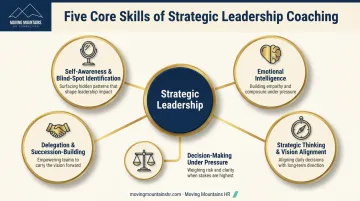
Self-Awareness and Blind-Spot Identification
Tools like 360-degree feedback and structured reflection give leaders an accurate picture of their strengths and their default behaviors under stress. Most owners think they know how they show up in a crisis. Feedback from their own team often tells a different story.
Emotional and Social Intelligence
Coaching develops the four EQ domains identified by psychologist Daniel Goleman:
- Self-awareness: recognizing your own emotions and patterns
- Self-management: regulating behavior and adapting responses
- Social awareness: reading others and organizational context
- Relationship management: influencing, resolving conflict, and building teamwork
Research across more than 100 leadership studies links higher EQ to stronger leader performance. How EQ is measured varies, but the positive pattern holds in most cases.
Strategic Thinking and Vision Alignment
Coaching builds the discipline to align daily operational decisions with long-term goals, often using tools like:
- Scenario planning: test how alternative futures might change resource or staffing needs
- SWOT analysis: map internal strengths and weaknesses against external opportunities and threats
- Cascading goals (OKRs): connect team priorities to the company’s longer-term vision
Decision-Making Under Pressure
Structured frameworks like cost-benefit analysis and decision trees give leaders a repeatable process instead of a gut reaction.
Picture an owner facing a budget cut mid-year. Without a framework, leaders decide on emotion or whoever spoke last in the meeting. With one, they weigh costs, benefits, and downstream risk before committing.
Delegation and Succession-Building
Coaching pushes leaders to shift from "doing it all" to empowering a team to carry real responsibility.
This matters more than most owners realize. 56% of HR professionals report their organization has no succession plan at all, and only 21% have a formal one in place, per SHRM's succession planning research. Lack of time and resources is the most common reason cited.
Key Benefits of Strategic Leadership Coaching for Business Owners
The payoff from coaching extends well past the individual leader's own performance.
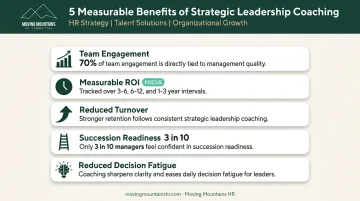
Stronger team alignment and engagement. Gallup research shows 70% of the variance in a team's engagement is tied to management, according to Gallup's workplace research. When a leader's behavior improves, engagement typically follows.
Measurable ROI, with a caveat. Return on coaching investment depends on program structure, coach experience, and how you measure progress. The International Coaching Federation recommends tracking productivity, turnover, decision quality, and team cooperation over 3–6 months, 6–12 months, and 1–3 years. Skip generic "10x ROI" claims and measure your own numbers.
Reduced turnover and stronger retention. Consistent leadership reduces the friction that drives good employees out the door. Structured HR strategy support reinforces those coaching outcomes.
Moving Mountains HR's retention and HR strategy guidance pairs staffing, compensation, and benefits planning with the behavioral shifts a leader works on in coaching, so both efforts pull in the same direction.
Succession readiness and reduced founder dependency. Only about 3 in 10 managers in talent reviews feel confident in their leadership bench, according to Gartner's 2024 research. Coaching that includes delegation work targets this gap directly.
Reduced decision fatigue and burnout. A personalized decision framework lowers the cognitive load on owners juggling sales, operations, and people management. Fewer decisions made from scratch means more bandwidth for the ones that matter.
Strategic Leadership Coaching vs. HR Strategy Consulting: How They Work Together
These two services get confused constantly, and the distinction matters more than most owners assume.
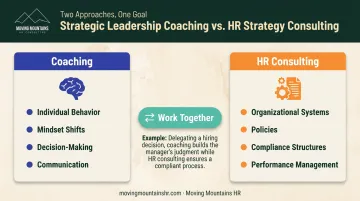
Coaching changes individual leadership behavior and mindset. It works on how a person thinks, decides, and communicates. HR strategy consulting builds the organizational systems — policies, performance management, compliance structures — that make those leadership decisions stick once they're made.
A coach can help a founder decide to delegate hiring decisions to a manager. HR strategy consulting builds the interview process, offer templates, and onboarding structure that make that delegation work in practice.
For small and mid-size businesses without an internal HR function, that gap is common — and pairing leadership coaching with fractional CHRO support closes it. Moving Mountains HR's Premium tier includes Fractional CHRO support covering:
- High-level HR strategy and guidance
- Compliance management oversight
- Performance management support
- Workplace culture development
That combination turns a leader's decisions into consistent, compliant people practices rather than one-off intentions.
Before choosing a provider, diagnose your actual problem:
- Is the challenge behavioral — does the leader need to think or decide differently?
- Is it structural — does the organization lack the policies or systems to support good decisions?
- Is it both, which is common for growing companies without dedicated HR?
How to Choose the Right Strategic Leadership Coaching Partner
Treat this decision with the same rigor you'd apply to any other strategic business investment. That means checking credentials, not just chemistry.
Key criteria to evaluate:
- Relevant experience with companies your size and industry
- Documented methodology—not ad hoc advice improvised session to session
- Success metrics defined before the engagement starts, not added afterward
Red flags to watch for:
- Answers handed to you instead of building your own decision-making capacity
- One-size-fits-all group programs with no individual tailoring
- No plan for sustaining progress after the engagement ends
Once you know what good (and bad) looks like, pressure-test fit before you sign:
- What does your process actually look like, session to session?
- How do you measure progress, and how often do we check it?
- What's the typical program duration, and why?
- What happens after the formal engagement ends?
If a coach can't answer these clearly, move on.
Frequently Asked Questions
How much does a strategic leadership coach cost?
Costs vary by coach experience, program length, and whether the engagement is individual or organization-wide. Weigh price against expected ROI, not the upfront number alone.
What is the 70/30 rule in leadership coaching?
About 70% of leadership growth comes from on-the-job experience and real-time application. The other 30% comes from coaching conversations, feedback, and reflection. Coaching amplifies experience; it doesn't replace it.
What are the four P's of strategic leadership?
Common frameworks use purpose, people, process, and performance to connect vision with day-to-day execution. Models vary by methodology, so ask any coach which framework they use and why.
How is strategic leadership coaching different from HR consulting?
Coaching develops individual leadership behavior and decision-making. HR consulting builds the compliant policies and performance systems that support those behaviors across the whole organization.
How long does a strategic leadership coaching program typically take?
Most structured programs run a few months to a year. Shorter engagements target a specific skill; longer ones support broader organizational alignment.
Can a small business benefit from strategic leadership coaching without a full-time HR executive?
Yes. Fractional CHRO and HR strategy support, like the tiered services offered by Moving Mountains HR, let small businesses pair leadership development with executive-level HR guidance without the cost of a full-time hire.