Introduction
Picture a 22-person company: the owner is tracking hours across three spreadsheets, texting shift swaps at 11 p.m., and Googling "do I need a written meal break policy in California" the night before an audit. That's not a hypothetical. It's Tuesday for a lot of growing businesses.
Employee management has become a high-stakes function in a small or mid-size company. Get it wrong, and you're looking at payroll errors, missed compliance deadlines, or a harassment complaint nobody knows how to handle.
Many owners hear "employee management solutions" and picture an app. The reality is messier. The category covers software, professional employer organizations (PEOs), outsourced HR consulting, and in-house teams, each solving a different piece of the puzzle.
This guide breaks down what employee management solutions actually are, walks through the four main types available, and gives you a framework for matching a solution to your company's size, budget, and risk level.
Key Takeaways
- Employee management is more than software—options include PEOs, outsourced HR consulting, and in-house teams
- Choose based on company size, budget, and the compliance risk you carry
- Software tracks day-to-day work; strategy, compliance, and investigations still need human judgment
- Software plus an HR consulting partner often costs less than a full-time HR hire and covers more risk
What Are Employee Management Solutions?
Employee management solutions are the tools, processes, and expert support that guide employees through the full lifecycle: hiring, onboarding, day-to-day performance, compliance, and offboarding. Effective solutions work as a system.
That system typically draws from three sources:
- Technology — software that tracks hours, manages tasks, and stores records
- Outsourced services — PEOs and consulting firms that take on administrative or strategic HR work
- Expert guidance — HR professionals who interpret law, resolve conflict, and build policy
Employee Management vs. Workforce Management vs. Talent Management
These terms get used interchangeably, and that's a problem, because they solve different issues.
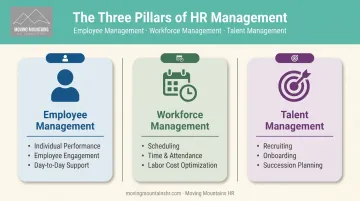
- Employee management centers on the individual: performance, engagement, day-to-day support
- Workforce management focuses on operations: scheduling, time and attendance, labor cost optimization
- Talent management, per Gartner's definition, covers attracting, selecting, and retaining people, including recruiting, onboarding, and succession planning
A scheduling app solves workforce management. A performance review tool solves employee management. Neither one writes your harassment policy or confirms a job posting complies with pay transparency law.
Why "Solutions" Means More Than Software
A lot of small business owners without a dedicated HR person assume the fix is buying software. It helps, but it doesn't replace judgment. When a complaint lands on your desk, or you're expanding into a second state with different labor rules, no dashboard tells you what to do next.
That gap is exactly why employee management solutions need to include human expertise, not just platforms. This matters even more in regulated industries like healthcare, where staffing decisions intersect with licensing rules, credentialing, and patient-safety regulations on top of standard employment law.
Types of Employee Management Solutions Available Today
Most businesses land on one of four approaches, or some combination of them.
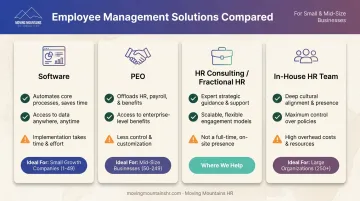
Employee Management Software
Software is the option most teams encounter first. Typical capabilities include:
- Time and attendance tracking, including clock-in/out and overtime alerts
- Onboarding workflows: digital paperwork, e-signatures, task checklists
- Performance reviews and goal tracking
- Reporting dashboards for turnover, headcount, and labor cost
Software excels at operational tracking. It's not built to interpret a new wage-and-hour law or decide how to handle a conflict between two managers. Those judgment calls still need a person.
Professional Employer Organizations (PEOs)
A PEO co-employs your staff, taking on payroll, benefits administration, and compliance at scale. NAPEO reports that 14% of employers with 20 to 499 employees now use a PEO, with roughly 230,000 businesses nationwide relying on the model.
PEOs work well for companies that want to hand off HR administration entirely. The tradeoffs:
- Less customization, since you're often working within the PEO's systems
- A shared employer liability structure, which some owners find uncomfortable
- Pricing that can be inefficient for very small teams
HR Consulting and Fractional HR Support
Consulting firms provide the judgment calls software can't make: compliance audits, HR strategy, performance management systems, and workplace investigations, all without a full-time hire.
This model fits businesses facing issues software simply can't resolve: a harassment complaint, multi-state compliance questions, or a policy rewrite ahead of a deadline.
Moving Mountains HR is built around this model, offering tiered ongoing support:
- Passive support: on-demand help by phone or email, bundled with a compliance package
- Active & Passive (Standard): the above, plus participation in company HR meetings
- Active & Passive (Premium): adds fractional CHRO services, including strategic HR leadership, compliance oversight, and workplace culture guidance
That setup fits regulated industries such as healthcare especially well. Founder Michelle Schwanhauser's background gives clients a partner who already knows what HR looks like in a heavily audited environment.
In-House HR Teams
Larger, established companies often build internal HR departments. It works, but it comes with fixed overhead: salary, benefits, and training costs that many growing businesses aren't ready to carry. For a lot of companies, that overhead arrives well before the headcount that would justify it.
Must-Have Features in Employee Management Software
Whether you're evaluating your first platform or replacing an old one, focus on features that solve real operational pain:
- Time tracking and attendance that feeds accurate clock data into payroll and reduces disputes
- Automated onboarding workflows with digital forms and task checklists that cut new-hire paperwork
- Performance and goal tracking that keeps reviews consistent instead of scattered across email
- Compliance reporting with audit trails for hours worked, breaks taken, and policy acknowledgments
Integration matters more than feature count. A platform with 40 features is useless if it doesn't connect to your payroll or accounting system. Look for direct integrations with your existing HRIS or payroll provider. Every manual re-entry point is a chance for a costly error.
Mobile access matters just as much as the feature list. If your workforce is remote, deskless, or spread across multiple locations, employees need to clock in, request time off, and view pay history from a phone—not only a desktop dashboard.
How to Choose the Right Employee Management Solution for Your Business
Choosing well starts with an honest audit of where the pain actually lives. The right fit depends on whether you need better tools, outside expertise, or both.
Diagnose the Real Gap
Ask yourself:
- Is this operational? Missed clock-ins, scheduling conflicts, messy PTO tracking.
- Or is it strategic and compliance-related? Policy gaps, high turnover, legal exposure.
Operational gaps usually point toward software. Strategic and compliance gaps point toward outsourced expertise, whether that's a PEO or an HR consultant.
Match the Solution to Your Growth Stage
Headcount and complexity should drive the decision more than brand names:
- A 10-person startup might get by with a solid software platform and a compliance checklist.
- A 75-person company juggling multiple locations often needs a PEO or a fractional HR partner.
- Companies scaling fast in a high-compliance state like California tend to need expert guidance sooner than headcount alone would suggest.
Calculate the Real Cost
Sticker price rarely tells the whole story. Core HR software typically runs $15 to $30 per employee, per month, according to G2's 2025 pricing research. That range excludes implementation, data migration, training, and add-on modules.
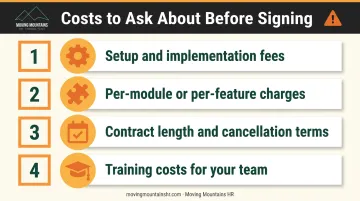
Before committing, ask about:
- Setup and implementation fees
- Per-module or per-feature charges
- Contract length and cancellation terms
- Training costs for your team
Weigh Compliance Expertise Seriously
If you operate in a strict regulatory state like California, or a high-compliance industry like healthcare, software alone won't protect you. Pay transparency rules, harassment prevention training mandates, and wage-and-hour requirements change often enough that a static handbook goes stale fast.
This is where pairing software with an HR consulting partner pays off. Software handles daily operations. A partner like Moving Mountains HR handles compliance audits, policy updates, and neutral third-party workplace investigations when something goes wrong internally.
Vet Before You Commit
Before you sign, run through a short diligence checklist:
- Request a demo or consultation to see the solution in action.
- Ask for client references, especially from businesses your size.
- Confirm the solution scales as your headcount grows.
- Clarify what happens if your needs change mid-contract.
Benefits of Implementing Employee Management Solutions
The right employee management approach pays for itself in ways that rarely show up on a spreadsheet right away.
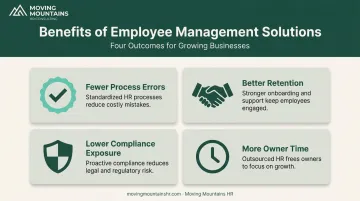
Fewer process errors. Standardized onboarding, clear policies, and consistent HR procedures cut down on payroll mistakes and duplicate data entry that eat up hours every pay period.
Better retention. Proactive employee management—clear expectations, consistent feedback, and fair processes—reduces the guesswork that drives people to quit.
Lower compliance exposure. This is where the financial stakes get serious. Federal OSHA penalties for willful or repeated violations can reach $165,514 per violation as of 2026. Add wage claims and employment litigation, and the cost of skipping expert compliance review adds up fast.
More owner time. When day-to-day HR administration and compliance are handled with clear systems and outside expertise, you get hours back for actual business growth.
Solid HR processes paired with experienced guidance for strategy and compliance help growing businesses reduce risk on both the operational and legal sides at once.
Frequently Asked Questions
What are employee management solutions?
Employee management solutions combine software, outsourced services, and consulting support to run the employee lifecycle. That typically covers hiring and onboarding through performance, compliance, and offboarding.
What is the best employee management system?
There isn’t a single best system—it depends on your size, budget, and compliance exposure. Many growing businesses pair software for daily tracking with expert HR guidance for strategy and compliance.
What is the difference between employee management and workforce management software?
Employee management focuses on individual performance, engagement, and development. Workforce management focuses on scheduling, time tracking, and optimizing labor across a team.
Do small businesses need employee management software or an HR consultant?
Often both. Software handles day-to-day tracking; a consultant covers compliance and strategy most small businesses can’t staff in-house.
How much does employee management software typically cost?
Core HR software often runs $15–$30 per employee per month, depending on features, setup, and company size. Consulting or outsourced HR is usually custom-quoted—compare a few options before you buy.
What is a PEO and how does it relate to employee management services?
A PEO co-employs your staff to handle payroll, benefits, and compliance administration. It's one option among several, alongside software and consulting, for managing your workforce.