Introduction
Picture this: A thriving regional medical practice has grown from 15 to 75 employees in three years. The office manager still handles HR "on the side," scrambling to process new-hire paperwork and fielding termination questions without a consistent process.
Too late, leadership realizes there is no documented succession plan for senior physicians. When a harassment complaint surfaces, the practice has no investigation protocol. Meanwhile, the CEO wonders why recruiting takes four months and why the best candidates accept offers elsewhere.
This scenario plays out daily in small and mid-size businesses. Only 21% of surveyed HR professionals report having a formal succession plan, and 56% report having none at all. When HR remains reactive—focused on paperwork rather than people strategy—organizations face persistent talent gaps, compliance exposure, and missed growth opportunities.
Strategic HR leadership courses close this capability gap. They equip professionals to align workforce management with business goals, speak the language of finance and operations, and use data to drive decisions. This guide covers what these courses teach, why they matter for your career and your organization, and how to choose the right program.
Key Takeaways
- Strategic HR courses move you from transactional admin to talent strategy that drives competitive advantage
- Core topics cover workforce planning, analytics, business acumen, change management, and SHRM-aligned strategy
- Options range from short specialty credentials to SHRM-SCP and 6–9 month executive education programs
- Pick programs by role scope, skill gaps, format, and need for credentials versus hands-on application
- Pair coursework with fractional CHRO support so teams apply frameworks while skills are still building
What Is Strategic HR Leadership?
Strategic vs. Operational HR
Strategic human resource management links people management and development to long-term business goals and outcomes. It integrates HR strategies with organizational strategies, treating talent as a driver of competitive advantage rather than an administrative cost center.
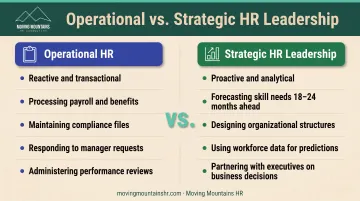
Traditional operational HR is reactive and transactional:
- Processing payroll and benefits enrollment
- Maintaining employee files and ensuring basic compliance
- Responding to manager requests for job postings or termination paperwork
- Administering annual performance reviews designed by someone else
Strategic HR leadership is proactive and analytical:
- Forecasting skill needs 18-24 months ahead based on business plans
- Designing organizational structures that support market expansion or product launches
- Using workforce data to identify flight risk, predict turnover costs, and recommend retention investments
- Partnering with executives on decisions about market entry, M&A integration, or risk management
The contrast goes beyond seniority. Strategic HR works on a longer time horizon and connects people decisions directly to business results.
The Business Impact
Strategic HR leaders join executive discussions with workforce insights that shape critical decisions:
- A CFO evaluating whether to open a new regional office hears from HR about local talent availability, typical time-to-fill for required roles, and competitive compensation benchmarks
- A COO planning a technology transformation learns from HR which departments have change-ready cultures, where resistance is likely, and what upskilling investments are needed
- A board of directors receives quarterly talent metrics (quality of hire, succession-bench strength, revenue per employee) tied directly to strategic KPIs
In Gartner's 2024 survey of nearly 1,900 managers, only 30% believed their leadership bench was strong, and 70% said talent reviews were not driving necessary development. Strategic HR leadership closes that gap with intentional succession planning, skills-gap analysis, and development tied to business needs.
Evolution and Current Relevance
The HR function has evolved from "personnel management"—primarily record-keeping and compliance policing—to strategic partner. This evolution accelerated over the past two decades and became critical post-2020. Talent shortages, hybrid-work complexity, rapid AI adoption, and mounting regulatory requirements have made workforce strategy central to how companies compete.
In a 2025 survey of 212 U.S. CHROs, 51% selected leadership and manager development among their top three priorities. Organizations now treat people capability and alignment as central to competitive advantage, right alongside product innovation and operational efficiency. Strategic HR leadership courses prepare professionals to build that advantage.
Why Strategic HR Leadership Courses Matter
Capability Gap in Most Organizations
Most HR professionals were trained in compliance, benefits administration, and employee relations. These skills remain essential, but they don't equip someone to forecast talent needs three years out, calculate HR ROI, or redesign an organization for agility. Strategic HR courses close that gap with workforce-planning models, live case work, and peer critique you can reuse on the job.
A 2023 survey of 2,957 people professionals found that 64% said their function adds strategic value, but only 47% said that impact is acknowledged by stakeholders. The disconnect often stems from HR professionals lacking business acumen and data fluency—plus the communication skill to translate people initiatives into terms executives recognize. Strategic HR courses directly target these competencies.
Measurable Business ROI
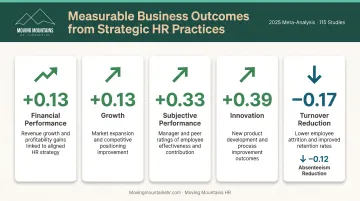
Organizations with integrated strategic HR practices see measurable gains. A 2025 meta-analysis of 115 studies covering 124 small and medium enterprise samples linked high-performance work practices to:
- Stronger financial performance (0.13) and growth (0.13)
- Higher subjective performance (0.33) and innovation (0.39)
- Lower turnover (-0.17) and absenteeism (-0.12)
Those results come from full HR systems, not a single class. Courses still teach the practices that drive them: workforce planning, performance management, and data-driven decisions. Graduates can apply the frameworks right away, shorten the learning curve, and skip expensive trial-and-error.
Career Advancement and Credibility
Completing recognized strategic HR leadership courses positions professionals for director, VP, and CHRO roles. Credentials demonstrate that you've mastered the competencies boards and CEOs expect: financial literacy, change leadership, board-ready storytelling, and the ability to tie people metrics to business outcomes.
Deloitte research found that 70% of surveyed companies had added or expanded board or committee oversight of talent and human capital in the prior five years. This trend elevates expectations for HR leaders to present data-driven insights and strategic recommendations at the board level. Formal training provides both the vocabulary and the confidence to meet those expectations.
Faster Implementation Than Self-Teaching
Courses compress years of on-the-job learning into structured programs spanning weeks or months. Self-teaching strategic workforce planning often means learning through missed hiring targets, costly recruiting misses, or succession gaps. A structured course replaces that trial period with:
- Tested planning models you can run in your next cycle
- Case examples from organizations that already made the mistakes
- Instructor and peer feedback before you put budget at risk
You move from theory to a usable plan faster, with less exposure for the business.
Core Skills Taught in Strategic HR Leadership Courses
Workforce Planning and Talent Analytics
Workforce planning balances labor supply and required skills against future demand and numbers needed. Strategic courses teach:
- Forecasting skill needs by analyzing business plans, product roadmaps, and market-entry timelines
- Conducting skills-gap analyses to identify capability shortfalls before they become bottlenecks
- Building talent pipelines through internal development, external recruiting, and strategic partnerships
- Using predictive analytics to identify flight risk and intervene before high performers leave
- Translating workforce data into executive-ready recommendations with clear ROI
These are practical tools you can apply immediately to hiring plans, training budgets, and organizational-design decisions.
Strategic Business Acumen
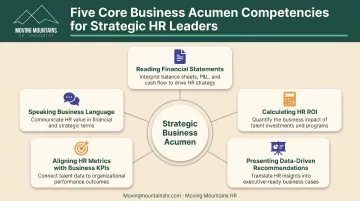
SHRM's Body of Applied Skills and Knowledge places Business Acumen, Consultation, and Analytical Aptitude in the Business competency cluster. Strategic HR courses teach you to:
- Read financial statements and understand P&L impact of people decisions
- Calculate HR ROI: cost per hire, time to productivity, turnover cost, and training ROI
- Speak the language of finance and operations so you can participate meaningfully in strategy discussions
- Align HR metrics (quality of hire, succession coverage, engagement scores) with business KPIs (revenue per employee, customer satisfaction, market share)
- Present workforce recommendations using the same data rigor executives expect from other functions
This shift from HR jargon to business language changes how stakeholders perceive your value.
Change Management and Organizational Design
Strategic HR leaders drive transformation, not just react to it. Courses cover:
- Leading change initiatives (mergers, restructures, technology rollouts) from a people perspective
- Redesigning structures to support new strategies, such as moving from functional silos to cross-functional teams
- Managing M&A integration, including cultural assessment, retention of key talent, and harmonizing policies
- Building change-capable cultures where employees expect and embrace continuous improvement
These capabilities let you contribute while major decisions are still forming, not after the fact.
Advanced Performance and Reward Strategies
Beyond administering annual reviews, strategic courses teach:
- Designing performance systems that drive specific business outcomes—innovation, customer focus, speed to market
- Creating total rewards strategies aligned with your market positioning (pay premium for scarce skills, competitive base plus incentives for sales roles)
- Using compensation to incentivize strategic behaviors (team collaboration, risk-taking, long-term thinking)
- Ensuring internal equity while remaining externally competitive
- Connecting performance management to succession planning and development
SHRM's competency framework includes Employee Engagement and Retention, Talent Management, and Total Rewards as strategic domains—all addressed in leadership-level coursework.
Types of Strategic HR Leadership Courses and Programs
Professional Certifications
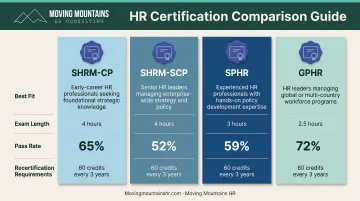
- SHRM-CP covers generalist HR practice and requires no prior HR experience or degree
- SHRM-SCP requires at least three years of strategic HR work, or SHRM-CP held for three years while moving into strategic work
- Both use the same 134-question, 3-hour-40-minute exam; SCP items put more weight on strategy and judgment
- Recent pass rates: SHRM-CP 68%, SHRM-SCP 50%
- Recertification: 60 professional development credits every three years
SPHR (Senior Professional in Human Resources):
- U.S. strategy and policy focus
- Eligibility: four years HR experience plus a master's, five years plus a bachelor's, or seven years of HR experience
- Exam: 2 hours 30 minutes, 115 scored questions plus 25 pretest; $495 exam fee plus $100 application
- Recertification: 60 credits every three years
- 2025 pass rate: 76%
GPHR (Global Professional in Human Resources):
- Multinational HR strategy focus
- Eligibility: two years global HR experience plus a master's, three years plus a bachelor's, or four years of global HR experience
- Content mix: Strategic Global HR 25%, Global Talent Management 20%, Mobility/Culture/Rewards 15% each, Risk/Compliance 10% (outline)
- Exam: 2 hours 15 minutes, 100 scored questions plus 25 pretest; $495 exam fee plus $100 application
- 2025 pass rate: 56%
| Credential | Best fit | Exam length | Pass rate | Recertification |
|---|---|---|---|---|
| SHRM-CP | Generalist HR, early career | 3 hr 40 min | 68% | 60 credits / 3 yrs |
| SHRM-SCP | Strategic HR leaders | 3 hr 40 min | 50% | 60 credits / 3 yrs |
| SPHR | U.S. senior HR strategy/policy | 2 hr 30 min | 76% (2025) | 60 credits / 3 yrs |
| GPHR | Multinational HR strategy | 2 hr 15 min | 56% (2025) | 60 credits / 3 yrs |
Pick a certification when you need a portable credential that hiring managers and boards already recognize.
University-Based Executive Programs
Cornell Strategic HR Leadership:
- Online certificate; three months; 3–5 hours per week; $3,900
- Modules on aligning HR with business strategy, workforce planning, and change leadership
- Self-paced with structured milestones and peer interaction
Michigan Ross Advanced HR Executive Program:
- Blended format; 70+ hours over six weeks; $23,500
- Online learning plus in-person immersion at Ross School of Business
- Built for senior HR leaders who want transformational frameworks and peer networking
- Blended format; nine months; minimum 10 years' professional experience
- Prepares sitting or aspiring CHROs for C-suite scope
- Covers strategy, finance for HR leaders, board readiness, and organizational transformation
University programs cost more and take longer than certifications, but they trade that investment for faculty depth and a cross-industry peer network—most useful if you are aiming at VP or CHRO scope.
Specialty Credentials and Micro-Courses
- Focuses on using people data for strategic decisions
- Covers data gathering, analysis, and evidence-based recommendations
- Useful when you need analytics skill without a full generalist certification
- Covers hands-on use of AI tools alongside human judgment in HR
- No deep technical background required
- Built for professionals who need practical AI fluency on a short timeline
Shorter credentials fill gaps in analytics or AI without a full certification cycle, and they stack cleanly on top of SHRM or HRCI credentials you already hold.
How to Choose the Right Strategic HR Leadership Course
Assess Your Current Capability Level
Start with an honest skills audit:
- Map gaps with SHRM's Body of Applied Skills and Knowledge (Business Acumen, Consultation, Leadership, Analytical Aptitude)
- Identify your biggest deficits: Is it business acumen? Analytics? Change leadership?
- Choose programs that target those specific gaps rather than generic overviews
If you're strong operationally but weak on finance and data, prioritize programs with heavy business-acumen and analytics modules. If you understand the business but lack change-management experience, seek programs emphasizing transformation and organizational design.
Match Format to Learning Style and Schedule
Synchronous vs. asynchronous online:
A 2021 meta-analysis of online learning found a small cognitive edge for synchronous formats, though results varied by context. Pick live sessions if you learn through real-time discussion and want built-in accountability. Go self-paced if you need schedule flexibility and prefer to work through material on your own.
Intensive in-person workshops vs. extended part-time programs:
Intensive formats (e.g., Michigan Ross's six-week blended program) require significant time commitment but deliver immersive learning and strong peer connections. Extended part-time formats (e.g., Cornell's three-month online or Wharton's nine-month blended) spread the workload and allow you to apply concepts continuously in your day job.
Self-paced vs. cohort-based:
Cohort programs provide peer learning, networking, and mutual accountability. Research on training transfer flags peer support as a major driver of applying new skills on the job. Self-paced programs offer maximum flexibility but require strong self-discipline.
Evaluate Accreditation and Industry Recognition
Check whether the program is:
- Recognized by SHRM, HRCI, or other credentialing bodies
- Eligible for recertification credits if you already hold a credential
- Taught by faculty or practitioners with strong reputations
- Attended by alumni who now hold leadership roles at respected organizations
Recognition shapes both what you learn and how hiring managers weigh the credential. SHRM-SCP and SPHR are broadly recognized; university executive programs carry prestige but may be less familiar to some employers. Specialty credentials signal focused expertise—they don't replace broad strategic competency.
Implementing Strategic HR Leadership Learning
Create an Application Plan During the Course
Don't wait until the course ends to apply what you learn. Identify 2-3 specific business challenges in your organization where you can test new frameworks as you progress:
- Use workforce-planning models to forecast hiring needs for an upcoming product launch
- Apply analytics techniques to calculate turnover cost and build a retention business case
- Redesign your performance-review process using principles from the course
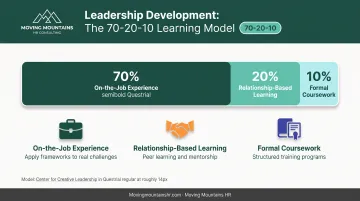
According to the Center for Creative Leadership's 70-20-10 model, coursework is only the 10% "formal learning" piece—pair it with on-the-job experience (70%) and relationship-based learning (20%). Applying frameworks while you learn turns theory into results you can show leadership.
Build a Peer Learning Network
Actively engage with cohort members or online communities:
- Share implementation experiences and troubleshoot challenges
- Exchange tools, templates, and resources
- Access diverse perspectives from different industries and company sizes
- Maintain relationships beyond the program for ongoing support
Research on training transfer shows peer support and a positive transfer climate largely determine whether new skills get used on the job. Course peers often become a lasting professional network after the program ends.
Measure and Communicate Impact
Track before-and-after metrics on initiatives you lead post-course:
- Turnover reduction (regrettable departures before vs. after intervention)
- Time-to-fill improvement (average days-to-hire before vs. after process redesign)
- Quality-of-hire scores (manager ratings, 90-day performance, first-year retention)
- Succession coverage (percentage of critical roles with ready successors)
Present results to leadership using the business language you learned in training. For example:
"By implementing a structured onboarding program, we reduced time-to-productivity from 120 days to 75 days, accelerating contribution worth approximately $30K per new hire based on average fully loaded cost. For our 20 hires this year, that's $600K in value."
Demonstrating ROI reinforces the value of continued strategic investment in HR and your role as a business partner.
Getting Strategic HR Support for Your Organization
Leadership courses build lasting skill. Some situations still call for outside help right away—or both at once.
When to Invest in Training vs. External Expertise
Invest in courses when:
- You have HR staff with the capacity to learn and apply new skills over 6-12 months
- Your organization is stable enough to allow learning time
- You want to build long-term internal capability
- You're preparing for career advancement
Engage fractional or consulting support when:
- You need immediate strategic guidance and can't wait for training timelines
- You lack internal HR bandwidth to handle both operations and learning
- You face urgent challenges (compliance gaps, leadership transitions, rapid scaling) that need expert help now
- You want experts guiding implementation while your team builds skills through coursework
Fractional CHRO and Strategic Consulting Services
Experienced HR leaders can provide on-demand strategic support without the cost and commitment of a full-time executive:
- Conducting HR audits to identify compliance gaps, policy weaknesses, and capability deficits
- Designing workforce plans aligned with business growth targets
- Coaching internal HR teams as they implement new frameworks learned in training
- Representing HR in executive meetings while your team builds confidence and credibility
- Leading urgent projects such as harassment investigations, restructuring, or M&A integration that need seasoned judgment
Moving Mountains HR offers fractional CHRO services and strategic HR consulting that sit alongside leadership development. If your team is in certifications, executive education, or new analytics work, fractional support fills gaps and keeps strategy moving.
You get senior oversight in executive discussions and help putting frameworks into practice while internal people grow into those roles. External expertise plus internal development keeps quality and business alignment steady during the handoff.
Frequently Asked Questions
What is strategic human resource leadership?
Strategic HR leadership aligns people management with long-term organizational goals and outcomes. It uses data, workforce planning, and business acumen so talent decisions support competitive strategy instead of only reacting to administrative needs.
What are the four HR strategies?
There is no universal "four HR strategies" framework. HR usually aligns with business models such as cost leadership, differentiation, and focus—matching efficiency, talent, or specialized expertise practices to the competitive approach. Strategic HR courses teach how to design people practices around that choice.
What is a strategic HR example?
A technology company planning international expansion maps required engineering and sales skills 18 months ahead. HR builds internal upskilling programs, recruiting pipelines in target regions, and talent-readiness tracking against business milestones so growth is not blocked by capability gaps.
What are the seven pillars of HR?
SHRM's Business Accretive HR framework identifies seven pillars: inclusion and diversity with ROI, strategic talent management, revenue-driving talent acquisition, retention, compensation and benefits, culture, and HR metrics. Strategic HR leadership integrates these areas so people practices drive business outcomes, not siloed administration.
What is the most respected HR certification?
SHRM-SCP and SPHR (from HRCI) are the most recognized senior-level HR credentials. Both validate strategic competency and business acumen; SHRM-SCP has about a 50% pass rate, while SPHR focuses on U.S. strategy and policy with a 76% pass rate. Choose based on your role scope, geography, and career goals.
Ready to build strategic HR leadership in your organization? If you need team development or interim strategic support while capabilities grow, Moving Mountains HR can help. Contact us for a 30-minute consultation on how fractional CHRO services, HR audits, and strategic consulting can complement your leadership development so your business stays compliant, competitive, and ready for growth.