Introduction
Employment law doesn't stand still. Wage and hour rules shift, new leave laws pop up at the state level, and anti-discrimination requirements keep expanding. For small and mid-size businesses, keeping up feels like a full-time job, because it is one.
Most companies under 100 employees can't justify a full-time compliance executive on payroll. But ignoring the risk isn't an option either. The EEOC alone secured almost $660 million in monetary relief for workers in FY2025, a reminder that regulatory exposure is real and expensive.
An outsourced compliance officer sits between those two extremes. This article covers what the role actually involves, what it costs compared to an in-house hire, and how to know if your business needs one.
Key Takeaways
- Outsourced compliance officers deliver expert HR oversight without the salary cost of a full-time executive
- Scope centers on audits, policy updates, training coordination, and tracking regulatory changes
- Fractional arrangements cost a fraction of a full-time hire, especially for businesses under 50 employees
- Best fit hinges on company size, industry risk, and growth stage—not a one-size-fits-all rule
- Moving Mountains HR structures its support in tiers so businesses pay only for what they need
What Is an Outsourced Compliance Officer?
An outsourced compliance officer is a third-party HR expert or firm hired to oversee an organization's adherence to employment laws and workplace regulations. For small and mid-size businesses that can't justify a full-time compliance hire, the role fills that gap without the full-time salary and benefits package. The arrangement is fractional or contract-based, scaling up or down as needs change.
This role differs from a general HR consultant in one key way: focus. A general HR consultant might handle recruiting, onboarding, or benefits questions. An outsourced compliance officer zeroes in on regulatory risk, legal adherence, and audit-readiness.
Typical scope includes:
- Wage and hour law compliance (overtime, classification, recordkeeping)
- Workplace safety standards under OSHA
- Anti-discrimination and harassment policy enforcement
- Leave law administration, including FMLA and state-specific requirements
- Documentation and recordkeeping practices that hold up under scrutiny
For regulated industries like healthcare, the job expands further. Layered federal and state employment rules mean the officer must know general labor law plus the extra requirements that apply to healthcare employers.
Outsourced Compliance Officer vs. Fractional CHRO
These two roles overlap, but they're not identical. An outsourced compliance officer focuses primarily on regulatory risk and legal adherence: audits, policy documentation, and staying current on law changes. A fractional CHRO takes a broader strategic view. Compliance is one piece of a larger HR puzzle that also includes staffing strategy, retention, compensation planning, and organizational culture.
Many small businesses find the hybrid model works best. One provider handles both compliance oversight and higher-level HR strategy under a single engagement.
Key Responsibilities of an Outsourced Compliance Officer
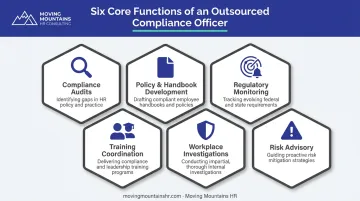
The day-to-day work of an outsourced compliance officer centers on a handful of core functions. Each one closes a gap that could otherwise become a legal or financial problem.
- Compliance audits: Review employee classifications, policies, and records to spot gaps in wage-and-hour rules, recordkeeping, or workplace safety before violations occur.
- Policy and handbook development: Update handbooks and workplace policies so they reflect current federal, state, and local law—what passed muster two years ago may not today.
- Regulatory monitoring: Track new leave laws, wage thresholds, and training rules, then turn those changes into clear action items so owners don't learn about a requirement after missing the deadline.
- Training coordination: Manage required programs end to end. California, for example, requires harassment prevention training for employers with five or more employees—one hour for nonsupervisory staff and two hours for supervisors, every two years, with the next statewide deadline of January 1, 2027. An outsourced compliance officer tracks those dates and runs the training.
- Workplace investigations: Bring in a neutral third-party investigator when harassment, discrimination, or policy complaints surface, protecting the business from claims of bias.
- Risk advisory: Advise leadership on where exposure is highest—litigation, fines, or regulatory penalties—and what to fix first.
Why Businesses Outsource: Cost, Benefits & In-House Comparison
The math behind outsourcing usually comes down to one number: the cost of a full-time hire.
The National median pay for an HR manager was $140,030 as of May 2024, according to the Bureau of Labor Statistics—a common proxy for senior compliance and HR leadership cost. In California, the mean annual wage for the same role reached $182,460. Benefits, payroll taxes, office space, and training typically push total employment cost well beyond base salary.
Compare that to a fractional arrangement, where businesses pay for a defined scope of work or a tiered retainer instead of a full annual salary. The exact savings vary by provider and service level, but the structural difference is clear: one is a fixed year-round cost, the other flexes with actual need.
Beyond cost, outsourcing brings a few other advantages:
- Specialized, current expertise: Multi-client compliance pros usually stay sharper on regulatory changes than one in-house generalist
- Scalability: Support can expand during growth and contract when things quiet down
- Less single-point-of-failure risk: One internal departure doesn't leave the business exposed
Outsourced vs. In-House: Key Differences
Those advantages sit alongside real tradeoffs. Here's how the two models compare side by side.
| Factor | In-House Hire | Outsourced Provider |
|---|---|---|
| Availability | Full-time, always on-site | Scheduled or on-demand, depending on tier |
| Institutional knowledge | Deep, builds over time | Strong but built through onboarding |
| Breadth of expertise | Limited to one person's experience | Cross-industry, multiple clients |
| Cost structure | Fixed salary + benefits | Scalable, tiered fees |
| Risk if role is vacant | High (single point of failure) | Low (backup coverage built in) |
An in-house hire brings full-time presence and deeper day-to-day institutional knowledge. An outsourced provider brings broader cross-industry experience and cost efficiency. Neither is universally better.
Many growing businesses use outsourced compliance support—such as fractional CHRO or tiered HR retainers from firms like Moving Mountains HR—as a bridge. They build internal HR muscle gradually until they're ready to bring the function fully in-house.
Is Outsourcing Your Compliance Function Right for Your Business?
A few common triggers tend to push business owners toward outsourced compliance support:
- Rapid headcount growth that outpaces existing HR capacity
- Expansion into a new state, particularly one like California with stricter employment laws
- A recent complaint or claim that exposed gaps in existing policies
- No formal HR compliance oversight at all, which is more common than most owners admit
Industry matters too. Healthcare organizations face layered federal and state requirements on top of standard employment law, from violence-prevention plans to facility-specific wage schedules. That mix is why specialized outsourced compliance support pays off for healthcare employers juggling standard HR rules and industry-specific mandates.
Whatever your industry, you don't need a full engagement on day one. Start with a compliance audit or gap assessment. It shows where the risk sits—classification errors, outdated policies, or missing documentation—so you can choose the right level of support instead of guessing.
How Moving Mountains HR Delivers Outsourced Compliance Support
Outsourced compliance works best when support matches what your business actually needs. Moving Mountains HR built its model around that idea: not every company needs the same level of help, so it shouldn't have to pay for the same package.
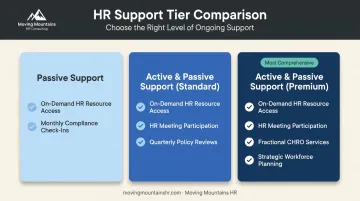
The firm offers three ongoing support tiers:
- Passive Support — on-demand email and phone access, available with the purchase of a compliance package
- Active & Passive Support (Standard) — adds participation in company HR meetings alongside on-demand availability
- Active & Passive Support (Premium) — includes fractional CHRO services, bringing executive-level HR strategy and compliance oversight into one engagement
On the compliance side, Moving Mountains HR offers three focused packages:
- HR Document Audits — full gap analysis against current regulations, plus a formal review report
- Fresh Compliance Docs — clean-slate policy build for companies starting from scratch
- Audit & Update — combined tier for a full compliance overhaul
Founder Michelle Schwanhauser brings deep healthcare industry experience to client work. The firm's California employment law focus runs through every engagement, including neutral third-party workplace investigations for harassment, discrimination, and code of conduct complaints.
For business owners who want to self-assess before engaging a provider, Moving Mountains HR offers a complimentary California HR Compliance Checklist. It is a practical starting point for spotting gaps before they become bigger problems.
Frequently Asked Questions
Can you outsource a compliance officer?
Yes, businesses commonly outsource compliance oversight to a consulting firm or fractional expert. Ultimate legal responsibility for compliance still rests with the business, not the outsourced provider.
What does an outsourced compliance officer actually do day-to-day?
Core tasks include conducting compliance audits, updating policies and handbooks, coordinating required training, and monitoring regulatory changes. The exact mix depends on the service tier selected.
How much does it cost to outsource a compliance officer compared to hiring one in-house?
A full-time HR/compliance executive typically costs well over $140,000 annually in salary alone, before benefits and overhead. Fractional or outsourced arrangements cost far less; request a quote tied to your business size for specifics.
What's the difference between an outsourced compliance officer and a fractional CHRO?
An outsourced compliance officer focuses narrowly on regulatory risk and legal adherence. A fractional CHRO takes a broader strategic role across HR functions, with compliance as one component. Many providers, including Moving Mountains HR, offer both under one engagement.
Is outsourcing HR compliance a good option for small businesses?
For most small businesses that can't yet justify a full-time HR hire but still face real regulatory risk, outsourcing is often the most practical option. It provides expert oversight without the fixed cost of a salaried executive.
How do I choose the right outsourced compliance provider for my business?
Look for industry-specific experience, state-law expertise relevant to where you operate, flexible service tiers, and a demonstrated track record with audits and investigations. A free consultation is a good way to gauge fit before committing.