While conflict itself is inevitable whenever people work together, the difference between teams that thrive and those that fracture comes down to how managers and business owners respond. Small businesses face particular pressure: without dedicated HR departments, owners often juggle conflict resolution alongside daily operations, risking legal exposure when they mishandle serious allegations or let minor disagreements fester into culture-damaging rifts.
This guide walks through six real workplace conflict scenarios, resolution frameworks that work, and the warning signs that tell you when to escalate from informal conversation to formal process.
Key Takeaways
- Most workplace conflicts trace back to communication breakdowns, unclear expectations, or competing priorities
- Early intervention through structured resolution prevents escalation and protects team morale
- Managers who practice active listening, stay objective, and solve problems collaboratively resolve disputes faster and more fairly
- Small businesses benefit from clear written protocols and knowing when external HR support is necessary
Why Workplace Conflict Resolution Matters for Small Businesses
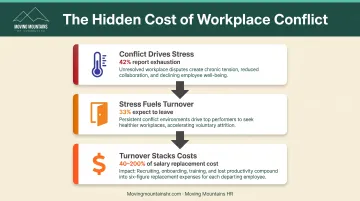
Unresolved conflict hits your bottom line. CIPD's 2024 survey of UK workers found that 33% of employees experiencing conflict expected to leave within 12 months, compared to just 16% of those without conflict.
Gallup estimates replacement costs at 40-200% of annual salary depending on role. The larger cost is the cascade that follows:
- Conflict drives stress (42% report exhaustion vs. 18% without conflict)
- Stress fuels turnover and leaves knowledge gaps behind
- Turnover stacks recruiting costs on top of lost productivity
Legal risk escalates when conflicts involve protected characteristics. The EEOC received 88,531 new discrimination charges in FY2024—a 9% jump from the prior year—and secured $660 million for victims in FY2025.
California small businesses face even stricter thresholds. FEHA harassment protections apply regardless of company size, and discrimination and retaliation coverage begins at just five employees.
Mishandling a harassment complaint—or retaliating against someone who raises concerns—can trigger investigations, settlements, and reputational damage that outlast the original dispute.
Effective conflict resolution strengthens your employer brand. When managers address disputes promptly, fairly, and consistently, employees see the company as a place where concerns are heard and resolved. That perception lowers stress, raises engagement, and makes your business more attractive to talent in markets where candidates research culture before they apply.
6 Common Workplace Conflict Examples and How to Resolve Them
Example 1: Communication Style Clash Between Team Members
Scenario: A detail-oriented project coordinator communicates through lengthy, documented emails that outline every task, deadline, and contingency. Her colleague, an action-oriented sales lead, prefers quick verbal check-ins and finds the emails overwhelming. He stops reading them, she interprets his silence as disengagement, and project timelines slip as critical information gets lost.
Resolution steps:
- Facilitate a neutral discussion where each person explains their communication preference and why it matters to them
- Identify the underlying need: The coordinator needs a documented trail for accountability; the sales lead needs speed and clarity without information overload
- Establish team protocols that honor both styles: Agree to brief verbal check-ins for urgent items, followed by short email summaries (3-5 bullets maximum) that capture decisions and next steps
- Set expectations for response times: Emails require acknowledgment within 24 hours; urgent items get a phone call or Slack message
Outcome: Each person gets information in the format they need. Clear team norms take hold, and project delays drop because people actually read what they receive.
Example 2: Manager-Employee Conflict Over Performance Expectations
Scenario: A manager grows frustrated with an employee's work quality, while the employee genuinely believes she's meeting expectations. During feedback conversations, the employee becomes defensive, the manager grows more critical, and the relationship deteriorates.
Resolution steps:
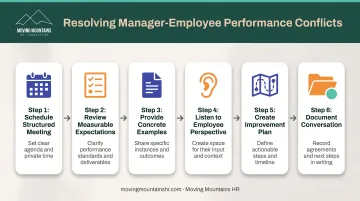
- Schedule a structured meeting focused on performance standards, not personality
- Review specific, measurable expectations tied to the role, not vague goals like "be more proactive"
- Provide concrete examples of both successful work and areas needing improvement, with dates and outcomes
- Listen to the employee's perspective: Ask what resources, clarity, or support would help her meet the standards
- Collaboratively create a performance improvement plan with clear benchmarks, timelines, and check-in dates
- Document the conversation and email a summary to the employee
Outcome: The employee understands exactly what success looks like. The manager has a documented baseline for later conversations, and regular check-ins catch issues before they escalate.
Example 3: Interpersonal Conflict Stemming from Personal Values or Beliefs
Scenario: Two employees have tense interactions after one makes comments about political or social issues that the other finds offensive. The uncomfortable dynamic spreads to team meetings, where colleagues feel pressure to pick sides.
Resolution steps:
- Reaffirm workplace respect policies in a team meeting, without singling out individuals
- Meet separately with each employee to hear their perspective and clarify that the goal is professional conduct, not changing beliefs
- Facilitate a joint conversation focused on agreed-upon boundaries: what topics will remain off-limits, how disagreements will be handled, and what respectful collaboration looks like
- Establish consequences for repeated violations of workplace conduct standards
When to escalate: If comments target a protected characteristic (race, religion, gender, disability, age, etc.), the situation may constitute harassment or discrimination and requires a formal investigation. Moving Mountains HR's workplace investigation services provide neutral, third-party assessment for allegations involving protected classes, helping businesses meet California FEHA obligations and reduce legal exposure.
Example 4: Competition for Resources or Recognition
Scenario: Two department heads repeatedly clash over budget allocations and credit for company successes. Their tension trickles down to their teams, who begin avoiding cross-department collaboration.
Resolution steps:
- Senior leadership clarifies decision-making criteria for budget requests—transparent, documented standards everyone can reference
- Establish a resource allocation process with timelines, required documentation, and an appeals pathway
- Recognize both contributions publicly when projects involve multiple departments
- Create shared goals that require collaboration, tying performance metrics to joint outcomes rather than individual wins
Outcome: Transparent processes reduce the perception of favoritism, public recognition reduces the need to compete for credit, and shared goals incentivize cooperation.
Example 5: Remote Work Conflict Over Availability and Responsiveness
Scenario: In-office employees perceive remote colleagues as less engaged because they don't respond to messages immediately. Remote workers feel unfairly monitored and believe their flexibility isn't respected.
Resolution steps:
- Establish clear availability expectations for the entire team—core hours when everyone is reachable, and flex hours when responses can wait
- Define response-time standards for different communication channels (Slack = 2 hours, email = 24 hours, urgent items = phone call)
- Address assumptions on both sides: Discuss what productivity looks like for different roles, and clarify that physical presence doesn't equal output
- Create equitable policies that don't penalize work arrangement choices
Outcome: Everyone knows when colleagues are expected to be available. Remote workers are held to the same standards as in-office staff, which cuts down assumptions about engagement.
Example 6: Conflict Escalation Due to Avoided or Delayed Conversations
Scenario: Two employees disagree about a project approach but never address it directly. Instead, they vent to colleagues, creating divided camps and workplace gossip that damages multiple relationships.
Resolution steps:
- Intervene immediately once gossip or side-taking becomes apparent
- Facilitate a mediation session where both parties share their original concerns, which often seem minor in retrospect
- Address the gossip separately with employees who participated, clarifying the harm it caused and setting expectations for direct communication
- Establish a team norm of raising concerns directly and promptly, and create psychological safety by modeling non-defensive responses to feedback
Outcome: The original disagreement is resolved, employees understand the compound costs of avoidance, and the team develops a habit of addressing issues early.
Essential Conflict Resolution Skills Every Manager Needs
Resolving workplace conflict takes more than good intentions. Managers need concrete skills: listening under pressure, staying objective, and knowing when informal talks must become a formal process.
Active Listening and Emotional Regulation
Active listening means focusing completely on the speaker without planning your rebuttal. Harvard's Program on Negotiation recommends techniques that acknowledge emotions, clarify misunderstandings, and reframe the issue as a joint problem rather than a win-lose battle.
Techniques that work:
- Reflect back what you hear: "It sounds like you're concerned that decisions are being made without your input. Is that right?"
- Pause before responding, especially during heated conversations
- Ask open-ended questions that gather information, not lead to a preset conclusion: "Help me understand what happened from your perspective"
- Manage your own emotional reactions by recognizing triggers and taking breaks when necessary
Maintaining Objectivity and Avoiding Bias
Personal preferences, past relationships, and affinity bias cloud judgment. Before you decide how to resolve a conflict, ask: Am I favoring one party because they remind me of myself? Have I heard from everyone involved?
Practical checks:
- Speak privately with each party before drawing conclusions
- Document what each person says in their words, not your interpretation
- Look for patterns in your decisions. Do you side with certain personality types or styles?
- When you notice bias, acknowledge it and adjust
Focusing on Interests Rather Than Positions
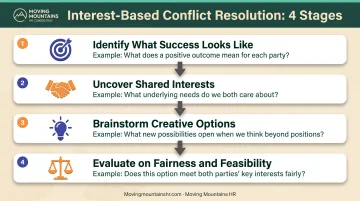
A position is what someone says they want ("I need the corner office"). An interest is the underlying need driving that demand ("I need quiet space for client calls"). Interest-based negotiation uncovers those deeper needs and searches for creative solutions that address both parties' interests.
Framework:
- Ask each party: "What would a successful resolution look like for you, and why does that matter?"
- Identify shared interests (both employees want the project to succeed, both need clear expectations)
- Brainstorm options that meet underlying needs without requiring one party to "lose"
- Evaluate options based on fairness, feasibility, and business impact
Documentation Best Practices
Documentation protects both employees and the business by creating a factual record of what happened, what was agreed, and what follow-up occurred.
What to document:
- Date and participants in each conversation
- Specific behaviors observed, not subjective labels (write "arrived 30 minutes late on March 3, 5, and 8" instead of "has a bad attitude")
- Resolution steps agreed upon, including who will do what by when
- Follow-up meetings and whether improvement occurred
California-specific requirements: California Labor Code 1198.5 requires employers to retain personnel records for at least three years after termination. Government Code 12946 extends that to four years for records used in employment decisions, with longer retention for records relevant to filed complaints.
Knowing When Issues Require Formal Process
Some conflicts move beyond informal resolution and trigger legal obligations.
Situations requiring formal process:
- Allegations of harassment based on a protected characteristic (race, religion, gender, disability, age, national origin, etc.)
- Claims of discrimination in hiring, promotion, compensation, or termination
- Retaliation complaints from employees who raised concerns or participated in investigations
- Workplace safety violations
California's FEHA prohibits harassment regardless of company size and extends discrimination protections to employers with five or more employees. 2 CCR 11023 requires covered employers to maintain written prevention policies, provide a complaint route outside the direct supervisor, and conduct fair, timely, thorough investigations.
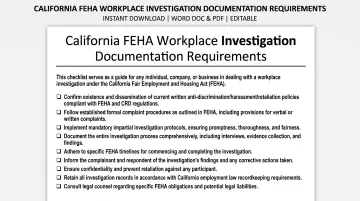
The EEOC recovered $660 million in FY2025, a clear signal that treating serious allegations as personality disputes is costly. When protected conduct is involved, bring in a neutral third-party investigator rather than handling the claim inside the reporting chain.
When to Bring in External HR Support
Small business owners benefit from HR consulting expertise when internal resolution isn't enough:
- Recurring conflicts that informal conversations haven't resolved
- Manager-involved conflicts where the manager's own conduct is in question
- Compliance concerns involving California FEHA obligations, EEOC thresholds, or documentation requirements
- Limited internal experience when owners need structured conflict resolution guidance
Serious allegations—harassment, discrimination, retaliation, hostile work environment, or code-of-conduct violations—call for a neutral third-party investigation. Moving Mountains HR's workplace investigation process typically includes:
- Intake and investigation planning
- Confidential interviews with parties and witnesses
- Evidence collection
- A summary report with findings
That documented approach helps small businesses meet California's formal complaint requirements while reducing legal exposure.
Fractional HR support also gives small businesses executive-level conflict resolution strategies without full-time HR overhead. Moving Mountains HR offers tiered options from on-demand guidance to active HR meeting support and premium fractional CHRO services, so you can match help to the complexity of the situation.
Frequently Asked Questions
What are the steps to resolve a conflict?
Address the issue promptly, gather all perspectives through private conversations, identify the root cause and shared interests, facilitate collaborative solution development, and follow up to ensure the resolution holds. Documentation at each stage protects both parties.
How can I effectively handle conflict in the workplace?
Create a culture where employees feel safe raising concerns early. Maintain neutrality as a manager, focus conversations on specific behaviors and business impact rather than personalities, and establish clear communication norms that prevent small disagreements from escalating.
What are the main conflict resolution strategies?
The Thomas-Kilmann model identifies five approaches: avoiding, accommodating, compromising, competing, and collaborating. Match the approach to whether the goal, the relationship, or both matter most in that situation.
What are some healthy conflict resolution skills?
Core skills include active listening, emotional self-awareness, clear expectations, separating the person from the problem, and curiosity about others' views. Managers also need objectivity, solid documentation, and judgment about when informal resolution isn't enough.
What are some real-life examples of conflict resolution?
The six scenarios earlier in this article cover communication clashes, performance disagreements, values tensions, resource competition, remote work friction, and escalation from avoidance. Each shows resolution working through direct communication, focus on business impact, and collaborative problem-solving.
What are some examples of workplace conflict scenarios?
Common categories include communication breakdowns, personality clashes, competition for limited resources, unclear role boundaries, performance disagreements, and conflicts arising from organizational change. Small businesses also face conflicts when company growth outpaces HR infrastructure or when remote work creates coordination challenges.