
Key Takeaways
- Orientation training is a structured 1-5 day process that introduces new employees to company culture, policies, and job expectations
- Well-designed orientation builds cultural knowledge, commitment, and performance while cutting costly early turnover
- Strong programs cover legal paperwork, safety training, workplace logistics, technology setup, and role expectations
- Pacing content with breaks, a personal welcome, and a buddy helps new hires absorb information and feel supported
- Common mistakes include overwhelming employees on day one, inconsistent delivery, and failing to provide meaningful initial work
Introduction
Picture this: A new employee walks through your door on day one, excited and hopeful. By the end of the week, they're already questioning their decision.
Research from a controlled field study of 605 call center employees found that first-day orientation design directly influenced six-month retention and job performance. Personalized approaches reduced attrition by more than 32% compared to conventional methods.
Orientation training is the structured process of welcoming and preparing new employees during their first days on the job. It shapes retention, productivity, and company culture from day one.
This article covers what orientation training is, why it matters, what to include, how to conduct it effectively, and best practices to help new hires start strong.
What Is Orientation Training for New Employees?
Definition and Duration
Orientation training is the initial phase of welcoming new employees to your organization. SHRM defines it as a formal event that introduces company structure, vision, mission, and values. It also covers policies and administrative procedures, required paperwork, and mandatory training.
Typically, orientation lasts 1-5 days depending on role complexity. SHRM recommends spreading content over a few days or a week when possible to reduce information overload.
Orientation vs. Onboarding: Key Distinction
These terms are often confused, but they mean different things:
- Orientation is a specific event: the first day or week of activities that welcome a new hire
- Onboarding is a longer process spanning 3-12 months that includes orientation plus ongoing training, integration, and performance development
Orientation is only the first step of that longer onboarding process.
Primary Goals
Orientation aims to:
- Complete necessary employment paperwork and legal documentation
- Communicate company values, culture, and expectations
- Build initial relationships with team members and key contacts
- Reduce first-day anxiety by providing clear direction and resources
Typical Activities
A comprehensive orientation includes:
- Legal compliance: Employment forms (I-9, W-4), direct deposit setup, benefits enrollment
- Policy review: Employee handbook walkthrough, safety procedures, confidentiality agreements
- Workplace integration: Office or facility tour, introductions to team members and key stakeholders
- Technology setup: Email account, communication platforms, role-specific software and login credentials
- Role clarity: Job description review, initial responsibilities, performance expectations
Paid Work Time
Orientation is compensated work time. Under the Fair Labor Standards Act (FLSA), training may be unpaid only when it is outside normal hours, completely voluntary, not job-related, and involves no productive work.
Orientation is mandatory and job-related, so those exceptions do not apply. Nonexempt employees must be paid their regular wage or salary during orientation.
Why Orientation Training Matters
Effective orientation delivers measurable results: stronger commitment, lower early attrition, faster productivity, and a clearer cultural start.
Research-Backed Outcomes
Studies show a structured first impression pays off:
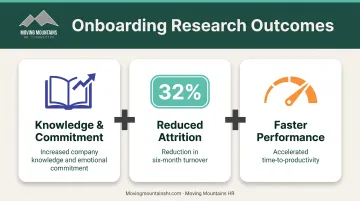
- Knowledge and commitment: A 2000 study of 116 new employees found formal orientation raised knowledge of company goals, values, and history, and increased emotional commitment to the company.
- Attrition and service quality: The Wipro call center study found personalized first-day orientation cut six-month attrition by over 32% versus conventional programs, with better customer service evaluations.
- Speed to performance: A related Wipro lab experiment linked personalized orientation to faster, higher-quality data-entry work.
Turnover Cost and Time-to-Productivity
Employee turnover is expensive. Gallup estimates replacement costs at 0.5x to 2x annual salary once you factor in recruiting, hiring, training, lost productivity, and morale. Weak orientation feeds early departures and multiplies those costs.
Well-oriented employees reach full productivity faster. They make fewer costly mistakes, need less supervision, and understand workflows and expectations from day one.
Engagement and Culture From Day One
Orientation is your first chance to connect a new hire’s role to the organization’s mission. Gallup found that only 4 in 10 U.S. employees strongly agree their mission or purpose makes their job important. Early mission alignment correlates with lower turnover and higher profitability.
It also puts values into practice. Strong orientation sets communication norms, reinforces safety culture, and shows new hires the company invests in its people—before bad habits or disengagement take root.
What Should Be Included in Employee Orientation Training
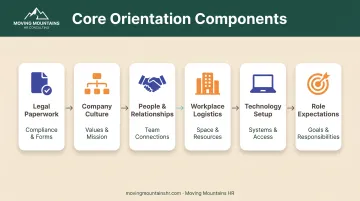
A strong orientation covers more than forms and logins. Build yours around six areas: legal paperwork, culture, people, logistics, tools, and role expectations so new hires can contribute with fewer early missteps.
Essential Paperwork and Legal Compliance
Start with the basics:
- Form I-9 (Employment Eligibility Verification): Must be completed within 3 business days of the employee's first day of paid work
- Form W-4 (Tax Withholding): Should be signed before the first wage payment
- State-required new-hire notices: Required notices vary by state (for example, California's Wage Theft Prevention Act notice)
- Direct deposit setup and benefits enrollment documents
- Employee handbook acknowledgment: Confirms the employee received key policies
- Safety policies and emergency procedures: Evacuation routes, incident reporting, and workplace safety rules
- Confidentiality and data-security agreements: Protects company and customer information from day one
Company Culture and Values Introduction
Help new hires understand what the organization stands for:
- Mission, vision, and core values
- How values show up in daily decisions and customer interactions
- Organizational history, milestones, and growth trajectory
- Company structure and reporting relationships via an org chart
People and Relationship Building
Orientation works best when it builds relationships, not only transactions:
- Introductions to immediate team members
- Key stakeholders across departments
- Assigned mentor or buddy (ideally not their direct manager)
- Direct manager and HR contacts, including preferred communication channels
Workplace Logistics and Resources
Cover the practical details:
- Office or facility tour (for on-site roles)
- Parking, building access, and security badges
- Break rooms, restrooms, and amenities
- Where to find supplies, printers, and mail/package procedures
- Dress code expectations
- Time-off request process and paid-leave policies
Technology and Tools Setup
Ensure new hires have the tools they need to work:
- Company laptop, phone, and equipment
- Email account and communication platforms (Slack, Microsoft Teams, Zoom)
- Cloud storage and document access (Google Drive, SharePoint)
- Payroll and HR platforms
- Security software and VPN access
- Role-specific tools and software with login credentials
Role-Specific Foundational Information
Connect the employee to their work:
- Job description review
- Initial responsibilities and expectations for the first 30-60-90 days
- Reporting structure and team workflows
- Performance evaluation criteria and timeline
- Growth opportunities and professional development resources
- A meaningful first assignment so they can contribute right away
How to Conduct Effective Orientation Training
Effective orientation is a coordinated process—not a single day of presentations. Prepare before day one, split ownership between HR and the hiring manager, pace the first week, and match training methods to the content.
Pre-Arrival Preparation (Employer-Side)
Before day one, prepare:
- Workspace ready with desk, chair, and supplies
- Equipment ordered and configured (laptop, phone, monitors)
- IT access provisioned (email, systems, software)
- Facilities coordinated (parking pass, building access, security badge)
- Mentor or buddy assigned and briefed
- First-week schedule drafted and shared with relevant stakeholders
Define Clear Roles: HR Responsibilities
Human Resources should own:
- Legal paperwork and compliance documentation (I-9, W-4, handbook acknowledgment)
- Benefits enrollment sessions and open-enrollment timelines
- Company-wide policy review (employee handbook, code of conduct)
- Safety and emergency procedures
- Facility tour and building access
- Organization-wide culture, mission, and values overview
Define Clear Roles: Manager Responsibilities
The direct manager should handle:
- Personal welcome on day one
- Introduction to team members and key collaborators
- Explanation of department culture, workflows, and norms
- Review of role-specific expectations and immediate priorities
- Regular check-ins for the first 90 days
- Assignment of meaningful initial work to build confidence
Structure the First Day and Week Schedule
Balance information with breathing room:
- Avoid back-to-back meetings for 8 hours straight—spread orientation over several days
- Include a team lunch or casual gathering to build rapport
- Provide downtime for the new hire to set up their workspace and review materials
- End each day with a brief check-in to answer questions and confirm next steps
SHRM recommends spreading orientation content over a few days or a week to prevent overload.
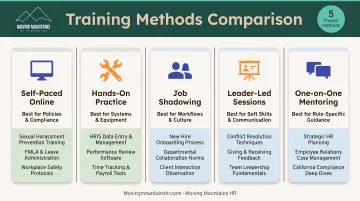
Choose the Right Training Methods
Match the method to the content:
- Self-paced online training for policies, compliance, and software tutorials
- Hands-on practice with equipment, systems, and tools
- Job shadowing with experienced team members for workflow and culture immersion
- Leader-led sessions for soft skills, team dynamics, and communication norms
- One-on-one mentoring for role-specific guidance and questions
OSHA's training guide recommends activity-based learning for at least two-thirds of safety training time, with no more than one-third lecture. Use demonstrations, hands-on exercises, role-play, and small-group discussions to keep new hires engaged.
Best Practices for New Hire Orientation
Strong orientation programs share a few habits: they treat people as individuals, give them a real guide, stay consistent on the non-negotiables, and keep sessions interactive.
Personalize the Experience
The Wipro study showed that asking newcomers to identify and share their signature strengths on day one—rather than focusing solely on organizational identity—led to better retention and performance. Personalization works.
Consider sending a brief pre-orientation survey asking about:
- Food preferences or dietary restrictions (for team lunches)
- Learning style preferences
- Interests or hobbies
- Any concerns or questions before day one
Use responses to customize welcome materials, plan inclusive meals, and tailor communication style.
Assign a Mentor or Buddy
Pair new hires with an experienced team member (not their direct manager) who can:
- Answer day-to-day questions without formality
- Provide cultural insights and unwritten norms
- Stay available through the first 90 days so the new hire has a go-to person and feels less isolated
The U.S. Office of Personnel Management (OPM) recommends introducing the buddy during the first week.
Create and Use a Standardized Orientation Checklist
Develop a checklist that ensures every new hire receives consistent information and experiences, regardless of department. Track completion of:
- Required legal forms and acknowledgments
- Benefits enrollment and payroll setup
- Technology and system access
- Safety training and emergency procedures
- Team introductions and workspace setup
- Role expectations and initial assignment
- End-of-day debrief and feedback
Standardization reduces compliance gaps and ensures equitable employee experiences.
Make It Engaging and Interactive
Avoid lecture-only formats. Incorporate:
- Icebreakers such as Two Truths and a Lie or team bingo
- Short videos or demos instead of slide-only decks
- Hands-on activities and walkthroughs
- Two-way discussion instead of one-way information dumps
OSHA recommends opportunities for questions and feedback during and after training. People remember what they practice and discuss—not what they only hear once.
Common Orientation Training Mistakes to Avoid
Information Overload
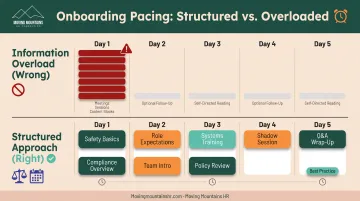
Cramming everything into day one overwhelms new hires. Cognitive research shows working-memory capacity is typically limited to 3-5 chunks of information under ideal conditions. SHRM explicitly warns that orientation can overload employees.
Instead:
- Spread orientation over 3-5 days with built-in processing time
- Prioritize essential information for day one (safety, access, immediate role expectations)
- Revisit and reinforce key concepts throughout the first week
- Skip day-one dumps of 50+ policy documents and back-to-back meetings that fill eight hours
Lack of Structure or Consistency
Allowing each department to create ad-hoc orientation processes leads to:
- Missed critical compliance information
- Inequitable employee experiences
- Regulatory and safety gaps
Instead:
- Standardize core components (legal paperwork, policies, safety, technology, role expectations)
- Allow for role-specific customization within a consistent framework
- Use a master checklist to track completion across all new hires
No Follow-Up or Feedback Loop
Orientation shouldn't end after day one. Without structured follow-up, you miss opportunities to adjust, support, and improve.
Instead:
- Schedule 30-60-90 day check-ins to review progress and address concerns
- Request feedback from new hires about their orientation experience within the first two weeks
- Continuously improve the program based on what you learn
Small businesses without dedicated HR staff can partner with a consultant such as Moving Mountains HR to build a structured orientation program and keep it compliant as the business grows.
Frequently Asked Questions
What should orientation training for new employees include?
Orientation should cover five essentials: legal paperwork and compliance (I-9, W-4, benefits, handbook), company culture and values, people introductions, workplace logistics and tech setup, and role expectations with a 30-60-90 day roadmap.
How long should orientation training for new employees last?
Formal orientation typically lasts 1-5 days depending on role complexity. SHRM recommends spreading content over several days to avoid overload. Orientation is only the start of a longer 3-12 month onboarding process.
How do you conduct orientation training for new employees?
Use a collaborative approach: HR handles compliance, paperwork, policies, benefits, and culture; managers handle team introductions, role expectations, workflows, and first assignments. Balance the schedule with sessions, breaks, hands-on work, and end-of-day check-ins.
What are the benefits of orientation training for new employees?
Strong orientation reduces turnover (one study found personalized programs cut six-month attrition by over 32%), speeds time-to-productivity with fewer mistakes, and builds confidence and engagement from day one.
What is the 30-60-90 onboarding rule?
The 30-60-90 framework structures the first three months: days 1-30 focus on learning culture, policies, and systems; days 31-60 on contributing through guided projects; days 61-90 on independent ownership and demonstrated competency.
What are common mistakes to avoid during new employee orientation?
Avoid three common pitfalls: overloading new hires with information on day one, running inconsistent orientation across departments (a compliance risk), and skipping structured follow-up check-ins after the initial period.