Employee-centric performance management offers a fundamentally different path. Instead of the traditional "manager evaluates employee" model built around infrequent annual reviews, it creates ongoing, collaborative conversations that balance business goals with individual growth, motivation, and wellbeing. This approach transforms managers from annual judges into everyday coaches and partners in employee success.
In this article, you'll learn what employee-centric performance management is, why it matters for small to mid-sized businesses, how to implement it practically, and best practices that drive real retention and performance gains.
Key Takeaways
- Balances company goals with individual development and motivation through ongoing dialogue—not once-a-year scorekeeping
- Weekly 15–30 minute check-ins replace disconnected annual reviews and raise day-to-day engagement
- Cuts turnover 21%–28% and lifts performance when managers get training to run the conversations well
- Small businesses can run this without enterprise budgets by building manager skill and simple, structured check-ins
What Is Employee-Centric Performance Management?
Employee-centric performance management is a continuous process that places individual employees at the center of performance conversations. Rather than treating performance as an annual event, it balances achievement of business goals with personal development, motivation, and wellbeing through regular manager-employee dialogue.
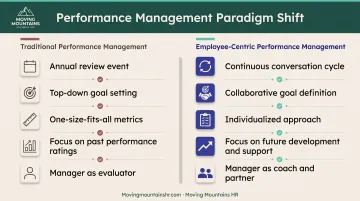
Traditional vs. Employee-Centric Models:
| Traditional Performance Management | Employee-Centric Performance Management |
|---|---|
| Annual review event | Continuous conversation cycle |
| Top-down goal setting | Collaborative goal definition |
| One-size-fits-all metrics | Individualized approach |
| Focus on past performance ratings | Focus on future development and support |
| Manager as evaluator | Manager as coach and partner |
Employees perform best when they feel valued, understood, supported, and connected to meaningful work. When managers shift from delivering annual judgments to providing ongoing partnership, performance improves and retention strengthens.
Research from Gallup shows that 80% of employees who received meaningful feedback in the prior week were fully engaged, while only 16% described their latest manager conversation as extremely meaningful. The gap between potential and reality is wide, and managers can close it.
Key Principles of Employee-Centric Performance Management
Employee-centric performance management rests on five interconnected principles. Together they shift the focus from rating people once a year to developing them all year long.
Continuous Feedback and Conversation
Annual reviews fail because they address issues too late, recognize achievements long after they occur, and leave employees guessing about expectations for 11 months of the year. Employee-centric systems replace this with weekly 15-30 minute check-ins that maintain alignment, surface problems early, and build trust through consistency.
What makes a 1:1 conversation meaningful? Gallup's research identifies five ranked characteristics:
- Recognition for recent work
- Collaboration and relationships
- Current goals and priorities
- Appropriate conversation length
- Focus on employee strengths
These conversations don't require elaborate preparation. A simple recurring agenda covering recent wins, current priorities, obstacles, and support needs keeps discussions focused and productive. The key is psychological safety—employees must trust that raising concerns won't trigger punishment.
Google's research on team effectiveness ranked psychological safety as the top dynamic among five factors that drive team success. Managers build this safety by soliciting opinions, clarifying roles and expectations, sharing work preferences openly, and using structured agendas that invite two-way dialogue.
Individualized Approach
Not every employee is motivated by the same rewards, learns the same way, or faces the same personal circumstances. Employee-centric systems recognize these differences and adapt accordingly.
Examples of individualization:
- Flexible working arrangements for employees with caregiving responsibilities
- Varied recognition methods based on personality (public praise for some, private acknowledgment for others)
- Career pathing that respects different ambitions (individual contributor excellence vs. management tracks)
- Learning approaches tailored to how people absorb information (hands-on projects, formal training, mentorship)
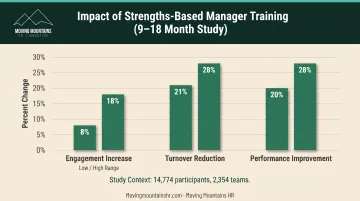
Controlled studies by Gallup involving 14,774 participants and 2,354 teams found that strengths-based manager training led to 8%-18% higher engagement, 21%-28% lower turnover, and 20%-28% higher likelihood of performance improvement after 9-18 months.
Recognizing individual strengths and tailoring development produces measurable business results.
Goal Alignment with Employee Input
Top-down goal cascades often fail because employees don't understand the "why" behind objectives or see how goals connect to their own career aspirations. Employee-centric performance management invites employees to participate in defining objectives, ensuring alignment between business needs and personal growth.
This collaborative approach doesn't mean employees choose whatever they want. In practice it looks like:
- Managers share organizational priorities and constraints
- Employees propose contributions that also support their growth
- Both sides agree on specific, measurable objectives
- Check-ins keep goals current as work shifts
The result is stronger buy-in and clearer purpose.
Development Focus
Rather than fixating on past performance ratings, employee-centric systems emphasize skill-building, career growth, and learning opportunities. This forward-looking orientation creates internal talent pipelines and reduces reliance on expensive external hiring.
Gallup's 2024 study of 717 voluntary leavers found that 42% said something could have prevented their departure, yet 45% had no proactive discussion about satisfaction, performance, or their future in the preceding three months. Among leavers who did have a pre-exit conversation, only 29% discussed their career future.
Making development conversations routine closes this gap.
Development conversations should cover:
- Skills the employee wants to build
- Career goals and next logical steps
- Stretch assignments that accelerate growth
- Training or mentorship opportunities
- Progress toward long-term aspirations
Holistic Performance View
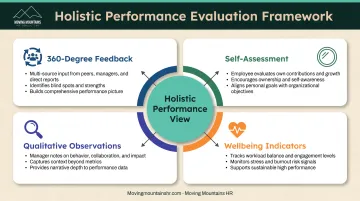
Employee-centric performance management considers multiple factors beyond output metrics: collaboration quality, motivation levels, wellbeing, and values alignment. This holistic view recognizes that sustainable high performance depends on more than hitting numbers.
Components of holistic evaluation:
- 360-degree feedback from peers, direct reports, and cross-functional partners
- Self-assessment that invites employee reflection on strengths and growth areas
- Qualitative observations about how work gets done, not just what gets delivered
- Wellbeing indicators such as workload sustainability and stress levels
This comprehensive perspective prevents burnout, surfaces problems before they escalate, and keeps employees from sacrificing health or relationships to hit short-term targets.
Benefits for Small to Mid-Sized Businesses
Employee-centric performance management delivers measurable returns for smaller organizations, where every hire and every departure carries real weight.
Improved Retention and Reduced Turnover Costs
Turnover is expensive. Replacing an employee typically costs between half and twice their annual salary when you factor in recruiting, onboarding, lost productivity, and institutional knowledge that walks out the door.
Employee-centric performance management directly addresses the retention drivers that matter most. Gallup's controlled studies showed 21%-28% lower turnover in teams where managers received strengths-based training and held regular meaningful conversations. For a 50-person company with 20% annual turnover, cutting exits by even one-quarter saves tens of thousands of dollars a year.
Enhanced Productivity and Engagement
When employees understand how their work connects to the company mission and feel supported in their development, they put in more effort. They solve problems proactively, collaborate more effectively, and deliver higher-quality work.
The same Gallup research found 20%-28% higher likelihood of performance improvement in teams with trained managers and continuous feedback. Small businesses, where every employee's contribution counts, gain the most from these productivity lifts.
Competitive Advantage in Talent Acquisition
Small companies often struggle to compete with larger employers on salary and benefits. Employee-centric performance management offers something different: a growth-focused, supportive environment where people feel genuinely valued.
Top talent increasingly prioritizes development opportunities, manager quality, and workplace culture over raw compensation. By investing in these areas, smaller businesses can attract candidates who might otherwise default to enterprise employers.
How to Implement Employee-Centric Performance Management
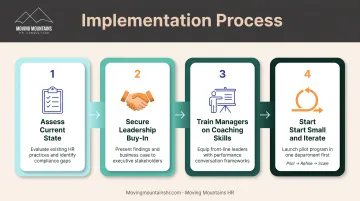
1. Assess Your Current State
Evaluate your current performance management process and gather feedback from employees and managers on what works and what doesn't.
Key questions to answer:
- How often do managers and employees discuss performance?
- Do employees understand how their goals connect to company objectives?
- Are current conversations developmental or purely evaluative?
- What documentation exists, and does it support or hinder meaningful dialogue?
- Do managers feel equipped to coach effectively?
2. Secure Leadership Buy-In and Model Desired Behaviors
Leaders must champion the shift, participate in training, and demonstrate employee-centric principles in their own management approach. If the CEO still conducts annual reviews while asking managers to adopt weekly check-ins, the initiative will fail.
In practice, leaders should:
- Scheduling and protecting weekly 1:1 time with direct reports
- Sharing personal development goals openly
- Asking for feedback and acting on it
- Celebrating managers who excel at employee development
3. Train Managers on Coaching Skills
Most managers were promoted for technical expertise, not people skills. Expecting them to conduct effective developmental conversations without training is unrealistic.
Provide frameworks, templates, and ongoing support to build manager capability and confidence. Training should cover:
- Practicing active listening
- Giving constructive feedback
- Running goal-setting conversations
- Recognizing and developing individual strengths
- Addressing performance issues early
- Building psychological safety
Small to mid-size businesses without internal HR support can work with partners like Moving Mountains HR to build coaching-focused performance systems that fit their culture, industry, and budget.
4. Start Small and Iterate
Don't attempt to overhaul everything at once. Pilot the new approach with a small group of managers and employees, gather feedback, refine the process, and then scale gradually.
A phased rollout helps you:
- Limit risk while the process is still new
- Course-correct based on real feedback
- Build internal champions who can share what worked
Common Challenges and How to Overcome Them
Shifting to employee-centric performance management rarely goes smoothly on day one. These three obstacles show up most often, and each has a practical fix.
Manager Resistance or Lack of Time
Frequent conversations feel like additional work, especially to managers already stretched thin. Preventing problems and keeping people aligned still costs less time than crisis management and repairing damaged relationships.
Solutions:
- Provide efficient 15-30 minute meeting structures that managers can follow easily
- Emphasize time savings from fewer performance crises and lower turnover
- Track and share stories of managers who've experienced the benefits firsthand
- Make 1:1s non-negotiable calendar commitments, not optional nice-to-haves
Inconsistent Implementation Across Managers
Some managers embrace the new approach while others revert to old habits, creating inequity and confusion across the organization.
Solutions:
- Establish accountability through HR check-ins on manager performance
- Offer training refreshers and peer learning sessions
- Share success stories that demonstrate impact
- Tie manager performance evaluations to how well they develop their teams
Documentation and Compliance Concerns
California employers in particular need records that support compliance without turning every conversation into a formal evaluation.
California's Labor Commissioner states that employees may inspect and receive copies of personnel records relating to performance or grievances. Keep coaching developmental, but document goals, dates, observable behaviors, commitments, and follow-up consistently. Have California counsel validate your retention and response procedures.
Best Practices for Sustained Success
Use Technology Thoughtfully
Performance management software can support scheduling, documentation, goal tracking, and analytics. The best tools strengthen real conversations between managers and employees.
Evaluate tools based on whether they:
- Send reminders that keep 1:1s on schedule
- Make goals visible and trackable
- Enable employee input and self-assessment
- Support note-taking during conversations
- Provide trend reporting for HR and leadership
- Allow secure access and exportable records
Make It a Cultural Priority, Not Just an HR Initiative
Embed performance conversations into daily work rhythms. Celebrate managers who excel at employee development. Share stories of employee growth that resulted from great coaching.
When performance management becomes "how we work here" rather than "that HR thing," it sticks. Deloitte's research points to a few habits that make the shift stick:
- Define the purpose of performance management clearly
- Simplify the process so managers actually use it
- Model the behavior from the top
- Set clear team norms around feedback
- Give real-time feedback on wins and improvement needs
Continuously Gather Feedback and Iterate
Regularly survey employees and managers on the performance management process itself. Ask what's working, what's confusing, and what needs improvement. Make adjustments based on this feedback.
Performance management should evolve as your business grows and your workforce changes. What works for a 20-person startup often needs adjustment at 50 employees—and again at 100.
Frequently Asked Questions
What are the 5 key performance indicators for employees?
The five most common KPIs are quality of work output, productivity/efficiency, goal achievement rate, collaboration and teamwork, and professional development progress. Employee-centric management still tailors those metrics to each role and to organizational priorities instead of scoring everyone the same way.
What are the top 3 areas to improve work performance?
The three most common improvement areas are time management and prioritization, communication and collaboration skills, and technical/job-specific competencies. Employee-centric approaches surface those areas through dialogue, not generic prescriptions, so development plans match real gaps.
How is employee-centric performance management different from traditional performance management?
Traditional performance management relies on annual reviews, top-down goal setting, and retrospective evaluation. Employee-centric performance management uses continuous conversations, collaborative goal-setting, a developmental focus, and an individualized approach that treats employees as partners rather than subjects of judgment.
How long does it take to implement employee-centric performance management?
Initial rollout typically takes 3-6 months including planning, manager training, and the first cycle of check-ins. Embedding it in culture usually takes 12-18 months of steady practice while managers build skill and employees see the difference.
Is employee-centric performance management suitable for small businesses?
Yes. It fits small businesses well: relationships are already close, you can put energy into high-impact conversations, and you can move faster than a large enterprise. Weekly 15-30 minute check-ins need manager commitment and a simple structure—not enterprise software.
What does it cost to transition to employee-centric performance management?
Main costs are manager training, optional software, and any HR consulting support—driven by company size and how far you roll the model out. Most organizations recoup that investment through better retention and productivity within 12-18 months.
Employee-centric performance management is a practical, evidence-based way for managers and employees to work together. Swap disconnected annual reviews for ongoing conversations, shared goals, and real development support, and small to mid-sized businesses can compete for talent and cut costly turnover.
The shift takes commitment, manager training, and cultural change. Organizations that invest in their people typically see stronger retention, engagement, and day-to-day performance over time.