Most small business owners have never been trained to make that call. That gap between "something feels wrong" and knowing how to respond legally is exactly where risk management investigations come in.
Left unaddressed, workplace risks like harassment, fraud, or safety violations rarely stay contained. They escalate into litigation, EEOC or DOL complaints, and reputational damage that can outlast the original incident by years. In fiscal year 2024 alone, the EEOC received 88,531 new discrimination charges and recovered nearly $700 million for victims — numbers that include plenty of small and mid-size employers who didn't act fast enough.
This guide covers what risk management investigations are, when to launch one, the step-by-step process, and why bringing in neutral third-party expertise (like Moving Mountains HR) often makes the difference between a defensible outcome and an expensive one.
Key Takeaways
- Investigations respond to specific triggering events—not theoretical exposure
- Delayed investigations can become evidence of employer negligence
- A documented, consistent process protects your business and your employees
- External investigators provide objectivity in-house managers often can't match
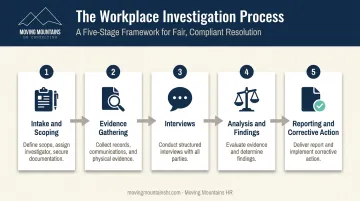
- A sound process runs five stages, from intake through corrective action
What Is a Risk Management Investigation?
A risk management investigation is a structured, fact-finding process used to identify, assess, and address threats before they turn into losses. Those threats can be legal, financial, reputational, or operational.
Investigations put the classic "identify, assess, mitigate" risk framework into practice. Instead of theorizing about what might go wrong, they dig into what already went wrong, uncovering the root cause behind a specific incident or allegation.
Investigations vs. Risk Assessments
These terms get used interchangeably, but they're not the same thing:
- Risk assessments look at ongoing exposure and probability — think of them as your radar system
- Investigations respond to a specific triggering event, like a complaint, an incident report, or an audit flag
You run assessments continuously. You launch an investigation when something specific happens.
Common Triggers for Small and Mid-Size Employers
- Harassment or discrimination complaints
- Wage-and-hour disputes
- Safety incidents or near-misses
- Suspected fraud or embezzlement
- Regulatory audits, particularly in regulated industries like healthcare
Each trigger carries its own legal exposure. A missed harassment complaint can turn into a Title VII claim. An ignored financial discrepancy can become an embezzlement case with six-figure losses. Waiting rarely makes either problem smaller.
Why Workplace Investigations Are Essential to Your Risk Management Strategy
A properly documented investigation does more than resolve a single complaint. It builds a legal defense record showing your business made a good faith effort to respond, which can decide the outcome if a claim later reaches litigation or a regulatory agency.
The Legal Record You're Building
When you document intake, interviews, evidence review, and findings at every stage, you're creating a paper trail that demonstrates:
- The complaint was taken seriously and acted on promptly
- All parties were heard fairly, not just one side
- Findings were based on evidence, not assumptions
- Corrective action followed logically from the conclusions
This record matters under federal and state law. Title VII requires a prompt, thorough, and impartial process, followed by corrective action.
California's FEHA goes further. It requires reasonable steps to prevent and correct harassment, plus investigations that start as soon as feasible and reach a fair, timely conclusion.
Finding the Gaps Before They Repeat
Investigations often surface something bigger than the original complaint: a systemic policy gap. Maybe your harassment reporting channel is unclear. Maybe disciplinary action has been inconsistent across departments. Left unaddressed, these gaps create repeat liability: the same problem resurfacing under a different employee's name.
The Retention Connection
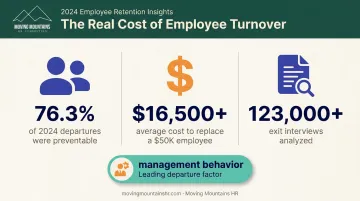
Retention is part of the risk equation, and the costs add up quickly. Work Institute's 2025 Retention Report, based on more than 123,000 exit interviews, found that 76.3% of 2024 departures were preventable. Management behavior and workplace environment ranked among the leading factors.
Replacing an employee earning $50,000 a year can cost your business $16,500 or more in recruiting, onboarding, and lost productivity.
Employees who see complaints taken seriously internally are far more likely to raise concerns with HR rather than skip straight to an attorney or a government agency. A credible investigation process protects you legally and helps you keep the people you've already invested in.
Types of Risk Management Investigations Every Business Should Know
Not every investigation looks the same. The right approach depends on what triggered it.
Internal investigations cover the complaints most small businesses encounter directly:
- Harassment and discrimination allegations
- Hostile work environment claims
- Policy violations and code of conduct breaches
- Retaliation concerns
- Performance-related misconduct
External or compliance investigations typically involve a regulatory body or forensic review:
- Wage-and-hour audits from the Department of Labor
- OSHA safety incident reviews
- Fraud investigations tied to financial reporting
Healthcare-sector investigations add workplace-conduct issues inside a heavily regulated environment. Employee behavior tied to patient safety events and licensing board complaints often requires fluency in both HR practice and healthcare workplace norms. Moving Mountains HR's founder brings direct healthcare-industry HR experience, which helps clients handle the employment side of these situations with the right context.
Most small businesses will encounter the first category most often. Knowing the difference helps you scope the investigation correctly from day one.
Red Flags: When to Launch a Risk Management Investigation
Some warning signs are obvious. Others are easy to rationalize away until it's too late.
Watch for these behavioral and operational signals:
- Sudden changes in an employee's demeanor or work patterns
- Secrecy around processes that used to be transparent
- Unexplained financial discrepancies in budgets or expense reports
- Multiple complaints pointing at the same individual over time
When any of these signals show up, speed matters as much as the investigation itself.
Delay Is Its Own Liability
Here's the part managers often miss: waiting to investigate a formal complaint can itself become evidence of negligence.
In Fuller v. City of Oakland, the Ninth Circuit found the employer liable in part because the accused wasn't even interviewed until after the employee filed an EEOC complaint. The court's message was clear: an investigation that comes too late doesn't count as a remedy.
Set a documented threshold before you need one. Decide now, not during a crisis, that any harassment complaint or suspected safety violation triggers an investigation automatically. That way, managers aren't left guessing under pressure.
The Investigation Process: A Step-by-Step Approach
A defensible investigation follows a consistent structure, regardless of the allegation.
Intake and scoping — Define the allegation, identify the parties involved, and set interim measures (such as separating complainant and respondent) before evidence gathering begins.
Evidence gathering — Collect relevant documents, emails, time records, and any physical evidence. Identify every witness with firsthand knowledge, not just the obvious ones.
Interviews — Conduct structured, neutral conversations with the complainant, respondent, and witnesses separately. Use open-ended questions and document responses consistently across every interview.
Analysis and findings — Weigh each account against corroborating evidence under a preponderance of the evidence standard (more likely than not), as recommended by California's Civil Rights Department. Draft factual conclusions tied to company policy, not personal opinion.
Reporting and corrective action — Deliver a written report to leadership with clear findings and recommended remediation. Record how findings were communicated and how the matter was closed.
Skip a step, or rush interviews toward a predetermined conclusion, and the investigation becomes a liability—not a defense.
Why Partner with a Neutral Third-Party Investigator
An internal manager investigating a complaint about a colleague, or worse, a direct report, carries built-in bias risk. It doesn't matter how fair-minded that manager actually is. The appearance of a conflict can undermine the entire process in the eyes of employees, opposing counsel, or a court.
A neutral third-party investigator removes that problem. No reporting relationship, no personal stake, no history with either party. That objectivity strengthens the legitimacy of the findings before anyone even reads the report.
There's an expertise angle too. Employment law nuances, particularly California-specific requirements around FEHA and mandatory reporting steps, are easy for an in-house manager to miss. A seasoned investigator catches those details as a matter of routine.
Moving Mountains HR structures its workplace investigation service as a standalone engagement, scoped specifically to the claim at hand. That includes:
- Formal intake and complaint documentation
- Neutral interviews with all involved parties
- Evidence collection and preservation
- A written summary report with findings and recommendations
- Anti-retaliation education built into every stage
The firm handles investigations involving harassment, discrimination, hostile work environment, retaliation, conflict of interest, and code of conduct issues. Founder Michelle Schwanhauser brings deep HR experience—especially in healthcare—to each engagement.
For employers who need a defensible, unbiased process without adding internal HR headcount, a third-party investigator is often the more practical path.
Frequently Asked Questions
What are the 4 types of risk management?
The four standard risk treatment strategies are avoidance, reduction, sharing or transfer, and retention. In a workplace context, that might mean stopping a risky practice entirely, adding controls like training, using outside investigators, or knowingly accepting a small residual risk after documented mitigation.
What are the 5 P's of risk management?
A common version is Policy, Process, People, Procedures, and Performance. Applied to a business, it means having written policies, defined processes, trained people, consistent procedures, and a way to measure whether the system is actually working.
What are the 4 elements of QRM?
Quality Risk Management, as defined in the pharmaceutical industry's ICH Q9(R1) guidance, includes risk assessment, risk control, risk communication, and risk review. This framework is most relevant to regulated healthcare and pharmaceutical operations rather than general HR investigations.
How long does a typical workplace investigation take?
Most straightforward workplace investigations take a few days to a few weeks, depending on complexity, witness availability, and records volume. There's no universal legal deadline, but prompt resolution limits ongoing liability exposure.
Should a small business use an internal or external investigator?
External investigators are generally recommended when the complaint involves senior leadership, carries significant legal exposure, or the business lacks dedicated in-house HR expertise. Internal reviews work fine for lower-stakes, straightforward policy matters.
What happens after a workplace investigation is completed?
The investigator delivers a written report with findings to leadership, who then implement corrective action based on those conclusions. Follow-up to confirm the fix worked—and that no retaliation occurred—matters as much as the report itself.