Blended learning offers a practical solution. By combining the flexibility of online training with the proven effectiveness of face-to-face instruction, small to mid-size businesses can build training programs that fit real-world constraints while delivering measurable results. This guide walks you through what blended learning is, why it matters for your organization, and how to implement it without a dedicated L&D department.
Key Takeaways
- Blended learning pairs live instruction with digital content so small teams get flexible, scalable training
- Four models (flipped classroom, rotation, flex, face-to-face driver) fit different training needs and constraints
- Clear objectives, the right technology, and change-management planning reduce employee resistance at rollout
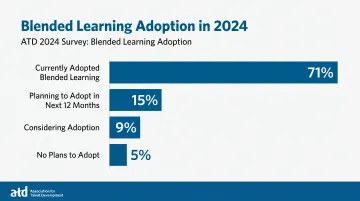
- 71% of organizations use blended learning for at least half their programs (ATD, 2024)
What Is Blended Learning and Why Does It Matter for Employee Training?
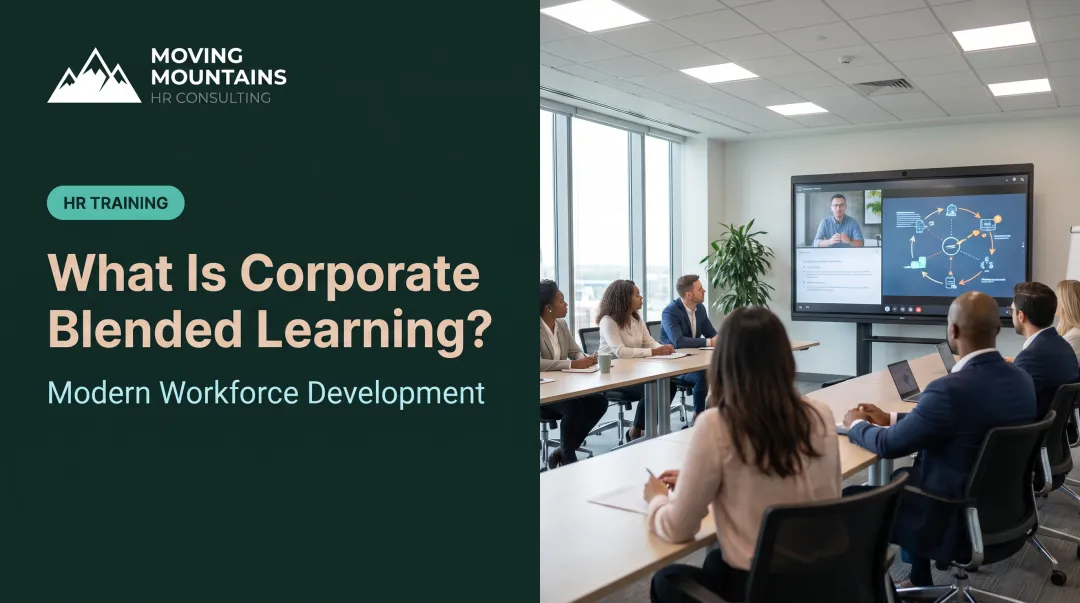
Blended learning combines traditional face-to-face instruction with online or digital learning components. Strong programs assign each format to what it does best.
Online modules handle foundational knowledge, self-paced review, and scalable content delivery. In-person sessions cover hands-on practice, live discussion, and coaching on complex scenarios. For employee training, that split matters: people learn the rules on their own time, then use live sessions to practice judgment, ask questions, and document completion.
Blended Versus Hybrid Learning
The terms are often confused, so clarification matters:
- Blended learning = Integrated design where online and in-person components are built to work together. The same learner experiences both modalities as part of one program.
- Hybrid learning = Choice-based model where learners pick fully online or fully in-person for the same course, or some join remotely while others attend in person at the same time.
Blended Learning in Practice
Small business examples:
- Onboarding program: New hires complete pre-work videos covering company history, policies, and systems before their first day. Day one focuses on in-person introductions, workspace setup, and Q&A with department leads.
- Compliance training: Employees complete online modules on harassment prevention at their own pace, followed by a scheduled live Q&A session where an HR consultant addresses scenario-based questions and documents attendance.
- Leadership development: Supervisors watch recorded case studies and complete self-assessments online, then attend monthly in-person workshops to practice feedback conversations and problem-solving.
Adoption Across Organizations
ATD's 2024 survey of 360 talent-development professionals found that 71% said at least half of their organization's learning was blended. About 75% reported growth in blended use over the prior two years.
Respondents most often applied blended learning to new-employee orientation and leadership development. Highly effective users also used it for customer service, interpersonal skills, and business processes.
Why Small Businesses Need Blended Learning Solutions
Small to mid-size businesses face distinct training challenges: limited budgets, no dedicated L&D staff, and employees who can't afford extended time away from daily operations. Blended learning addresses each constraint.
Cost and Time Advantages
Traditional instructor-led training requires paying facilitators, booking meeting spaces, and pulling entire teams off the floor simultaneously. Blended approaches move foundational content online and reserve live time for discussion and practice. Self-paced modules replace hours of classroom instruction, which cuts instructor fees, travel, and facility costs—and shortens total delivery time.
Flexibility That Fits Small Workforces
When your team has three people covering customer service, scheduling a full-day training session creates operational risk. Blended learning allows employees to complete online portions during slower periods, revisit materials as needed, and attend shorter live sessions that minimize scheduling conflicts.
Engagement and Retention
Research on blended workplace learning found that learner-facilitator, learner-learner, and learner-colleague interactions strengthen behavioral, cognitive, and emotional engagement. Online modules keep foundational knowledge consistent. Live sessions add accountability and room to apply concepts to real work.
Compliance and Risk Management
Blended learning helps small businesses maintain compliance in several practical ways:
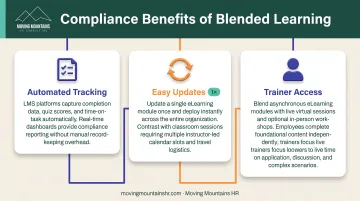
- Track completions automatically in an LMS for audit-ready records
- Update one online module when rules change instead of re-running full classroom sessions
- Capture trainer access and attendance in live sessions (virtual or in-person) when regulations require it
OSHA guidance permits interactive computer training as part of a program but generally requires access to a qualified trainer and sufficient hands-on practice. Blended delivery meets both requirements by pairing digital instruction with facilitated sessions.
Common Blended Learning Models for Employee Training
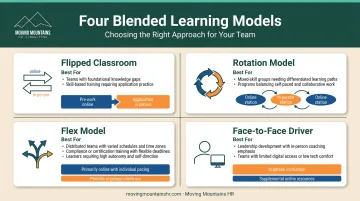
Four main models serve different training objectives and organizational constraints.
Flipped Classroom Model
Employees complete online learning (videos, readings, modules) before attending in-person sessions focused on application, discussion, and practice.
Best for:
- Skills training requiring hands-on coaching
- Leadership development with role-play scenarios
- Complex topics where learners need different amounts of prep time
Example: Supervisors watch a 20-minute video on performance feedback frameworks and complete a self-assessment. The following week's in-person workshop uses case studies and peer role-play to practice delivering feedback.
Rotation Model
Learners alternate between online self-study and scheduled live sessions (virtual or in-person) on a fixed schedule.
Best for:
- Extended onboarding programs spanning weeks
- Certification training with multiple competencies
- Programs requiring regular check-ins and reinforcement
Example: New hires rotate weekly between self-paced online modules on company systems and scheduled live sessions with department leads who answer questions and demonstrate workflows.
Flex Model
Digital content serves as the primary delivery method, with instructors or coaches available on-demand for support.
Best for:
- Software training where learners work at different speeds
- Self-paced professional development
- Geographically dispersed teams
Example: Sales reps complete online product training modules and access recorded demos. A Slack channel connects them to a product specialist who answers questions within 24 hours.
Face-to-Face Driver Model
Classroom instruction remains the primary delivery channel, supplemented with online resources for reinforcement and practice.
Best for:
- Hands-on technical skills (equipment operation, safety procedures)
- Situations where in-person coaching is critical
- Learners with limited tech comfort
Example: Warehouse staff attend in-person forklift safety training with hands-on practice. They access online videos and checklists afterward to refresh their knowledge before certification renewal.
Selecting the Right Model
Match your model to three factors:
- Content type: Does the skill require hands-on practice, or is it knowledge-based?
- Learner population: Are employees distributed or centralized? Tech-savvy or resistant?
- Organizational constraints: What's your budget, timeline, and facilitator availability?
Quick starting points:
- Real-time coaching with an on-site team → face-to-face driver
- Remote team, primarily informational content → flex
- Engagement and discussion matter most → flipped classroom or rotation
How to Implement Blended Learning in Your Organization
Follow these six steps to build a blended learning program that fits your resources.
Step 1: Identify Training Objectives and Current Gaps
Ask three questions:
- What knowledge or skills gaps exist? Survey managers, review performance issues, check compliance requirements.
- What are the business consequences? Lost sales, safety incidents, compliance violations, or turnover.
- What does success look like? Define measurable outcomes: certification completion, reduced error rates, faster onboarding time.
Step 2: Evaluate Existing Training Content
Audit your current materials:
- Reusable content: Do you have training decks, videos, or manuals that can be digitized?
- Content gaps: What needs to be created from scratch?
- Format fit: Which content works better online (policies, definitions, processes) versus in-person (role-play, equipment demos, Q&A)?
Convert PowerPoint decks into short video narrations. Turn printed handbooks into searchable PDFs. Identify where live facilitation adds the most value.
Step 3: Choose the Right Blended Learning Model
Use the framework from the previous section. Match your content type, learner preferences, and constraints to one of the four models. Don't force a model. Pick what fits your specific training need.
Step 4: Select Appropriate Technology
You need three core functions:
- Content delivery and tracking: A learning management system (LMS) hosts modules, tracks completion, and generates reports. Options range from enterprise platforms to affordable small-business solutions.
- Video conferencing: Zoom, Microsoft Teams, or Google Meet for virtual live sessions.
- Content creation tools: Screen recording software (Loom, Camtasia), presentation tools (PowerPoint, Canva), or simple smartphone videos work for most small businesses.
Choose tools your team will actually use and that fit your budget. Many LMS platforms offer tiered pricing for small teams. Free tools like Google Slides, YouTube for hosting, and Zoom for live sessions can support a pilot program.
Step 5: Design Your Program with Clear Integration
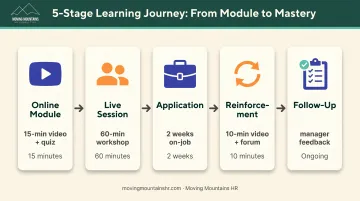
Create a learning journey map that shows:
- Sequence: What do learners complete first, second, third?
- Connections: How does online pre-work support in-person activities?
- Checks and reinforcement: Where do you assess understanding and provide follow-up?
Example journey:
- Online module: 15-minute video on customer service principles + 5-question quiz
- Live session: 60-minute workshop practicing difficult customer scenarios
- On-the-job application: Apply techniques for two weeks
- Online reinforcement: 10-minute refresher video + peer discussion forum
- Follow-up: Manager observation and feedback
Step 6: Pilot, Gather Feedback, and Iterate
Test with a small group first:
- Select 5-10 participants representing your broader audience
- Collect learner feedback on content clarity, pacing, and technical issues
- Gather facilitator observations on what worked and what didn't
- Make adjustments before full rollout
When internal resources are limited, bring in an HR consultant for strategy and program design. Moving Mountains HR provides fractional support and training development so small and mid-size teams can build blended learning without full-time staff overhead.
Overcoming Common Blended Learning Challenges
Most blended learning rollouts stall for the same three reasons. Handle them up front and you protect completion rates and training ROI.
Challenge 1: Employee Resistance to Technology-Based Training
- Run short orientation sessions that walk employees through the platform before training starts
- Create simple user guides with screenshots and step-by-step instructions
- Stress practical benefits: learn during slower periods, pause and revisit content, and spend less time away from work
- Offer a tech-support contact (email, phone, or Slack) for quick troubleshooting
Challenge 2: Lack of Internal Resources and Expertise to Develop Content
- Start with existing content from trusted providers instead of building every module from scratch
- Use templates and authoring tools built for non-designers (Canva, Google Slides, basic LMS builders)
- Record subject-matter experts narrating current presentations instead of scripting polished videos
- Outsource complex, business-critical programs when internal capacity is the bottleneck
Challenge 3: Maintaining Engagement and Completion Rates in Self-Paced Portions
- Build accountability with manager check-ins and live sessions that assume pre-work is done
- Keep modules under 15 minutes and focus each on one concept
- Add interactive elements: scenario questions, drag-and-drop activities, and real-world examples
- Set deadlines with flexible windows instead of open-ended timelines
Measuring ROI and Training Effectiveness
Set success metrics before you launch. Without a baseline, you cannot show whether training reduced errors, improved compliance, or paid for itself.
Key Metrics to Track
- Completion rates: Percentage of learners who finish the full program
- Assessment scores: Knowledge gain shown through quizzes or practical tests
- Time-to-competency: How quickly can new hires perform job tasks independently?
- Behavioral changes: Whether employees apply what they learned on the job
- Business impact: Reduced errors, fewer compliance violations, higher customer satisfaction, or lower turnover
Use Your LMS Analytics
If you use a learning management system, most platforms track:
- Learner progress through modules
- Time spent on each section
- Assessment results
- Drop-off points where learners abandon content
Review these patterns to spot where learners struggle, then refine the content. No LMS? Spreadsheets, quiz scores, and manager feedback still give you usable data.
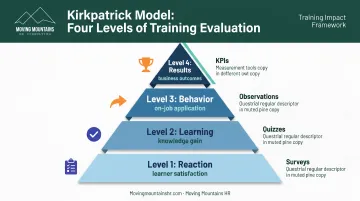
Apply the Kirkpatrick Model
The Kirkpatrick Model defines four evaluation levels:
- Reaction: Learner satisfaction (did they find the training valuable?)
- Learning: Knowledge gain shown through assessments
- Behavior: On-the-job application of new skills
- Results: Business outcomes such as safety, sales, compliance, or retention
Measure each level with different tools: surveys for reaction, quizzes for learning, manager observations for behavior, and KPIs for results.
Conduct Follow-Up Assessments
Knowledge retention and behavioral change take time. Follow up at 30, 60, and 90 days post-training to see whether learning sticks and shows up in workplace performance. Use manager check-ins, refresher quizzes, or observation checklists.
To estimate ROI, compare training costs (design, delivery, and time away from work) against gains from fewer violations, faster ramp-up, or lower turnover. Even directional numbers help justify the next training investment.
Frequently Asked Questions
What is a blended training program?
A blended training program combines instructor-led training (virtual or in-person) with self-paced digital learning activities. The two modalities work together, creating a more flexible and effective experience than either approach alone.
What are some strategies for blended learning?
Effective strategies include:
- Flipped classroom sessions so live time focuses on discussion and practice
- Microlearning modules for ongoing reinforcement
- Peer collaboration during instructor-led sessions
- Analytics to personalize paths based on progress and performance
What are the four models of blended learning?
The four main models are:
- Flipped classroom: Online content first, then live application
- Rotation: Learners alternate online and live sessions on a set schedule
- Flex: Digital content is primary, with on-demand facilitator support
- Face-to-face driver: Classroom instruction plus online reinforcement
How much does blended learning cost for small businesses?
Costs vary by program scope, platform, and whether you build or buy content. Blended programs usually cost less than instructor-led-only training because you spend less on instructor time, travel, and facilities. Budget for LMS licensing, content, and facilitator time.
What technology do I need to implement blended learning?
Essential technology includes a learning management system (LMS) for content delivery and tracking, a video conferencing platform for virtual sessions (Zoom, Teams, or Meet), and basic content creation tools. Small businesses can start with affordable or free options such as Google Workspace, Loom for screen recording, and tiered LMS plans.
Can blended learning work for compliance training?
Yes. Blended learning works well for compliance training: standardized online modules cover foundational knowledge, and live sessions handle scenarios, Q&A, and attendance documentation. This approach meets regulatory requirements for trainer access and creates audit-ready records.