
This article covers seven evidence-based strategies for improving management skills at any career stage. Whether you're a new supervisor learning to delegate or an experienced leader refining your emotional intelligence, these practical approaches will help you build stronger teams, make better decisions, and create healthier workplace cultures.
Key Takeaways
- Managers drive 70% of team engagement variance, so leadership style directly shapes performance
- Small and mid-size businesses gain stronger team results when managers keep building their skills
- Strong managers pair hard skills (delegation, decisions) with soft skills (communication, EQ)
- Strong people management reduces turnover costs, which can reach 200% of salary for management positions
- Practice plus consistent feedback turns management concepts into lasting behavior change
Why Strong Management Skills Matter
Management quality drives concrete business results. Gallup's 2024 meta-analysis of 736 studies covering more than 3.35 million employees found that top-quartile engagement teams beat bottom-quartile teams on every major outcome:
- 14%–18% higher productivity
- 23% higher profitability
- 21%–51% less turnover
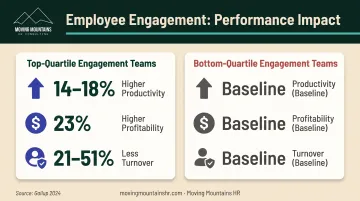
While engagement depends on multiple factors, managers account for 70% of the variance in how engaged employees feel.
For small to mid-size businesses, the pressure is higher. Managers often wear multiple hats: the same person handling strategic planning may also resolve employee conflicts, update policies, and oversee daily operations. Without dedicated HR departments, they need broad skills across compliance, communication, coaching, and decision-making.
Poor management carries direct financial consequences. Gallup estimates that replacing a manager costs approximately 200% of their salary. Beyond turnover, weak management contributes to low morale, compliance violations, safety incidents, and reduced profitability.
In one survey of 717 recent voluntary leavers, 42% said their departure was preventable. Another 45% reported no meaningful conversation with their manager about satisfaction, performance, or future opportunities in the three months before leaving.
Management skills are learnable at any career stage. A 2017 meta-analysis of 335 leadership-training studies found positive effects across multiple outcomes. Gains were strongest when training included needs analysis, practice opportunities, multiple teaching methods, spaced sessions, and regular feedback.
Mastering Communication & Interpersonal Skills
Communicating Clearly Across All Levels
Transparent, frequent communication underpins effective management. When managers communicate clearly, teams align on goals, misunderstandings drop, and decisions move faster. The hard part is adapting your style to the room. What works with your team can fall flat with executives or external stakeholders.
Gallup found that 80% of employees who received meaningful feedback in the prior week were fully engaged, compared to just 20% among those who did not. Daily feedback was associated with 3.6 times higher odds of strong motivation compared to annual feedback. That is not a call to micromanage. It means brief, specific, timely check-ins that keep people informed and supported.
Effective communication means matching the message to your audience's knowledge level, expectations, and concerns:
- Team conversations: prioritize clarity and actionable next steps
- Executive presentations: lead with business impact and strategic alignment
- External stakeholders: emphasize outcomes and credibility
Active Listening and Building Trust
Active listening means paying full attention to what someone is saying, asking clarifying questions, and resisting the urge to interrupt or jump straight to solutions. A 2025 Australian health-sector study connected active listening with increased trust and psychological safety, the confidence to speak up without fear of negative consequences.
Practical active-listening tactics include:
- Paraphrasing what you heard to confirm understanding
- Asking open-ended questions that encourage deeper explanation
- Avoiding interruptions even when you think you know the answer
- Making eye contact and using body language that signals attention
- Withholding judgment until you've heard the full story
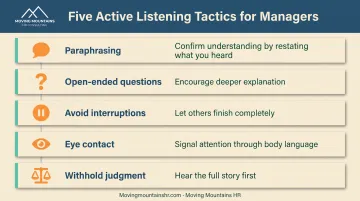
Consistent, empathetic communication builds trust over time. When employees believe their manager genuinely listens and cares about their concerns, they're more likely to share problems early, contribute ideas, and stay engaged during challenges.
Building Self-Awareness & Emotional Intelligence
Emotional intelligence (EQ) has four core components:
- Self-awareness: Recognizing your own emotions and their impact
- Self-management: Controlling impulses and adapting to change
- Social awareness: Reading others' emotions and organizational dynamics
- Relationship management: Influencing, coaching, and resolving conflict
Self-aware managers spot their biases, handle stress constructively, and respond thoughtfully instead of reacting impulsively. According to research cited by Harvard Business School Online, 95% of people believe they are self-aware, but only 10%–15% actually are. That gap matters: low self-awareness links to higher stress, lower motivation, and weaker team performance.
Actionable self-assessment techniques:
- Daily journaling to track emotional responses and patterns
- 360-degree feedback from direct reports, peers, and supervisors
- Personality assessments such as DISC, Myers-Briggs, or StrengthsFinder
- Reflection exercises after challenging interactions or decisions
- Frameworks like the Ladder of Inference to identify assumption-driven thinking
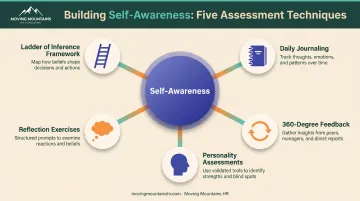
Those habits pay off under pressure. High-EQ managers model emotional regulation when a deadline slips or conflict escalates: they pause, assess the situation objectively, acknowledge emotions without being ruled by them, and steer the team toward solutions.
Example: Two employees clash over project priorities. A manager with strong EQ hears both sides without taking sides, validates each person's concerns, finds common ground, and facilitates a fix that addresses underlying needs—not just surface complaints.
Delegation, Coaching & Employee Development
Strategic delegation frees managers to focus on high-impact work while giving employees room to build skills and take ownership. Used well, it strengthens both manager effectiveness and employee growth.
Strategic delegation principles:
- Match tasks to employee strengths and development goals, not only who is free
- Provide context and authority so employees can act, not only follow steps
- Set clear expectations for outcomes, timelines, and decision-making boundaries
- Build in checkpoints without micromanaging
- Debrief after completion to reinforce learning
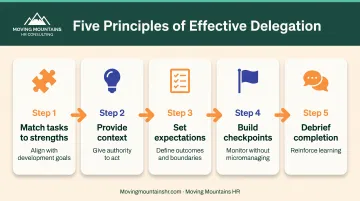
A 2017 study found that delegation predicted feedback-seeking behavior and psychological empowerment among employees. When managers delegate effectively, employees feel trusted, become more proactive about seeking guidance, and develop problem-solving skills.
Beyond delegation, effective managers serve as coaches. Rather than solving every problem, coaching managers ask targeted questions that push employees to think critically and land on solutions themselves. This approach builds capability over time and reduces dependency.
Balance hands-on support with autonomy:
- Provide training and resources before delegating complex tasks
- Stay available for questions without hovering
- Allow employees to make decisions within defined parameters
- Review outcomes together to identify lessons learned
Moving Mountains HR helps managers build these skills through supervisor training, leadership development, and coaching programs shaped around each organization's industry and culture.
Effective Decision-Making & Problem-Solving
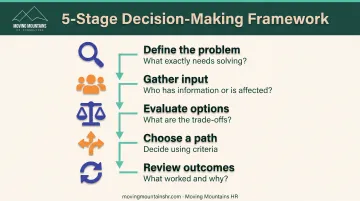
Sound decision-making follows a repeatable framework:
- Define the problem clearly: What exactly needs to be solved?
- Gather relevant input: Who has information or will be affected?
- Evaluate options: What are the trade-offs of each approach?
- Choose a path: Decide based on criteria, not gut feel alone
- Review outcomes: What worked, what didn't, and why?
Involve the right stakeholders and seek diverse perspectives before major decisions. A 2024 study of high-tech teams in China found that cognitive diversity correlated with increased knowledge sharing and creativity, though results varied by context and team dynamics.
Effective managers balance speed with thoroughness. Analysis paralysis delays action and signals indecision, but hasty choices made without adequate information create bigger problems down the road. When time pressure is high, gather the minimum viable information needed for a sound call—then decide and act.
Example: A manager hits a scheduling conflict during peak season:
- Problem: Not enough coverage on high-demand days
- Input: Affected team members share constraints and preferences
- Options: Overtime, temporary help, or shift swaps
- Decision: Shift swaps first, with overtime as backup after weighing cost and morale
- Review: After the season, she notes what held up and adjusts next year’s plan
Time Management & Strategic Prioritization
Effective time management allows managers to focus on high-impact activities like coaching, strategic thinking, and process improvement,rather than constant firefighting. The challenge is distinguishing between urgent tasks that demand immediate attention and important tasks that drive long-term results.
Prioritization frameworks:
- Eisenhower Matrix: Categorize tasks by urgent vs. important. Focus on important-but-not-urgent work to prevent future crises.
- 80/20 Rule (Pareto Principle): Identify the 20% of activities that produce 80% of results and protect time for those activities.
- Time blocking: Reserve specific calendar blocks for deep work, coaching sessions, and strategic planning.
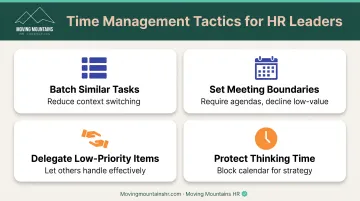
Practical time-management tactics:
- Batch similar tasks to reduce context switching.
- Set boundaries on meetings by requiring agendas and declining low-value invitations.
- Delegate low-priority items that others can handle effectively.
- Protect thinking time by blocking calendar space for strategy and reflection.
The real payoff is allocating the hours you already have to work that creates the most value. For managers in small to mid-size businesses, this often means saying no to tasks that feel urgent but don't align with strategic priorities.
Commitment to Continuous Learning
Management is an evolving discipline. Employment laws change, employee expectations shift, and new research reveals more effective approaches. Ongoing learning keeps managers effective and adaptable.
Effective learning methods:
- Formal training programs covering leadership, compliance, and people management
- Management books and podcasts for flexible, self-paced learning
- Peer learning groups such as manager roundtables that surface shared challenges and fixes
- Mentorship relationships with more experienced leaders
- On-the-job challenges that stretch skills and build capability
The Center for Creative Leadership's research-based 70-20-10 guideline suggests that 70% of development comes from challenging assignments, 20% from developmental relationships, and 10% from formal coursework. The key is deliberate practice: apply new concepts, seek feedback, and refine your approach based on results.
Seek feedback regularly from direct reports, peers, and supervisors to identify growth areas. Ask specific questions: What should I start doing? What should I stop doing? What should I continue doing? Create psychological safety so people feel comfortable being honest.
Use mistakes as learning opportunities. When a decision doesn't produce the expected outcome, analyze what happened, adjust your approach, and move forward with new insight. A 2022 study found that learning-oriented leadership was positively related to feedback-seeking and to how employees used that feedback to improve performance.
Practical Steps to Improve Your Management Skills
Put the seven strategies into practice with a simple plan:
- Start with self-assessment. Pick 1–2 areas from the strategies above where improvement would matter most. Ask trusted colleagues or direct reports where you're strong and where you could grow.
- Set specific, measurable goals. Swap vague aims like "improve communication" for concrete ones—for example, "hold a 15-minute one-on-one with each direct report weekly for the next three months."
- Find an accountability partner, mentor, or coach. Share your goals with someone who will check in, give feedback, and help when you hit friction. If you want structured support, Moving Mountains HR offers coaching and customized leadership development programs for managers.
- Track your progress. Journal what you're trying, what's working, and what to adjust. Run brief pulse checks with your team and schedule quarterly self-reviews to reset goals.
Steady weekly habits beat one-off bursts. Over a quarter, those small changes show up in clearer feedback, stronger one-on-ones, and a team that trusts your lead.
Frequently Asked Questions
What are the 5 key management skills?
Five core management competencies are managing yourself, communicating clearly, supporting your team, motivating performance, and resolving conflict constructively. Together they form the foundation of effective people management across industries.
What are the 5 C's of management?
The 5 C's are Communication, Collaboration, Critical Thinking, Creativity, and Commitment. The model comes from healthcare leadership literature and stresses both relational skills and sound judgment—not a universal standard, but a useful lens.
What are examples of top management improvement areas?
Common focus areas include stronger delegation, better active listening, and sharper time management—prioritizing important work over merely urgent tasks. Identify yours through self-reflection, 360-degree feedback, or mentor conversations.
Conclusion
Management skills are both learnable and critical to organizational success. Whether you are sharpening communication, emotional intelligence, delegation, decision-making, time management, or continuous learning, the path forward stays simple:
- Pick one or two high-priority skills
- Practice them deliberately
- Seek feedback regularly
- Refine your approach based on results
Strong managers raise the bar for everyone around them. Teams engage more, turnover drops, productivity climbs, and workplace culture gets healthier.
Start this week with one skill and one feedback conversation. Steady practice compounds—and the people you lead feel the difference first.