
Introduction
Two employees miss the same deadline. The first says, "I'm so sorry. I underestimated how long the client review would take. I should have flagged the delay last week. I'll have the final version to you by noon tomorrow and build in more realistic timelines moving forward." The second says, "The client didn't get back to me on time, and IT was slow setting up my access. There wasn't much I could do."
Same situation. Two very different responses. The first demonstrates accountability—taking ownership of outcomes, communicating obstacles early, and proposing solutions. The second deflects responsibility onto external factors.
For small business owners and people leaders, that gap shows up as missed commitments, eroded trust, and teams that stop believing follow-through matters.
Accountability means owning your actions, decisions, and results—good and bad. It goes beyond finishing assigned tasks. You stay answerable for how you execute the work, speak up early when something slips, and change how you operate so the same miss is less likely next time.
Below you’ll find what accountability looks like in practice, why it builds trust and engagement, the behaviors that define it, and concrete steps to strengthen it in yourself and across your organization.
Key Takeaways
- Accountability builds trust and stronger teams by making people mutually answerable for outcomes
- Strong accountability pairs ownership, transparent communication, and reliable follow-through
- Psychological safety is essential: effective teams discuss errors openly to learn and improve
- Clear expectations, regular feedback, and consistent consequences create an accountability culture
- Personal accountability starts with tracking commitments, seeking feedback, and communicating obstacles early
What Is Accountability?
Defining Accountability
Accountability means taking responsibility for the impact and consequences of your actions and decisions, not just the actions themselves. It's the difference between saying "I sent the email" and "I confirmed the client received the proposal and addressed their questions."
Responsibility vs. accountability:
- Responsibility = your assigned duties and tasks (what you're supposed to do)
- Accountability = ownership of the outcomes and impact of how you execute those duties (how well you did it and what resulted)
In teams, accountability is the shared expectation that people will be answerable for common actions and decisions. You answer not only upward to your manager, but also to teammates who depend on your work.
Being answerable means you can explain your choices, report progress, and accept consequences when results fall short or exceed expectations.
The Components of Accountability
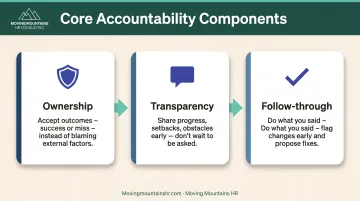
Three core elements define accountable behavior:
- Ownership: Accept outcomes as yours, success or miss, instead of blaming outside factors alone
- Transparency: Share progress, setbacks, and obstacles early rather than waiting to be asked or hiding problems
- Follow-through: Do what you said you would; when plans change, flag it early and propose a fix
Accountability is both proactive and reactive. Proactively, you spot and address issues before they escalate. Reactively, you own mistakes, find root causes, and put corrective action in place.
It also means learning from mistakes. Studies of high-performing teams (including Google's research across 200+ teams) show the strongest groups admit errors more often and discuss them openly as chances to diagnose problems and adapt.
Common Misconceptions About Accountability
Accountability is not blame, punishment, or perfectionism. It is honest assessment and a commitment to improve. Blame can feel like accountability, but it stops at fault instead of moving to solutions.
It also does not mean never making mistakes. Accountable people still hit setbacks; they name the miss quickly, communicate impact, and adjust so the same issue is less likely next time.
Nor is accountability micromanagement. People need autonomy and trust to own outcomes. Constant oversight removes that discretion. Healthy accountability sets clear expectations, supplies the resources to deliver, trusts people to execute, and holds them answerable for results.
Why Accountability Matters in the Workplace
Accountability shapes trust, performance, and how teams handle conflict. For small and mid-size workplaces, the payoff shows up in day-to-day reliability—not just culture slogans.
What strong accountability drives:
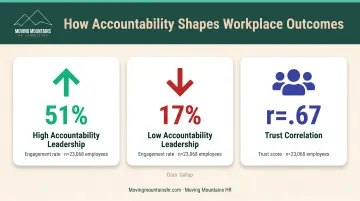
- Trust and follow-through: people can rely on each other to keep commitments and stay honest about challenges. Research links early team accountability with trust (r=.67), commitment (r=.45), and collective efficacy (r=.55), so collaboration feels predictable instead of fragile.
- Higher engagement and faster fixes: a 2026 Gallup survey of 23,068 employed U.S. adults found 51% engagement when managers rated leaders exceptional or outstanding at accountability, versus 17% when leaders scored poorly. Problems get raised and solved instead of buried.
- Less finger-pointing: clear expectations and shared ownership move conversations from "Who's to blame?" to "What happened, what can we learn, and how do we move forward?"
That same pattern supports staying power. A 2021 peer-reviewed study found accountability predicted team effort (beta=.51, p<.01) and team viability (beta=.38, p<.05)—teams that own outcomes are better built to keep working well together over time.
Key Components of Accountability
Taking Ownership of Outcomes
Ownership means accepting responsibility for results, both successes and failures, rather than blaming external factors or other people's actions.
Accept credit appropriately for positive results while giving recognition to team contributors. For example: "The campaign exceeded our lead target by 30%. The design team's quick turnaround on creative assets and Sarah's targeted audience segmentation made that possible."
Acknowledge failures or shortcomings without making excuses. Focus on what can be learned and improved rather than listing reasons the outcome wasn't your fault:
- ❌ "The vendor was late, the budget got cut, and nobody told me the deadline changed."
- ✅ "We missed the launch date. I didn't escalate the vendor delay early enough, and I should have confirmed the timeline in writing after the budget discussion. Next time I'll set internal deadlines two days ahead of client deadlines and send written confirmations after any scope conversation."
Honest and Transparent Communication
Proactively communicate progress, setbacks, and obstacles rather than waiting to be asked or hiding problems until they become crises. Google's research found psychological safety—the confidence to admit mistakes and ask questions—was the top dynamic separating effective teams from the rest.
Deliver difficult messages constructively and solution-oriented:
- State the situation clearly
- Explain what you've tried
- Propose next steps
- Outline any help or decisions you need
Example: "The Q3 report will be two days late. The data integration took longer than expected, and I discovered a formatting issue yesterday. I've corrected it and added a validation step. I'll deliver the final version Wednesday morning and document the new process to prevent this next quarter."
Ask for help or resources when needed. Requesting support early is more accountable than struggling silently and missing the goal. Say you're blocked before it derails the project.
Following Through on Commitments
Do what you say you will do. Google defines dependable teams by reliable, quality, on-time completion. Dependability builds credibility and lets others plan their work around your commitments.
Set realistic commitments by honestly assessing your capacity, workload, and potential obstacles. If you're unsure whether you can deliver, say so: "I can commit to the draft by Friday if no other priorities come in. Should I check back Wednesday to confirm that's still realistic?"
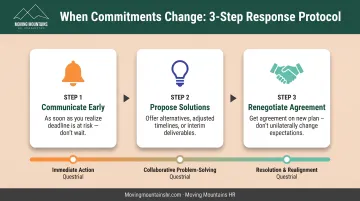
When circumstances change and you cannot meet a commitment:
- Communicate early — as soon as you realize the deadline is at risk
- Propose solutions — offer alternatives, adjusted timelines, or interim deliverables
- Renegotiate if necessary — get agreement on the new plan rather than unilaterally changing expectations
Learning and Improving from Mistakes
Accountability includes conducting honest post-mortems after failures or problems to identify root causes rather than surface symptoms. A 2021 meta-analysis of 61 studies covering 915 teams found that after-action reviews produced an overall improvement effect of d=.79.
Develop action plans based on lessons learned rather than simply promising to "do better." Specify what will change:
- ❌ "I'll pay more attention next time."
- ✅ "I'll add a two-day buffer to all client-facing deadlines and set a calendar reminder to send a status update if I'm more than 25% through the timeline."
Track progress on improvement areas and stay open to feedback on whether changes are working. Close the loop by showing you applied the lesson and got a different result.
Accepting Appropriate Consequences
Accountability means accepting both positive consequences (recognition, rewards, advancement) and negative ones (corrective feedback, lost privileges, formal performance improvement) for outcomes you own.
Respond professionally to consequences without defensiveness or a victim mentality. If you receive corrective feedback, focus on the specific behavior and its impact rather than debating intent or fairness:
- ❌ "That's not fair—other people do the same thing and nothing happens to them."
- ✅ "I understand. Missing the deadline delayed the client presentation and created extra work for the account team. I've implemented the tracking changes we discussed and will check in with you in two weeks."
In healthy organizations, consequences stay fair, consistent, and aimed at improvement—not punishment. Gallup notes that accountability works best as a regular, performance-linked practice tied to coaching and recognition, not only to moments of correction.
How to Develop Personal Accountability
Clarify Your Responsibilities and Expectations
Understand exactly what you are accountable for by asking clarifying questions about goals, quality standards, success criteria, and deadlines. Vague assignments lead to misaligned expectations.
Ask:
- "What does success look like for this project?"
- "What's the deadline, and is that when you need the draft or the final version?"
- "Who needs to review or approve this before it's complete?"
- "What level of detail or polish are you expecting?"
Document agreements and commitments so there is no ambiguity about what you agreed to deliver. Follow up important conversations with a brief written summary: "Just to confirm, I'll deliver the revised budget model by Friday, March 15, including the three scenarios we discussed."
Establish clear metrics or criteria for success so you can objectively assess whether you met expectations rather than relying on subjective judgment.
Practice Proactive Communication
Establish regular check-ins with managers or stakeholders to report on progress and surface obstacles early. Brief, frequent updates prevent surprises and allow course corrections before deadlines pass.
Communicate problems or delays as soon as you become aware of them rather than hoping they will resolve themselves. Waiting until the deadline arrives to announce a delay damages trust far more than flagging the risk a week earlier.
Frame challenges with a solution-oriented approach:
- "Here's the situation…"
- "Here's what I've tried…"
- "Here's what I'm proposing to do next…"
- "Here's what I need from you…"
That framing shows you are already managing the problem and makes it easier for others to help.
Create Systems for Self-Monitoring
Set up personal tracking systems (to-do lists, project management tools, shared task boards, calendars with reminders) to monitor your own commitments and deadlines rather than relying on memory or waiting for others to follow up.
A 2016 meta-analysis of 138 studies covering 19,951 participants found that interventions designed to increase progress monitoring produced a large positive effect on goal follow-through. Recording commitments and reviewing progress regularly strengthens follow-through.
Practice regular self-reflection:
- "What did I commit to this week?"
- "What did I actually deliver?"
- "What got in the way, and how can I address it?"
Anticipate potential obstacles and develop backup plans rather than being surprised when things go wrong. If you know a vendor often runs late, build buffer time into your schedule and confirm delivery dates in writing.
Seek and Act on Feedback
Proactively ask for feedback about your performance rather than waiting for formal reviews. Request specific input: "How did the client presentation go from your perspective? Was there anything I should adjust for next time?"
Receive feedback non-defensively by focusing on what you can learn rather than whether the feedback feels fair. Listen fully, ask clarifying questions, and thank the person for their input—even if you disagree with parts of it.
Create action plans based on feedback and follow up to demonstrate you made changes. For example: "You mentioned last month that my status updates were too high-level. I've started including specific metrics and blockers in each update. Is that level of detail working better?"
Model Accountability to Others
Demonstrate accountability in your own behavior to set expectations for others and build a culture of accountability. When you consistently own outcomes, communicate transparently, and follow through, you establish the standard for your team.
Acknowledge your own mistakes publicly and discuss what you learned. This gives others permission to do the same and reinforces that accountability is about learning, not blame: "I missed that the proposal was due Friday, not Monday. I've added all client deadlines to our shared calendar so the whole team has visibility going forward."
Hold others accountable in a supportive way by focusing on problem-solving and improvement rather than blame. Use the same constructive approach you'd want applied to your own work.
Creating a Culture of Accountability in Your Organization
Leaders and managers build an accountability culture when they:
- Set clear expectations for roles, goals, and standards
- Provide the resources and authority people need to deliver
- Establish consistent consequences for meeting or missing those standards
Google's research on team effectiveness identified five key dynamics, including structure and clarity (clear roles, goals, and plans) and dependability (reliably completing quality work on time). Accountability takes more than individual effort. It needs organizational systems that define success and enable follow-through.
Focus accountability conversations on learning and improvement, not punishment. People surface problems earlier when mistakes are treated as diagnostic opportunities instead of career risks. The strongest teams in Google's study admitted and discussed errors more often for that reason.
Gallup's research found that managers who rated their leaders exceptional at accountability were three times as likely to be engaged (51% vs. 17%). The survey covered 23,068 U.S. employees and measured accountability as holding everyone responsible for exceptional performance through regular coaching, clear priorities, and consistent standards.
Those findings only stick when policies, coaching, and performance systems match what leaders say they expect. Moving Mountains HR helps small and mid-size organizations close that gap.
Support typically includes:
- HR audits that flag gaps in policies, procedures, and performance-management processes
- Review of handbooks, evaluations, and disciplinary materials against regulatory requirements and best practices, with an HR Compliance Review Report and clear next steps
- Manager training on performance management, documentation, conflict resolution, and leadership
- Ongoing HR support, from email assistance to meeting participation and fractional CHRO guidance
A practical path is a compliance audit to lock in clear expectations, then manager training and performance-management design tailored to your industry and workforce.
Common Accountability Challenges and How to Overcome Them
Even capable teams run into accountability friction. These three patterns show up most often, and each has a practical fix.
Accountability Without Authority
This happens when you're responsible for outcomes you can't fully control, such as a project that depends on another department's priorities.
Navigate it by:
- Clarifying what you can influence (analysis quality, communication speed, escalating blockers)
- Owning those elements explicitly
- Documenting dependencies and flagging risks early
- Building shared goals with the people whose cooperation you need
Inconsistent Accountability
Different standards for different people erode trust fast. Teams notice when high performers get a pass, or when policies apply only some of the time.
Address it by:
- Publishing clear standards that apply across similar roles
- Handling comparable situations with the same process and documentation
- Ensuring leaders follow the standards they enforce
- Applying recognition and consequences fairly, every time
Shared Accountability
In collaborative work, responsibility can diffuse: many people contribute, but no one owns the final result.
Clarify it by:
- Defining who owns each deliverable, decision, or milestone
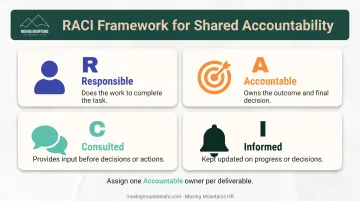
- Assigning one explicit owner per deliverable, even on team projects
- Holding team reviews that cover collective results and individual responsibilities
- Mapping roles with a simple RACI (Responsible, Accountable, Consulted, Informed)
Frequently Asked Questions
What are the 7 pillars of accountability?
A widely referenced model from Greg Bustin includes character, unity, learning, tracking, urgency, reputation, and evolution. Other frameworks stress clear expectations, resources, feedback, consequences, psychological safety, learning, and leadership modeling, all working together.
What 3 universal skills can we use as an accountable team member?
The three foundational skills are proactive communication (updating stakeholders before they ask), ownership mentality (focusing on what you control instead of excuses), and commitment to follow-through (doing what you said and flagging obstacles early).
What is the difference between responsibility and accountability?
Responsibility is the work you're assigned to do. Accountability is ownership of the outcomes: answering for results. You can delegate responsibility, but you cannot delegate accountability.
How do you hold someone accountable without being confrontational?
Frame the conversation around problem-solving and support, not blame. Clarify the expected result, compare it with evidence, ask what happened, agree on corrective action and support, then follow up. Keep the focus on behavior and impact, not on judging the person.
What should I do if I work in an organization that doesn't value accountability?
Focus on what you can control: document commitments, communicate proactively, and model follow-through in your own work. Clarify expectations with your manager and use simple tracking even if the broader culture does not reinforce it.
Can you have too much accountability?
Yes. When accountability becomes blame-oriented micromanagement, people hide mistakes and trust erodes. Healthy accountability balances ownership with support, learning, and psychological safety, not surveillance or punishment for speaking up.