Career development management goes beyond the annual performance review. It's an ongoing strategic approach to helping employees grow their skills, expand their responsibilities, and achieve meaningful professional goals—all while supporting your organization's needs. The good news? You don't need a large HR department or unlimited training budget to create effective career pathways.
This guide will walk you through what career development management actually means, why it matters for small businesses, and practical steps to implement it with the resources you already have.
Key Takeaways
- Regular career conversations and Individual Development Plans form the foundation of any effective program
- Lateral moves, cross-training, and stretch projects create growth opportunities even without promotion slots
- Training managers to coach employees delivers up to 18% higher engagement
- Internal mentoring and work-based learning offer high-impact development at minimal cost
- Most voluntary exits start within three months of a job search; prevent them with proactive development
What Is Career Development Management?
Career development management is the strategic process of helping employees plan, pursue, and achieve their professional goals while aligning with what your organization needs. It's a partnership: employees drive their own growth, while managers and business owners provide guidance, resources, and opportunities.
The Dual Ownership Model
The most effective approach uses a dual ownership framework:
- Employees own: Reflecting on strengths and interests, identifying career goals, proposing development activities, and driving their own learning
- Organizations provide: Structured career conversations, training and mentorship access, coaching and feedback, documented development plans, and chances to apply new skills
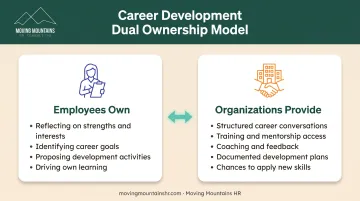
Employees set the direction. Managers supply structure, coaching, and real chances to apply new skills. Neither side can carry the process alone.
Beyond Promotions
Modern career development includes multiple growth dimensions:
- Skill building through training, certifications, and on-the-job learning
- Role progression with greater responsibility and decision-making authority
- Lateral moves that broaden experience across departments
- Mentorship from senior team members
- Leadership practice via project ownership and team coordination
- Cross-functional work that builds versatility
Career development is continuous. It happens in regular conversations, not only during annual performance reviews. Strong programs keep employee goals and business needs in the same ongoing discussion.
Why Career Development Matters for Small Businesses
The business case for career development is straightforward: it directly impacts your ability to keep good people.
Advancement opportunities drive retention. When Pew Research surveyed workers who quit their jobs in 2021, 63% cited lack of advancement opportunities as a primary reason, tied with low pay as the most common factor. More recently, Gallup found that one in four U.S. employees lack advancement opportunities, creating a significant retention risk.
Most exits happen fast. According to Gallup's 2026 analysis, 77% of employees who voluntarily left either quit within three months of beginning a job search or never actively searched at all. This leaves little time for reactive counteroffers. Prevention requires proactive development support before employees start looking.
Some turnover is preventable. The same Gallup study found that 42% of employees who left said their manager or organization could have prevented their exit. Among preventable actions, career advancement opportunities represented 11% of what employees wanted.
Replacement costs are substantial. Gallup estimates replacement costs at approximately 40% of salary for frontline staff, 80% for technical professionals, and 200% for managers and leaders. Retaining and developing existing talent is more cost-effective than constant recruiting.
Small businesses can compete for talent. You may not match the compensation packages of larger companies, but meaningful career development creates a competitive advantage. Employees who see a future with your company, even without dozens of promotion slots, stay more engaged and committed.
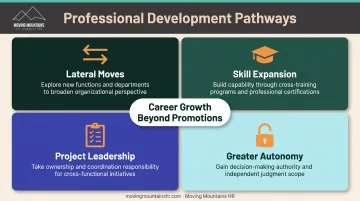
Growth paths don't require constant promotions. Most small businesses have limited management seats. Meaningful growth still comes from:
- Lateral moves into new functions
- Skill expansion and cross-training
- Project leadership opportunities
- Greater autonomy over work and decisions
Progress keeps people invested even when titles stay the same.
Key Components of Career Development Programs
Career Conversations and Goal Setting
Regular career development conversations (kept separate from performance reviews) form the foundation of any program. These discussions help managers understand employee strengths, interests, and aspirations while aligning development activities with organizational needs.
Structure matters. SHRM recommends starting career conversations at onboarding and continuing them throughout employment. Effective conversations include:
- Employee self-reflection on accomplishments and strengths
- Discussion of career goals and interests
- Identification of learning opportunities
- Manager feedback and guidance
- Documentation of agreed-upon actions
- Quarterly or bi-annual check-ins to review progress
Goals should be SMART. Development goals work best when they're Specific, Measurable, Achievable, Relevant, and Time-bound. Vague aspirations like "get better at leadership" become actionable when reframed as "complete supervisory training and lead two cross-functional projects by Q4."
Keep it separate from performance reviews. Career conversations focus on future growth and aspirations. Performance reviews address past results and current job responsibilities. Mixing the two creates confusion and reduces the quality of both discussions.
Individual Development Plans (IDPs)
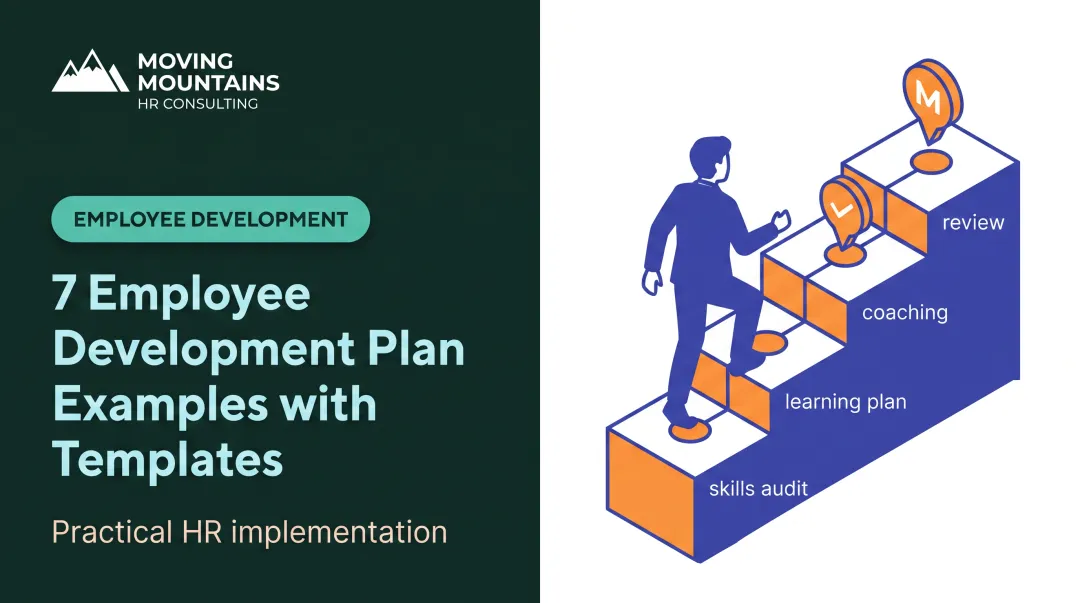
An IDP is a personalized roadmap that documents an employee's career goals, skill gaps, and planned development activities. It is a written agreement between employee and manager on what growth looks like over the next 6-12 months.
IDPs are collaborative. The most effective plans are created together: employees bring aspirations and ideas, managers add feedback and opportunities, and both agree on actions and timelines.
What IDPs should include:
- Specific career goals (short-term and longer-term)
- Current strengths and accomplishments
- Skills or competencies to develop
- Planned development activities (training, projects, mentorship)
- Timeline and scheduled review dates (quarterly or bi-annually)
- Manager feedback and organizational alignment notes
Example IDP goal: "Develop project management skills to prepare for a team lead role. Complete online PM certification by June, shadow senior project manager on Q2 product launch, and independently manage department website refresh project by September."
Learning and Development Opportunities
Development happens through multiple methods, and small businesses don't need expensive programs to offer meaningful learning.
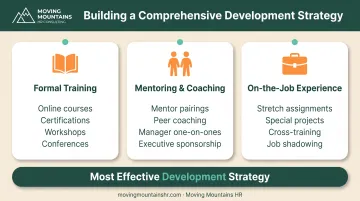
Formal learning options:
- Online courses and certifications (platforms like Coursera, LinkedIn Learning, industry-specific programs)
- Industry conferences and webinars
- Workshops and seminars
- Professional association memberships
- Lunch-and-learn sessions with internal or external speakers
Work-based development: These options often deliver the highest impact at the lowest cost:
- Stretch assignments that challenge employees slightly beyond their current capabilities
- Special projects in areas they want to explore
- Cross-training in other departments or roles
- Job shadowing with senior team members
- Leading initiatives or small teams
- Gradually increasing decision-making authority
Mentoring and coaching:
- Formal mentorship pairings between experienced and developing employees
- Informal peer coaching and knowledge sharing
- External coaching for high-potential team members
- Manager coaching through regular one-on-ones
According to SHRM, the most effective development strategies combine formal training with mentoring/coaching and on-the-job experience. This mix builds technical skills and broader capabilities such as adaptability and stronger business judgment.
How to Create a Career Development Program
Building a career development program doesn't require a large HR team or unlimited budget. Follow these steps to create a practical framework that fits your organization.
Conduct a Needs Assessment
Start by understanding both organizational requirements and employee aspirations.
Assess three levels:
- Organizational needs: What skills will your business need in the next 1-3 years? Where are you planning to grow? What capabilities are currently missing?
- Role/occupational needs: What competencies are required for different positions? What skills separate high performers from average performers?
- Individual needs: What are your employees' career goals? What skills do they want to develop? Where do they see gaps?
Gather information through:
- One-on-one conversations with employees
- Anonymous surveys about career interests and development preferences
- Manager input on team skill gaps and future requirements
- Strategic business plans and growth projections
- Job descriptions and performance data
Establish Career Pathways
Map potential progression routes within your organization, including both upward moves and lateral transitions. Small businesses benefit from documenting realistic pathways that acknowledge limited management positions while still showing growth possibilities.
Example pathway for a Customer Service Representative:
- Upward: Customer Service Team Lead
- Lateral skill expansion: Sales Coordinator
- Lateral specialization: Training & Onboarding Specialist
Even a small organization can create multiple routes through cross-functional moves, skill specialization, project leadership roles, and increasing autonomy within the same position.
Train Your Managers
Managers make or break career development. If they can't hold effective career conversations, give meaningful feedback, or spot development opportunities, your program will stall.
Gallup research shows that managers who receive training in coaching and people development see up to 18% higher engagement among their teams. The best programs emphasize ongoing development rather than one-time training events.
Manager training should cover:
- Conducting career development conversations (question frameworks, active listening)
- Providing specific, actionable feedback
- Identifying employee strengths and development areas
- Matching employees with appropriate stretch assignments
- Creating and reviewing Individual Development Plans
- Using coaching techniques and delegation skills
Unfortunately, 47% of employees report receiving feedback from their manager only a few times or less in the past year. Training managers to provide regular coaching conversations addresses this gap.

Create a Mentorship Framework
Pair less experienced employees with senior team members who can provide guidance, share knowledge, and help navigate career decisions. Mentorship doesn't need to be elaborate—even informal relationships add value.
According to ATD research from 2023, 48% of surveyed organizations had formal mentoring programs, and 42% of those without one planned to implement mentoring soon.
Basic mentorship structure:
- Define program purpose and guidelines
- Recruit and match mentors with mentees (consider career goals, skill areas, personality fit)
- Provide orientation for both parties on expectations and meeting structure
- Suggest monthly or bi-monthly meetings with flexible agendas
- Monitor relationships and gather feedback
- Evaluate results after 6-12 months
Informal mentoring can coexist with formal programs. Some of the most valuable relationships develop organically when employees seek advice from colleagues they respect.
Develop a Simple IDP Template
Standardize the documentation process with a flexible template that makes it easy for managers and employees to capture goals and development plans.
Essential IDP template fields:
- Employee name and current role
- Career goals (6-month and 1-year)
- Key strengths and recent accomplishments
- Skills or competencies to develop
- Specific development activities and resources
- Target completion dates
- Manager feedback and support commitments
- Next review date
- Employee and manager signatures
Keep it simple. A two-page document is sufficient. The goal is clarity and accountability, not bureaucracy.
Allocate Resources
Set realistic expectations about what your organization can provide.
Budget considerations:
- Annual training budget per employee (industry average in 2024 was $1,254 per employee, though small businesses often spend less)
- Paid time for development activities during work hours
- Access to online learning platforms or professional memberships
- Conference or workshop attendance
- External coaching or specialized training for high-potential employees
Process for requesting development opportunities:
- Clear submission process (who approves, what's required)
- Decision criteria (alignment with business needs, employee tenure, budget availability)
- Timeline for approval
- Expectations for sharing learning with the team
Small businesses without dedicated HR staff can partner with a consultant to design a framework that fits their size and budget. Moving Mountains HR brings executive-level HR strategy to your team without the cost of a full-time HR executive.
Common Challenges and Solutions
Challenge: "We're too small to offer many promotion opportunities"
Solution: Career development isn't synonymous with promotions. Focus on skill expansion, lateral moves, increasing autonomy, project leadership, and cross-functional experiences. These make employees more valuable to your organization and in their broader careers.
Offer:
- Broader decision-making authority within current roles
- Leadership of special projects or initiatives
- Cross-training in complementary departments
- Specialized skill-building in high-value areas
- External visibility through conference presentations or industry participation
Growth is about progress and increased capability, not just new titles.
Challenge: "We don't have time or budget for formal training programs"
Solution: Use low-cost and no-cost development methods that provide high impact without straining resources.
Cost-effective options:
- Internal mentoring and peer teaching: Free, and builds institutional knowledge
- Job shadowing and cross-training: Low cost, and improves organizational flexibility
- Stretch assignments and special projects: Free skill-building that advances business goals
- Free and low-cost online learning: Webinars, tutorials, and platforms often under $30/month per user
- Local workforce development boards: U.S. Department of Labor–sponsored free or subsidized training (CareerOneStop)
- Lunch-and-learn sessions: Employees share expertise with almost no budget impact
The most effective development often happens on the job, not in a classroom. Prioritize work-based learning that simultaneously builds skills and delivers business value.
Challenge: "Managers don't know how to have career development conversations"
Solution: Provide simple frameworks, question prompts, and templates that make career conversations less intimidating. Consider bringing in external HR expertise to train managers on effective career coaching techniques.
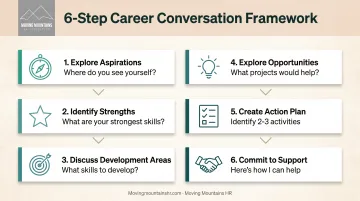
Sample conversation framework:
- Explore aspirations: "Where do you see yourself in the next 1-2 years? What kind of work excites you?"
- Identify strengths: "What do you feel are your strongest skills? What accomplishments are you most proud of?"
- Discuss development areas: "What skills would you like to develop? What feels challenging right now?"
- Explore opportunities: "What projects or experiences would help you grow in those areas?"
- Create action plan: "Let's identify 2-3 specific development activities and set target dates."
- Commit to support: "Here's how I can support you..." and "Let's check in on progress in [timeframe]."
Managers improve with practice and feedback. Start with a simple structure and refine over time.
Getting Started: Action Steps for Business Owners
Ready to implement career development in your organization? Start with these four actions.
Action 1: Schedule career conversations with each employee Within the next quarter, meet individually with every team member. Ask about their career goals, interests, and what skills they want to develop. Listen more than you talk. Document what you learn.
Action 2: Create a simple IDP template Develop or adopt a one- to two-page Individual Development Plan template. Managers and employees can use it to document goals and development activities. Keep it straightforward and focused on action.
Action 3: Implement one low-cost development opportunity immediately Choose something achievable right now:
- Establish an informal mentorship program by pairing junior and senior employees
- Create a monthly lunch-and-learn series where team members share expertise
- Set up a small annual training budget ($500-1,000 per employee)
- Start a book club focused on professional development
- Arrange quarterly job-shadowing days for cross-departmental learning
Action 4: Train your managers Equip managers to support employee development through regular coaching conversations, stretch assignments, and meaningful feedback. Bring in outside expertise if needed. Stronger manager capability improves coaching, retention, and performance across your business.
Frequently Asked Questions
What is career management and development?
Career development is the process of acquiring skills and experiences to advance professionally, driven primarily by the employee. Career management is the organizational support system that facilitates employee growth through resources, guidance, mentorship, and structured opportunities aligned with business needs.
What is the difference between career management and career development?
Career development is employee-owned: individuals drive their own growth by setting goals, seeking learning, and pursuing opportunities. Career management is organization-owned: the company builds systems, coaching, and pathways that enable that growth.
What are the 5 steps of career development?
The five steps are: assess your skills and interests, explore options and set goals, build a timed development plan, pursue learning through training and projects, then review progress and adjust as circumstances change.
What are good development goals for a manager?
Strong goals include sharper coaching and feedback, strategic thinking that ties team work to business objectives, clearer communication and conflict resolution, and better delegation so the team grows while you focus on higher-level work.
What are the four stages of career development?
The four stages are exploration (interests, values, and options), establishment (foundational skills and experience), maintenance (deeper expertise, leadership, and mentoring), and transition or reinvention (new roles, industries, or direction as priorities shift).