
This guide walks you through modern training methods proven to work, how to build a strategy that fits your organization, practical ways to overcome budget and time constraints, and how to measure real outcomes. Whether you're a small business owner without an HR team or a growing company looking to formalize your training approach, you'll find actionable guidance here.
Why Team Training Matters in 2026
The 2026 workplace looks different than it did even three years ago. Deloitte's 2026 Global Human Capital Trends report found that 7 in 10 business leaders say their primary competitive strategy is to be fast and nimble. That goal depends on multidisciplinary collaboration, continuous learning, adaptability, and strong human judgment.
The skills gap is widening, particularly around AI adoption. According to CompTIA's 2026 Workforce and Learning Trends research, foundational AI skills are the top training need, yet only 34% of organizations have formal reskilling or upskilling programs. Workers know they need help: SHRM's 2025 survey found that 51% of employees named enhanced training as their top priority for better AI outcomes.
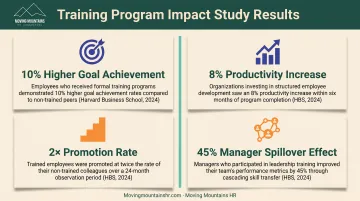
Training delivers measurable business value when done right. A 2026 Harvard Business School field study of a federal agency tracked a 120-hour, 16-week program covering goal setting, Excel, writing, and legal analysis. Results included:
- Roughly 10% higher frontline goal achievement
- 8% higher productivity among connected supervisors
- Better three-year retention, with trained employees about twice as likely to be promoted
- Manager spillover effects representing nearly 45% of total program benefits
Well-trained teams adapt faster, use new tools more effectively, solve problems better, and stay longer—advantages that compound as the skills gap grows.
Key Takeaways
- Blend mentorship, microlearning, workshops, and simulations instead of one-size-fits-all seminars
- Build high-impact programs with internal experts, selective outside partners, and role-specific priorities
- Prioritize AI fluency, adaptability, cross-functional collaboration, and human judgment
- Use Kirkpatrick's four levels so training drives business results, not only completion rates
Modern Team Training Methods for 2026
Skills-Based Workshops and Hands-On Learning
Skills-based workshops focus on learning by doing, not passive listening. Instead of sitting through slides for two hours, participants practice the exact skills they need: working through software exercises, role-playing customer interactions, or rehearsing sales conversations.
This method works because adults retain information best when they apply it immediately in realistic scenarios. A Harvard Business School case study found measurable productivity and goal-achievement gains from applied technical and communication training.
Effective workshop implementation:
- Keep sessions under 2 hours to maintain focus
- Include breakout activities where participants practice in pairs or small groups
- Use real workplace scenarios, not hypothetical examples
- Provide take-home job aids and reference materials
- Schedule practice time between workshop and real-world application
Examples that work:
- Software tool training with live walkthroughs and guided exercises
- Customer service teams practicing conflict de-escalation through role-plays
- Sales teams rehearsing pitch delivery with peer feedback
- Managers practicing performance-feedback conversations
Mentorship and Peer Learning Programs
Structured mentorship pairs experienced team members with those developing new skills, creating knowledge transfer without formal classroom time. Mentors build leadership and coaching skills, while mentees get practical guidance and organizational context.
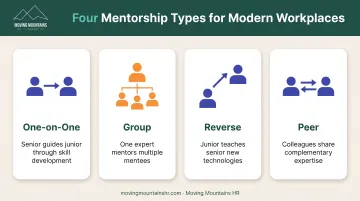
Different mentorship structures serve different needs:
- One-on-one mentoring: Senior employee guides one junior colleague through specific skill development
- Group mentoring: One experienced mentor works with 3-4 mentees, building peer learning among the group
- Reverse mentoring: Junior employees teach senior staff about new technologies, social platforms, or emerging work styles
- Peer mentoring: Colleagues at similar levels share knowledge in areas where each has unique expertise
Implementation tips:
- Set clear program goals upfront: what skills or outcomes will success look like?
- Match participants thoughtfully based on learning goals, personality fit, and schedule compatibility
- Schedule regular check-ins (biweekly or monthly) with accountability built in
- Use platforms or simple tracking sheets to monitor progress and discussion topics
- Recognize both mentors and mentees publicly for their participation
The U.S. Chamber of Commerce identifies mentorship as one of the most affordable, high-impact training methods available to small businesses.
Microlearning and Just-in-Time Training
Microlearning delivers bite-sized training modules, typically 5 to 15 minutes, when employees need specific information. Rather than front-loading all knowledge in a long course, it fits into the workflow.
Remote and hybrid teams can access training anytime, anywhere. Employees learn what they need when they need it, instead of trying to recall a session from months earlier.
Common microlearning formats:
- Short video tutorials demonstrating one specific task
- Interactive quizzes reinforcing key concepts
- Mobile-accessible job aids and checklists
- Digital infographics summarizing processes
- Searchable knowledge bases with tagged topics
Creating effective microlearning:
- Break complex topics into discrete, standalone chunks
- Use engaging formats—video, interactive elements, visuals—not just text
- Make content searchable by role, task, or keyword
- Test each module to ensure it can be completed in under 15 minutes
- Update regularly as processes or tools change
A 2024 systematic review published in PubMed found generally positive outcomes for microlearning across 40 studies, including improved retention, transfer, engagement, completion rates, and self-efficacy.
Simulation and Scenario-Based Training
Simulation training allows teams to practice high-stakes situations in safe environments before facing real-world consequences. Employees can make mistakes, receive feedback, and try again, something rarely possible when dealing with actual customers, emergencies, or compliance situations.
Applications across industries:
- Customer service teams practicing difficult client conversations
- Healthcare workers rehearsing emergency-response protocols
- Managers making leadership decisions in realistic case studies
- Compliance teams navigating regulatory scenarios
Technology and delivery options:
- Virtual reality (VR) simulations for immersive practice
- Tabletop exercises walking through hypothetical incidents step-by-step
- Role-playing activities with facilitator observation
- Case study discussions analyzing real organizational challenges
A 2024 CDC/NIOSH report documents simulation's effectiveness in improving reaction time, self-efficacy, situational awareness, preparedness, confidence, and competency, particularly for workplace safety training.
Implementation guidance:
- Design realistic scenarios based on actual workplace challenges your team has faced
- Facilitate thorough debriefs after each simulation to extract learning points
- Allow multiple practice attempts so participants can apply feedback
- Make simulations progressively more complex as skills develop
Cross-Training and Job Rotation
Cross-training teaches team members skills and knowledge beyond their primary roles, building versatility and organizational resilience. When employees understand how other roles work, collaboration improves and coverage during absences gets easier. Hidden talents often surface too.
Business benefits:
- Continuity during vacations, sick leave, or unexpected departures
- Improved collaboration as team members understand each other's challenges and constraints
- Identification of employees' hidden strengths and career-development interests
- Reduced bottlenecks when only one person knows how to complete critical tasks
Implementation approaches:
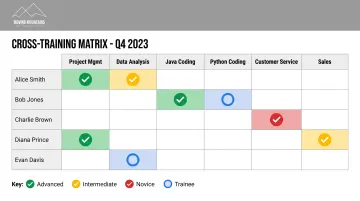
- Create a cross-training matrix showing which employees know which skills
- Schedule regular rotation periods (e.g., one week per quarter)
- Document processes clearly so cross-training isn't just tribal knowledge
- Start with related roles that share similar tools or customers
- Allow employees to shadow before taking on tasks independently
Overcoming resistance:
- Emphasize career-development benefits: learning new skills makes employees more valuable
- Start with willing volunteers rather than mandating participation
- Celebrate cross-trained employees and the value they bring to the team
- Keep primary role responsibilities manageable during cross-training periods
Building a Team Training Strategy That Works
Before launching any training program, invest time in planning. A structured approach ensures you focus effort and budget on the skills that move business results.
1. Conduct a skills gap analysis
Compare your team's current capabilities against what your business needs now and in the next three years. Involve managers and employees in identifying priority areas—they often see gaps leadership misses.
Ask questions like:
- What skills do employees need to perform their current roles effectively?
- What new capabilities will we need as our business evolves?
- Where do mistakes, delays, or customer complaints most often occur?
- What technologies or processes are changing that require new knowledge?
2. Set specific, measurable training objectives
Tie training goals directly to business outcomes. Instead of "improve customer service skills," aim for "reduce average complaint resolution time from 48 hours to 24 hours" so you can measure whether the training worked.
Good training objectives:
- Specify the skill or behavior employees will demonstrate
- Include measurable criteria (time, accuracy, customer ratings)
- Connect to a business metric (productivity, quality, retention, compliance)
- Set a realistic timeframe for achievement
3. Design a blended learning approach
One workshop rarely sticks on its own. Combine formats so employees hear the concept, practice the skill, and get coaching over time. A blended approach might include:
- Kickoff workshop to introduce concepts and build enthusiasm
- Microlearning modules for skill-specific practice
- Mentorship pairings for ongoing coaching
- Scenario-based exercises to apply skills in realistic contexts
- Follow-up coaching sessions to reinforce learning
4. Establish a realistic budget
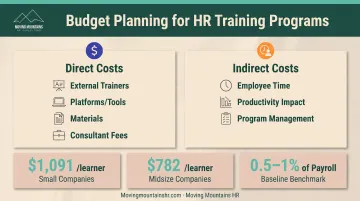
Training costs include both direct expenses (external trainers, platforms, materials) and indirect costs (employee time away from regular work). The 2025 Training Industry Report found that small companies averaged $1,091 per learner annually, while midsize companies spent $782 per learner.
For small businesses without formal training budgets, start by calculating 0.5% to 1% of total payroll as a baseline, then adjust based on priorities and available resources. Internal subject-matter experts, peer mentoring, and low-cost online modules can stretch a modest budget further.
Partnering with HR Consultants for Custom Training Programs
Many small and mid-size businesses lack internal HR resources to design and deliver training programs. External HR expertise helps in several situations:
When to bring in outside help:
- Your company has no dedicated HR staff or learning and development function
- You're facing complex compliance requirements that require specialized knowledge
- You're implementing major strategic changes that affect multiple roles and processes
- Internal staff lack the time or expertise to build programs from scratch
How HR consultants add value:
Firms like Moving Mountains HR assess organizational needs, design tailored training programs, and provide objective workplace guidance internal teams often cannot. Rather than generic courses, consultants build programs around your industry, workforce, culture, and business goals.
Custom programs can cover:
- Leadership development and performance management
- California employment compliance
- Workplace investigations, employee relations, and conflict resolution
- Hiring, onboarding, and respectful workplace practices
Training can run virtually or in person through workshops, leadership series, coaching, or customized learning resources.
ROI of professional HR support:
- Reduced compliance violations and associated penalties
- Improved employee retention through development investment
- Stronger culture through consistent practices
- Time back for owners to focus on core operations
If you're weighing an external partner, an introductory consultation can map your gaps and confirm whether a custom program is the right fit.
Overcoming Common Team Training Challenges
Even with the best intentions, training programs face predictable obstacles. Here's how to tackle the most common ones:
"We're too busy to train"
This objection reflects real pressure, but untrained employees make costly mistakes that consume far more time than training would. The Association for Talent Development's 2025 survey found that insufficient staff and time ranked among the top evaluation barriers.
Solutions:
- Integrate learning into workflow using microlearning formats that take 10 minutes, not two hours
- Schedule training during naturally slower periods
- Demonstrate how training prevents mistakes that currently waste hours each week
- Use just-in-time training so employees learn exactly when they need the skill
Limited training budgets
CompTIA's research identified training cost as the top workforce-development challenge.
Creative solutions:
- Tap internal subject matter experts to teach peers
- Use free or low-cost online resources from industry associations and professional groups
- Partner strategically with external consultants for high-priority topics only
- Focus budget on training that directly impacts revenue, compliance, or critical risks
- Apply for state workforce-development grants (for example, California's Employment Training Panel reimburses employers for qualifying customized training)
Low engagement and knowledge retention
SHRM identifies lack of motivation, forgotten material, irrelevant content, and outdated information as leading training complaints.
Tactics to boost engagement:
- Make training directly relevant to employees' daily work challenges
- Involve employees in topic selection so they feel ownership
- Use varied formats: video, hands-on practice, and peer discussion, not just lectures
- Recognize training participation and skill application publicly
- Schedule reinforcement sessions to revisit key concepts after initial training
Measuring Training Success and ROI
Training that doesn't deliver measurable results is wasted investment. Yet only 43% of organizations in a 2025 ATD survey aligned learning with business goals, and 29% didn't evaluate learning programs at all.
Set Clear Metrics Before Training Begins
Define success measures up front so you can prove impact later:
- Skill assessment scores (pre-test vs. post-test)
- Performance indicators tied to the topic (sales, error rates, customer satisfaction, production speed)
- On-the-job behavioral observations from managers
- Employee confidence surveys after training
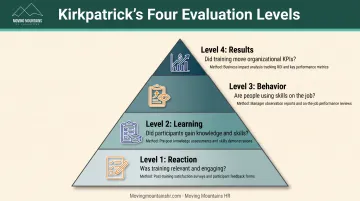
Evaluate With the Kirkpatrick Model
The Kirkpatrick framework works best when you start with business outcomes and work backward:
- Level 4 – Results: Did training move organizational KPIs—error rates, cycle time, sales, safety incidents, or customer satisfaction?
- Level 3 – Behavior: Are people using the new skills on the job? Check via observation, work samples, or manager feedback.
- Level 2 – Learning: Did participants gain the intended knowledge, skills, and confidence? Use assessments or skill demos.
- Level 1 – Reaction: Was the session relevant and engaging? Capture this with a short post-training survey.
Calculate Training ROI
Once you can tie behavior and results to the program, put a dollar value on the gain. The ROI Institute methodology uses two core formulas:
- Benefit-Cost Ratio (BCR) = Program Benefits ÷ Program Costs
- ROI (%) = (Net Program Benefits ÷ Program Costs) × 100
Net benefits equal monetary benefits minus costs.
Before you run the numbers:
- Isolate the training effect from other factors
- Monetize outcomes you can defend (productivity gains, fewer errors, lower turnover)
- Include full costs: needs assessment, design, delivery, facilitation, employee time, and evaluation
- Leave non-monetized gains—teamwork, morale—as intangibles
For example, if customer-service training costs $5,000 (including employee time) and cuts complaint-resolution labor by $15,000 over one year, ROI is 200%.
Frequently Asked Questions
What is the purpose of team training?
Team training builds skills for current and future roles, supports regulatory compliance, and strengthens collaboration and communication. Done well, it helps teams adapt faster and improve business performance.
How do you train your team?
Assess skill gaps, set objectives tied to business goals, and choose methods that fit how your team learns. Deliver with a blended approach, involve employees in planning, and measure results so you can improve the next cycle.
What are the most effective team training methods for 2026?
The strongest 2026 approaches blend mentorship, microlearning, hands-on workshops, and scenario-based practice. Match the method to the skill, the learning objective, and how your team actually works.
How much should companies budget for team training?
Per the Training Industry Report, small companies spend about $1,091 per learner annually and midsize firms average $782. Many small businesses start at 0.5–1% of payroll and scale as programs prove value.
How do you measure team training ROI?
Compare program costs to measurable gains such as higher productivity, fewer errors, lower turnover, and reduced compliance issues. Use the Kirkpatrick Model (reaction, learning, behavior, results) and monetize outcomes where you can, tracking softer benefits separately.
What are the 5 C's of a team?
The Salas Big Five teamwork framework names five essentials: team leadership, mutual performance monitoring, backup behavior, adaptability, and team orientation. Shared mental models, closed-loop communication, and mutual trust support those behaviors and can be strengthened through deliberate practice.