Key Takeaways
- Documented, fair conflict processes keep workplace disagreements from escalating into costly disputes
- Strong resolution cuts turnover costs, restores focus, and lowers harassment or discrimination risk
- Unresolved conflict drains productivity through distraction, silent treatment, and manager firefighting
- Small businesses need clear complaint procedures and neutral investigations for protected-class issues
- Conflict-competent cultures need consistent processes, manager training, and impartial HR support
What Is Conflict Management (Brief Context)
Conflict management is the practice of identifying and resolving workplace disagreements in ways that protect relationships, maintain productivity, and ensure compliance with employment law.
It applies when employees clash, manager-employee disagreements escalate, teams fight over resources or direction, or policy disputes surface.
Effective conflict management addresses issues like:
- Coworker disputes over workload, communication, or work styles
- Manager-employee tension involving feedback, expectations, or treatment
- Team conflicts driven by role clarity, resource allocation, or project priorities
- Formal complaints involving harassment, discrimination, or retaliation
Handled well, conflict management is a strategic business capability. Organizations that manage conflict fairly see measurable gains in retention, productivity, and legal protection.
Key Advantages of Conflict Management
Reduces Costly Employee Turnover and Improves Retention
Unresolved workplace conflict drives voluntary turnover. Employees leave when they feel unheard, when leaders leave toxic dynamics alone, or when interpersonal tension makes work unbearable.
A Gallup survey of 717 U.S. employees who voluntarily left their jobs found that 42% believed their manager or organization could have prevented the departure.
Why this matters:
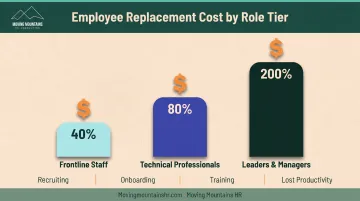
Replacement costs vary by role. Gallup estimates you'll spend:
- 40% of annual salary to replace frontline staff
- 80% of salary for technical professionals
- 200% of salary for leaders and managers
These figures include recruiting, onboarding, training, lost productivity, and the time remaining employees spend covering the gap.
Fair conflict management is one of the few levers that directly cuts those costs. When you address disputes fairly, employees feel valued. A CIPD survey of UK employees experiencing conflict found that only 44% said their issue was fully or largely resolved. Among those whose conflict went unresolved, 30% resigned.
Turnover rarely stops at one person. When someone leaves over unresolved tension, remaining teammates absorb negativity, extra workload, and the knowledge gap, which can trigger more departures.
KPIs impacted:
- Employee retention rate and voluntary turnover rate
- Time-to-fill for replacement positions
- Recruiting and onboarding costs
- Employee engagement scores
When this advantage matters most:
- High-growth companies where talent retention is critical to scaling
- Industries facing talent shortages
- Small businesses where each departure disrupts operations and erodes institutional knowledge
Increases Productivity and Reduces Lost Time
Workplace conflict drains productivity. Employees stuck in interpersonal drama, avoiding difficult colleagues, or checked out in meetings stop contributing to business goals. Managers spend hours mediating disputes instead of driving strategy.
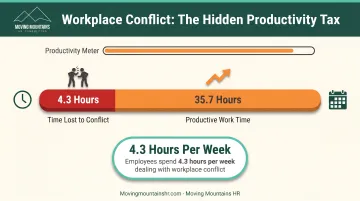
Research cited by SHRM found employees spend 4.3 hours per week dealing with workplace conflict. That's more than 10% of a standard 40-hour week lost to interpersonal issues rather than work.
Why this matters:
Conflict management restores focus. Resolve disputes constructively, and teams work more efficiently toward shared goals. People stop burning time on passive-aggressive behavior, silent treatment, or workarounds around difficult colleagues.
A meta-analysis examining team conflict and performance found that task, relationship, process, and status conflict all hurt team performance. Unmanaged conflict slows decisions, weakens collaboration, and delays projects.
Unresolved tension also drives presenteeism: employees show up physically but disengage mentally. A study of 6,368 Latvian employees found workers were 2.72 times more likely to work while sick during manager conflict, and 2.12 times more likely during coworker conflict.
KPIs impacted:
- Output per employee and project completion rates
- Meeting effectiveness scores
- Time spent on non-work interpersonal issues
- Collaboration metrics and decision-making speed
When this advantage matters most:
- Project-based environments where collaboration is essential
- Deadline-driven organizations
- Small teams where each person's contribution is critical
- During periods of organizational change or growth when efficiency matters most
Protects Against Legal Risk and Compliance Violations
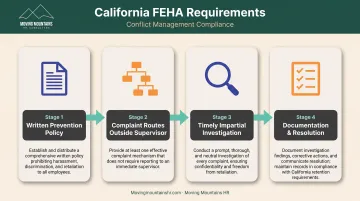
Unmanaged conflict often escalates into formal complaints, harassment claims, discrimination allegations, or hostile work environment situations. California employers face stringent requirements under the Fair Employment and Housing Act (FEHA), which protects employees and contractors even in workplaces with one person.
California regulations require written prevention policies with:
- Complaint routes outside the immediate supervisor
- Timely response and impartial investigation by qualified personnel
- Documentation and tracking of complaints
- Remedial options and timely closure
Proper conflict management creates a defensible record that demonstrates the employer took appropriate action. When conflicts involve potential harassment, discrimination, or retaliation, neutral third-party workplace investigations protect the organization by ensuring impartiality and thoroughness.
Why this matters:
Employment litigation is expensive, even when the employer prevails. The EEOC received 88,531 new charges in FY2024, a more than 9% increase over the prior year. The agency secured almost $660M in monetary relief in FY2025.
Attorney fees, discovery costs, management time, settlement exposure, and corrective-action expenses add up quickly.
California's requirements apply to all covered employers. Small to mid-size businesses often lack internal HR capacity to run qualified, impartial investigations, which makes neutral third-party support essential when conflicts involve protected-class issues.
KPIs impacted:
- Number of formal complaints filed (EEOC, state agencies)
- Litigation costs and settlement expenses
- Insurance premiums
- Management time spent on legal matters
When this advantage matters most:
- California employers subject to stringent employment laws
- Organizations without dedicated HR staff where conflicts can escalate unchecked
- Companies experiencing rapid growth where informal conflict resolution breaks down
- Businesses in highly regulated industries
What Happens When Conflict Management Is Missing or Ignored
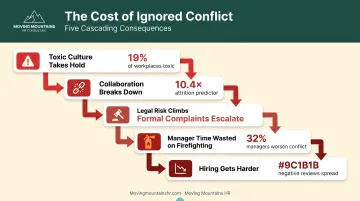
When conflict goes unmanaged, the fallout is predictable:
- Toxic culture takes hold. Incivility becomes normal. A 2023 APA survey of 2,515 U.S. employed adults found 19% called their workplace toxic, and those workers reported fair or poor mental health at much higher rates (58% vs. 21%). High performers often leave first, taking institutional knowledge and client relationships with them.
- Collaboration breaks down. People avoid tough colleagues, route work around friction, or burn energy on interpersonal drama. MIT Sloan's analysis of 34 million profiles found toxic culture was 10.4 times more predictive of attrition than pay during the 2021 Great Resignation.
- Legal risk climbs. Unaddressed conflict escalates into formal complaints, investigations, or litigation. In California, documentation and impartial-investigation expectations apply even to small employers.
- Managers lose the week to firefighting. Time goes to conflicts that have already escalated instead of hiring, coaching, and growth work. A CIPD workplace conflict survey found 32% of employees said their manager made the conflict worse, with resulting stress (48%), productivity decline (36%), and sickness absence (32%).
- Hiring gets harder. Negative experiences show up in employer reviews, social media, and professional networks, so stronger candidates pass you by.
How to Get the Most Value from Conflict Management
A few practical moves turn conflict management from firefighting into a retention and risk-control advantage:
- Establish clear resolution processes. Tell every employee how to raise concerns and what happens next. California law requires written policies with complaint routes outside the immediate supervisor, so even small businesses need a defined path.
- Train managers and team leads. Active listening, de-escalation, and fair mediation help supervisors catch issues early. Only 40% of people managers in the CIPD survey said their organization provided people-management training. Give them access to professional HR support when situations get complex.
- Use fractional HR or third-party investigators for sensitive cases. Harassment, discrimination, and retaliation claims need neutrality most shops cannot supply in-house. Moving Mountains HR runs impartial workplace investigations for California employers—confidential interviews, evidence collection, and documented findings without internal bias.
- Track outcomes regularly. Watch team-level turnover, complaint trends, time spent on interpersonal issues, and days from report to resolution. Adjust the process based on what the data shows.
- Make it safe to raise concerns early. Leaders should model that expectation. Treat disagreements as chances to fix systems before people disengage or leave.
Conclusion
Conflict management has a direct impact on retention, productivity, and legal protection—outcomes every business owner can measure. Those gains compound when you apply it consistently, so disagreements surface problems you can fix instead of driving people out the door.
Treat conflict management as an ongoing business practice with clear processes and professional support when needed. Build the habit before a crisis forces your hand.
Frequently Asked Questions
Why is conflict management important in the workplace?
Conflict management cuts costly turnover—replacement often runs 40%–200% of salary—and keeps teams focused on work instead of interpersonal drama. It also lowers legal risk by resolving issues before they become harassment or discrimination claims that can trigger EEOC investigations.
What are the 7 strategies for managing conflict?
Seven practical strategies: active listening, clear communication processes, early intervention, neutral third-party mediation, documenting resolutions, manager de-escalation training, and a culture that treats constructive conflict as normal.
What are the Three C's of conflict management?
The Three C's are Communication (open dialogue where everyone feels heard), Compromise (solutions that address each party's core needs), and Commitment (agreement to the resolution and follow-through).
What are the four R's of conflict management?
The Four R's are Recognition (spot conflict early), Research (gather facts and perspectives), Response (act through conversation, mediation, or investigation), and Resolution (agree on and implement solutions).