Introduction: The State of Employee Engagement in 2026
The cost of disengagement is staggering. According to Gallup, low engagement drains approximately $10 trillion from the global economy annually, equal to 9% of global GDP. Despite widespread awareness, most organizations struggle to move the needle. As of May 2026, only 31% of U.S. employees are engaged, while 17% remain actively disengaged.
For small to mid-size businesses, that gap is both a risk and an opening. Unlike large corporations with dedicated HR departments, smaller organizations often lack the resources to tackle engagement head-on. Still, engagement directly affects profitability, retention, and productivity.
This article presents five practical, cost-effective engagement strategies specifically designed for small to mid-size businesses: approaches you can implement without a massive budget or a full HR team.
Key Takeaways
- Engaged workplaces see 23% higher profitability and 78% lower absenteeism than disengaged counterparts
- Managers account for 70% of variance in team engagement, making leadership development essential
- Employees who get meaningful weekly feedback are 80% engaged
- 96% of employees value continuous skill development, and 58% will leave without growth opportunities
- High-impact, low-cost strategies (recognition, feedback, flexibility, and development) deliver measurable ROI
What Is Employee Engagement & Why It Matters
Employee engagement describes the emotional commitment and connection employees have to their organization. It differs from job satisfaction: a satisfied employee may be content without being enthusiastic or invested. Engaged employees bring involvement, energy, and extra effort to their roles.
Gallup research spanning 3.35 million employees across 183,806 business units found that top-quartile engagement units significantly outperform bottom-quartile units. High-engagement teams see:
- 23% higher profitability
- 18% higher sales productivity
- 78% lower absenteeism
- 21% lower turnover in high-turnover industries
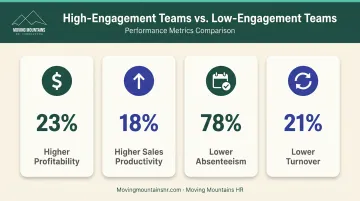
These figures reflect broad correlations, not guaranteed results for any one company. Still, they make a clear business case for prioritizing engagement.
Gallup groups U.S. workers into three categories:
- Engaged (31% of U.S. workers): Involved, enthusiastic, and committed to their work and organization
- Not engaged (52%): Doing the minimum required but lacking energy or passion
- Actively disengaged (17%): Unhappy at work and spreading negativity to colleagues
Moving people from "not engaged" to "engaged" takes steady, intentional work across the employee experience. The five strategies below focus on the levers that matter most for small and mid-size teams.
Strategy 1: Foster Open Communication & Feedback Cultures
Building Two-Way Communication Channels
Effective engagement starts with communication that flows in both directions. Employees need multiple channels to share ideas, raise concerns, and provide feedback. Leaders must communicate company updates, strategic decisions, and the rationale behind changes.
Communication mechanisms for small businesses include:
- Regular town halls or all-hands meetings where leadership shares updates and answers questions
- Anonymous suggestion systems that allow employees to raise concerns without fear of retaliation
- Open-door policies that make managers and executives accessible
- Pulse surveys that capture real-time feedback on specific topics
Great Place To Work recommends that small-business leaders respond to every inquiry submitted through open channels and occasionally join small-team calls to stay connected to the frontline experience.
Creating a Continuous Feedback Model
The annual performance review is outdated. Employees crave more frequent, actionable feedback that helps them course-correct and grow in real time.
Gallup's research of 13,490 U.S. full-time employees found that 80% of those who received meaningful feedback in the prior week were fully engaged. Meaningful feedback is frequent, specific, timely, future-oriented, and actionable, not vague praise or criticism.
Tactical examples of continuous feedback mechanisms:
- Weekly 1-on-1s between managers and direct reports to discuss priorities, obstacles, and development
- Real-time recognition tools (or simple Slack channels) where managers and peers acknowledge contributions immediately
- Project retrospectives after major initiatives to capture lessons learned and celebrate wins
- Peer feedback mechanisms that normalize constructive input from all directions
Shifting to continuous feedback requires more than installing a new tool. It demands a culture change supported by training and modeling from leadership.
Training Managers as Effective Communicators
Managers need training to give constructive feedback, facilitate difficult conversations, and actively listen. Many are promoted for technical expertise but lack formal coaching or communication skills.
Moving Mountains HR helps organizations build these skills through customized communication training tailored to their workforce and culture. Programs often cover supervisor development, performance coaching, and conflict resolution in workshops, leadership series, or one-on-one sessions.
Demonstrating Transparency and Follow-Through
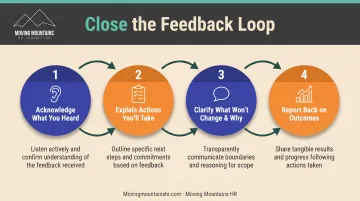
Communication without action erodes trust faster than silence. Employees need to see their feedback lead to meaningful changes, or at minimum receive a thoughtful explanation of why certain suggestions won't be implemented.
Close the feedback loop by:
- Acknowledging what you heard – Recap themes from surveys, town halls, or 1-on-1s
- Explaining actions you'll take – Be specific about changes, timelines, and owners
- Clarifying what you won't change and why – Transparency builds credibility even when the answer is "no"
- Reporting back on outcomes – Follow up to show progress and demonstrate accountability
Strategy 2: Invest in Professional Development & Growth Opportunities
Why Development Drives Engagement
Professional development consistently ranks among the top three drivers of engagement across industries.
The Conference Board's survey of more than 1,200 predominantly professional and office workers found that 96% said continuous skill development was important or very important, and 58% were likely to leave if they lacked professional development opportunities.
For employees, learning signals that the organization values their growth and sees them as long-term contributors. For employers, development builds capabilities, improves retention, and creates internal talent pipelines.
Creating Clear Career Pathways
Employees stay longer when they see a future. Career pathing shows potential trajectories within the organization—both vertical promotions and lateral moves that expand skills and responsibilities.
To implement career pathing:
- Document common career paths for key roles (such as individual contributor to team lead to manager)
- Identify the skills, experience, and competencies required at each level
- Communicate these pathways transparently so employees understand what advancement looks like
- Discuss career goals and development plans in regular 1-on-1 conversations
Career paths don't need to be rigid ladders—lateral moves, stretch projects, and cross-functional opportunities all contribute to growth and engagement.
Offering Diverse Learning Opportunities
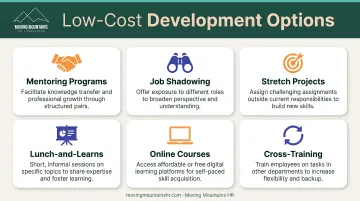
Development doesn't require large budgets. Small businesses can use internal expertise and low-cost external resources to create meaningful learning experiences.
Cost-effective development options include:
- Mentoring programs pairing junior employees with experienced colleagues
- Job shadowing to expose employees to other roles and departments
- Stretch projects that build new skills through real work
- Lunch-and-learns where team members share expertise or invite guest speakers
- Online courses from platforms like LinkedIn Learning, Coursera, or industry associations
- Cross-training to build versatility and deepen understanding of the business
In The Conference Board survey, 65% of employees most often used free external resources for development, 58% shared development needs with a manager, and 57% designed their own learning plans. Peer learning and internal knowledge-sharing can be highly effective when formalized and supported.
Making Time for Development
Lack of time is the most common barrier to employee development. If learning is treated as an "extra" that happens only when work slows down, it will never happen.
Build development into the normal workflow:
- Allocate a specific percentage of work time to learning (for example, 5-10% per quarter)
- Schedule recurring learning hours on team calendars
- Make development a standing agenda item in 1-on-1s and performance conversations
- Model continuous learning from the top—leaders should visibly invest in their own development
When development is part of the job, employees actually make time for it.
Measuring Development Impact
Track development initiatives to understand what's working and where to invest further.
Key metrics include:
- Internal promotion rate – percentage of roles filled from within
- Skills acquired – completions of courses, certifications, or training programs
- Employee satisfaction with growth opportunities – survey question scores
- Retention of high performers – turnover rates among top talent
Review them quarterly so you can double down on what works and drop what doesn't.
Strategy 3: Recognize & Reward Employee Contributions
The Power of Recognition
Recognition is a high-impact engagement lever that costs little to run. Yet Gallup's research shows only one in three U.S. workers strongly agree they've received recognition in the prior seven days.
In a longitudinal study tracking nearly 3,500 employees over two years, well-recognized employees were 45% less likely to have changed organizations. Recognition reinforces valued behaviors, strengthens connection to the organization, and signals that contributions matter.
Implementing Frequent, Specific Recognition
Meaningful recognition is timely, specific, and connected to impact. Vague praise ("Great job!") feels hollow. Effective recognition names what the person did well and explains why it mattered.
Recognition best practices:
- Recognize contributions within days, not months
- Name the action: "Your analysis of Q1 sales trends helped us reallocate budget to our highest-performing channels" beats "Nice work on that report"
- Tie the praise to team or company goals so the person sees why it mattered
- Make recognition weekly—or even daily—not something saved for annual reviews
A personal thank-you note or verbal acknowledgment costs nothing and can be more memorable than a cash bonus.
Creating Peer-to-Peer Recognition Programs
Recognition shouldn't flow only from managers. Peer-to-peer recognition creates a culture where appreciation comes from every direction.
Low-cost peer recognition options:
- A shared Slack (or Teams) kudos channel for public thanks
- Simple recognition cards employees can give peers, physical or digital
- Brief team shout-outs in meetings to celebrate recent wins
- A lightweight peer recognition platform later, if budget allows
Gallup found that peers accounted for 9% of employees' most memorable recognition sources, compared to 28% for managers. While manager recognition remains most impactful, peer appreciation adds meaningful reinforcement.
Pairing Recognition With Meaningful Rewards
Recognition works on its own. Occasional tangible rewards still help, especially after sustained performance or a major win.
Rewards appropriate for small-business budgets:
- Gift cards ($25-$100)
- Extra paid time off (half-day or full day)
- Flexible scheduling or remote work privileges
- Professional development opportunities (conference passes, course enrollments)
- Public acknowledgment (company newsletter, social media, town hall)
Match the reward to both the contribution and the person. Some employees want a public shout-out; others prefer a private thank-you and a concrete perk.

For small businesses without a formal HR team, write recognition expectations into manager habits and simple performance check-ins so appreciation does not depend on one person's memory.
Strategy 4: Promote Work-Life Balance & Employee Wellbeing
Why Wellbeing Matters for Engagement
Burnout kills engagement. Exhausted, overwhelmed employees cannot bring enthusiasm or discretionary effort to their work. Gallup's research shows that top-quartile engagement units experience 78% lower absenteeism than bottom-quartile units, partly because they prioritize wellbeing.
Actively disengaged employees are 4 times as likely to experience frequent burnout. Common drivers include:
- Unclear manager communication
- Lack of manager support
- Unfair treatment
- Unmanageable workload and unreasonable time pressure
Offering Flexible Work Arrangements
Flexibility is now expected in many industries. Employees who have real control over when and how they work are 43% less likely to experience high burnout.
Flexible work options include:
- Remote or hybrid schedules
- Flexible start and end times
- Compressed workweeks (for example, four 10-hour days)
- Seasonal flexibility (for example, summer Fridays)
Put these policies in your employee handbook so flexibility reads as a real benefit, not a manager-by-manager favor. Leaders have to model it too—if managers always work late or answer email at midnight, people will not feel safe using the arrangements you offer.
Engagement data backs the value of choice. In 2025, fully remote workers showed 31% engagement, compared with 23% for hybrid and on-site workers in remote-capable roles. Even when the job cannot be fully remote, schedule flexibility still reduces burnout risk.
Supporting Holistic Wellbeing
Schedule flexibility alone is not enough. Wellbeing also covers mental, emotional, and financial health—and small gaps here show up quickly as disengagement.
Practical wellbeing supports include:
- Employee Assistance Programs (EAPs) for counseling, assessments, and referrals
- Financial wellness resources for budgeting, debt, or retirement basics
- Fitness benefits such as gym memberships, wellness stipends, or on-site classes
- Mental health days separate from sick leave so people can rest without stigma
You do not need an enterprise budget to start. Even a clear EAP path plus a few protected mental health days shows employees that recovery is allowed—and that support is part of how you run the business, not an afterthought.
Strategy 5: Build Strong Leadership & Management Practices
Managers as the Key to Engagement
Gallup's research is clear: managers account for 70% of the variance in team engagement. Even the best engagement strategies will fail without capable, engaged managers who execute them at the team level.
Managers set the tone for communication, deliver feedback, provide recognition, support development, and model healthy work habits. An organization cannot out-strategy a poor manager.
Developing Manager Capabilities
Gallup identifies seven essential manager competencies:
- Build relationships
- Develop people
- Lead change
- Inspire others
- Think critically
- Communicate clearly
- Create accountability
Effective managers also need coaching skills, emotional intelligence, and the ability to facilitate difficult conversations.
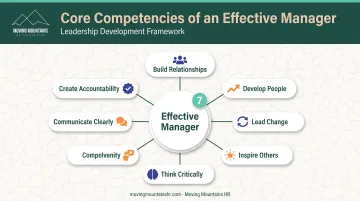
Moving Mountains HR designs manager development programs tailored to an organization's industry, workforce, and culture. Programs can cover supervisor development, leadership series, coaching, performance management, conflict resolution, and communication skills, delivered virtually or in person with practical tools and real-world scenarios.
A 2022 Gallup meta-analysis found that participating managers' teams improved engagement by up to 18% more than comparison teams and experienced 21%-28% less turnover. These findings come from controlled studies and are not guaranteed outcomes, but they show the leverage of investing in manager capability.
Equipping Managers With Tools and Time
Training alone isn't enough. Managers need adequate time, resources, and organizational support to prioritize engagement.
Support managers by:
- Reducing administrative burdens that consume time better spent on people leadership
- Clarifying role expectations so engagement becomes a realistic priority, not an add-on
- Providing templates, frameworks, and conversation guides for feedback and coaching
- Offering ongoing HR support through on-demand assistance or active participation in management meetings
Moving Mountains HR's ongoing support packages range from on-demand assistance to active participation in HR meetings, with premium options that include fractional CHRO services. Managers can tap expert HR support when they face performance or engagement challenges.
Holding Leaders Accountable for Engagement
Executive-level buy-in and modeling are essential. If senior leaders don't visibly prioritize engagement, middle managers won't either.
Build engagement accountability:
- Include engagement metrics (survey scores, turnover, retention) in leadership performance evaluations
- Review engagement data quarterly at the executive level
- Assign engagement action plans to specific leaders with clear timelines
- Celebrate leaders whose teams demonstrate high engagement and improvement
When engagement becomes a leadership competency rather than just an HR initiative, it gains the attention and resources needed to succeed.
How to Measure Employee Engagement Success
Measuring engagement shows you what's working and where to adjust course.
Key metrics to monitor:
- Voluntary turnover rate – voluntary separations divided by average employee count, excluding layoffs and terminations
- Retention rate – employees present for the entire period divided by employees at period start
- Internal promotion rate – percentage of roles filled from within (use a consistent internal definition)
- Employee Net Promoter Score (eNPS) – satisfaction and likelihood to recommend the organization; a useful signal, not a full engagement substitute
- Absenteeism – days absent divided by total workdays (BLS reported a 3.2% U.S. rate in 2025 for full-time wage and salary workers)
Beyond metrics, use engagement surveys (annual or quarterly) and pulse surveys for ongoing feedback on how employees experience your initiatives. Scores highlight priority areas for improvement.
Complement surveys with qualitative insights:
- Stay interviews – proactively explore why people stay, what frustrates them, and what might trigger an exit
- Exit interviews – capture retrospective feedback from departing employees
- Manager listening sessions or focus groups – help interpret survey results and develop action plans
SHRM's 2023 case study of OneDigital showed the company moving from annual surveys to three per year, enabling faster action on emerging issues. Match your cadence to your ability to review results and act. Surveying without follow-through damages trust.
Engagement is a lagging indicator. Track leading indicators to spot trends before they show up in survey scores:
- Weekly 1-on-1 completion rates
- Recognition frequency
- Development program participation
Frequently Asked Questions
What are some examples of employee engagement strategies?
The five strategies in this article are communication and feedback systems (1-on-1s, pulse surveys, open-door policies), professional development (mentoring, stretch projects, career pathing), recognition initiatives, work-life balance policies, and leadership development for managers.
How do small businesses with limited budgets improve employee engagement?
Focus on high-impact, low-cost tactics. Specific recognition and weekly manager conversations cost little or nothing. Peer mentoring, flexible scheduling, and free online learning paired with lunch-and-learns also stretch a tight budget.
How often should we measure employee engagement?
Most organizations run one annual engagement survey plus quarterly pulse surveys on specific topics. Survey only as often as you can act on the results, and back formal surveys with stay interviews, exit interviews, and regular 1-on-1s.
What role does HR play in employee engagement?
HR designs programs, trains managers, analyzes survey data, and recommends action plans, but engagement is shared across executives, managers, and employees. Moving Mountains HR can help with communication training, performance systems, and leadership development tailored to your organization.
How long does it take to see results from employee engagement strategies?
Recognition and frequent feedback can show impact within weeks. Manager development and communication improvements often take 3-6 months, while culture and retention gains may need 6-12 months of sustained effort. Track leading indicators (feedback frequency, recognition rates) alongside survey scores and retention.
Small to mid-size businesses can build engagement with focus, consistency, and genuine commitment—not large budgets. Start with one or two strategies from this article, measure your baseline, and iterate based on what you learn. Align initiatives with your culture, address employees' specific needs, and keep leadership support steady.
If you're ready to build a customized engagement strategy, Moving Mountains HR offers support from email and phone guidance to active meeting participation and fractional CHRO services. Schedule a free consultation to discuss your needs and build a more engaged workforce.