
Workforce redeployment is the strategic reassignment of employees from roles that are no longer needed to positions where their skills can be utilized within the same organization. This guide is designed for HR professionals, business owners, and executives at small-to-mid-sized companies seeking alternatives to layoffs during organizational change. We'll cover what redeployment is, when to use it, how to build a strategy, and how to measure success.
Key Takeaways
- Redeployment moves employees into new internal roles instead of layoffs, preserving institutional knowledge and reducing turnover costs
- Works best when internal opportunities exist, skills gaps are bridgeable, and the organization provides active transition support
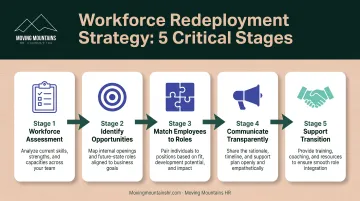
- Core steps include workforce assessment, opportunity mapping, skills matching, transparent communication, and post-placement support
- Measure success through retention rates, time to productivity, and cost avoidance to prove ROI to leadership
What Is Workforce Redeployment?
Workforce redeployment is the process of reassigning employees from roles that are no longer needed to positions where their skills can be used within the same organization. Rather than terminating employment, redeployment maintains the employment relationship while adapting to business change.
What redeployment achieves:
- Retains talent and institutional knowledge
- Maintains organizational productivity during transitions
- Avoids costs associated with layoffs, recruitment, and rehiring
How Redeployment Differs from Related Concepts
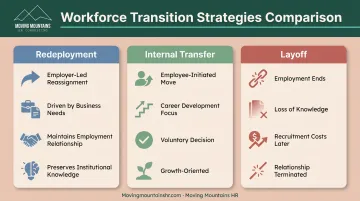
Internal transfer: Employee-initiated moves for career development, based on the worker's goals. Redeployment is employer-led and driven by business needs such as automation or restructuring.
Layoff: Employment relationship ends entirely, resulting in loss of institutional knowledge and potential future recruitment costs. With redeployment, the employee stays on in a different role.
Upskilling/reskilling: Training employees to perform better in their current role or to prepare for a significantly different future role. Redeployment instead places people in roles where they already have the skills or can close the gap quickly.
When Redeployment Applies
Redeployment typically occurs during:
- Organizational restructuring or departmental consolidation
- Automation-driven role elimination
- Mergers, acquisitions, or divestitures
- Significant shifts in business strategy or service offerings
Example: A data entry specialist whose role is being automated may be redeployed to a customer support role. The employee already has strong organizational skills, attention to detail, and familiarity with the company's software systems—capabilities that translate directly to resolving customer inquiries and navigating internal databases.
Why Redeployment Matters for Your Business
When roles shift or demand drops, redeployment protects more than headcount. It limits replacement spend, steadies the people who stay, and keeps hard-won knowledge inside the business.
Cost Avoidance
Replacing an employee costs 50–200% of their annual salary, according to Gallup's 2019 research. That figure typically includes:
- Recruitment expenses (advertising, screening, interviewing)
- Onboarding and training time
- Lost productivity during vacancy and ramp-up periods
- Administrative processing costs
Redeployment eliminates most of these expenses. While transition support requires investment, it's typically far less than the full cost of replacement.
Improved Employee Retention and Morale
Redeployment demonstrates organizational commitment to workers. When employees see the company investing in their future rather than immediately resorting to layoffs, it reduces "survivor guilt" and disengagement among those who remain.
Glassdoor's 2025 analysis of 304 layoff events found employer ratings fell 0.13 stars after layoffs. Current employees' ratings dropped 0.16 stars and took more than two years to recover. Those same employees increased job applications by 40% in the following 12 months, a clear signal of declining trust and engagement.
Preservation of Institutional Knowledge
Employees who have been with your organization for years understand:
- Internal processes and workflows
- Established relationships with clients, vendors, and colleagues
- Company culture and unwritten norms
- Historical context for decisions and systems
That knowledge takes years to build and external hires cannot simply replace it.
Research in Administrative Science Quarterly found internal movers outperformed comparable external hires for their first two years and left less often. Outside hires needed about two years to learn the organization and build effective relationships.
Organizational Agility
Teams that reallocate proven people move faster than teams stuck in long hiring cycles. When a product line shifts or a new compliance need appears, you can redeploy someone who already knows your systems instead of waiting months to fill a req. That flexibility is what lets smaller organizations pivot without freezing delivery.
Employer Brand Protection
Employers known for redeploying talent—not defaulting to layoffs—protect their reputation with current staff and future candidates. In tight labor markets, that trust shows up as stronger applicant quality, lower recruiting cost, and faster time-to-fill when you do need to hire.
How to Build a Redeployment Strategy
A successful redeployment strategy follows a structured five-stage process. Work through the stages in order so employees land in roles where they can succeed.
Stage 1: Conduct a Workforce Assessment
Map current roles against future business needs. Identify which positions are at risk over the next 6-18 months and where talent gaps are emerging. That 6–18 month view gives you time to move people before roles disappear or gaps widen.
Create a skills inventory that captures what capabilities exist in your current workforce beyond just job titles. Use a structured skills taxonomy that includes:
- Technical skills (software proficiency, specialized knowledge)
- Transferable skills (communication, problem-solving, project management)
- Behavioral strengths (adaptability, collaboration, attention to detail)
- Industry or domain knowledge
Validated skills inventories beat self-reported data alone. Build yours with work samples, manager assessments, or skills-based evaluations so matches rest on evidence, not guesswork.
Stage 2: Identify Viable Internal Opportunities
Work with department leaders early to surface open or anticipated roles that could be filled by internal candidates. Don't wait until restructuring is announced—the earlier you identify opportunities, the more options you'll have.
Document each opportunity's:
- Essential duties and responsibilities
- Required skills and qualifications
- Location, schedule, and compensation
- Timeline for filling the role
Stage 3: Assess Individual Fit and Match Employees to Roles
Match employees based on multiple factors:
- Skills: Core capabilities for the role, or a realistic path to close gaps quickly
- Behavioral compatibility: Will the employee's work style and strengths align with the receiving team and manager?
- Learning agility: Can the employee adapt to new responsibilities and contexts?
- Cultural alignment: Does the employee's approach fit the norms and expectations of the new department?
Skills match is necessary but not sufficient. Behavioral compatibility with the receiving team and manager matters equally for long-term success.
Organizations without in-house HR expertise can partner with firms like Moving Mountains HR for fractional CHRO support to run objective assessments and facilitate matching. An outside partner adds structure and lowers the risk of bias or favoritism in placement decisions.
Stage 4: Communicate with Transparency
Inform employees directly, clearly, and early about redeployment plans. Explain:
- What is changing and why
- Who is affected
- What the timeline looks like
- What support is available
- How decisions will be made
Brief managers before their teams. Managers need to understand the plan, be prepared to answer questions, and model calm, supportive leadership. Vague communication breeds anxiety and attrition.
Stage 5: Support the Transition Actively
Redeployment isn't complete when an employee accepts a new role. The stretch between day one and full productivity is where transitions succeed or fail.
Provide structured support:
- Set clear role objectives and performance expectations
- Run a formal onboarding process tailored to the new role
- Deliver necessary training (systems, processes, team-specific knowledge)
- Monitor performance through defined KPIs for the first 90 days
- Schedule regular check-ins with the employee and receiving manager
Without active support, even well-matched placements can fail.
Key Factors That Affect Redeployment Success
Bridgeable Skills Gaps
Assess whether employees can perform core duties of the new role now or close the gap within a practical timeframe through targeted training. Roles requiring entirely new skill sets, such as moving a warehouse associate to a financial analyst position, are not viable redeployment opportunities without substantial reskilling.
AT&T's Future Ready initiative demonstrates what intensive skill development looks like. One employee, Susan Bick, completed more than 100 hours of coursework over 18 months to transition from project manager to senior scrum master.
Another, Nathaniel Meyer, used an employer-funded computer science degree to move from a declining network operations role to data scientist.
These are examples of major reskilling investments, not quick redeployments. For most small to mid-size organizations, redeployment works best when the employee already has foundational skills that transfer to the new role.
Manager Readiness
Receiving managers must be equipped and willing to support someone through a role transition. According to Gartner data reported by SHRM, only 17% of candidates said their manager facilitated internal applications, and only 20% felt supported by their team.
Managers need:
- Capacity to integrate someone new into their team
- Training on how to onboard and coach redeployed employees
- Clear expectations about their role in the transition
- Recognition for successfully developing talent
Talent hoarding, where managers block internal moves to protect their own teams, is a common obstacle. Address this through release-date agreements, backfill ownership, and leadership accountability.

Employee Choice and Legal Considerations
Employees can decline redeployment offers. Whether refusal affects severance eligibility depends on company policy and whether the role constitutes "suitable alternative employment" under applicable employment law.
In California, for example, the Employment Development Department evaluates suitable work for unemployment-benefit purposes. Factors include health and safety, prior training and wages, length of unemployment, and commuting distance. This is a benefits determination, not a mandatory-acceptance rule.
Before structuring any redeployment program, consult employment law counsel to understand your obligations and risks, especially regarding:
- Pay, status, schedule, or location changes
- Protected-leave arrangements
- Accommodation under the ADA
- Collectively bargained terms
Common Challenges and When to Use Alternatives
Common Misconceptions
A few assumptions quietly sink redeployment programs before they start:
- Any employee can fill any role with light training. Redeployment only works with a real skills match or a narrow, bridgeable gap. Placing someone in a role they aren't qualified for sets the employee and the organization up to fail.
- Redeployment is just a job transfer. It applies when the source role is disappearing for a business reason. Voluntary moves for career growth are a different process.
- Strong hires will be productive right away. Even skilled employees need time to learn systems, build relationships, and read team dynamics. Build in a ramp-up period.
When Redeployment Is Not Appropriate
Redeployment is the wrong tool in these situations:
- No suitable internal role exists. If you have no open roles or near-term vacancies that fit the employee's skills and the business need, redeployment isn't viable.
- The skills gap is too wide to close on a practical timeline. Asking a frontline service worker to become a software developer without a multi-year training plan isn't redeployment. It's a different kind of workforce investment.
- You lack the infrastructure to support the move. Successful transitions need coaching, training, performance management, and manager capacity. Without those, even good matches struggle.
- Relocation demands are unreasonable. Requiring a move of hundreds of miles—or a hard shift from on-site to fully remote—may not qualify as suitable alternative employment.
The Responsible Alternative
When redeployment isn't viable, professional outplacement is the responsible path. It helps departing employees run a stronger job search, protects your employer brand, and limits disengagement among remaining staff who see how colleagues are treated.
Frequently Asked Questions
What is workforce redeployment?
Workforce redeployment is the strategic reassignment of employees from roles that are no longer needed to positions where their skills can be used, helping organizations retain talent and maintain productivity during business changes.
What are the rules on redeployment?
Redeployment isn't legally required in most US contexts. When offered, the role must constitute suitable alternative employment considering factors like location, compensation, job duties, and required skills. Consult employment law counsel for specific situations.
What is the difference between redeployment and a layoff?
Redeployment maintains the employment relationship by moving employees to new internal roles. Layoffs terminate employment, resulting in loss of institutional knowledge and requiring future recruitment costs if roles need refilling.
How long does a redeployment process typically take?
Straightforward redeployments into adjacent roles can move in 2-4 weeks. Transitions involving substantial skill development typically require 60-90 days from identification to full productivity. Planning ahead of restructuring announcements expands available options.
Can an employee refuse a redeployment offer?
Yes, employees can legally decline redeployment offers. Whether refusal affects severance eligibility depends on company policy and whether the offered role constitutes suitable alternative employment under applicable law.
How do you measure redeployment success?
Key metrics include time to full productivity (30/60/90-day checkpoints), retention at 12 months, manager satisfaction scores, performance ratings vs. KPIs, cost avoidance per placement, and employee engagement scores at 90 days post-transition.
Workforce redeployment is a practical alternative to layoffs when internal roles are available and skills gaps are bridgeable. It preserves institutional knowledge, reduces costs, and shows real commitment to employees.
Organizations without in-house HR capacity can use fractional CHRO support to design, implement, and measure redeployment initiatives built around their needs.