This disconnect reveals a critical gap many business leaders miss: training completion doesn't guarantee workplace application. Understanding the difference between training and enablement matters because it determines whether your HR investments translate into actual performance improvements, compliance protection, and operational consistency—or simply sit on a shelf collecting digital dust.
Key Takeaways
- Structured training builds foundational knowledge through programs with clear start and end dates
- Ongoing enablement supplies tools, resources, and support so employees can apply skills on the job
- Success metrics differ: training tracks completion and retention; enablement tracks application, productivity, and business results
- High-performing organizations layer enablement on top of training—not treat them as either-or choices
Training vs. Enablement: Quick Comparison
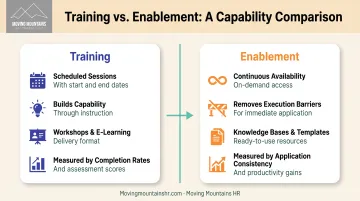
| Dimension | Training | Enablement |
|---|---|---|
| Definition | Structured learning designed to build specific knowledge, skills, and competencies | Ongoing access to tools, resources, processes, and support that help employees perform their jobs effectively |
| Timing | Scheduled sessions with clear start and end dates | Continuous availability, accessible whenever needed |
| Focus | Building capability through instruction and practice | Removing barriers to execution in real work scenarios |
| Delivery Method | Workshops, e-learning courses, coaching sessions, certifications | Knowledge bases, templates, process documentation, collaboration tools, mentorship programs |
| Measurement | Completion rates, assessment scores, knowledge retention | Application consistency, productivity gains, error reduction, business outcomes |
| Best Used For | New hires, skill gaps, compliance requirements, major system changes | Performance inconsistency, distributed teams, complex roles requiring frequent reference materials |
How to use this comparison:
- Choose training when employees lack foundational knowledge or skills
- Choose enablement when they know what to do but struggle with consistent execution
- Plan for both when you need capability built first and sustained on the job afterward
What is Training?
Training is structured learning designed to build specific knowledge, skills, and competencies that employees need to perform their jobs. The Association for Talent Development defines it as the formal process used to improve performance at work: a planned activity with clear learning objectives and measurable outcomes.
Characteristics of Effective Training
- Scheduled and structured – Happens at set times, from a two-day onboarding workshop to a six-week virtual certification program
- Curriculum-based – Follows a logical path from foundational concepts to complex applications, often in modules or units
- Instructor-led or self-paced – May use live facilitators, recorded video, interactive simulations, or mixed formats
- Assessment and certification – Uses knowledge checks, skills demonstrations, or final assessments to verify learning
Common Training Delivery Methods
- Workshops and seminars – In-person or virtual sessions where participants learn together
- E-learning courses – Self-paced online modules employees complete on their own schedule
- Coaching sessions – One-on-one or small-group instruction tailored to specific skill development
- Certification programs – Structured learning paths that culminate in a recognized credential
Use Cases of Training
Onboarding new employees: When someone joins your organization, they need foundational knowledge about company processes, culture, systems, and role-specific skills before they can contribute effectively.
Compliance training: Legal and regulatory requirements demand documented instruction. For California businesses, that includes mandatory harassment-prevention training.
Employers with at least five employees must provide one hour for non-supervisors and two hours for supervisors every two years. Cal/OSHA's Injury and Illness Prevention Program similarly requires safety instruction with proper documentation.
Skill development programs: When you introduce new software, methodologies, or processes, employees need structured learning to build proficiency before they can apply the new approach independently.
Research shows a positive relationship between training and organizational performance. Returns vary by industry and how well training is designed and reinforced. Organizations invested an average of $846 per employee in direct learning expenditure in 2025, according to ATD's latest industry data.

What is Enablement?
Enablement provides ongoing access to tools, resources, processes, and support that help employees perform their jobs effectively after initial training ends. While training answers "Can you do this?" enablement addresses "Can you do this consistently, in real situations, when it matters?"
Characteristics of Effective Enablement
Strong enablement programs share a few traits:
- Continuous availability: Resources stay on hand during customer calls, report prep, or unexpected situations
- Workflow integration: Tools live where work happens, so finding the right resource takes less effort
- Self-service access: Employees get answers on their own instead of waiting on a manager or specialist
- Performance support: Job aids, templates, and references guide execution rather than re-teaching concepts
Common Enablement Components
- Knowledge bases – Searchable repositories where employees find policies, procedures, and answers to common questions
- Templates and frameworks – Pre-built documents that keep work consistent and cut time spent building materials from scratch
- Process documentation – Step-by-step guides employees reference for complex or infrequent tasks
- Collaboration tools – Platforms that connect employees with colleagues who have relevant expertise
- Mentorship programs – Structured relationships that offer ongoing guidance beyond formal training
Use Cases of Enablement
Complex projects and customer interactions: When someone faces a nuanced situation (contract negotiation, escalated complaint, or technical diagnosis), just-in-time resources help them make sound decisions without starting from scratch.
Consistency across distributed or growing teams: As your organization scales or operates in multiple locations, enablement keeps everyone on the same processes and standards, even without direct supervision.
Bridging the learning-to-execution gap: Employees may grasp concepts in training yet struggle when real-world complexity shows up. Enablement supplies the scaffolding that connects classroom learning to workplace performance.
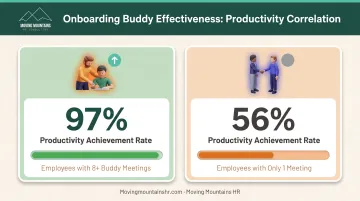
Microsoft Research found that new employees who met with an onboarding buddy more than eight times reported a 97% rate of the buddy helping them become productive, compared to just 56% among those with only one meeting. That buddy system is classic enablement: continuous, contextual support that helps people navigate real situations beyond what initial training covers.
Training vs. Enablement: Key Differences
| Dimension | Training | Enablement |
|---|---|---|
| Timing | Episodic and scheduled | Always-on, on demand |
| Measurement | Completion and retention | Application and business outcomes |
| Ownership | L&D or HR | Distributed / operations |
| Cost | Concentrated upfront | Ongoing tools and maintenance |
| Scalability | Resource-intensive per cohort | Efficient via self-service |
Timing and Availability
Training is episodic and scheduled. It has a defined beginning and end. You attend a workshop on Tuesday, complete an e-learning module by Friday, or finish a certification program in six weeks. Once training concludes, the formal learning event is over.
Enablement is always-on and accessible when needed. A searchable knowledge base doesn't close at 5 p.m., templates remain available whenever an employee starts a new project, and process documentation sits ready for reference during execution.
Measurement Approaches
Training tracks completion and knowledge retention. Did employees attend? Did they pass the assessment? Can they recall key concepts in a quiz?
Enablement measures application, productivity, and business outcomes. Are employees applying the process consistently? Has error rate decreased? Did time-to-resolution improve?
A case study from Deutsche Telekom showed first-time resolution rising 10% and customer recommendation scores increasing 14 points after implementing dashboards, real-time support, and KPI feedback alongside formal learning programs.
Ownership and Management
Training typically falls under Learning & Development or HR departments. These teams design curricula, schedule sessions, track completion, and manage assessments.
Enablement is often distributed across departments or managed by operations teams. Sales operations might own the sales playbook, IT manages the internal knowledge base, and department managers maintain process documentation for their teams.
Cost Structure
Training has concentrated upfront costs: instructor fees, platform licenses, content development, and time away from work. These expenses cluster around the learning event.
Enablement requires ongoing investment in tools and content maintenance. Knowledge bases need regular updates, templates must reflect current processes, and someone has to ensure resources remain accurate as your business evolves.
Scalability
Training can be resource-intensive to scale. Adding 50 new employees means scheduling more sessions, engaging additional instructors, or increasing platform capacity. Each new cohort requires time and attention.
Enablement scales more efficiently through digital tools and self-service resources. Once you've built a comprehensive knowledge base or template library, 50 employees can access it as easily as five, with minimal incremental cost.
When Training and Enablement Work Together
Training creates the foundation that enablement builds upon for sustained performance. Training is teaching someone to ride a bicycle. Enablement is the safe paths, clear signage, and maintenance support that keep them riding after the lesson ends.
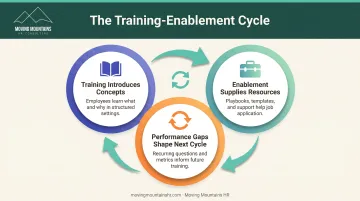
The Reinforcement Cycle
- Training introduces concepts — Employees learn the "what" and "why" in a structured setting, with time to practice and ask questions.
- Enablement supplies references and tools — Back on the job, playbooks, templates, and peer support help them apply learning in real situations.
- Performance gaps shape the next cycle — Recurring questions, common mistakes, and heavily used resources show what future training should cover more thoroughly.
Example of an Effective Combined Approach
A California-based healthcare company onboards new supervisors with a two-day leadership training program covering performance conversations, documentation requirements, and California employment law basics. The program includes role-playing exercises and knowledge assessments.
After training, supervisors get access to:
- A digital handbook with step-by-step guides for common scenarios
- Performance conversation templates that prompt them through difficult discussions
- A peer Slack channel where they can ask questions and share approaches
- Monthly check-ins with HR where they discuss real cases and get coaching
Training built the capability. Enablement kept supervisors executing consistently when real performance issues showed up months later. Together, the approach cut disciplinary-action errors by 40% and raised supervisor confidence scores on the company's annual survey.

How to Choose the Right Approach for Your Organization
Match the intervention to the gap. Use training when people lack skill or knowledge; use enablement when they know what to do but still can't execute consistently.
When to Prioritize Training
Choose training when you need to build capability first:
- New hires: They lack foundational knowledge of your processes, culture, systems, and expectations. Structured onboarding is essential.
- Skill gaps: The team has never used the software, doesn't know the methodology, or lacks the technical expertise the role requires.
- Compliance mandates: California harassment-prevention training, safety instruction, and other regulatory requirements need formal, documented programs. Enablement alone will not satisfy legal obligations.
- Major system or process changes: A new CRM, sales-process overhaul, or project-management shift calls for structured instruction before go-live.
When to Prioritize Enablement
Shift to enablement when capability is already there but results still slip:
- Inconsistent performance after training: Employees completed courses and passed assessments, yet still struggle, or only perform well under close supervision. The gap is support, not skill.
- Distributed teams: Remote or multi-location staff can't rely on hallway conversations or over-the-shoulder coaching. Self-service resources and documented processes become critical.
- Complex, reference-heavy roles: Nuanced decisions, detailed compliance rules, or infrequent but high-stakes tasks benefit more from just-in-time support than from repeated courses.
Building an Integrated Strategy
Most organizations need both. Weight each approach using:
- Organizational size: Smaller businesses can start with foundational training plus simple enablement (shared folders, regular team check-ins). Mid-size companies often add more structured tools and dedicated owners.
- Available resources: When budget is tight, put training dollars into high-impact, compliance-critical, or role-specific programs. Extend that value with lower-cost enablement such as shared drives, peer mentorship, and team huddles.
- Business goals: If you are scaling fast, prioritize enablement that keeps execution consistent as headcount grows. If you are entering a new market or launching new offerings, invest in training that builds the capabilities those moves require.
The U.S. Office of Personnel Management recommends a diagnostic framework that assesses performance at organizational, team, and individual levels before you pick an intervention. Training closes skill and knowledge gaps; enablement removes execution barriers such as unclear processes, hard-to-find resources, or weak day-to-day support.
Moving Mountains HR helps small and mid-size businesses design training and enablement strategies that fit how they actually operate. Customized programs cover leadership development, California compliance, performance management, and respectful workplace practices, delivered virtually or in person.
Ongoing HR support—from email and phone assistance to fractional CHRO services—gives employees the continuous guidance to apply what they learn on the job.
Frequently Asked Questions
What does training and enablement mean?
Training refers to structured learning events designed to build knowledge and skills through workshops, courses, or coaching sessions. Enablement provides ongoing tools, resources, and support that help employees apply those skills consistently in their daily work.
Which comes first: training or enablement?
Training typically comes first to build foundational knowledge and capability. Once employees understand core concepts, enablement supplies the references, templates, and support they need to execute in real work situations.
Can training and enablement be handled by the same team?
In many small to mid-size businesses, HR or operations teams manage both. The skill sets differ: training needs instructional design and facilitation, while enablement needs content management and process documentation.
How do I know if my organization needs better training or enablement?
If employees lack foundational knowledge or fail assessments, focus on training. If they understand concepts but struggle with consistent execution, can't find resources, or only perform well with close supervision, focus on enablement.
What is the ROI difference between training and enablement investments?
Training ROI typically shows in skill development, compliance protection, and capability building. Enablement ROI appears in productivity gains, error reduction, and faster time-to-competency. Both contribute to organizational performance, but through different mechanisms and timelines.
Can small businesses afford both training and enablement programs?
Yes. Start with foundational compliance training and simple enablement resources like shared document libraries and peer mentorship. Partners like Moving Mountains HR can implement both cost-effectively within your budget.
Need help building a training and enablement strategy? Moving Mountains HR provides customized training programs and ongoing support for small to mid-size businesses. Contact us at 866-474-3575 or questions@movingmountainshr.com.