
Introduction
In 2024, 75% of organizations struggled to fill full-time positions. That gap is expensive: replacing an employee can cost 50% to 200% of annual salary, and disengagement alone costs the U.S. about $1.9 trillion in lost productivity.
Yet only 43% of organizations strongly align learning programs with business goals. Most training spend never ties back to measurable results.
A corporate learning strategy is a framework that connects employee development to business performance. Done well, it closes skill gaps, improves retention, and helps the organization adapt when markets shift. This guide covers what these strategies are, the main types, essential components, how to build yours, and how to measure success so training supports growth instead of sitting as an unchecked cost.
Key Takeaways
- Tie employee development to business objectives to improve measurable performance
- Five strategy models span ad-hoc training to full corporate universities; most organizations blend approaches
- Strong strategies need clear objectives, leadership buy-in, learner-centric design, the right technology, and ongoing measurement
- Small businesses can deliver high-impact learning by prioritizing key capabilities and using fractional HR support
What is a Corporate Learning Strategy?
A corporate learning strategy is a plan that outlines how an organization will develop employee capabilities to achieve business objectives. According to Training Industry, it defines your approach to training and skills development: not just what you teach, but why, how, and to whom.
Strategy vs. Training Programs
The distinction matters. A learning strategy is the overarching plan; training programs are the tactical execution. Your strategy answers questions such as: Which capabilities will drive our business forward? Who needs development? How will we deliver and measure it?
Training programs deliver the workshops, e-learning, and coaching that fulfill the strategy.
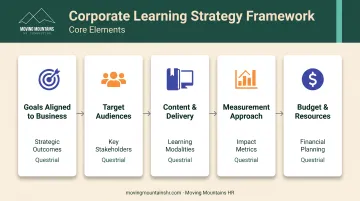
Core Elements Every Strategy Addresses:
- Goals aligned to business needs – Connect development to revenue growth, operational efficiency, market expansion, or innovation
- Target audiences – Define who receives what training based on role, career stage, and performance
- Content types and delivery methods – Determine the mix of instructor-led, self-paced, peer learning, and on-the-job application
- Measurement approach – Establish metrics linking learning activities to business outcomes
- Budget and resources – Allocate funding based on strategic priorities and expected ROI
Corporate learning has moved from a "nice-to-have" employee benefit to a driver of competitive advantage, retention, and agility. The strongest programs build skills over time and tie learning directly to business performance.
Reactive Training vs. Strategic Learning
Reactive training responds to problems as they arise—for example, compliance updates after regulatory changes or software training when a new tool launches. Strategic learning proactively builds capabilities for future business needs. It begins with skill-gap assessment, aligns with business-leader input, and prepares employees for changing roles before problems surface.
Main Types of Corporate Learning Strategies
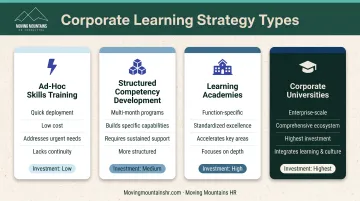
Organizations typically use one or a combination of four strategy models, selected based on maturity, size, and business priorities.
Ad-Hoc Skills Training
Short-term, targeted interventions close immediate skill gaps. Examples include compliance training after regulatory changes or software training for a new tool rollout.
Benefits:
- Quick deployment with low cost
- Addresses urgent needs effectively
Limitations:
- Lacks continuity and doesn't build long-term capabilities
- Difficult to scale across the organization
Structured Competency Development
Specific competencies build over time through learning journeys that combine workshops, e-learning, mentoring, and practice. SHRM defines this as enhancing workforce knowledge, skills, abilities, and other characteristics to meet current and future organizational needs.
When It Works Best:
- Critical competencies are clearly identified
- Competencies tie directly to measurable job performance
- The organization can support multi-month development programs
Example: A 6-month leadership development program systematically building management capabilities through classroom training, peer coaching, real project application, and feedback loops.
Capability Building Through Learning Academies
Learning academies are function-specific training programs—Sales Academy, Leadership Academy—designed to accelerate excellence in key areas. According to ATD, academy journeys should align with business strategy and organizational development initiatives.
Academies create consistency in approach and philosophy across teams while allowing customization for different roles. They fit best when standardized excellence in a specific function creates competitive advantage.
Real Example - Walmart Academy: Walmart operates one of the largest U.S. training programs, linking learning to pathways into store management, trucking, pharmacy technician, HVAC, and other higher-paid roles. The company committed $1 billion to career-driven training and education by 2026. That investment shows how academies can support internal mobility and staffing needs.
Corporate Universities for Strategic Capacity
Corporate universities are comprehensive, formalized learning ecosystems spanning all organizational functions and career stages. They take the highest investment and the longest time to pay off, but they build lasting capability across the workforce.
Case Study - McDonald's Hamburger University: Founded in 1961, Hamburger University had trained more than 275,000 graduates by 2015, establishing McDonald's operational consistency and leadership culture worldwide.
It suits organizations with complex capability needs, wide geographic reach, and formal governance—usually driven by strategic importance, not headcount alone.
Key Components of an Effective Learning Strategy
Five building blocks separate learning programs that move the business from those that sit on a shelf. Get these right and the rest of your L&D work has a clear job to do.
Business Alignment and Clear Objectives
Learning strategies must support concrete business goals such as revenue growth, market expansion, operational efficiency, or innovation. SHRM ties strong L&D outcomes to productivity, revenue growth, and customer satisfaction.
Translate each business goal into a learning objective. Market expansion, for example, may call for cross-cultural competency or regional product knowledge. Define success metrics up front that link learning to results:
- Sales training tied to close rates
- Leadership development tied to team retention
- Compliance training tied to audit findings or incident rates
Stakeholder Engagement and Leadership Buy-In
Executive sponsorship is non-negotiable. Senior leaders and managers need to:
- Secure funding and protect learning time
- Remove barriers that block participation
- Model learning themselves
- Hold managers accountable for employee development
Identify learning champions across the organization who will advocate for the strategy day to day. Small businesses without a full-time HR team often partner with fractional HR consultants or external advisors to supply the strategy and credibility that unlock leadership commitment.
Learner-Centric Design
Start with how your workforce actually prefers to learn. Common formats include:
- Self-paced online modules
- Instructor-led sessions
- Peer learning
- Microlearning
- Blended programs
Run needs assessments through surveys, focus groups, and engagement data from past training. Build personalized paths by role, career stage, and job requirements, and weave learning into daily work so people can apply it immediately.
Skill transfer also depends on the environment around the learner:
- Supervisor support and coaching
- Peer reinforcement
- Timely feedback
- A climate that rewards practice, not just completion
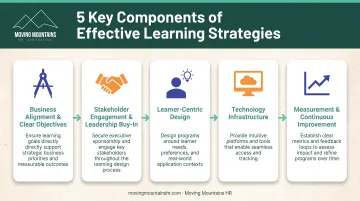
Technology Infrastructure and Content Strategy
Learning Management Systems (LMS) and modern learning platforms deliver, track, and measure training at scale. A solid LMS streamlines content delivery and administration; integrated analytics show participation, completion, and skills mastery.
Choose build, buy, or a mix based on budget and how unique your needs are. Technology should serve the strategy, not define it. Pick platforms that match your learning philosophy and culture.
Measurement and Continuous Improvement Framework
Track activity and impact as separate layers:
- Activity: completion rates, time spent, certifications
- Proficiency: skill or knowledge gains
- Business impact: performance, retention, and KPI movement
Set review cycles quarterly or twice a year. Use each cycle to drop what is not working, close gaps, and reallocate budget toward programs that move the metrics you defined up front.
How to Develop Your Corporate Learning Strategy
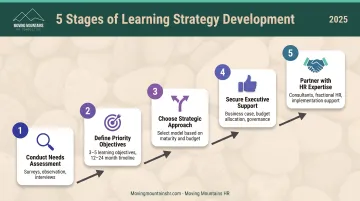
A practical corporate learning strategy follows a clear sequence: assess needs, set priorities, pick a model, fund it, and bring in expertise where you lack capacity. Use the five steps below to move from gaps to an executable plan.
Step 1: Conduct a Comprehensive Needs Assessment
Map current skill gaps, future capabilities tied to business strategy, and how employees prefer to learn. SHRM's Body of Applied Skills and Knowledge frames needs assessment around person, organizational, training, and cost-benefit analysis.
Common methods include:
- Surveys across roles and teams
- Direct observation of work quality and process friction
- Leader and employee interviews
Step 2: Define Priority Learning Objectives
Work with business leaders to lock 3–5 learning objectives that support the most critical goals over the next 12–24 months. Effective L&D starts when skill-gap data and leadership agree on what matters first.
Step 3: Choose Your Strategic Approach
Pick your model (ad-hoc, structured competency development, academy, or university) based on maturity, budget, and urgency. Many small businesses start with structured competency programs in 2–3 high-impact areas where measurable performance gains justify the spend.
Step 4: Secure Executive Support and Resources
Present a business case that ties learning objectives to revenue, retention, productivity, or other strategic priorities. Then allocate budget, assign accountability, and set simple governance so the plan does not stall after kickoff.
Step 5: Partner with HR Expertise When Needed
If you lack dedicated HR leadership, bring in HR consultants or fractional HR professionals. SHRM notes that small companies often outsource specialized training and organizational development work.
Partners can help you:
- Facilitate the needs assessment
- Design the learning strategy with leadership
- Advise through implementation without a full-time hire
That fractional model is especially useful when you are building your first formal learning strategy.
Moving Mountains HR builds Training & Development Programs around your industry, workforce, culture, and goals. Typical focus areas include:
- Leadership and communication
- Compliance and workplace risk
- Performance management and employee relations
Delivery can be virtual or in person through workshops, coaching, or a learning series. For teams without an internal HR executive, fractional CHRO support can join planning meetings and guide strategy at a senior level.
Measuring Learning Strategy Success
A learning strategy only works if you can show it moves the business. Establish a balanced scorecard that tracks both leading and lagging indicators:
| Metric Layer | Examples | Type |
|---|---|---|
| Reach and activity | Participation, completion, certification | Leading |
| Learning and transfer | Skill proficiency, application frequency, observation, work performance | Leading/Intermediate |
| Business impact | Productivity, revenue, customer satisfaction, turnover, sales growth | Lagging |
| Financial value | Monetary benefits, benefit-cost ratio, ROI, intangibles | Lagging |
Connect Learning to Business KPIs
Track whether sales training correlates with increased close rates, leadership development reduces team turnover, or compliance training lowers violation rates.
McKinsey describes a global services firm that replaced generic annual workshops with tailored certification, client work, mentoring, and compensation linkage. That shift produced field commitments tied to more than $100 million in incremental sales opportunities in the pipeline.
Calculate ROI Using the Phillips ROI Methodology
Isolate the program's effects from other influences and convert the right business impacts to monetary value. Include all program costs (needs assessment, design, delivery, participation, evaluation) and report intangible benefits separately.
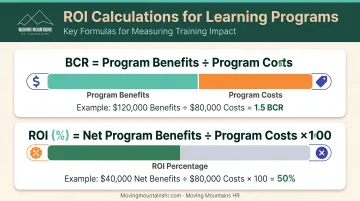
The formulas:
- Benefit-Cost Ratio (BCR) = Program Benefits / Program Costs
- ROI (%) = Net Program Benefits / Program Costs × 100
Conduct regular learning impact reviews that compare training costs against measurable benefits such as reduced turnover, higher productivity, or fewer compliance violations.
Common Challenges and How to Overcome Them
Lack of Participation Time
More than 90% of organizations in ATD's 2025 manager-development study named insufficient time as a challenge. Treat learning as part of the workday, not an add-on:
- Embed microlearning and just-in-time resources into daily workflows
- Use short lunch-and-learns instead of long off-site sessions
- Get managers to protect dedicated learning time on the calendar
Budget Constraints
Put spend on the few initiatives that move performance, not a thin layer of everything:
- Use free or low-cost content where it meets the need
- Build peer-to-peer learning and internal subject-matter experts into the plan
- Limit expensive external programs to gaps you cannot cover in-house
According to Training Magazine's 2025 study, U.S. organizations with 100+ employees spend an average of $874 per learner:
- Small companies: $1,091
- Midsize: $782
- Large: $468
Low Engagement
Relevance and visible leadership drive participation. Tie learning to career paths and recognition, and have leaders join and champion programs—not only assign them.
ATD found 62% of surveyed organizations use coaching or mentoring in manager training. Peer learning raises relevance and on-the-job application.
Frequently Asked Questions
What are the main types of corporate learning strategies?
The four main types are ad-hoc skills training (short-term, task-focused), structured competency development (multi-month journeys), capability-building academies (function-specific programs), and corporate universities (enterprise-scale ecosystems). Most organizations use a hybrid approach based on maturity and business needs.
How do you measure the ROI of corporate learning programs?
Connect training investments to business outcomes such as improved performance, reduced turnover, increased revenue, and faster time-to-productivity. Use the Phillips ROI Methodology: isolate the program's effects, convert impacts to monetary value, calculate ROI, and report intangible benefits separately.
What budget should small businesses allocate to employee training?
Training Magazine's 2025 study shows U.S. organizations averaging $874 per learner annually, with small companies spending about $1,091 per learner. Focus on high-impact areas and measurable outcomes rather than arbitrary percentages; even modest investments in the right skills can pay off.
How often should corporate learning strategies be updated?
Align formal reviews with your business planning cycle, typically annually, and run quarterly check-ins to assess progress. Adjust tactics based on changing priorities, learning data, and workforce feedback.
What's the difference between training and development in corporate learning?
SHRM defines training as shorter-term and focused on specific skills for current job performance or compliance. Development is broader and longer-term, preparing employees for future responsibilities, advancement, and adaptability.
How can companies without HR departments implement learning strategies?
Start with a needs assessment identifying 2–3 priority skill areas, secure executive support by linking learning to business goals, and consider fractional HR support to design and launch the strategy. Focus resources on those priorities and use blended delivery with internal experts and external partners.