It's a common move, and it often backfires. According to a CareerBuilder survey conducted by Harris Interactive, 58% of managers received no management training at all, and 26% said they weren't ready to lead when they first started.
The fallout is real: higher turnover, sagging morale, and in regulated industries like healthcare, genuine compliance exposure. This article breaks down what leadership consulting actually is, how it differs from training, why the 70-20-10 rule matters, and how to pick a partner who fits your business.
Key Takeaways
- Leadership consulting builds lasting systems; training builds specific skills in a single session
- Weak leadership is a measurable driver of preventable turnover and legal risk
- The 70-20-10 rule blends real experience, mentorship, and formal coursework for lasting development
- Fractional CHRO models give growing businesses executive HR guidance without executive-level payroll
- Choose a partner with industry knowledge, flexible service tiers, and proven neutrality in investigations
What Is Leadership Consulting?
Leadership consulting is a strategic engagement. A consultant assesses your organization's leadership capacity, identifies where it falls short, and builds custom solutions to close those gaps.
In practice, that work typically includes:
- Leadership assessments to identify where management skills or systems are weakest
- Executive coaching for current leaders and rising talent
- Succession planning to prepare for leadership transitions before they become emergencies
- Performance management system design, including goal frameworks and review structures
The engagement stays ongoing and strategic. It focuses on organizational systems and culture, and it evolves as your business grows.
In regulated industries like healthcare, this work carries added weight. Leadership decisions can't be separated from compliance obligations, which is why specialized experience matters. Michelle Schwanhauser, founder of Moving Mountains HR, built her practice on a healthcare HR background. That experience shapes the compliance-aware leadership guidance she delivers to clients in regulated fields.
Training vs. Consulting: What's the Difference?
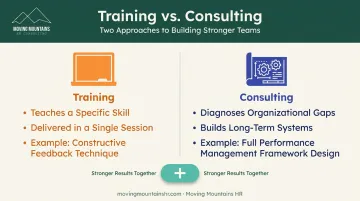
Training delivers a specific, structured skill. Think: "how to run a performance review" in a two-hour workshop.
Consulting diagnoses a broader organizational problem and builds a long-term solution around it. Here's the contrast in action:
- A trainer teaches managers how to give constructive feedback in the moment
- A consultant designs the entire performance management framework: the review cycle, the goal-setting structure, the documentation process, and the escalation path
Neither approach replaces the other. The strongest leadership development programs use both: training to build individual skills, and consulting to make sure those skills fit into a system that actually sticks.
Why Small and Mid-Size Businesses Need Leadership Training and Consulting
Poor management is one of the fastest ways to lose good employees.
In a nationally representative Gallup study of employees who voluntarily left a job, 42% said their manager or organization could have done something to prevent the exit. Most preventable reasons traced back to everyday management behavior: poor personal interactions, unresolved frustrations, and lack of career support.
That turnover carries a real cost. Every departure means recruiting, onboarding, and lost institutional knowledge, plus disruption to team morale.
The Compliance Angle
Untrained managers don't just create engagement problems. They create legal exposure:
- Mishandled harassment or discrimination complaints
- Wage and hour errors, from misclassified overtime to inaccurate recordkeeping
- Inconsistent discipline that opens the door to claims of unfair treatment
For healthcare organizations especially, these risks stack on top of already complex regulatory requirements. A single mishandled complaint can escalate quickly.
Building for the Future
SMBs often promote from within without formal preparation, which creates capability gaps that compound over time. Leadership training and consulting close those gaps by:
- Building succession pipelines so a key leader's departure doesn't stall the business
- Strengthening manager effectiveness, which drives team engagement and productivity
- Giving growing companies and healthcare organizations executive-level guidance without a full-time hire
Essential Services Offered by Leadership and HR Consultants
A strong leadership and HR consulting practice covers more ground than most business owners expect. Common services include:
- Leadership coaching and executive development for both current leaders and high-potential emerging talent
- Training and development programs on leadership, compliance, and workplace risk, delivered virtually or in person
- Performance management system design, including goal-setting frameworks, review cycles, and feedback structures
- Fractional CHRO services, giving organizations senior HR and leadership strategy support without a full-time executive salary
- HR and organizational strategy consulting, aligning leadership practices with broader business goals
- Neutral, third-party workplace investigations to resolve conflicts and complaints that often trace back to leadership breakdowns
Tiered Support Models
Not every business needs the same level of involvement. Moving Mountains HR structures ongoing support in three tiers:
| Tier | On-Demand Support | Meeting Participation | Fractional CHRO |
|---|---|---|---|
| Passive | Yes | No | No |
| Active & Passive | Yes | Yes | No |
| Premium | Yes | Yes | Yes |
A business just starting to formalize HR might begin with passive support. A company navigating rapid growth or leadership turnover often needs the Premium tier. Fractional CHRO access puts strategic HR leadership in the room without a full-time executive salary.
The 70-20-10 Rule: A Proven Framework for Leadership Development
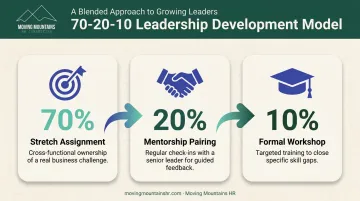
If you've ever asked what the 70-20-10 rule means for leaders, here's the short version. According to the Center for Creative Leadership, leadership growth breaks down roughly like this:
- 70% comes from challenging, on-the-job experience
- 20% comes from developmental relationships, like mentorship
- 10% comes from formal coursework and training
CCL describes this as a guideline, not a rigid formula. Still, the underlying idea holds up: classroom training alone rarely produces capable leaders.
That's why experienced consultants design blended development plans instead of defaulting to a single workshop. A practical example looks like this:
- Stretch assignment (70%): Give the manager ownership of a cross-functional project outside their comfort zone
- Mentorship pairing (20%): Connect them with a senior leader for regular, informal check-ins
- Formal workshop (10%): Enroll them in a targeted leadership training session to reinforce specific skills
Moving Mountains HR builds training programs around this same blended logic. Leadership series programs, one-on-one coaching, and workshops pair real-world scenarios with on-the-job reinforcement that changes behavior.
How to Choose the Right Leadership Consulting Partner
Not all consultants bring the same value, especially if your business operates in a regulated space. Check these factors before you sign anything:
- Industry-specific experience. Ask whether the consultant understands compliance requirements in your sector, especially healthcare.
- Flexible service offerings. Look for a partner who can scale from a single training engagement to ongoing fractional leadership support as your needs change.
- Neutrality and confidentiality. Leadership work often touches sensitive issues; trust determines whether coaching, investigations, or culture work actually sticks.
If you're not ready to commit to a full engagement, start small. A free consultation or a resource like Moving Mountains HR's California HR Compliance Checklist can surface gaps worth addressing before you invest in a bigger project.
Frequently Asked Questions
What does a leadership consultant do?
A leadership consultant assesses an organization's leadership capacity, identifies gaps, and designs strategies like coaching, succession planning, and performance systems to build stronger leaders at every level.
What is the difference between training and consulting?
Training builds specific skills through structured sessions. Consulting diagnoses broader organizational challenges and creates customized, ongoing solutions that go well beyond a single skill set.
What is the 70-20-10 rule for leaders?
It's a development framework: 70% experiential learning through real work, 20% mentorship and coaching, and 10% formal training. The mix reflects how leaders actually learn on the job.
How much does leadership consulting cost for a small business?
Costs vary based on scope, from a one-time audit to ongoing fractional support. Most consultants, including Moving Mountains HR, provide a customized quote based on your business size and needs.
How long does a typical leadership development engagement take?
Timelines range widely. A leadership assessment might take a few weeks, while fractional CHRO support often spans months or years depending on organizational goals.
Can leadership consulting help reduce employee turnover?
Yes. Strengthening leadership capability improves engagement and workplace culture, both of which are directly tied to lower voluntary turnover, according to Gallup's research on preventable exits.