Any of these leaves you exposed. State and local rules change almost every January, and a policy that was compliant in 2022 can create real liability today.
This guide breaks down whether California actually requires a handbook, which policies you can't skip, the 2025-2026 law changes worth knowing, the so-called "4-hour rule," and how to keep your handbook audit-ready year-round.
Key Takeaways
- FEHA still requires written harassment and discrimination policies once you hit 5 employees—even if a full handbook isn’t mandated
- Strong handbooks layer California rules (breaks, paid sick leave, reimbursement) on top of federal baselines
- Cannabis, reproductive loss leave, and workplace violence plan rules from 2024–2026 mean most handbooks need updates
- Reporting time pay can still owe wages when you send someone home early or cut a shift short
- Annual reviews and California-specific policies beat generic templates for cutting legal exposure
Is an Employee Handbook Legally Required in California?
Short answer: no single law forces every California employer to hand new hires a bound, 40-page handbook. But several state and federal laws create what amounts to a mandate for certain written policies, and the trigger point that catches most small businesses off guard is five employees.
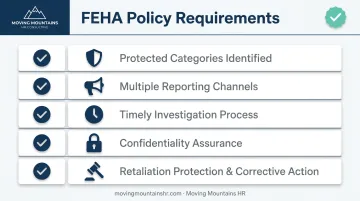
The FEHA trigger: Once you reach 5 or more employees, the Fair Employment and Housing Act requires a written policy addressing harassment, discrimination, and retaliation. That policy must:
- Identify protected categories under state law
- Offer more than one way to report a complaint
- Promise a timely, fair investigation process
- Confirm confidentiality "to the extent possible"
- Outline corrective action and protection from retaliation
Beyond FEHA, other California laws create practical documentation requirements regardless of headcount:
- Paid sick leave: Notice on pay stubs or a companion document
- Wage Theft Prevention Act: Written notice at hire covering pay rate, payday, and workers' comp carrier
Neither law technically requires a "handbook," but bundling these notices into one document is how most businesses stay organized.
Why Verbal Policies Don't Hold Up
If an employee alleges harassment, discrimination, or unpaid wages and your only defense is "we told them at a staff meeting," you have no paper trail. Agencies and courts weigh documented, distributed policies far more heavily than recollections of a hallway conversation.
That gap matters because most harassment never gets reported at all. The EEOC's national study on workplace harassment found that roughly three in four people who experienced harassment never told a supervisor, manager, or union representative.
A clear, written complaint process with multiple reporting channels directly addresses that silence.
What about businesses with just one or two employees? You're not required to build a traditional handbook, but you should still distribute core written policies covering harassment prevention, available leave, and wage practices. A two-page policy summary with a signed acknowledgment beats nothing every time.
Must-Have Policies in a California Employee Handbook
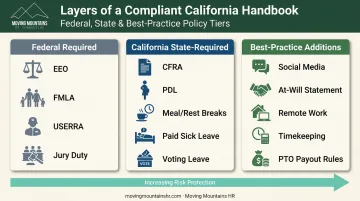
A compliant handbook layers three types of policies: federal baseline protections, California-specific requirements, and best-practice additions that reduce risk even when not strictly mandated.
Federally Required Policies
Regardless of state, most employers need to address:
- Equal Employment Opportunity: anti-discrimination protections covering race, sex, religion, national origin, disability, and age
- FMLA leave: for employers with 50+ employees, covering up to 12 workweeks of job-protected leave
- USERRA: protections for employees returning from military service
- Jury duty protections: prohibiting termination or retaliation for serving
California State-Required Policies
California layers its own leave and pay rules on top of federal law:
- CFRA leave: up to 12 workweeks for employers with 5+ employees, for eligible employees with 12+ months of service
- Pregnancy disability leave (PDL): up to 4 months for employers with 5+ employees
- Meal and rest breaks: a 30-minute meal period after 5 hours worked, plus a paid 10-minute rest break for every 4 hours
- Paid sick leave: accrual and usage rules
- Voting leave and school/child-care activity leave: for employers with 25+ employees at one location
Leave rules are only half the picture. Wage and hour classification is where many small businesses stumble.
To classify an employee as exempt under the executive, administrative, or professional test, you must pay at least twice the state minimum wage for full-time work. With the state minimum wage rising to $16.90/hour on January 1, 2026, the annual exempt salary floor climbs to $70,304 ($1,352/week).
Misclassifying an employee below that threshold is one of the fastest ways to trigger a wage claim.
Your handbook should also address Labor Code § 2802, which requires reimbursement for necessary business expenses such as:
- Cell phone use
- Mileage
- Home internet for remote staff
- Other costs employees incur doing their jobs
Recommended Best-Practice Policies
These aren't legally mandated, but skipping them creates unnecessary risk:
- Social media use and confidentiality expectations
- At-will employment statement
- Remote and hybrid work expectations
- Timekeeping procedures for non-exempt staff
- PTO and vacation accrual, use, and payout rules
The PTO payout rule catches employers off guard most often. Once vacation or PTO is earned in California, it's treated as wages.
You can cap accrual, but you cannot enforce a "use it or lose it" policy, and any unused balance must be paid out at termination. Skipping this in your handbook doesn't erase the obligation—it usually surfaces during a labor board complaint.
2025-2026 California Employment Law Updates to Reflect in Your Handbook
California's legislature doesn't sit still, and neither should your handbook. Here's what's changed recently and what still needs updating in many small business handbooks:
| Law | What Changed | Effective Date |
|---|---|---|
| SB 1137 | Recognizes discrimination based on a combination of protected traits (such as race and disability) | January 1, 2025 |
| AB 1815 (CROWN Act update) | Confirms hairstyles and hair texture, including braids, locs, and twists, are protected under race-based nondiscrimination | January 1, 2025 |
| SB 616 | Raised minimum paid sick leave from 3 to 5 days, 24 to 40 hours | January 1, 2024 |
| SB 848 | Added up to 5 days of unpaid reproductive loss leave for employers with 5+ employees | January 1, 2024 |
| AB 2188 | Protects off-duty, off-premises cannabis use | January 1, 2024 |
| SB 553 | Requires a written Workplace Violence Prevention Plan | July 1, 2024 |
A few of these deserve extra attention:
- Intersectional discrimination (SB 1137): Your anti-discrimination policy shouldn't just list protected categories individually. It needs language acknowledging that discrimination based on a combination of characteristics is also unlawful.
- Cannabis protections (AB 2188): Revise drug policies that treat marijuana metabolites as automatic violations. Off-duty, off-site use is protected; tests that only show historical use—not current impairment—generally can't support adverse action outside exempt industries.
- Workplace Violence Prevention Plan (SB 553): A "zero tolerance for violence" paragraph doesn't meet the law. Most employers need a written plan, training, an incident log, and hazard-response procedures—in the handbook or as a companion document.
Confirm your paid sick leave section uses the current 80-hour/10-day accrual cap, not the older 3-day standard still buried in many templates.
Understanding California's "4-Hour Rule" (Reporting Time Pay)
Despite the nickname, California's "4-hour rule" isn't a flat four-hour payout every time a shift gets cut short. The actual formula, set by the Industrial Welfare Commission (IWC) Wage Orders, depends on the length of the scheduled shift. Getting it wrong is an easy way to underpay employees.
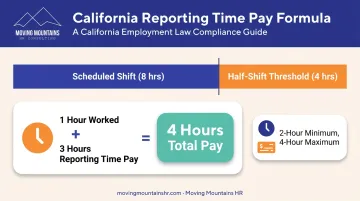
The formula: If a scheduled employee reports to work and is sent home early, they must be paid for at least half their scheduled shift at their regular rate. That amount is subject to a minimum of 2 hours and a maximum of 4 hours' pay, even if they worked less.
Example: An employee scheduled for an 8-hour shift arrives, works one hour, and gets sent home due to slow business. Half of 8 is 4, so they are owed 4 hours of pay total at their regular rate—the 1 hour worked plus 3 hours of reporting time pay.
When Reporting Time Pay Doesn't Apply
A few narrow exceptions exist:
- Public utility failures (power outages, water main breaks) beyond the employer's control
- Threats to employees or property, or civil authority recommendations to cease operations
- Acts of God, such as earthquakes or severe weather, that interrupt normal operations
Everyday reasons like "we overstaffed" or "sales were slower than expected" don't qualify for these exceptions.
Don't Forget Local Ordinances
If you operate in San Francisco, Los Angeles, Berkeley, or Emeryville, predictive scheduling ordinances may add requirements on top of the state formula:
- Advance notice of work schedules
- Extra "predictability pay" for last-minute changes
These local rules apply on top of, not instead of, state reporting time pay.
Your handbook should spell out your scheduling and reporting-pay policy in plain language, so managers and employees both understand the math before a dispute happens.
Best Practices for Keeping Your Handbook Compliant Year-Round
Treat your handbook as a living document, not a one-time project.
- Review annually, ideally each December, since most new California employment laws take effect January 1. Add a mid-year check whenever major legislation passes outside the normal cycle.
- Skip the generic template. Off-the-shelf or insurance-bundled handbooks often include sections that don't match your headcount, industry, or operations, and can create obligations you never intended.
- Collect signed acknowledgment forms every time you distribute or update the handbook. This creates the paper trail that protects you if a policy is ever challenged.
At Moving Mountains HR, we built a complimentary California HR Compliance Checklist so business owners can self-assess these gaps before they turn into claims.
For hands-on help, our consultants offer handbook audits against current California requirements, plus fractional HR support when you need ongoing guidance.
Frequently Asked Questions
Is it mandatory to have an employee handbook in California?
California does not require a full handbook for every employer, but if you have 5 or more employees, the Fair Employment and Housing Act (FEHA) requires written harassment, discrimination, and retaliation prevention policies. Most businesses still benefit from a full handbook regardless of size.
What are the changes to the California employee handbook in 2026?
2026 does not introduce sweeping new mandates, but handbooks should reflect 2024–2025 changes: expanded paid sick leave, reproductive loss leave, cannabis protections, and workplace violence prevention plans.
What is the 4-hour rule in California?
Reporting time pay requires paying employees sent home early for at least half their scheduled shift, with a 2-hour minimum and 4-hour maximum.
How often should a California employee handbook be updated?
At minimum, review it annually around January 1, plus anytime new state or local legislation affects an existing policy.
Do remote employees need to acknowledge the same handbook as in-office staff?
Yes. Remote-specific sections should address expense reimbursement, timekeeping accuracy, and data security expectations.
What happens if my handbook doesn't comply with California law?
An outdated or non-compliant handbook can be used as evidence against you in litigation, increasing exposure to wage, discrimination, and wrongful termination claims.