Introduction
A recent college graduate walks into their first professional role armed with a degree and technical skills—yet struggles with email etiquette, misses deadlines, and treats meetings as optional. Their employer sees productivity stall and starts asking why basic professionalism is so hard to find. This scenario plays out across thousands of workplaces every year.
According to NACE's 2025 data, 89.4% of employers rate professionalism as very or extremely important, yet only 50.3% believe recent graduates demonstrate it—a gap of nearly 30 percentage points.
Professionalism isn't just dressing well or using polite language. It's the behaviors, attitudes, and standards that keep a workplace respectful, productive, and ethical.
This article breaks down what professionalism means today, why it matters for careers and companies, the core elements that define it, and how employers can build cultures that hold everyone to fair, observable standards.
Why Professionalism Matters in the Workplace
Professionalism is a business-critical competency, not just a soft skill for annual reviews. It directly affects your bottom line, retention rates, and client relationships.
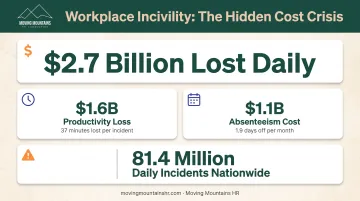
The hidden cost of unprofessional behavior adds up fast. According to SHRM's Q4 2024 research, workplace incivility costs U.S. employers an estimated $2.7 billion every single day.
Key figures from that research:
- More than $1.6 billion lost daily in productivity and over $1.1 billion in absenteeism
- 37 minutes of productivity lost per incident on average
- 1.9 days off taken in the prior month by employees who experienced or witnessed incivility
- An estimated 81.4 million daily acts of incivility nationwide
Beyond productivity losses, unprofessional conduct damages team dynamics and speeds up turnover. The fallout shows up in several places:
- Trust erodes when employees see disrespect, missed commitments, or ethical lapses
- Client relationships suffer from unclear communication, missed deadlines, or poor conduct
- Reputation built over years can be damaged by one unprofessional interaction that surfaces in reviews or on social media
Professionalism is also a foundational career competency. Employees who show consistent accountability, clear communication, and ethical conduct advance faster and earn greater trust.
Organizations that set clear behavioral standards see measurable gains. Gallup's engagement research finds that top-quartile units report:
- 10% higher customer loyalty
- 18% higher sales productivity
- 23% higher profitability
These outcomes reflect overall engagement, not professionalism alone. Still, they show how respect, accountability, and clear standards support organizational success.
For small to mid-size businesses, the stakes are even higher. You can't afford prolonged conflicts, compliance violations, or turnover costs that derail growth. Professionalism creates the stable foundation that allows your team to focus on core business activities rather than managing interpersonal crises or legal risks.
Key Elements of Professionalism
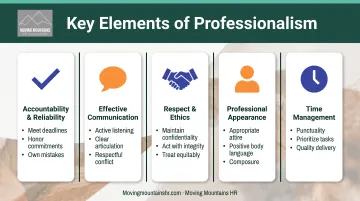
Professionalism is observable. NACE defines it through specific behaviors that contribute to workplace success:
Accountability and Reliability
Professional employees act with integrity and accountability in all business dealings. This means:
- Meeting deadlines consistently without last-minute excuses
- Honoring commitments made to colleagues, clients, and managers
- Taking ownership of mistakes rather than deflecting blame
- Following through on tasks without requiring constant reminders
- Demonstrating dependability so others can trust your word
Accountability builds the trust that holds teams together. When employees consistently deliver what they promise, projects move forward smoothly and collaboration becomes easier.
Effective Communication Skills
Clear, respectful communication is non-negotiable. NACE emphasizes:
- Active listening that shows genuine attention to others' ideas and concerns
- Clear articulation of thoughts in meetings, emails, and presentations
- Professional written communication free of slang, excessive informality, or errors
- Adapting communication for varied abilities and cultural differences
- Managing conflict respectfully rather than avoiding difficult conversations or escalating unnecessarily
Effective communicators exchange information in ways that others can understand and act upon. They recognize when a quick email suffices and when a face-to-face conversation is required.
Respect and Ethical Conduct
Respect means treating every colleague with dignity, regardless of role or seniority. This includes:
- Maintaining confidentiality when handling sensitive information
- Acting with integrity even when no one is watching
- Treating all team members equitably, not just those in positions of authority
- Avoiding gossip, public criticism, or undermining behavior
Yet respect remains elusive for many workers. Gallup's January 2025 report found that only 37% of U.S. employees strongly agreed they were treated with respect at work, matching a record low first observed in 2022. When respect is absent, engagement and productivity decline sharply.
Professional Appearance and Demeanor
While dress codes vary by industry and role, NACE advises employees to maintain a positive personal brand. This doesn't prescribe one universal standard but emphasizes:
- Appropriate attire for your workplace setting (business formal, business casual, or industry-specific norms)
- Body language that conveys engagement: eye contact, posture, and attentive presence
- Maintaining composure under pressure rather than reacting emotionally in meetings or emails
A polished appearance and calm demeanor signal respect for colleagues and clients and reinforce your credibility.
Time Management and Work Quality
Professionalism includes delivering results consistently:
- Punctuality for meetings, shifts, and deadlines
- Prioritizing tasks effectively so high-value work gets done first
- Attention to detail that prevents errors and rework
- Consistently delivering high-quality work, not just meeting minimum standards
NACE describes this as being present and prepared, prioritizing and completing tasks, meeting expectations, and attending to detail. These behaviors separate employees who merely show up from those who contribute meaningfully.
How to Develop Professionalism in Your Organization
Professionalism doesn't happen by accident. It requires intentional systems, clear expectations, and ongoing reinforcement.
Establish Clear Standards Through Written Policies
Start with an employee handbook and code of conduct that define expected behaviors in plain language:
- Outline communication protocols (response times, tone, appropriate channels)
- Define accountability standards (deadlines, follow-through, ownership of mistakes)
- Specify workplace etiquette (meeting conduct, use of technology, respectful language)
- Clarify consequences for violations
Written standards eliminate ambiguity and give you a reference point when issues arise. Moving Mountains HR helps organizations build compliant policies through Fresh Compliance Docs and HR Document Audit. The audit reviews existing handbooks and recommends updates based on regulatory requirements.
Implement Comprehensive Onboarding Programs
Professionalism expectations must be introduced on day one. Effective onboarding includes:
- Orientation sessions that cover workplace norms, communication protocols, and cultural values
- Pairing new hires with onboarding buddies who model professional behavior and answer questions
- Role-specific expectations so new hires know what professionalism looks like in their job
Microsoft's 600-employee onboarding-buddy pilot found that new hires with buddies reported 23% higher onboarding satisfaction after one week and 36% higher satisfaction at 90 days compared to those without buddies.
The benefit scaled with contact frequency: 97% of new hires who met with buddies more than eight times in 90 days said the buddy helped them become productive, versus just 56% who met once.

Create Professional Development Training Opportunities
One-time training isn't enough. Build ongoing development through:
- Workshops on communication skills, time management, and workplace etiquette
- Mentorship programs that pair junior employees with seasoned professionals
- Skill-building sessions focused on conflict resolution, feedback delivery, and emotional intelligence
Moving Mountains HR offers Training & Development Programs on leadership, communication, respectful workplace practices, performance management, and conflict resolution. Sessions run virtually or in person.
Provide Regular Feedback and Performance Reviews
Reinforcing professional standards requires consistent feedback:
- Deliver constructive feedback promptly when standards aren't met
- Recognize and praise employees who show professional growth
- Address unprofessional behavior immediately rather than letting it fester
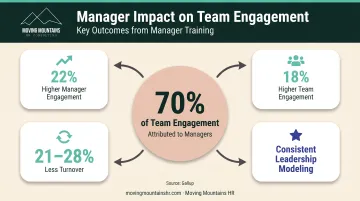
Gallup's 2022 manager-development analysis found that trained managers improved their own engagement by up to 22% and their teams' engagement by up to 18%, with 21%–28% less turnover in trained-manager groups versus comparison groups. Ongoing manager development, not one-time training, drives these results.
Lead by Example
Managers and executives must model professional behavior consistently. Gallup attributes at least 70% of team-level engagement variance to managers. If leadership arrives late to meetings, ignores emails, or treats colleagues disrespectfully, employees will follow suit regardless of what the handbook says.
Leaders who demonstrate accountability, clear communication, respect, composure, and high-quality work set the tone for the entire organization.
Common Professionalism Challenges and How to Address Them
Even with clear standards, professionalism challenges arise. Here's how to handle the most common issues.
Inappropriate Technology Use
Personal device usage during work hours, scrolling social media in meetings, and unprofessional online communications disrupt productivity and signal disengagement.
How to address it:
- Establish clear technology policies specifying when and where personal devices are acceptable
- Define expectations for digital communication tone and channels
- Address violations promptly through private conversations and documentation
- Monitor patterns rather than isolated incidents
Lack of Accountability or Follow-Through
Employees who consistently miss deadlines, make excuses, or fail to deliver undermine team performance.
How to address it:
- Use documentation systems to track commitments, deadlines, and outcomes
- Set clear expectations in writing for every project and task
- Apply progressive discipline when necessary: verbal warning, written warning, performance improvement plan, termination
- Ensure consistency—don't excuse some employees while punishing others
Disrespectful or Entitled Attitudes
76% of U.S. workers experienced or witnessed incivility in SHRM's Q4 2024 research, with 56% of that group reporting incidents while working. Left unchecked, that behavior erodes trust and drags down team performance.
How to address it:
- Address conflict promptly through private, documented conversations
- Set clear boundaries about acceptable language, tone, and conduct
- Escalate to HR when behavior crosses into harassment or discrimination
- Engage a neutral third-party investigator for impartial fact-finding when internal handling isn't appropriate or the allegation is serious
When you need that outside fact-finding, Moving Mountains HR conducts neutral workplace investigations covering harassment, discrimination, retaliation, misconduct, and code-of-conduct issues.
Punctuality and Attendance Issues
Chronic lateness and excessive absenteeism disrupt workflows and burden colleagues.
How to address it:
- Use tracking systems to monitor attendance patterns
- Enforce policies consistently across all employees
- Understand when accommodation may be legally required (medical conditions, disabilities, religious observance)
- Document all conversations and corrective actions
Generational Differences in Professionalism Expectations
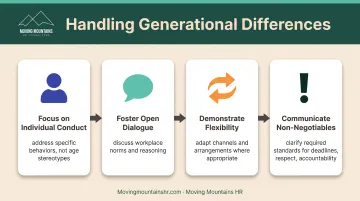
Resist the temptation to blame "millennials" or "Gen Z" for professionalism gaps. A 2020 organizational-science review concludes that generational categories are weak bases for HR policy because age, period, cohort, and individual differences are confounded. The review recommends abandoning generation-based management.
Instead:
- Focus on specific conduct and individual needs rather than stereotypes
- Foster open dialogue about workplace norms and why they matter
- Demonstrate flexibility where appropriate (e.g., communication channels, work arrangements)
- Communicate non-negotiable standards clearly (e.g., deadlines, respect, accountability)
The Employer's Role in Fostering Professionalism
Employers can't demand professionalism from employees while tolerating unprofessional conduct from management. Professionalism must flow both ways.
Create a Culture of Mutual Respect
Respect starts at the top. When only 37% of employees strongly agree they are treated with respect, individual conduct is only part of the story. Organizational culture drives the rest. Gallup found that engaged employees were five times more likely to strongly agree they were respected, though the causal direction isn't established.
How to build respect:
- Model respectful communication and behavior at every level
- Address disrespectful conduct from managers as seriously as from frontline staff
- Create mechanisms for employees to report disrespect safely
- Recognize and reward respectful behavior publicly
Provide Resources and Support for Professional Development
Professionalism grows through investment:
- Offer access to training programs, workshops, and coaching
- Provide clear career pathways so employees see how professionalism advances their goals
- Invest in manager development through continuing practice, resources, and follow-up (not one-time courses)
Moving Mountains HR offers flexible HR support tiers: Passive (email/phone support), Active & Passive (participation in HR meetings), and Premium (fractional CHRO services). Growing organizations can build professional development systems without hiring a full-time HR executive.
Address Unprofessional Behavior Consistently and Fairly
Inconsistent enforcement undermines any professionalism initiative. EEOC guidance emphasizes prompt, appropriate correction of unlawful harassment, and the same principle applies to unprofessional conduct generally.
Best practices:
- Investigate complaints promptly (EEOC's federal-sector benchmark: begin within 10 calendar days of awareness)
- Document all steps: complaint intake, interviews, evidence collection, findings
- Apply consequences consistently across all employees regardless of role or seniority
- Bring in neutral third-party investigators when serious misconduct or repeated unprofessional behavior continues
That 10-day figure is a federal-sector benchmark, not a universal private-sector legal deadline.
Moving Mountains HR conducts formal, impartial workplace investigations covering harassment, discrimination, retaliation, misconduct, hostile work environments, and related code-of-conduct issues. The process includes confidentiality protections, anti-retaliation education, and detailed findings reports that support fair resolution.
Modern Professionalism Considerations
Professionalism still rests on integrity and respect, but remote work, industry norms, and anti-discrimination rules change how those standards show up day to day.
Professionalism in Remote and Hybrid Work Environments
Virtual work introduces new challenges:
- Virtual meeting etiquette: OPM advises giving meetings full attention and avoiding multitasking or reading email during calls
- Work-life boundaries: Establish clear availability expectations and respect off-hours unless urgent
- Professional digital communication: Maintain tone, grammar, and clarity in emails, chats, and video calls
- Confidentiality: Ensure sensitive conversations occur in private spaces, not coffee shops or shared home offices
Adaptation for Different Industries and Cultures
Not every workplace requires the same dress code or formality level. A tech startup's standards will differ from a law firm's, and teams that span regions or cultures may read punctuality, directness, or small talk differently.
Preserve the same core behaviors (integrity, preparation, dependability, and respectful communication). Adapt appearance, scheduling, and communication style to the actual work context.
Inclusive Professionalism That Doesn't Discriminate
Professionalism policies must not discriminate based on protected characteristics. EEOC guidance restricts certain practices:
- Accent-based decisions: Permitted only where the accent materially interferes with job performance
- Religious dress and grooming: Employees should request religious accommodation; employers must provide it unless it causes undue hardship
- Appearance standards: Audit for job relevance and protected-class effects
Anchor standards in observable behaviors: punctuality, quality, communication clarity, and accountability. Skip subjective calls on appearance, accent, or personal expression when they don't affect work quality.
Frequently Asked Questions
What are the key elements of professionalism?
NACE names five core elements: accountability and reliability, effective communication, respect and ethical conduct, professional appearance and demeanor, and time management with strong work quality. In practice, that means meeting commitments, listening well, acting with integrity, presenting yourself appropriately, and delivering careful, on-time work.
What are some good professional development topics?
Useful topics include communication skills, time management, conflict resolution, emotional intelligence, business etiquette, and leadership for individual contributors and managers. These build the day-to-day habits that make professionalism stick.
How should employers handle unprofessional behavior in the workplace?
Address issues promptly in private, documented conversations that name the behavior and the expected change. Follow progressive discipline consistently, respect employment law on harassment and discrimination, and involve HR or outside investigators when the situation warrants it.
What legal considerations should employers keep in mind regarding professionalism standards?
Policies must not discriminate against protected classes and must be applied consistently to everyone. Appearance or communication rules may need legal review for disparate impact, and harassment or discrimination requires formal investigation—consult employment counsel or HR when you are unsure.
How is professionalism different in remote work environments?
Remote work puts more weight on virtual etiquette, self-managed productivity, and digital work-life boundaries. Dress appropriately for video, stay focused on calls, keep email professional, and honor deadlines even when schedules are flexible.
When should a company bring in an outside HR consultant for professionalism issues?
Bring in outside help for serious misconduct allegations, patterns that internal efforts have not fixed, or when you need a neutral investigation and stronger documentation. Moving Mountains HR provides workplace investigations, compliance audits, policy development, and fractional CHRO support for small and mid-size businesses.
Clear standards, solid onboarding, consistent follow-through, and leaders who model respect build a workplace where employees thrive and clients trust you.
Moving Mountains HR supports policy development, training, workplace investigations, and ongoing HR needs for businesses of all sizes. Contact us at 866-474-3575 or staff@movingmountainshr.com to discuss next steps.