Introduction: Understanding Organizational Culture in Healthcare
In the American Medical Association's 2025 Organizational Biopsy data, 41.9% of physicians reported at least one burnout symptom across nearly 19,000 responses from 106 organizations in 38 states. That figure points to a workforce under strain, where culture either protects staff well-being or speeds burnout.
Organizational culture—the shared beliefs, values, attitudes, and daily behaviors shaping your workplace—directly influences patient safety, employee retention, compliance risk, and financial performance. For small to mid-size healthcare organizations, culture isn't just an HR concern; it's a measurable driver of outcomes.
This guide covers how culture shows up in daily clinical work, why it affects safety and retention, and how smaller healthcare organizations can strengthen it without a large HR team.
Key Takeaways:
- Stronger healthcare culture supports patient safety; engagement links to fewer errors
- RN turnover averaged 17.6% in 2026, costing about $60,090 per bedside nurse
- Joint Commission requires valid safety-culture measurement, not optional surveys
- Culture change needs leadership modeling, staff voice, and real values alignment
- Small organizations can improve culture with feedback, recognition, and fractional HR support
What Is Organizational Culture in Healthcare?
Organizational culture in healthcare is the shared ways of thinking, feeling, and behaving across your organization. Posters and mission statements rarely capture it. Real culture shows up when leadership isn't in the room, how staff respond when a mistake occurs, and whether nurses feel safe raising concerns during morning huddles.
Three Levels of Culture
Culture operates at three distinct levels:
- Visible artifacts and behavior: How meetings run, what gets recognized, who speaks first
- Shared values and beliefs: Stated priorities around patient care, teamwork, and accountability
- Unconscious assumptions: Deeper, often unexamined beliefs about hierarchy, knowledge, power, and patient roles
The gap between your stated values (what's on the wall) and your actual culture (what happens in the halls) determines whether employees trust leadership and whether patients receive consistent, high-quality care.
Healthcare-Specific Complexity
Healthcare organizations contain overlapping subcultures divided by specialty, occupation, hierarchy, and service line:
- Emergency department staff operate under different norms than outpatient clinic teams
- Physicians and nurses may interpret "collaboration" differently
- Administrative leaders may promote values floor staff have never experienced
These groups may support or obstruct quality improvement depending on how well the broader culture acknowledges their realities.
Regulatory and Safety Context
Unlike other industries, healthcare culture is constrained by patient-safety duties and accreditation standards. The Joint Commission requires hospital leaders to measure safety culture with valid tools, establish safety processes, address intimidation, and prevent workplace violence. Culture is not optional. Regulators treat it as an inspectable element of your risk-management and compliance systems.
Why Organizational Culture Matters in Healthcare
Culture shows up in safety scores, burnout rates, turnover costs, and accreditation risk—not as a soft topic on the side. The evidence below ties those outcomes to measurable workforce conditions.
Patient Safety and Quality of Care
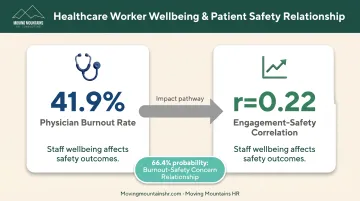
A 2021 meta-analysis covering 11 studies and 30,490 healthcare workers found a small but significant association between staff engagement and patient safety (r=0.22; 95% CI 0.07-0.36). While this correlation doesn't prove that engagement programs prevent errors, it supports measuring culture alongside incident data rather than treating them as separate initiatives.
A 2019 meta-analysis found burnout related to patient-safety actions, with a 66.4% probability of superiority, meaning burned-out clinicians were more likely to be involved in safety concerns. When staff are exhausted, communication breaks down, attention narrows, and error risk rises.
Employee Wellbeing and Burnout
The AMA's 2025 data showed 41.9% of physicians reported burnout symptoms, a slight decline from 43.2% in 2024 but still representing nearly half the workforce. Physician job satisfaction was 77% in 2025, statistically unchanged from the prior year.
These figures show that workforce indicators can move independently. Satisfaction may hold steady while burnout stays elevated, so track multiple wellbeing measures instead of one engagement score.
Healthcare work is inherently high-stress, involving life-and-death decisions, emotional labor, unpredictable demands, and regulatory scrutiny. A 2023 systematic review linked nurses' job stress with weaker safety culture, reinforcing that workload and wellbeing are culture conditions, not side issues.
Recruitment and Retention Challenges
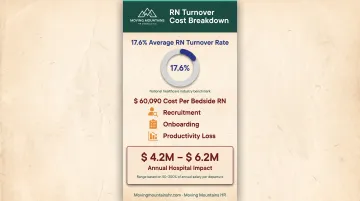
The 2026 NSI National Health Care Retention Report found RN turnover averaged 17.6%, with an estimated replacement cost of $60,090 per bedside RN. For a typical hospital, that translates to $4.2 million to $6.2 million annually in turnover-related losses. These figures come from survey data, not universal accounting costs, and they illustrate why retention-focused culture work has real financial weight.
Turnover costs generally range from 50% to 200% of an employee's annual salary, depending on role complexity, onboarding time, and productivity loss. Losing experienced nurses or physicians means losing institutional knowledge, continuity of care, and team cohesion. Those losses weaken culture further and speed up the next wave of departures.
Compliance and Risk Management
Joint Commission hospital standards require leaders to:
- Measure safety culture with valid tools
- Establish safety processes across the organization
- Address intimidating and disruptive behavior
- Prevent workplace violence
These are accreditation requirements, not optional best practices. A weak culture raises exposure to regulatory citations, workplace-violence incidents, harassment claims, and patient-safety events—each with financial and reputational cost.
Bottom-Line Impact
BMJ reports a consistently positive association between culture and outcomes across healthcare settings, but also cautions that no single culture type works everywhere and no quick fix exists. You can't copy another organization's values and expect instant results.
Instead, track specific operational indicators:
- Labor costs: Overtime, agency use, vacancy rates
- Safety events: Incident reports, near misses, harm events
- Patient satisfaction: HCAHPS scores and complaint trends
- Throughput: Length of stay, appointment availability, surgical case volume
- Retention: Voluntary turnover by role, unit, and tenure
Culture influences these outcomes, but shifts in the metrics need analysis, not assumption, before you credit a culture intervention.
Key Elements of a Strong Healthcare Organizational Culture
Strong healthcare cultures rest on a few operational building blocks. Each one shows up in daily practice, not only in handbooks or wall posters.
Clear Mission, Vision, and Values
Cleveland Clinic's official values state that caregivers care for patients and each other, promoting teamwork, engagement, and integrity. Patient focus is explicitly paired with how employees treat one another, rather than being treated as a patient-only program.
Your mission and values must:
- Define organizational purpose in concrete terms
- Align individual roles with enterprise goals
- Appear in hiring, onboarding, performance reviews, and recognition
- Be reinforced by leadership behavior, not just HR posters
Patient-Centered Care Philosophy
Culture shapes whether "patient-centered care" means shared decision-making, family involvement, and respect for patient preferences, or simply a marketing slogan. Observable patient-first practices include:
- Rounding protocols that invite patient input
- Care plan discussions that include family members
- Service recovery processes when things go wrong
- Leadership visibility on patient units
Open Communication and Transparency
Psychological safety, the belief that you can speak up without punishment, requires structured communication channels, not just good intentions. AHRQ describes 10-15 minute interdisciplinary huddles with consistent timing and visual boards. Strong huddles invite every member to raise safety concerns, assign follow-up, and use the Concern-Uncomfortable-Safety Event escalation language.
Effective communication structures include:
- Daily safety huddles at the unit level
- Anonymous reporting systems with visible follow-up
- Leadership rounding with direct-care staff
- Transparent incident reviews that focus on system fixes, not blame

Recognition and Appreciation
The DAISY Award is one widely recognized nursing recognition program. The American Organization for Nursing Leadership's 2024 summary identifies meaningful recognition as a strategic priority for chief nursing officers, though it does not supply a universal ROI estimate.
Recognition strategies that improve morale and retention:
- Peer-nominated awards tied to organizational values
- Real-time acknowledgment during huddles or staff meetings
- Written thank-you notes from leadership
- Career milestone celebrations
- Public recognition in newsletters or digital channels
Avoid generic "employee of the month" programs that feel arbitrary. Recognition must be specific, timely, and connected to observable contributions.
Professional Development and Growth
A 2020 evidence-based project used structured mentorship with an established nursing clinical ladder and reported improved engagement and satisfaction. While not a national retention benchmark, it illustrates how combining mentorship with clear advancement pathways can strengthen culture.
Development opportunities include:
- Continuing education reimbursement
- Leadership development programs for front-line supervisors
- Clinical ladder or career progression frameworks
- Mentorship pairing new hires with experienced staff
- Tuition assistance for advanced degrees or certifications
Investment in staff development signals organizational commitment, reduces skill gaps, and builds internal talent pipelines that protect continuity during turnover.
Work-Life Balance and Wellness Support
Allegheny Health Network's RetuRN to Practice program required only 8 hours per pay period in 2-hour increments, with structured refresher training for nurses returning to bedside care. The initial 30 nurses remained employed, and a later cohort had 90% retention. While this small case involved lower wages and no benefits, and lacked a control group, it shows how flexible scheduling paired with skill support can retain experienced staff.
The AMA's Joy in Medicine program offers a system-level physician wellbeing framework, while the American Hospital Association reports that healthcare workers seek flexibility, wellbeing support, and participation in decisions. These findings support organization-level rather than resilience-only framing. Culture change requires operational adjustments, not just wellness apps.
Wellness strategies include:
- Flexible scheduling options where clinically feasible
- Mental health resources and employee assistance programs
- Peer support groups for high-stress roles
- Adequate break rooms and rest areas
- Workload monitoring and staffing adjustments
How to Build and Improve Organizational Culture in Healthcare Settings
Assess Your Current Culture
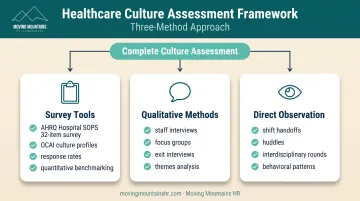
You can't improve what you haven't measured. Begin with a baseline assessment using multiple methods:
Survey tools:
- AHRQ Hospital SOPS 2.0: 32-item safety-culture survey covering teamwork, staffing, learning, error response, leadership support, communication, and handoffs
- Organizational Culture Assessment Instrument (OCAI): profiles clan, adhocracy, market, and hierarchy cultures (2020 hospital validation: Cronbach alpha 0.60–0.80)
Qualitative methods:
A 2021 review of 694 hospital safety-culture studies found only 31 used qualitative or mixed methods (23 included interviews; 9 used focus groups).
Qualitative assessment explains what percent-positive scores cannot: why staff skip near-miss reports, or which leadership behaviors erode psychological safety.
Observation:
Attend shift handoffs, huddles, and interdisciplinary rounds. Observe who speaks, who interrupts, how questions are received, and whether concerns are followed up or dismissed.
Identify gaps between your stated values and actual daily practice. If your values emphasize "respect" but senior physicians routinely interrupt nurses, that is a cultural gap, not a training problem. It requires leadership intervention.
Engage Leadership and Secure Buy-In
Culture change fails without visible, sustained leadership commitment. Leaders must model desired behaviors, participate in culture initiatives, and hold peers accountable for conduct violations.
How to secure leadership buy-in:
- Present financial data: turnover costs, safety-event expenses, compliance risk
- Connect culture to strategic priorities: patient satisfaction, staff retention, accreditation readiness
- Use peer comparisons: AHRQ's 2024 database shows 68% of hospitals rated unit safety "Excellent" or "Very Good." How does your organization compare?
- Assign executive sponsors to culture initiatives
- Include culture metrics in leadership performance evaluations
For organizations without dedicated HR leadership, a fractional CHRO or external HR consultant can guide strategy, facilitate leadership discussions, and support culture-transformation planning without a full-time executive hire.
Moving Mountains HR provides fractional CHRO support for small and mid-size healthcare organizations, including HR meeting participation, performance management guidance, and culture-development planning.
Implement Targeted Initiatives Based on Assessment
Start small and build momentum with quick wins rather than attempting enterprise-wide transformation immediately.
Examples of culture-building initiatives:
- Onboarding improvements: Extend orientation, assign peer mentors, schedule 30-60-90 day check-ins
- Recognition systems: Launch peer-nominated awards tied to organizational values
- Communication channels: Establish daily safety huddles using AHRQ's structured format
- Performance feedback: Train supervisors in real-time coaching and constructive feedback
- Career pathways: Implement clinical ladders or competency-based advancement
Focus on 2-3 initiatives that address your highest-priority gaps, measure results quarterly, and adjust based on feedback.
Foster Continuous Feedback and Adaptation
Culture is dynamic, not static. Build mechanisms for ongoing staff input and culture monitoring:
- Stay interviews: Regularly ask current employees what keeps them engaged and what concerns them
- Exit interviews: Standardize questions, track themes, and close the loop by addressing recurring issues
- Pulse surveys: Short, frequent check-ins supplement annual engagement surveys
- Leadership rounding: Structured conversations with front-line staff about unit-level concerns
- Feedback loops: Communicate what you heard and what actions you're taking in response
IHI's Joy in Work approach starts by asking staff what matters most, then jointly identifying barriers. That structure keeps employee voice at the center of culture improvement.
Common Challenges in Healthcare Organizational Culture
Leadership Turnover and Inconsistency
A 2025 systematic review of hospital CEO turnover found heterogeneous evidence that does not support a single quantified effect on culture. However, frequent leadership changes disrupt culture-building efforts by introducing competing priorities, changing communication norms, and eroding staff trust.
Strategies for maintaining cultural continuity:
- Document decision rights, priorities, and communication protocols
- Use planned interim leadership rather than rushed external hires
- Maintain internal talent pipelines through succession planning
- Identify critical roles and develop successors proactively
- Preserve key culture initiatives across leadership transitions
A 2024 healthcare succession review frames succession planning as a deliberate system for leadership continuity, not a scramble to recruit after someone resigns. That distinction is what keeps culture intact when leaders change.
Resistance to Change Among Staff
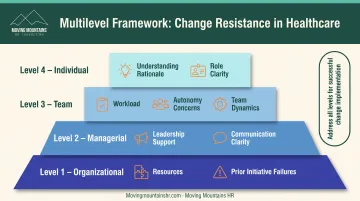
A 2023 nursing integrative review treats resistance as multilevel, not simple unwillingness. Staff may push back because prior initiatives failed, time and resources are thin, the rationale is unclear, or they fear losing autonomy.
Approaches for addressing resistance:
- Involve staff early in planning and decision-making
- Communicate transparently about why changes are needed
- Provide role-specific education and support
- Ensure managers actively champion initiatives
- Allocate adequate time and resources for implementation
- Create feedback loops so staff see their input matters
BMJ warns that healthcare cultures are only partly manageable and that culture reform cannot replace adequate resources. Don't blame staff culture for structural staffing or workload failures; fix the root causes.
Balancing Multiple Priorities in Resource-Constrained Environments
Small to mid-size healthcare organizations often lack dedicated HR departments, making culture initiatives feel out of reach. However, cost-effective strategies exist:
- Model desired values, hold consistent expectations, and address conduct issues promptly (commitment, not budget)
- Improve huddles, staff meetings, and one-on-ones instead of launching new programs
- Start peer-nominated recognition that costs little but raises visibility and morale
- Use free tools such as AHRQ’s Hospital SOPS survey and NIOSH’s Worker Well-Being Questionnaire
- Bring in fractional CHRO or HR consulting support for strategy without full-time executive overhead
Measuring the Effectiveness of Your Organizational Culture
Culture shows up in retention, safety, and patient experience—but only if you measure it on purpose. Combine engagement surveys, operational indicators, and qualitative listening so you can see trends, spot root causes, and act before problems harden into turnover or harm.
Employee Engagement and Satisfaction Metrics
Use consistent instruments over time to track trends rather than single snapshots:
- Safety culture: AHRQ Hospital SOPS; 2024 database benchmark: 68% rated unit safety "Excellent" or "Very Good"
- Engagement: Gallup Q12, UWES, or validated healthcare-specific engagement tools
- Burnout: Maslach Burnout Inventory or single-item burnout measures
- Wellbeing: NIOSH WellBQ (work experience, policies/culture, safety climate, health, home/community)
Survey data alone can't explain outcomes—pair with qualitative listening and operational indicators.
Operational and Clinical Outcome Indicators
Operational metrics show whether culture is helping or hurting day-to-day performance:
| Metric | Definition | Benchmark/Note |
|---|---|---|
| RN turnover | Voluntary and involuntary departures by role, unit, tenure | Recent NSI National Health Care Retention & RN Staffing Report: ~16–18%; define denominator carefully |
| Patient satisfaction | HCAHPS scores and complaint trends | CMS updates four times yearly; indirect culture measure only |
| Safety events | Incident reports, near misses, harm events, reporting volume | More reports may reflect safer reporting culture, not worse care |
| Vacancy and agency use | Open positions, time to fill, reliance on temporary staff | Rising agency use signals retention or recruitment problems |
| Overtime and labor hours | Worked hours per service, adjusted for volume and acuity | Persistent overtime indicates staffing or workload issues |
Track baseline and monitor quarterly. Use statistical process control charts to distinguish normal variation from meaningful change.
Qualitative Assessment Methods
Metrics show what is changing; qualitative input explains why:
- Exit interviews: Standardize questions, maintain confidentiality, track themes, and review trends with leadership
- Stay interviews: Ask what keeps people and what concerns them; peer-led nurse stay interviews have surfaced actionable themes in practice settings
- Focus groups: Small-group discussions with front-line staff about specific culture issues
- Leadership rounding: Structured conversations using consistent questions and documented follow-up
Feed themes into concrete changes—staffing rules, recognition, escalation paths—then tell staff what you heard and what you changed. That closed loop is itself a culture signal.
Frequently Asked Questions
What is the role of organizational culture in healthcare?
Organizational culture influences patient care quality, staff satisfaction, safety outcomes, and organizational performance by shaping how employees communicate, make decisions, respond to errors, and prioritize competing demands.
What are the four main types of organizational culture?
The Competing Values Framework identifies four types: clan (collaborative, team-focused), adhocracy (creative, adaptive), market (competitive, results-focused), and hierarchy (rule-based, process-focused). Healthcare organizations often blend multiple types depending on service line and role, rather than fitting neatly into one category.
What are five examples of organizational culture?
Examples include whether morning huddles invite safety concerns, nurses feel safe questioning orders, leaders act quickly on reports, reviews reward teamwork or only individual metrics, and mistakes trigger blame or system fixes.
What are the 7 main elements of organizational culture?
Seven practical elements include: values (shared beliefs justifying behavior), norms (accepted "way things are done"), assumptions (unconscious beliefs about roles and power), symbols (visible artifacts and arrangements), language (communication patterns and terminology), narratives (stories explaining what is done and why), and practices (care pathways and associated behavior).
What are the four C's of cultural competence in healthcare?
The Campinha-Bacote model has five constructs, not four: cultural awareness (examining biases), cultural knowledge (learning about diverse groups), cultural skill (culturally based assessments), cultural encounters (cross-cultural interactions), and cultural desire (motivation to engage).
How can small healthcare organizations improve culture with limited resources?
Prioritize low-cost moves: leaders model desired values, strengthen existing communication channels, tie peer recognition to those values, and use free tools such as AHRQ Hospital SOPS. Fractional CHRO or external HR support can add strategy without a full-time executive hire.
A strong organizational culture in healthcare is a measurable driver of patient safety, employee retention, compliance risk, and financial performance. Whether you are addressing burnout, turnover, or accreditation readiness, culture change needs leadership commitment, staff voice, valid measurement, and sustained effort.
For small to mid-size healthcare organizations, fractional HR leadership can supply that expertise without a full-time executive. Moving Mountains HR offers fractional CHRO services, performance management support, workplace investigations, and customized training tailored to healthcare organizations so you can build a compliant, engaged, and patient-focused culture.