
Introduction
Picture two longtime team members who've stopped collaborating. One escalates to HR, citing unprofessional behavior. HR launches an investigation, determines fault, documents a formal warning, and sends everyone back to work. The team members now sit in separate corners at meetings, productivity drops, and within six months, one resigns.
This scenario plays out daily across workplaces. Traditional punitive approaches establish consequences but rarely repair the relationships that make teams function. Restorative practices offer a different path. They ask who was affected, what those people need, and how the team moves forward together.
Rooted in restorative justice, these approaches trade blame for dialogue, accountability, and relationship repair. Workplace conflict becomes a chance to learn and rebuild trust, not only a rule violation to document.
In a business environment where 76% of U.S. workers have experienced or witnessed incivility, and 26% say they're likely to leave because of it, unresolved conflict costs far more than one difficult conversation.
Key Takeaways
- Repair workplace relationships through structured dialogue instead of blame
- Workplace conflict costs U.S. employers billions each year in lost productivity, turnover, and absenteeism
- Give affected parties a voice, use forward-looking accountability, and solve problems together
- Start with restorative circles, trained facilitators, and ties to existing HR processes
- Small teams can begin by training key leaders and using simple check-in practices
What Are Restorative Practices in the Workplace?
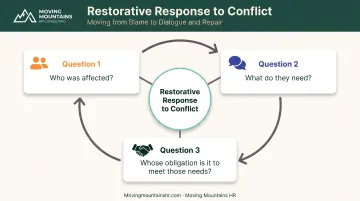
Restorative practices represent a framework rooted in restorative justice principles that emphasizes dialogue, accountability, healing, and relationship repair. When harm occurs, these practices ask three questions: Who was affected? What do they need? Whose obligation is it to meet those needs?
This approach moves away from punitive "crime and punishment" models toward collaborative problem-solving. Instead of treating conflicts only as rule violations that need proportional consequences, restorative practices treat them as disruptions to workplace relationships that need repair.
Restorative justice vs. restorative practices:
- Restorative justice originated in criminal justice contexts, addressing serious harm through victim-offender dialogue and community accountability
- Restorative practices apply these principles more broadly in organizational settings, including proactive relationship-building and conflict prevention
The philosophy treats conflicts as opportunities for learning and growth—not only as violations to punish. When organizations respond to workplace disputes by bringing affected parties together in structured dialogue, they create conditions for understanding root causes, acknowledging impact, and rebuilding working relationships.
That gap shows up clearly in the data. Only 36% of UK employees who experienced workplace conflict in the prior year said it was fully resolved, even though 70% of employers believed their conflict procedures were effective. US employers face the same pattern: traditional processes often document an outcome without repairing the working relationships teams still need day to day.
Restorative accountability is forward-looking. It asks people to own the impact of their actions and commit to specific steps that prevent recurrence and restore trust.
The Business Case: Why Restorative Practices Matter for Small and Mid-Sized Businesses
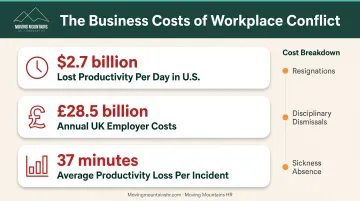
Workplace conflict carries tangible financial consequences that small and mid-sized businesses can't afford to ignore. SHRM estimated that incivility alone costs U.S. employers more than $2.7 billion per day in lost productivity and absenteeism, with workers reportedly losing an average of 37 minutes of productivity per incident.
In the UK, workplace conflict cost employers an estimated £28.5 billion annually, including £11.9 billion from resignations, £10.5 billion from disciplinary dismissals, and £2.2 billion from sickness absence. While U.S.-specific cost models differ, the pattern is consistent: unresolved conflict drives turnover, absenteeism, and disengagement.
Why restorative practices improve retention and engagement:
- Give employees psychological safety to raise concerns early, before issues harden into formal disputes
- Strengthen belonging through inclusive dialogue that shows every voice counts
- Cut repeat conflict by repairing relationships instead of only documenting blame
- Hold people accountable through repair, so mistakes can be owned without fear-driven silence
Results from Mersey Care NHS show what a structured restorative approach can deliver. After implementation, disciplinary and suspension cases fell from 66 to 37 across two units, and voluntary incident reporting rose 7–18% each year.
The organization estimated roughly £2.5 million in economic benefit. Researchers cautioned that the observational design and short follow-up limit how far those findings should be generalized—but the direction of travel matters for U.S. small and mid-sized employers watching turnover, sick leave, and investigation load.
For small and mid-sized businesses, that translates into a practical payoff: fewer damaged working relationships, lower replacement costs, and less time lost when conflict shows up. Preserving the team you already have is often cheaper than replacing it.
Core Principles of Restorative Practices
Inclusivity and Voice
Restorative practices ensure all affected parties have the opportunity to be heard and participate in resolution. Rather than limiting involvement to the people directly in conflict, these approaches bring in anyone meaningfully impacted—team members who witnessed the harm, colleagues whose work was disrupted, or supervisors whose trust was affected.
Equitable participation gives everyone genuine access to the conversation, not equal airtime. Structured formats, such as using a talking piece that passes from person to person, create space for quieter voices and prevent dominant personalities from controlling the outcome.
Accountability and Responsibility
Accountability in restorative settings is different from blame. Individuals take ownership of their actions and their impact on others, moving beyond defensive justifications to genuine understanding. This requires naming what happened, acknowledging who was affected, and committing to specific repair actions.
Forward-looking accountability asks: What will you do to address the harm? How will you prevent this from happening again? What support do you need to follow through? These questions shift energy from judgment to collaborative problem-solving.
Focus on Relationships and Repair
The goal is restoring workplace relationships and trust, not determining winners and losers. Restorative practices recognize that in most workplace conflicts, people must continue working together after the process concludes.
A resolution that leaves one party vindicated and the other resentful creates a hollow victory that undermines long-term team function.
Repair might include:
- Direct apologies with acknowledgment of specific impact
- Commitments to changed behavior with clear accountability measures
- Agreements about communication norms or work boundaries
- Follow-up conversations to assess whether trust is rebuilding
Relationship repair doesn't always mean friendship or closeness. In many cases, it means reestablishing the baseline respect and cooperation required for professional collaboration.
How to Implement Restorative Practices in Your Organization
Implementing restorative practices works best in phases. Treat them as an addition to your HR system, not a swap-out for investigations, documentation, or compliance requirements.
Assess Your Current Conflict Resolution Approach
Start by evaluating your existing disciplinary policies and conflict-resolution procedures. Ask:
- When conflicts arise, do current processes address root causes or just immediate symptoms?
- Do employees trust that they'll be heard fairly if they raise concerns?
- Are managers equipped to facilitate difficult conversations, or do they default to escalation?
- What percentage of conflicts result in formal complaints, investigations, or turnover?
Document your current approach: written policies, informal manager practices, investigation protocols, and typical outcomes. Then mark the gaps where restorative methods could strengthen what you already do.
When restorative practices are appropriate:
- Interpersonal conflicts between team members who must continue working together
- Communication breakdowns affecting team performance
- Situations where harm occurred but all parties are willing to participate in dialogue
- Performance concerns rooted in relationship or communication issues
When traditional HR processes remain necessary:
- Serious policy violations involving threats, violence, or safety risks
- Legally mandated harassment or discrimination investigations
- Situations where power imbalances or fear of retaliation make voluntary dialogue unsafe
- Compliance requirements that demand formal fact-finding and documentation
Start with Restorative Circles
Restorative circles are structured dialogue sessions where participants sit in a circle and share perspectives using a talking piece (an object passed from person to person that shows who has the floor).
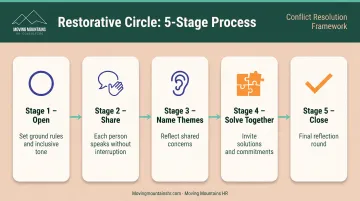
Basic circle structure:
- Open – Explain ground rules (confidentiality, respect, voluntary participation) and set an inclusive tone
- Share – Give each person a turn with the talking piece to answer an opening question without interruption
- Name themes – Reflect on what the group heard and call out shared concerns or needs
- Solve together – Invite solutions, commitments, and clear next steps
- Close – End with a final round where each person offers one word or phrase about the experience
When to use circles:
- After a conflict has disrupted team dynamics
- Following organizational change that created uncertainty or tension
- To address performance concerns affecting the whole team
- As proactive team-building to strengthen communication and trust
Circles work best when participants enter voluntarily and when a skilled facilitator can maintain psychological safety throughout.
Train Facilitators and Leaders
Effective restorative processes depend on facilitators who can create a safe space, stay neutral, and guide hard conversations. Weak facilitation can deepen harm when emotions run high.
Build these skills before you put anyone in the facilitator seat:
- Active listening that reflects what you hear without judgment or interpretation
- Open-ended questions ("What impact did that have on you?" instead of "Did that make you angry?")
- Emotional regulation so you stay steady when others escalate
- Theme summarizing that names patterns without taking sides
- Boundary holding when dialogue turns disrespectful or unsafe
Mt. San Antonio College, for example, requires at least 24 training hours for employee facilitators and up to 60 hours a year for ongoing practice. Most small businesses won't need that much structure—but some formal training in restorative dialogue should come before high-stakes sessions.
Integrate with Existing HR Processes
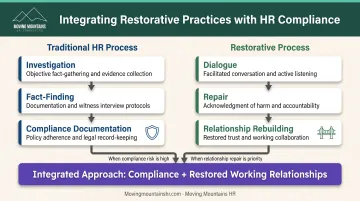
Restorative practices complement necessary HR compliance measures; they don't replace them. A formal investigation can establish facts and ensure legal compliance, while a subsequent restorative process addresses relational harm and working dynamics.
Integration examples:
- Conduct a neutral investigation to determine whether policy violations occurred, then offer a restorative circle to repair team relationships
- Use restorative conversations as an early intervention before conflicts escalate to formal complaints
- Incorporate restorative accountability measures (specific repair commitments) into performance improvement plans
- Document restorative agreements while maintaining confidentiality about personal disclosures made during dialogue
Keep the lanes clear: investigations stay objective and fact-based; restorative dialogue holds space for subjective experience and emotional impact. Used in that order—or as an early off-ramp before formal complaints—you get compliance and repaired working relationships.
Restorative Practices vs. Traditional Disciplinary Approaches
| Dimension | Restorative Approach | Traditional Disciplinary Approach |
|---|---|---|
| Primary Question | Who was affected, what do they need, and who must act? | Which rule was violated, who is culpable, and what consequence is proportional? |
| Participation | Affected stakeholders collaborate in a respectful response | Authority investigates and decides |
| Accountability | Forward-looking ownership, repair, learning, and prevention | Backward-looking finding and sanction |
| Relationship Goal | Repair harm and working trust where feasible | Establish compliance and consequences |
| Process Control | Shared among participants with facilitator support | Top-down, manager or HR-driven |
Restorative practices still include consequences. Those consequences focus on repair and learning rather than punishment alone.
An employee who violated trust might commit to regular check-ins, complete specific training, or rebuild credibility through transparent communication. Each step is a form of accountability that serves the relationship and the organization.
Situations where traditional approaches remain necessary:
- Threats of violence or actual physical harm
- Mandatory harassment or discrimination investigations
- Safety violations requiring immediate corrective action
- Legal compliance requirements that demand formal documentation
- Serious policy breaches where employment termination is under consideration
These aren't mutually exclusive. An organization can use a traditional investigation to gather facts and ensure safety, then offer restorative dialogue to address the human impact and chart a path forward.
When to Consider External Support for Workplace Conflict Resolution
Some conflicts require expertise, neutrality, or capacity beyond what internal teams can provide. Consider bringing in external HR consultants or trained facilitators when:
Complex or high-stakes conflicts:
- Multiple parties with competing accounts of what happened
- Long-standing interpersonal tensions that have resisted prior resolution attempts
- Conflicts involving senior leaders or cross-departmental dynamics
Power imbalances or fear of retaliation:
- Disputes between supervisors and direct reports
- Situations where employees don't trust internal HR to remain impartial
- Cases where previous internal interventions increased fear or disengagement
Lack of internal expertise:
- No one on staff has training in restorative facilitation or complex conflict resolution
- The conflict involves issues (harassment, discrimination, retaliation) requiring specialized investigation skills
- Your organization needs help designing a restorative framework, not just facilitating one conversation
Need for credible neutrality:
- Conflicts where all internal options carry perceived bias
- Situations requiring documentation that will withstand legal scrutiny
- Cases where an external voice can break through entrenched positions
Moving Mountains HR offers neutral third-party workplace investigations and HR strategy support for small to mid-size businesses. These services can incorporate restorative principles—such as ensuring all parties feel heard and respected—while maintaining the rigor and documentation required for compliance.
When internal capacity is limited, external support brings the specialized skill and impartial perspective sensitive workplace conflicts demand.
Frequently Asked Questions
What are restorative practices in the workplace?
Restorative practices are conflict-resolution approaches that focus on structured dialogue, accountability, relationship repair, and addressing root causes rather than assigning blame or imposing punishment. They bring affected parties together to understand impact, identify needs, and collaboratively determine how to move forward.
What are examples of restorative practices?
Common examples include restorative circles (with a talking piece), facilitated dialogues between conflicting parties, and team check-ins built on restorative questions. Performance conversations can also use a restorative lens that prioritizes learning and growth over blame.
How do restorative practices differ from traditional disciplinary approaches?
Traditional approaches focus on rule-breaking and proportional punishment decided by authority figures. Restorative practices focus on the harm caused, who was affected, and collaborative repair. Accountability shifts from backward-looking blame to forward-looking commitments that rebuild trust and prevent recurrence.
What types of workplace conflicts are best suited for restorative practices?
They fit interpersonal conflicts, team dysfunction, communication breakdowns, change-related tension, and any situation where working relationships still matter. They work best when people are willing to engage and the issue does not involve immediate safety threats or a mandatory legal investigation.
Can small businesses implement restorative practices without a full HR team?
Yes. Start with simple team check-in circles, train key leaders in basic facilitation, and bring in external support for complex or high-stakes conflicts. Inclusive dialogue, accountability, and repair do not require a large HR department—only commitment and skill.
How long does it take to see results from restorative practices?
Improved dialogue and de-escalation can show up during or right after a well-facilitated conversation. Broader shifts in trust and proactive conflict resolution build with consistent use—watch for earlier concern-raising, stronger manager confidence, and fewer formal complaints.
Ready to move beyond punitive conflict resolution? Moving Mountains HR provides neutral workplace investigations, customized conflict-resolution training, and strategic HR support that help small and mid-sized businesses build stronger, more resilient teams. Contact us to explore how restorative approaches can complement your HR processes and create lasting cultural change.