For small and mid-size businesses, that statistic isn't abstract. Disengagement shows up as turnover you can't afford, compliance complaints you didn't see coming, and productivity that quietly stalls. These are the exact problems Moving Mountains HR helps clients solve every day.
This guide compares the top employee engagement training programs for 2026, walks through how to choose the right one for your organization, and explains why pairing training with real HR guidance is what actually moves the needle.
TL;DR
- Engagement training gives managers research-backed ways to lift morale, retention, and productivity.
- 2026 options span executive workshops (Gallup, Harvard) to affordable self-paced courses (LinkedIn Learning).
- Choose by budget, format, credentialing needs, and company size.
- Training alone won’t fix engagement; pair it with ongoing HR strategy and compliant people practices.
- Moving Mountains HR helps small and mid-size businesses turn training into lasting retention gains.
Overview of Employee Engagement Training Programs in 2026
Employee engagement training refers to structured programs such as workshops, certifications, and e-learning. These programs teach leaders and managers how to build genuine employee commitment and reverse disengagement.
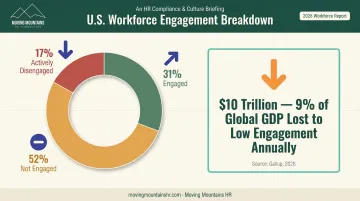
The scale of the problem justifies the investment. Gallup's most recent U.S. data shows 31% of employees engaged and 17% actively disengaged, leaving roughly half the workforce simply going through the motions. Globally, low engagement costs the world economy an estimated $10 trillion, or 9% of GDP, in lost productivity each year, per Gallup's 2026 analysis.
The five programs below were selected for their reputation, flexibility, and relevance to managers at organizations of every size, including SMBs operating without a dedicated HR department.
Top 5 Employee Engagement Training Programs for 2026
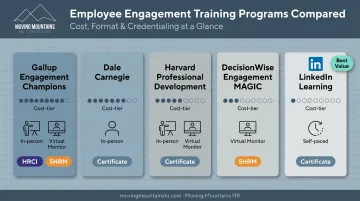
These five options range from executive institutes to on-demand platforms, so you can match budget and depth to your team. Each program is evaluated on cost, format, credentialing, and how well it applies to real-world management challenges—not theory alone.
Gallup Engagement Champions
Gallup built its reputation on decades of workplace research, and its Creating an Engaging Workplace Course for Engagement Champions builds on that research base. The course trains leaders to cascade engagement practices down through mid-management using Gallup's well-known Q12 framework.
What sets it apart:
- Built on the research-validated Q12 employee engagement survey
- Carries HRCI and SHRM professional credit hours
- Best suited to larger organizations already investing in leadership development
| Category | Details |
|---|---|
| Cost | Around $3,000 per participant for a virtual session |
| Length & Format | Two-day course; in-person and virtual options available |
| Credit/Outcome | 14.5 HRCI hours and 14.5 SHRM PDCs |
Dale Carnegie — A Manager's Guide to Sustainable Employee Engagement
Dale Carnegie has trained managers for over a century, and this course zeroes in on discretionary effort, the extra energy employees give when they genuinely care. The emphasis is on emotional empathy as a management skill, not just a personality trait.
Why SMB managers gravitate toward it:
- Shorter time commitment than most executive programs
- Delivered entirely online, no travel required
- Lower price point makes it easy to justify for a single department head
| Category | Details |
|---|---|
| Cost | $795 per person |
| Length & Format | Three live online sessions, 6 total hours |
| Credit/Outcome | 5.5 HRCI credits and 5.5 SHRM PDCs |
Harvard Professional Development — The Art of Workplace Engagement
Harvard's Division of Continuing Education offers The Art of Workplace Engagement: Creating a Positive Environment to Engage Employees, which digs into communication and conflict resolution as engagement drivers. Content centers on the interpersonal dynamics that make or break a team, including how managers handle conflict day to day.
Why senior leaders pick it:
- Harvard's brand carries weight in leadership circles
- Counts toward Harvard's Certificate of Leadership Excellence (four qualifying programs required within four years)
- Depth of content geared toward senior leaders, not first-time supervisors
| Category | Details |
|---|---|
| Cost | $2,950 |
| Length & Format | Online, spread across two consecutive Tuesdays and Thursdays |
| Credit/Outcome | Qualifies toward Harvard's Certificate of Leadership Excellence |
DecisionWise — Engagement MAGIC
DecisionWise built its training around five drivers of engagement: Meaning, Autonomy, Growth, Impact, and Connection. The provider blends engagement technology with hands-on training, which appeals to teams that want practical tools, not just concepts.
Notable advantages:
- Budget-friendly compared to Gallup and Harvard
- One-day format keeps disruption to a minimum
- Available as an in-person workshop or a shorter online version
| Category | Details |
|---|---|
| Cost | Not publicly listed; pricing is quote-based |
| Length & Format | One-day, in-person or virtual |
| Credit/Outcome | No formal continuing education credit publicly confirmed |
LinkedIn Learning — Employee Engagement Courses
For businesses just starting to invest in training, LinkedIn Learning's on-demand catalog, including courses like Performance Management: Employee Engagement, offers a low-risk entry point. There's no schedule to coordinate and no travel budget needed.
Why it works for very small businesses:
- Lowest cost and most flexible scheduling of any option on this list
- Fully self-directed, learn at your own pace
- Provides a completion certificate, though it doesn't carry course-specific SHRM or HRCI credit
| Category | Details |
|---|---|
| Cost | Subscription or trial-based; individual pricing not publicly listed |
| Length & Format | Self-paced, fully virtual (this course runs about 1 hour 16 minutes) |
| Credit/Outcome | Certificate of completion; no confirmed SHRM/HRCI credit |
How to Choose the Right Employee Engagement Training Program
The most common mistake businesses make? Picking a program because of its name recognition or its price tag, without asking whether it actually fits how their managers work day to day.
Before you commit, weigh these factors against your real business outcomes:
- Cost vs. budget: A $3,000 Gallup course delivers more depth, but a $795 Dale Carnegie session might cover 80% of what a first-time manager needs.
- Format: In-person builds stronger group dynamics; virtual saves travel time and works better for distributed teams.
- Credentialing: If your managers need SHRM or HRCI hours for recertification, that narrows your options fast.
- Scalability: The right program can train five managers this year and fifteen next year without breaking the budget.
- Frontline accessibility: Self-paced, mobile-friendly courses reach shift supervisors that a two-day in-person seminar simply can't.
Each factor ties directly to a business outcome. Get the format wrong, and attendance drops. Skip credentialing, and you lose a recruitment perk for HR hires. Ignore scalability, and training becomes a one-time event instead of a habit.
Why Training Alone Isn't Enough: The Role of Expert HR Guidance
Training builds individual manager skills. It teaches someone how to give better feedback or recognize good work more consistently. But skills that live only in a training manual rarely survive daily operations without reinforcement.
Sustained engagement requires those lessons to be embedded into:
- Performance management systems that reinforce what managers just learned
- Feedback mechanisms that make recognition a habit, not an afterthought
- Compliant HR policies that build the trust engagement depends on
That last point matters more than most businesses realize. A 50% to 200% turnover cost per lost employee, depending on role and skill level, is a common benchmark. Moving Mountains HR shares that figure with clients trying to size up their exposure. Multiply that by last year's departures, and disengagement stops looking like a morale problem and starts looking like a line item.
This is where a fractional HR partner earns its keep. Moving Mountains HR's strategy and Fractional CHRO services give organizations executive-level engagement guidance without a full-time HR hire. That support typically covers:
- Retention strategy
- Performance management oversight
- Workplace culture development
Training gives managers new tools. A fractional CHRO makes sure those tools get used—and that the policies behind them hold up under scrutiny.

Conclusion
The best employee engagement training program is the one that fits your budget, your managers' schedules, and the outcomes you actually need. Before you enroll, weigh scalability, measurable ROI, and whether the content matches your team's day-to-day reality.
Training alone won't hold engagement gains. If you want a retention and engagement strategy built around the program you choose, Moving Mountains HR can help turn that investment into lasting culture change.
Frequently Asked Questions
What is the best employee engagement training program for small businesses?
Lower-cost, flexible options like LinkedIn Learning or DecisionWise often fit small businesses best. Larger firms with bigger training budgets may get more value from Gallup or Harvard's deeper, credentialed programs.
How much does employee engagement training typically cost?
Leading providers typically charge from $795 (Dale Carnegie) to about $3,000 (Gallup), with Harvard around $2,950. Self-paced options like LinkedIn Learning usually cost much less.
What is the difference between employee engagement and employee satisfaction?
Satisfaction reflects contentment with pay, benefits, or working conditions. Engagement reflects emotional commitment and the discretionary effort employees choose to give beyond their job description.
Can employee engagement training actually reduce turnover?
Yes—especially manager training that strengthens communication and recognition. Gallup-Workhuman research found well-recognized employees were 45% less likely to leave within two years; results stick when training ties into broader HR practice.
Do only managers need employee engagement training, or should HR staff attend too?
Managers drive most day-to-day engagement, but HR professionals benefit from training too. They're the ones designing and measuring engagement initiatives at the organizational level.
How often should companies refresh their employee engagement training?
Annual refreshers, or training tied to new manager onboarding, work well. Pair this with ongoing engagement measurement rather than treating training as a one-time event.