Introduction
A high performer resigns. During the exit interview, they say the same thing so many others say: "I didn't see a future here." Not the paycheck. Not the commute. The growth.
That's not a fluke. Gallup research found that 51% of employees who left a job said no manager or leader had talked with them about their growth or job satisfaction in the three months before they quit. Even more striking: 52% believed their employer could have done something to keep them.
For small and mid-size businesses that can't out-pay a Fortune 500 company, talent development coaching earns its place—not as a perk, but as a retention strategy.
This post breaks down what talent development coaching actually is, how it differs from training and mentoring, and the frameworks that make it work (including the 70-20-10 rule). You'll also see how SMBs can build a coaching culture without hiring a full L&D department.
Key Takeaways
- Talent development coaching is a personalized, forward-looking partnership—not advice-based mentoring or generic training
- 72% of HR and talent professionals tie coaching to higher engagement, per ICF/HCI research
- The 70-20-10 rule and Five C's framework make coaching consistent instead of accidental
- SMBs can get coaching-driven development via fractional HR leadership—no full-time HR executive required
What Is Talent Development Coaching?
Talent development coaching is a collaborative process where a coach helps an employee identify goals, spot blind spots, and build skills for where they're headed, not just where they are today. The coach doesn't hand over answers. They ask the questions that help someone find their own.
Performance coaching corrects a current problem: a missed deadline, a communication gap, a skill deficit holding someone back right now. Talent development coaching is proactive. It builds capability before a gap turns into a performance issue.
The mechanics look different from a training session or a lecture:
- Powerful questioning — helping someone think through a challenge rather than telling them the answer
- Active listening — picking up on what's unsaid, not just responding to the surface request
- Goal-setting — turning vague ambition ("I want to grow") into a concrete, trackable plan
Coaching also isn't a one-format affair. Common setups include:
- One-on-one between a manager and direct report
- Small teams building a shared capability
- Group cohorts moving through a leadership program together
The format depends on the organization's goals and, frankly, its budget.
Who Benefits from Talent Development Coaching?
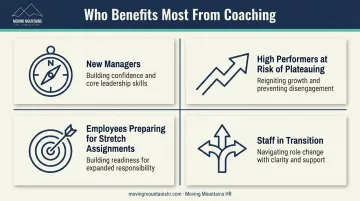
Coaching isn't reserved for the C-suite. Some of the highest-impact work happens with:
- New managers navigating their first experience leading people
- High performers at risk of plateauing or leaving for a "bigger" title elsewhere
- Employees preparing for stretch assignments who need confidence before a formal promotion
- Staff in transition — career pivots, department moves, expanded scope
In regulated industries like healthcare, this matters even more. Supervisors there aren't just managing people; they're managing compliance risk, documentation standards, and high-stakes interpersonal situations at the same time. Coaching gives these leaders a structured way to build judgment, not just memorize policy.
Coaching vs. Mentoring vs. Training: Key Differences
These three terms get used interchangeably, and that's a problem. They serve different purposes, and confusing them is how development budgets get wasted on the wrong intervention.
Training is structured and content-driven. Everyone in the room gets the same material, whether it's a compliance module or a new software walkthrough. It's efficient for transferring knowledge, but it doesn't account for individual context.
Mentoring is a relationship, usually informal, where a more experienced person shares advice, lessons learned, and connections. The Association for Talent Development describes it as long-term and career-oriented. A mentor tells you what worked for them.
Coaching is different from both. It's personalized, question-driven, and centered on the employee's actual situation, not a generic curriculum or someone else's career story. A coach uses targeted questions so employees clarify goals, surface options, and choose how to act.
| Approach | Format | Who Leads | Best For |
|---|---|---|---|
| Training | Structured, group-based | Instructor/content | Knowledge transfer |
| Mentoring | Informal, relational | Experienced advisor | Career wisdom, networks |
| Coaching | Personalized, questioning | The employee | Self-awareness, application |
Most organizations that get development right use all three together. Training builds the knowledge base. Mentoring provides context and wisdom. Talent development coaching builds the self-awareness and accountability to apply both on the job.
Popular Talent Development Coaching Frameworks
Ad hoc coaching conversations are better than nothing, but they don't scale. Structured frameworks give managers and coaches a shared language, which is what turns "occasional check-ins" into a real program.
The 70-20-10 Rule for Talent Development Coaching
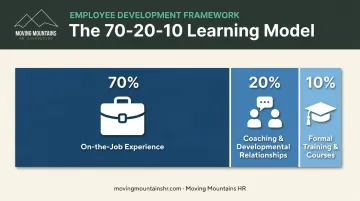
The Center for Creative Leadership built this model on more than 30 years of leadership research, and it's still one of the most cited frameworks in workforce development. The 70-20-10 rule breaks learning into three sources:
- 70% comes from challenging on-the-job experiences and assignments
- 20% comes from developmental relationships — mentoring, feedback, and coaching
- 10% comes from formal coursework and training
Coaching lives in that 20%, and it's the connective tissue holding the other two together.
Someone can finish a leadership workshop (the 10%) and still fumble their first tough conversation with a direct report (the 70%). The coach's job is bridging that gap—turning what was taught into what actually gets applied.
CCL is clear that this isn't a rigid budget formula. Some experiences carry more developmental weight than others. Treat it as a guideline for where to focus energy, not a strict percentage to hit.
The Five C's of Talent Development Coaching
Many HR practitioners organize coaching conversations around five themes: Clarity, Competence, Confidence, Connection, and Commitment. This isn't a single standardized model from one governing body. It's a practical lens that shows up across coaching practice.
Here's how each "C" plays out in a real conversation:
- Clarity — Does the employee know exactly what success looks like in their role or goal?
- Competence — What skill gaps stand between them and that success?
- Confidence — Do they believe they can actually get there?
- Connection — Who are the relationships (peers, mentors, managers) that support this growth?
- Commitment — What's the concrete next action, and by when?
A manager running a development conversation doesn't need to hit all five every time. But when a coaching relationship stalls, it's usually because one of these is missing, often confidence or clarity.
Why Talent Development Coaching Matters for Small and Mid-Size Businesses
Large companies can throw money at retention: bonuses, unlimited PTO, stock options. Most SMBs can't compete there. What they can compete on is whether an employee believes they'll actually grow.
That belief has a dollar value attached to it. Gallup estimates that replacing an employee costs roughly half to two times their annual salary, a figure the organization calls conservative. For a $60,000 role, that's potentially $30,000 to $120,000 walking out the door, on top of the disruption to the team left behind.
Coaching addresses this in two ways:
- Gives high performers a reason to stay. When someone sees a real path forward internally, they're less likely to go looking elsewhere.
- Builds a leadership pipeline. SMBs rarely have deep management benches. Coaching turns "we'll figure out succession when someone leaves" into an actual plan.
Here's the catch: most SMBs don't have a Chief Learning Officer, or an HR department at all. This is where fractional HR leadership changes the math.
Moving Mountains HR's Fractional CHRO and HR Strategy services give small and mid-size businesses executive-level guidance on staffing, retention, and performance management without a full-time hire. Companies can build a coaching-driven development plan with the same strategic thinking larger competitors use, scaled to a smaller budget.
Building a Coaching Culture Without a Full HR Team
You don't need a roster of certified professional coaches to start. Most of the value comes from something simpler: teaching managers to ask questions instead of just giving directives in their regular 1:1s.
Start small. Pick one team, or a handful of high-potential employees, and pilot a coaching-first approach for 90 days. Track what changes. Use those early wins—better engagement, faster problem-solving, fewer repeated mistakes—to build buy-in from the rest of the leadership team.
A few practical starting points:
- Replace "here's what to do" with "what do you think the options are?" in routine check-ins
- Set one development goal per employee per quarter, tied to a specific behavior, not just a vague aspiration
- Give managers a simple structure (like the Five C's above) so coaching conversations stay consistent across teams
The biggest pitfall is inconsistency: one manager coaches well, another doesn't coach at all, and nobody's measuring any of it.
That's where outside support helps. Moving Mountains HR's Training & Development Programs build supervisor coaching skills tailored to your industry and culture, so managers get concrete tools instead of a vague push to "coach more." Paired with performance management guidance, good intentions become a repeatable practice.

Frequently Asked Questions
What is the 70-20-10 rule for talent development coaching?
It's a learning model where roughly 70% of development comes from on-the-job experience, 20% from coaching and other social learning, and 10% from formal training. Coaching connects on-the-job experience with social learning and formal training so skills actually stick.
What are the five C's of talent development coaching?
A commonly used organizing framework covering Clarity, Competence, Confidence, Connection, and Commitment. Coaches use it to diagnose where a development conversation is stalling.
How is talent development coaching different from performance management coaching?
Talent development coaching is proactive and growth-focused, aimed at unlocking future potential. Performance coaching is typically reactive, correcting a specific underperformance issue in someone's current role.
Who should receive talent development coaching in an organization?
It benefits employees at every level, but it's especially valuable for new managers, high performers at risk of plateauing, and staff preparing for expanded responsibilities or promotions.
How much does talent development coaching cost for a small business?
Costs vary widely depending on format. Many small businesses start with internal coaching-skills training for managers, then add external coaching or fractional HR support when they need more structure or senior guidance.
How do you measure the success of a talent development coaching program?
Use a mix of quantitative measures (retention rates, promotion rates, performance metrics) and qualitative ones (self-reported confidence, manager feedback on behavior change). Track both before and after coaching begins.