Introduction
Healthcare employers face a workforce challenge unlike any other industry. The U.S. Bureau of Labor Statistics projects that healthcare and social assistance sectors will add roughly 2.0 million jobs by 2034, an 8.4% increase driven by growing patient populations and expanding service demands.
Even as demand surges, the industry still struggles to fill specialized roles that need certifications, licenses, and clinical expertise.
Healthcare HR professionals safeguard patient care quality through the workforce they build and retain. When 53% of medical-group leaders name finding qualified candidates as their top staffing challenge, and 47% cite medical assistants as the hardest role to recruit, HR directly affects whether a practice can serve patients at all.
Nurse shortages, high turnover, burnout, and layered federal and state rules raise the stakes further. Without strong workforce management, healthcare organizations cannot deliver the care communities depend on. This guide covers how healthcare HR handles staffing, retention, compliance, and executive-level support models that fit small and mid-size practices.
Key Takeaways:
- Healthcare will add roughly 2M jobs by 2034, yet nursing, allied health, and admin roles stay hard to fill
- HR in healthcare balances workforce needs with patient safety, clinical credentials, and complex regulatory compliance
- High turnover and burnout directly impact care quality and organizational costs
- Compliance spans OSHA, HIPAA workforce rules, FMLA, ADA, and clinical credentialing
- Small practices can access executive-level HR support through fractional CHRO and consulting models
What Is Human Resources Management in Healthcare?
Human resources management in healthcare is the strategic function that recruits, develops, and retains qualified clinical and administrative staff. It also keeps the organization compliant with federal, state, and industry-specific regulations. Unlike HR in other industries, healthcare HR operates in an environment where workforce decisions directly affect patient outcomes, safety, and regulatory standing.
Healthcare HR differs in several critical ways:
- 24/7 operations: Hospitals and urgent-care facilities require around-the-clock staffing, shift coordination, and on-call coverage
- Clinical credentials: Roles require active licenses, certifications, and ongoing competency verification
- Patient safety accountability: Hiring and training errors can lead to medical errors, patient harm, and legal exposure
- Higher regulatory density: Employers must meet OSHA exposure-control rules, HIPAA workforce requirements, Joint Commission credentialing, and state scope-of-practice laws
- Specialized roles: Each position, from respiratory therapists to medical assistants, demands role-specific qualifications and training
When healthcare organizations lack solid HR infrastructure, they face compliance violations, turnover-driven care gaps, and operational drag. Those failures show up in patient experience and in financial performance.
Core Functions of HR in Healthcare Organizations
Healthcare HR runs through five connected functions: talent, compliance, compensation, training, and culture. Each one affects care quality, legal risk, and whether skilled staff stay.
Talent Acquisition and Workforce Planning
Healthcare hiring is hard because roles demand specialized skills, active licensure, and you are competing with every other provider in the market. The National Center for Health Workforce Analysis projects 2038 shortages of 108,960 registered nurses, 245,950 licensed practical nurses, 60,610 physical therapists, and 30,400 pharmacists.
Location widens the gap further. Nonmetropolitan areas face an 11% RN shortage versus 2% in metropolitan regions.
Workforce planning strategies include:
- Building talent pipelines through partnerships with nursing schools, community colleges, and training programs
- Forecasting staffing needs by role, shift, department, and seasonality to prevent care gaps
- Offering flexible scheduling, part-time roles, and per-diem options to attract candidates with varied availability
- Structuring signing bonuses and retention incentives for hard-to-fill positions
Retention strategies specific to healthcare:
- Career pathways that enable medical assistants to advance to LPN roles, or LPNs to pursue RN credentials
- Recognition programs tied to patient-care milestones, safety achievements, and years of service
- Competitive pay benchmarked to role, credential, specialty, and local market rates
- Manager training to support frontline supervisors who influence employee engagement and turnover
A 2025 review of 15 orientation studies found that structured onboarding programs reduced turnover by an average of 18% and increased retention by 13%. Early investment in new hires shows up directly in those retention numbers.
Compliance and Risk Management
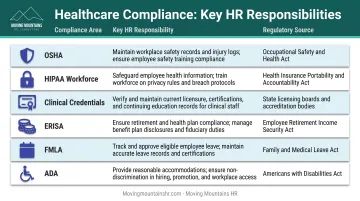
Healthcare HR carries compliance responsibilities that extend beyond standard employment law:
| Compliance Area | HR Responsibility | Source |
|---|---|---|
| OSHA | Annual bloodborne-pathogen training for exposed staff; must occur within one year of prior training | 29 CFR 1910.1030 |
| HIPAA Workforce | Train workforce members on privacy and security; apply appropriate sanctions for policy violations | 45 CFR 164.530 |
| Clinical Credentials | Verify licenses, certifications, and qualifications tied to job responsibilities | Joint Commission 2025 Standards |
| ERISA | Fiduciary standards for those managing group health plan assets | DOL ERISA Guidance |
| FMLA | Up to 12 workweeks for qualifying reasons; 26 weeks for military-caregiver leave | DOL Fact Sheet 28 |
| ADA | Federal employment-discrimination protections generally begin at 15 employees | EEOC Small Business Guide |
HR reduces legal risk with clear documentation, consistent policy enforcement, and regular audits. Small practices without in-house HR often bring in outside support for HR document audits and policy updates so employment-law gaps get fixed before they turn into fines, claims, or reputational damage.
Compensation and Benefits Administration
Competitive compensation is essential in an industry where 17% hospital nurse turnover is common and 40% of nurses intend to leave within a year. HR structures pay to reflect credential levels, specialties, and market demand.
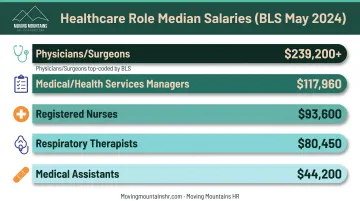
BLS national compensation benchmarks (May 2024):
- Registered nurses: $93,600 median (bottom 10% below $66,030)
- Physicians and surgeons: At least $239,200 median (top-coded by BLS)
- Respiratory therapists: $80,450 median
- Medical assistants: $44,200 median (bottom 10% below $35,020)
- Medical and health services managers: $117,960 median
Healthcare-specific benefits:
- Tuition reimbursement and continuing-education stipends to support career advancement
- Loan forgiveness programs, including the federal Nurse Corps Loan Repayment Program, which repays 60% of nursing-education debt over two years
- Wellness programs addressing mental health, physical fitness, and stress management
- Retirement planning and 403(b) or 401(k) contributions
The practical test for HR is simple: benefits have to fit the budget and still hold up against what competing employers offer down the street.
Training and Professional Development
Healthcare staff require continuous training to maintain clinical competence, meet regulatory requirements, and adapt to new technologies.
Ongoing training includes:
- Clinical skills updates (wound care, medication administration, equipment operation)
- Compliance training (OSHA exposure control, HIPAA privacy, harassment prevention)
- Technology training as EHR systems, telehealth platforms, and clinical tools evolve
- Leadership development for supervisors and department heads
HR runs clinical onboarding (patient-care protocols, credential checks, competency assessments) and non-clinical onboarding (admin procedures, software, culture). Career-path programs give staff a reason to grow inside the organization instead of leaving for the next offer.
Employee Relations and Workplace Culture
Healthcare is a high-stress environment. CDC data shows frequent health-worker burnout rose from 32% in 2018 to 46% in 2022. HR plays a central role in fostering positive culture by addressing workload, staffing levels, supervisor support, and psychological safety.
Key employee-relations strategies:
- Conflict resolution processes that address interpersonal disputes quickly and fairly
- Anonymous reporting channels for harassment, discrimination, and workplace safety concerns
- Employee-assistance programs (EAPs) offering mental-health counseling and crisis support
- Diversity, equity, and inclusion (DEI) initiatives that recruit, retain, and promote employees from underrepresented backgrounds
A 2024 JAMA study linked nurse burnout with lower quality and safety outcomes. When staff are depleted, patient care suffers with them.
Healthcare-Specific HR Challenges
Healthcare HR faces pressures most other industries rarely see at once: clinical labor shortages, high turnover, burnout risk, dense regulation, and 24/7 scheduling. The challenges below are where those pressures show up day to day—and where HR strategy has to be healthcare-specific.
Addressing Critical Staffing Shortages
Workforce gaps hit far more roles than nursing alone. NCHWA projects 2038 deficits of 245,950 LPNs, 60,610 physical therapists, 30,400 pharmacists, and 12,770 respiratory therapists. Rural and underserved areas face the widest gaps.
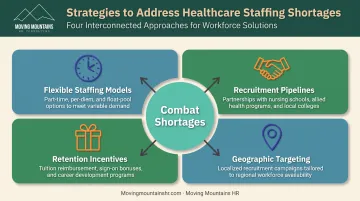
Strategies to combat shortages:
- Flexible staffing models (part-time, per diem, job sharing) to expand available candidate pools
- Recruitment pipelines through internships, residencies, and community partnerships
- Retention incentives such as tuition reimbursement, loan forgiveness, and performance bonuses
- Geographic targeting to address local shortages with location-specific recruitment campaigns
Managing High Turnover and Retention
High turnover disrupts care continuity and imposes significant costs. Press Ganey reports $313,000 in savings per 100 RNs from lower turnover, driven by reduced patient falls and associated expenses.
Evidence-based retention strategies:
- Competitive pay aligned to market benchmarks and role credentials
- Career-development opportunities including internal promotions and upskilling programs
- Supportive management through supervisor training and regular one-on-one check-ins
- Structured orientation programs that help cut early-career turnover
Preventing Employee Burnout
Research in JAMA Network Open links burnout to lower care quality and safety. HR needs organizational controls—not only individual wellness perks.
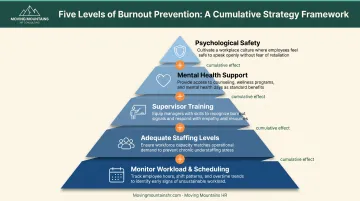
Burnout-prevention strategies:
- Monitor workload, consecutive shifts, overtime hours, and on-call frequency
- Staff adequately to prevent unsafe patient-to-nurse ratios
- Train supervisors to recognize early warning signs (absenteeism, disengagement, irritability)
- Provide mental-health support through EAPs, peer-support groups, and counseling
- Create psychological safety so employees can report concerns without retaliation
Navigating Complex Regulatory Requirements
Healthcare employers must comply with federal employment law, OSHA exposure standards, HIPAA workforce rules, state licensing boards, and accreditor requirements such as Joint Commission standards. Keeping policies current requires continuous monitoring.
Consequences of non-compliance:
- OSHA penalties for bloodborne-pathogen violations
- HIPAA sanctions for failure to train workforce members or enforce privacy policies
- Joint Commission citations affecting accreditation status
- Legal exposure from ADA, FMLA, or wage-and-hour violations
- Reputational damage affecting patient trust and recruitment
Proactive compliance audits—run in-house or with external HR support—surface policy and training gaps before inspections or employee complaints do.
Scheduling and Shift Management
24/7 healthcare operations require rotating shifts, night coverage, weekends, and on-call availability. NIOSH cautions that 12-hour shifts should be used carefully due to fatigue risks.
Best practices:
- Self-scheduling or bidding systems that give employees input into their shifts
- Advance notice for schedules to support work-life balance
- Technology solutions (scheduling software, mobile apps) to streamline shift swaps and last-minute coverage
- Consecutive-shift and overtime monitoring to reduce fatigue-related errors
6 Strategic HR Best Practices for Healthcare Organizations
1. Implement Competitive Compensation and Signing Bonuses
Research market rates using BLS occupational data, local salary surveys, and competitor job postings. For hard-to-fill roles such as specialty nurses or therapists, build incentive packages that include:
- Signing bonuses for hard-to-fill clinical roles
- Retention bonuses at 12 and 24 months
- Premium pay for nights, weekends, or on-call shifts
2. Create Clear Career Pathways
Internal mobility reduces turnover and raises engagement. Build career ladders with clear next steps, such as:
- Medical assistants pursuing LPN credentials
- LPNs advancing into RN roles
- Clinical staff moving into supervisory or specialty positions
Support those paths with tuition reimbursement and paid time for coursework.
3. Prioritize Employee Wellness and Burnout Prevention
Support mental health with EAPs, reasonable workloads, adequate staffing ratios, and trained supervisors. Encourage staff to use PTO and take breaks during shifts.
Strengthen psychological safety with clear reporting channels for harassment, discrimination, and unsafe conditions.
4. Leverage Flexible Staffing Models
Offer part-time, per-diem, and flexible-schedule options that serve both the organization and employee preferences. Flexibility draws candidates with caregiving duties, students, and anyone seeking stronger work-life balance.
The same models help cover gaps during high-census periods or unexpected absences.
5. Invest in Ongoing Training and Development
Structured orientation keeps new hires engaged and cuts early turnover. Ongoing training maintains clinical competence, regulatory compliance, and readiness for new technology.
Leadership-development programs prepare high performers for supervisory roles and strengthen internal talent pipelines.
6. Conduct Regular Compliance Audits
Proactive reviews find gaps in policies, procedures, employee handbooks, and employee-facing documents before they turn into legal issues. Audit coverage should include:
- OSHA and workplace safety requirements
- HIPAA workforce requirements
- FMLA and ADA obligations
- Credential verification and employment practices
Document findings and close gaps with corrective actions right away.
How Small Healthcare Practices Can Access Executive-Level HR
Small medical practices face a difficult challenge: they need sophisticated HR capabilities to manage compliance, retention, and workforce planning, but they lack the budget or workload to justify a full-time HR executive.
Fractional HR and consulting models close that gap:
- Fractional CHRO services deliver executive-level HR leadership on a part-time or project basis, without full-time overhead
- HR consulting partnerships cover compliance audits, policy development, performance management, workplace investigations, and training sized to the practice
- Passive and active support tiers let practices set the involvement level—from on-demand phone and email help to HR meetings and strategic planning
Moving Mountains HR offers fractional CHRO services and HR consulting built for small to mid-size organizations, including healthcare practices. With experience in healthcare HR, compliance audits, and performance management, the firm helps practices find gaps, put practical fixes in place, and get executive-level guidance without a full-time hire.
Practices can start with a 30-minute virtual consultation or a 15-minute introductory call to discuss specific needs.
Frequently Asked Questions
What are the main functions of human resources in healthcare organizations?
HR in healthcare typically covers five core functions:
- Talent acquisition for clinical and administrative roles
- Compliance with OSHA, HIPAA, FMLA, ADA, and credentialing standards
- Compensation and benefits design
- Training, onboarding, and ongoing competency development
- Employee relations and workplace culture
What does human resources mean in healthcare organizations?
Human resources in healthcare is the strategic management of a qualified workforce so organizations can deliver safe patient care and meet regulatory requirements. It spans recruiting, credentialing, training, compliance, retention, and culture—areas where workforce decisions directly affect patient safety and organizational risk.
What is the highest-paid human resources position in healthcare organizations?
The Chief Human Resources Officer (CHRO) or VP of HR is typically the highest-paid HR role, overseeing strategy, workforce planning, compliance, and executive leadership. BLS reports a May 2024 median of $140,030 for HR managers; healthcare CHRO pay varies by organization size, location, and scope.