McKinsey's research on 1,034 transformation participants found only 30% of transformations succeed, meaning both performance improved and the gains stuck (McKinsey, 2021). The difference between the 30% and everyone else usually comes down to diagnosis quality, leadership behavior, and whether HR systems actually reinforce the new norms.
This guide walks through the exact steps to transform culture, when a full transformation is actually warranted, what to prepare before you start, the factors that separate success from failure, and the mistakes that derail even well-intentioned efforts.
Key Takeaways
- Culture change is a structured process of diagnosis, leadership commitment, and systems alignment—not a comms campaign
- Lasting success depends on leadership behavior and HR systems reinforcing new norms after rollout
- Start by diagnosing the gap between current and desired culture with tools like the OCAI
- SMBs without dedicated HR often use fractional CHRO support to turn culture goals into workable policies
- Plan for a year or more of change plus ongoing reinforcement so old norms don't return
How to Transform Organizational Culture: Step-by-Step Process
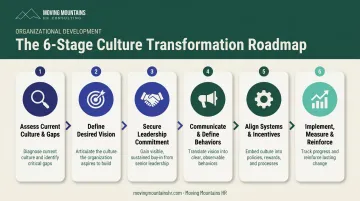
Step 1: Assess Your Current Culture and Identify Gaps
Start by mapping what your culture actually is, not what leadership hopes it is. Employee surveys, focus groups, and structured frameworks like the Organizational Culture Assessment Instrument (OCAI) give you a defensible baseline.
Developed by Kim Cameron and Robert Quinn, the OCAI scores your organization across four culture types (Clan, Adhocracy, Market, Hierarchy) on six dimensions, from leadership style to what defines success. Comparing current-state and preferred-state profiles shows you exactly where to focus.
Pair the survey data with hard numbers:
- Turnover rates by department or tenure
- Engagement scores over time
- Exit interview themes
The stakes are real. Workers who rate their culture positively are almost four times more likely to stay with their employer — only 15% were job-hunting, compared to 57% among those who rated their culture poorly (SHRM, 2024).
Finally, look past stated values to actual behavior. If your handbook says "we value transparency" but managers withhold information from direct reports, that gap is your real starting point, not the words on the wall.
Step 2: Define the Desired Culture and Vision
Vague aspirations like "innovative" or "collaborative" don't change behavior. Translate business strategy into specific, observable cultural attributes instead.
- Accountability might mean owning missed deadlines publicly instead of deflecting
- Collaboration might mean cross-team check-ins built into weekly workflows
- Innovation might mean protected time for testing new ideas without penalty for failure
Involve senior leadership and key managers in co-creating this vision. A culture defined solely by the C-suite, without input from the people living it daily, rarely survives contact with reality.
Set measurable success criteria now—engagement score targets or specific behavioral benchmarks—so you can track progress later.
Step 3: Secure Leadership Commitment and Build a Guiding Coalition
Nothing sinks a culture initiative faster than executives who talk about change but don't practice it. Research from change management firm Prosci consistently shows that visible, active executive sponsorship is the single biggest predictor of whether a transformation meets its objectives.
Before asking employees to change, address leadership behaviors that contradict the desired culture. If executives model accountability but middle managers don't, employees notice the inconsistency immediately.
Build a cross-functional coalition beyond the executive team:
- Managers who influence day-to-day team norms
- Informal influencers employees already trust
- Representatives from different departments and tenure levels
Step 4: Communicate the Vision and Define Key Behavioral Shifts
Abstract values don't stick. Narrow your vision down to three to five specific, observable behaviors employees can practice daily. "Be more collaborative" becomes "flag blockers in the team channel within 24 hours" or "credit collaborators by name in project updates."
Communicate through multiple channels, repeatedly:
- Town halls to explain the "why" behind the change
- Team meetings to translate it into role-specific expectations
- Newsletters or intranet updates for ongoing reinforcement
Build two-way loops too. Pulse surveys and open forums let employees ask questions and surface concerns before resistance hardens into cynicism.
Supervisors often make or break adoption. Leadership coaching paired with practical scenarios outperforms generic compliance slides—an approach Moving Mountains HR uses in its training and development work when managers need help turning values into daily habits.
Step 5: Align Systems, Structures, and Incentives
This is where most transformations quietly die. If your performance reviews, promotions, and recognition programs still reward the old behaviors, employees will follow the incentives, not the memo.
Update these systems to match the new culture:
- Performance criteria — weight the specific behaviors you defined in Step 4
- Hiring and onboarding — assess cultural fit alongside technical skills, starting at the job description
- Recognition programs — publicly reward the new behaviors, not just output
- Reporting structures — redesign team setups where the current structure actively works against the culture you want
Businesses without in-house HR often find this step hardest. It touches legally sensitive areas like performance documentation and promotion criteria. Outside support—such as fractional CHRO help—earns its keep here by turning cultural goals into policies that hold up under scrutiny.
Step 6: Implement, Measure, and Reinforce the Change
Roll out formal changes (updated policies, new performance metrics) alongside informal ones (leadership conversations, team rituals). Both matter. Formal changes without informal reinforcement feel bureaucratic; informal reinforcement without formal backing feels hollow.
Track progress against your Step 1 baseline with recurring engagement surveys and repeat culture assessments. Celebrate early wins publicly.
Then lock the change in: fold the new behaviors into onboarding and leadership development so they outlast the initial push.
When Culture Transformation Is Needed & What You Need to Get Started
Not every culture complaint requires an organization-wide overhaul. Sometimes a targeted fix, like retraining one team or updating a single policy, solves the actual problem faster and with less disruption.
Signs Your Organization Needs Culture Transformation
- Stated values and daily behavior consistently diverge, and engagement stays flat despite competitive pay
- Major triggers hit: leadership turnover, a merger, rapid headcount growth, or repeated complaints and compliance issues
- Voluntary turnover stays high, or you struggle to attract talent even with strong compensation
If you're only seeing isolated friction in one department, a targeted intervention likely beats a company-wide transformation.
What You Need Before You Begin
- Committed leadership sponsorship with a clear mandate: transformations stall without visible executive ownership
- Baseline data from surveys, exit interviews, or a structured HR audit so you know your true starting point
- HR expertise that turns cultural goals into compliant policies and performance systems
Smaller businesses without a full-time HR executive often can't build all three in-house. That is a common reason companies bring in outsourced or fractional support.
Moving Mountains HR's HR Document Audit, for instance, reviews existing policies and practices against compliance standards and best practices. You get a documented starting point before layering on culture-specific diagnostics like employee surveys.
Key Factors That Determine Culture Transformation Success
Whether a transformation sticks depends far less on the kickoff announcement than on how consistently you manage a handful of variables over the following months.
Leadership Modeling and Communication
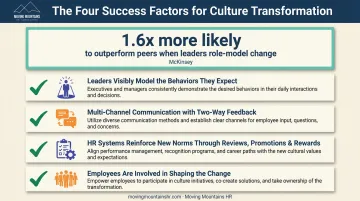
Employees calibrate what's actually acceptable by watching what leaders do, not by reading policy documents. Respondents who said leaders role-modeled the requested changes were 1.6 times more likely to report their organization outperforming peers, according to a McKinsey survey of 472 transformation participants (2023).
Deeply embedded habits don't shift after one all-hands meeting. They need repeated, multi-channel messaging before new norms feel credible instead of temporary. Two-way communication—where employees can ask questions and raise objections—speeds adoption and cuts rumor-driven resistance.
Systems Alignment and Employee Ownership
Performance reviews, promotions, and rewards signal what's truly valued far louder than anything said in a town hall. When those systems still favor old behaviors, employees get mixed signals, and transformation progress erodes—often unnoticed until engagement scores drop again.
People adopt new behaviors faster when they help shape them and feel safe raising concerns without retaliation. Higher involvement means less resistance and stronger long-term retention of new norms, because employees feel ownership rather than compliance pressure.
Use these checks to keep the factors working together:
- Leaders visibly practice the behaviors they ask of others
- Messages repeat across channels and invite real pushback
- Reviews, promotions, and rewards reinforce the new norms—not the old ones
- Employees help shape the change and can raise concerns without fear
Common Mistakes to Avoid During Culture Transformation
Even well-funded initiatives fail for predictable, avoidable reasons:
- Skipping the diagnostic step: Jumping straight to new value statements or office redesigns without understanding root causes
- Treating culture change like a communications campaign: A one-time rollout instead of ongoing systems and behavior change
- Leaving HR systems misaligned: Performance metrics, hiring criteria, and incentives still reward old behaviors and send mixed signals
- Declaring victory too early: Pulling reinforcement too soon lets old habits resurface within months
Conclusion
Culture transformation succeeds when diagnosis, leadership commitment, and systems alignment work together. Announcements and slogans alone won't change how people work. Most failures trace back to inconsistent leadership behavior or misaligned HR systems, not employee unwillingness to change.
Start with an honest assessment of where your culture stands today. If you lack the internal HR capacity to run that diagnosis and align systems, outside support can close the gap.
A partner like Moving Mountains HR can help through an HR audit or fractional CHRO support—executive-level guidance without the overhead of a full-time hire.
Frequently Asked Questions
How do you transform a company culture?
Start by diagnosing the current culture against your desired state and defining specific behavioral shifts. Then secure visible leadership buy-in, align HR systems like hiring and performance reviews, and reinforce consistently for well over a year.
What are the 5 C's of culture change?
There's no single standardized framework, but a common version includes Clarity, Commitment, Communication, Consistency, and Culture-systems alignment. Each addresses a different lever needed to make new behaviors stick.
What are the 5 P's of corporate culture?
Developed by Sheila Margolis, the Five Ps are Purpose, Philosophy, Priorities, Practices, and Projections. Purpose and Philosophy stay relatively fixed, while Priorities, Practices, and Projections shift as strategy evolves.
How long does a culture transformation typically take?
Expect several months for early behavioral shifts and multiple years for deep, sustained change, depending on organization size and complexity. Plan for at least a year of active reinforcement before old norms fully retire.
Who should lead a culture transformation effort?
CEOs and senior leaders must sponsor and visibly model the change themselves. HR designs the supporting systems, communication cadence, and measurement tools that keep the transformation on track.
What's the difference between culture change and culture transformation?
Culture change targets specific, discrete adjustments, like updating one policy or team norm. Transformation is a fundamental, organization-wide shift touching values, systems, and behavior across every department.