
Employee turnover costs far more than most business owners realize. According to Gallup's research, replacing a frontline worker costs about 40% of their annual salary, technical professionals cost 80%, and managers cost up to 200%. For a mid-level employee earning $60,000, that's a $48,000 replacement cost—nearly enough to hire another full-time person.
Beyond direct recruiting expenses, turnover drains productivity, disrupts projects, erodes institutional knowledge, and forces remaining employees to shoulder extra work until a replacement gets up to speed. This article will help you understand what drives employees to leave, how to measure your organization's retention health, and which strategies actually reduce turnover.
Key Takeaways
- Replacement costs run 40% of salary for frontline roles and up to 200% for managers
- Career development and competitive pay top the reasons people stay or leave, ahead of management and culture
- Simple retention and turnover formulas help you benchmark your team and catch problems early
- Well-recognized employees are 45% less likely to leave over two years
- Stay interviews, manager training, and other HR support can prevent the 42% of turnover that is avoidable
What Are Employee Turnover and Retention?
Employee retention measures your organization's ability to keep its workforce over time. It tracks how many people who started a period (usually a year) are still with you at the end. Strong retention indicates satisfied employees, healthy culture, and stable operations.
Employee turnover measures the rate at which employees leave and must be replaced. It includes both voluntary departures (resignations) and involuntary separations (terminations, layoffs). While some turnover is inevitable and even healthy, excessive churn signals deeper problems.
Why They're Not Simply Inverses
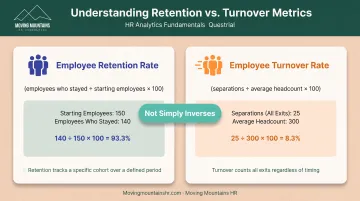
Many people assume retention and turnover are mirror images: that 90% retention means 10% turnover. Not quite. Retention follows a specific cohort of employees from day one of a measurement period. Turnover counts all separations against your average headcount during that period.
If you repeatedly refill the same position multiple times in one year, your turnover rate climbs while your starting-cohort retention number stays unchanged. This difference helps you distinguish between natural workforce evolution and problematic revolving-door positions.
Why Both Metrics Matter for Small Businesses
Each metric answers a different question:
- Retention shows whether employees are building long-term commitment. High retention means people see a future with you; cohort and department breakdowns show who stays longest.
- Turnover reveals why and when people leave. Split voluntary vs. involuntary exits, reasons, and team patterns to spot fixable issues like a bad manager, weak pay band, or burnout.
For small businesses, both matter. Losing even one key person can stall operations, delay deliveries, and pull owners back into day-to-day work they already delegated.
How to Calculate Turnover and Retention Rates
Measuring your rates is straightforward once you understand the formulas.
Employee Retention Rate Formula
(Number of employees who stayed the entire period ÷ Number of employees at start of period) × 100
This formula tracks employees who were present on day one and remained through the end. Do not include people hired during the measurement period.
Example: You start the year with 120 employees. By year-end, 112 of those original 120 are still with you (8 left voluntarily or involuntarily).
Retention rate = (112 ÷ 120) × 100 = 93.3%
Employee Turnover Rate Formula
(Number of separations during period ÷ Average number of employees during period) × 100
Calculate average headcount by adding beginning and ending headcount, then dividing by two—or average monthly headcounts when you need more precision.
Example: In Q1, 10 employees leave. Your average headcount for the quarter is 120.
Turnover rate = (10 ÷ 120) × 100 = 8.3%
Understanding Industry Benchmarks
There's no universal "good" retention or turnover rate. Context matters. The U.S. Bureau of Labor Statistics tracks monthly separation rates by industry. In 2024, the average monthly total separation rate was:
- Total nonfarm: 3.3%
- Health care and social assistance: 3.0%
- Retail trade: 4.0%
- Professional and business services: 4.4%
- Leisure and hospitality: 5.5%
These are monthly rates, not annualized percentages. Industries with seasonal workforces, entry-level positions, or high-volume hiring naturally see higher churn.
Rather than comparing yourself to a generic benchmark, track your own trend. Is your quarterly turnover rising or falling? Which departments consistently lose people? Those patterns reveal whether your interventions are working.
Why Do Employees Leave? Understanding the Root Causes
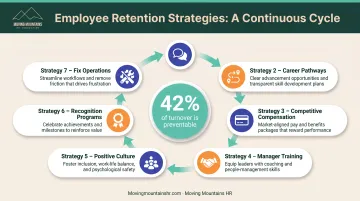
Here's the good news: 42% of employee turnover is preventable, according to Gallup. That means nearly half of the people who resign could have been retained if their manager or organization had addressed the issue proactively.
Lack of Career Growth and Development
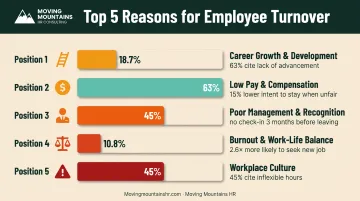
In the Work Institute's 2023 Retention Report, Career ranked as the top reason people left jobs, accounting for 18.7% of exits. Meanwhile, Pew Research found that 63% of people who quit in 2021 cited lack of advancement opportunities.
Employees need to see a path forward. If they feel stuck in the same role with no skill-building, promotion prospects, or expanded responsibilities, they'll look elsewhere.
Compensation and Pay Equity Issues
Pew's research also showed 63% of quitters cited low pay. When employees discover they're paid significantly below market rate, or learn that a peer in the same role earns more—they start updating their résumés.
Gartner research found that workers who perceive their pay as inequitable had 15% lower intent to stay and 13% lower engagement. Regular market analysis and transparent pay practices help you stay competitive.
Poor Management and Lack of Recognition
Gallup found that 45% of employees who left voluntarily reported that no manager or leader had proactively discussed their satisfaction, performance, or future in the three months before they resigned. When managers don't check in, employees assume no one cares.
Recognition matters too. Gallup's longitudinal study tracking nearly 3,500 workers found that well-recognized employees were 45% less likely to turn over over two years. Acknowledgment doesn't require expensive bonuses. Timely, specific praise for contributions often suffices.
Workplace Culture, Burnout, and Work-Life Balance
Gallup research on burnout shows that employees experiencing frequent burnout are 2.6 times more likely to actively seek another job. The five strongest burnout drivers are:
- Unmanageable workload
- Unclear manager communication
- Lack of manager support
- Unfair treatment
- Unreasonable time pressure
Toxic environments, chronic understaffing, and cultures that glorify overwork push talented people toward healthier employers.
Work Institute ranked Work-Life Balance fifth at 10.8% of exits. Pew found 45% of quitters cited inflexible hours and 39% cited excessive hours.
7 Proven Strategies to Improve Employee Retention
Holding on to good people takes deliberate work across management, pay, culture, and day-to-day operations. These seven strategies target the root causes of preventable turnover.
Strategy 1: Conduct Stay Interviews and Pulse Surveys
Don't wait for exit interviews to learn why people are unhappy.
Stay interviews are one-on-one conversations with current employees about what keeps them engaged and what might drive them to leave. Ask questions like:
- What do you look forward to each day?
- What would make your role more fulfilling?
- Have you considered leaving? If so, what triggered that thought?
Pulse surveys (short, recurring questionnaires) help you track satisfaction trends across the organization. The key is acting on the feedback. Employees who see their input ignored become even more disengaged.
Strategy 2: Develop Clear Career Pathways
Create transparent advancement criteria for every role. Employees should know:
- What skills or certifications they need for the next level
- What performance standards apply
- Approximately how long advancement typically takes
Pair career maps with professional development opportunities: training programs, mentorship, cross-functional projects, and tuition assistance. When employees see a future at your company, they're less likely to seek growth elsewhere.
Strategy 3: Ensure Competitive and Equitable Compensation
Conduct annual market salary analyses to ensure your pay scales align with industry standards for your region and role. Use transparent pay bands where feasible, and address internal equity issues before employees discover them on their own.
If you can't match top-of-market salaries, emphasize total compensation: benefits, flexibility, professional development budgets, and work-life balance. Many employees will accept slightly lower cash pay for better overall value.
Strategy 4: Train Managers in Essential Leadership Skills
Managers are the frontline of retention. Invest in training that develops:
- Effective communication and active listening
- Regular recognition and constructive feedback
- Delegation and trust-building
- Coaching conversations and career development discussions
Gallup research has long tied manager quality to retention, yet many organizations still promote high performers into leadership roles without preparing them to lead people.
Moving Mountains HR offers customized training programs, delivered virtually or in person, that help supervisors give better feedback, lead more confidently, and build respectful workplace cultures.
Strategy 5: Create a Positive Workplace Culture
A strong culture rests on psychological safety, fair treatment, manageable workloads, and respect for employees' time outside work. Office perks cannot replace those basics.
Prioritize:
- Work-life balance policies that employees actually use (not just policies on paper)
- Transparent decision-making and consistent enforcement of rules
- Inclusion practices that make all employees feel valued
- Wellbeing initiatives that address mental health and stress
Strategy 6: Implement Meaningful Recognition Programs
The Gallup-Workhuman study found that high-quality recognition was associated with 65% lower active job searching. Recognition should be:
- Frequent: Acknowledge everyday contributions, not just major milestones
- Specific: "Great job handling that client issue by proposing the custom timeline" beats "Nice work"
- Timely: Praise close to the event, not weeks later
- Authentic: Generic praise feels hollow; personalized recognition resonates
Peer-to-peer programs, manager shout-outs in meetings, and formal awards for tenure or achievement all help good work get noticed in real time.
Strategy 7: Address Operational Issues Promptly
Burnout and turnover often stem from fixable operational problems: chronic understaffing, inefficient workflows, outdated tools, or unclear processes. Gallup found that staffing, workload, and scheduling issues accounted for 9% of preventable turnover actions.
When employees repeatedly flag the same workflow bottleneck or complain that they're doing the work of two people, listen. Fixing broken workflows or adjusting headcount budgets can keep high-value employees from burning out and leaving.
The Role of HR Expertise in Reducing Turnover
HR Audits Identify Retention Risks Early
Professional HR audits review your policies, procedures, handbooks, performance documentation, and management practices to spot vulnerabilities before they result in exits. Common gaps include:
- Inconsistent performance feedback or lack of regular check-ins
- Compensation structures that lag market rates or create internal inequities
- Unclear advancement criteria that frustrate ambitious employees
- Insufficient manager training in coaching and communication
- Policies that inadvertently create burnout or work-life imbalance
Moving Mountains HR's compliance audits compare your current practices against regulatory requirements and HR best practices, then deliver an HR Compliance Review Report with prioritized recommendations. Acting on those priorities closes the policy and management gaps that most often drive preventable exits.
Fractional CHRO Services Provide Strategic Retention Guidance
Small to mid-size businesses often lack the budget for a full-time Chief Human Resources Officer, yet they face the same retention challenges as larger companies. Fractional CHRO services give you executive-level HR strategy without a full-time executive salary.
Moving Mountains HR's fractional CHRO offering (included in the Active & Passive Support Premium package) covers participation in company HR meetings, high-level retention strategy guidance, and ongoing support by email or phone. This service helps organizations:
- Assess retention alongside broader staffing, compensation, and benefits planning
- Build scalable HR systems aligned with business growth
- Develop manager capability and performance management practices
- Strengthen workplace culture and employee engagement initiatives
With fractional CHRO support, you get a strategic partner who treats turnover as a real P&L issue—employee replacement often costs 50% to 200% of annual salary. Together you build retention solutions that fit your size, industry, and culture without overspending on HR overhead.

Frequently Asked Questions
What is the difference between employee retention and turnover?
Retention measures how many employees stay over time, typically calculated annually by tracking the percentage of starting employees who remain through year-end. Turnover measures how many leave and are replaced, often calculated monthly or quarterly using all separations. Retention focuses on building long-term commitment; turnover analysis reveals departure patterns and reasons.
What's a good staff retention rate?
There's no universal threshold. Rates vary by industry, role, location, and company maturity. Benchmark against your own history and compare departments to spot problem areas—consistent improvement matters more than any single percentage.
What are the 5 main drivers of employee retention?
The five main drivers are:
- Career development with a clear path forward
- Competitive compensation and benefits aligned to market rates
- Supportive managers who communicate and recognize contributions
- Positive culture with fairness and work-life balance
- Meaningful recognition for everyday effort and major wins
How often should I calculate turnover and retention rates?
Calculate turnover monthly or quarterly to catch trends early and spot seasonal patterns. Measure retention annually for year-over-year comparisons and cohort tracking.
What's the cost of losing an employee?
Replacement costs vary by role complexity. Frontline employees cost approximately 40% of their annual salary to replace, professional and technical roles cost 80%, and managers or leaders cost up to 200%. These figures include recruiting expenses, training, lost productivity during the vacancy, and the time it takes new hires to reach full performance.
Can small businesses afford to invest in retention strategies?
Small businesses cannot afford not to invest in retention. Losing even one key employee can cost tens of thousands in replacement expenses and lost productivity. Low-cost tactics like manager training, regular check-ins, career conversations, and recognition programs still keep experienced people engaged.
Ready to reduce turnover and build a stronger team? Moving Mountains HR helps small and mid-size businesses build practical retention strategies, train managers, and close HR compliance gaps before they cost you talent.
Contact us at questions@movingmountainshr.com or call 866-474-3575 to talk through fractional CHRO support, manager training, or an HR audit.