Introduction
A nurse disagrees with a physician's treatment plan. Two departments argue over who covers a short-staffed shift. A tense exchange in the break room turns into a formal complaint. In healthcare, conflict is baked into the work.
A 2019 healthcare-specific study found that 20% of U.S. residents had experienced serious conflict with other staff members. Researchers who studied a teaching hospital collected 130 separate team-conflict stories from just 82 clinicians (Cullati et al., 2019).
Left unmanaged, this conflict doesn't just hurt morale. It threatens patient safety, invites regulatory scrutiny, and drains budgets through turnover. This guide breaks down where healthcare conflict comes from, how to resolve it before it escalates, and when it's time to bring in outside HR expertise.
Key Takeaways
- Resource limits, unclear roles, and communication gaps drive most healthcare conflict under constant time pressure
- Unresolved conflict is directly tied to medical errors, patient harm, and staff turnover
- Early use of DESC, CUS, and Thomas-Kilmann tools stops disputes before they become formal complaints
- Documented policies and neutral third-party investigators protect organizations from compliance exposure
Understanding Conflict in Healthcare: Why It's Inevitable
Healthcare combines high stakes, rigid hierarchies, and constant interdependence among roles. A single patient's care might pass through a physician, three nurses, a pharmacist, and a case manager in one shift. Add chronic staffing shortages, and friction becomes structural, not incidental.
A study of a Swiss teaching hospital found 75% of reported conflicts (98 of 130 cases) were experienced firsthand by the clinician reporting them, not just observed secondhand (Cullati et al., 2019). Conflict in clinical settings isn't rare or abstract. It's something most staff live through directly.
Common Sources of Friction
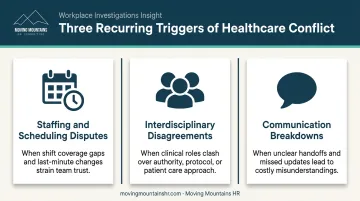
Most healthcare conflict traces back to a handful of recurring triggers:
- Staffing and scheduling disputes — Uneven workload distribution, disagreements over shift coverage, and staffing ratios that leave teams stretched thin
- Interdisciplinary disagreements — Conflicting opinions on treatment plans, unclear decision-making authority, and role responsibilities that overlap between nursing, medical, and support staff
- Communication breakdowns — Incomplete handoffs between shifts, siloed information across departments, and assumptions that go unchecked until something goes wrong
Two Core Types of Conflict
Not all workplace conflict looks the same, and the fix depends on which type you're dealing with. The Agency for Healthcare Research and Quality (AHRQ) draws a clear line between two categories.
Informational conflict is task-related: disagreement over data, a care plan, or the right process. Example: a nurse and physician disagree about whether a patient is ready for discharge based on differing readings of the chart.
Interpersonal conflict is personality-driven and unrelated to the task itself: tension, annoyance, or animosity between coworkers (AHRQ TeamSTEPPS).
It's harder to resolve because there's no clear "right answer" to negotiate toward. AHRQ notes that staff burnout makes it worse. A 2025 survey of 1,501 nurses found emotional exhaustion correlated with conflict involving both supervisors and coworkers (Qiu et al., 2025).
The Real Cost: How Unresolved Conflict Impacts Patient Care and Your Bottom Line
Conflict doesn't stay contained to the people involved. It bleeds into patient outcomes and organizational risk.
CRICO Strategies analyzed 23,658 malpractice cases filed between 2009 and 2013 and found communication failures contributed to 30% of them: 7,149 cases tied to $1.7 billion in incurred losses (CRICO Strategies, 2015). Communication failure isn't the only driver behind these cases, but it's a consistent thread.
On the ground, unresolved team conflict shows up as:
- Delayed diagnoses when staff avoid raising concerns to a colleague they're at odds with
- Unnecessary duplicate testing caused by poor handoff communication
- Disrupted continuity of care across shifts and departments
- Unsafe workarounds when staff route around a difficult coworker instead of addressing the issue directly
When Conflict Becomes a Legal Problem
Interpersonal conflict that goes unaddressed doesn't stay a "personality issue" forever. It can escalate into harassment, discrimination, or hostile work environment claims that require a formal investigation.
The Joint Commission has required accredited organizations to maintain a code of conduct addressing disruptive behavior since 2009, specifically because intimidating conduct undermines team effectiveness and patient safety (Joint Commission, 2008).
There's also a hard dollar cost to letting a toxic culture persist. NSI's 2026 retention report puts the average cost of replacing a single RN at $60,090, and estimates that each one-point shift in RN turnover costs (or saves) the average hospital roughly $295,000 a year (NSI Nursing Solutions, 2026).
Add the reputational damage from patient complaints and the licensing scrutiny that follows repeated incidents, and unmanaged conflict becomes a bottom-line problem fast.
Proven Conflict Resolution Styles and Communication Techniques
Not every conflict calls for the same response. The Thomas-Kilmann Conflict Mode Instrument identifies five recognized styles, each useful in different clinical situations.
| Style | Best used when | Can backfire when |
|---|---|---|
| Collaborating | Time allows for finding a solution both parties support | Used during a true emergency needing quick action |
| Compromising | Both sides have valid points and time is limited | Used as a default instead of solving root causes |
| Accommodating | The issue matters more to the other person and preserving the relationship counts | Overused, it signals your input doesn't matter |
| Competing | A safety-critical decision needs immediate action | Used routinely, it damages trust and teamwork |
| Avoiding | The issue is minor and will resolve on its own | Used on recurring problems, it lets resentment build |
Active Listening and De-Escalation
Before applying any framework, most conflicts need basic de-escalation. That means:
- Letting the other person finish without interrupting
- Using silence intentionally instead of rushing to fill it
- Asking clarifying questions rather than assuming intent
- Using "I feel" language and non-blaming statements instead of accusations
Saying "I felt caught off guard when the order changed without a heads-up" lands very differently than "You never communicate."
Structured Tools for High-Stakes Moments
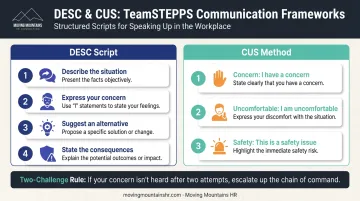
When a disagreement carries patient-safety weight, AHRQ's TeamSTEPPS framework offers two field-tested tools:
- DESC script: Describe the situation with concrete facts, Express your concern, Suggest an alternative, and state Consequences in terms of patient impact (AHRQ TeamSTEPPS)
- CUS method: State your Concern, explain why you're Uncomfortable, and flag the Safety issue if it goes unresolved
If a concern goes unheard after two attempts, AHRQ's Two-Challenge Rule says it's time to escalate up the chain of command rather than let it drop (AHRQ TeamSTEPPS). The goal in every case: keep the conversation focused on shared goals like patient safety, not who's "right."
Building a Structured Conflict Management Process for Your Organization
Reactive conflict handling, waiting until something blows up, puts your organization in constant catch-up mode. A written process changes that.
A solid conflict resolution policy should define:
- Escalation paths — who staff go to first, second, and third if an issue isn't resolved
- Timelines — how quickly each escalation step should happen
- Roles — what's expected of staff, supervisors, and HR at each stage
Documentation matters just as much as the policy itself. Every conflict that reaches a formal stage should record:
- What happened
- What steps were taken
- What resolution was reached
- A follow-up check confirming it stuck
Without that paper trail, patterns go unnoticed and repeat offenders slip through.
Training is the piece organizations skip most often, and regret skipping. Ongoing coaching for supervisors and charge staff, not just a one-time orientation session, keeps conflict resolution skills sharp before a crisis forces the issue.
Moving Mountains HR builds conflict resolution into its broader training and development programs. That includes supervisor leadership, employee relations, documentation practices, and California-specific compliance requirements, so managers aren't learning these skills for the first time mid-dispute.
When Internal Resolution Isn't Enough: The Role of HR and Neutral Investigations
Some conflicts outgrow team-level fixes. Watch for these red flags:
- The same two people or departments keep clashing despite repeated intervention
- There's a power imbalance: a manager involved, or a complaint against someone senior
- Allegations involve harassment, discrimination, or retaliation
At that point, sticking with internal resolution can become a liability. SHRM notes that organizations should bring in an outside investigator when internal staff have close ties to the people involved, when the accused holds significant authority, or when findings risk looking biased (SHRM, 2017).
A neutral third party protects the credibility of the findings and the organization's legal position.
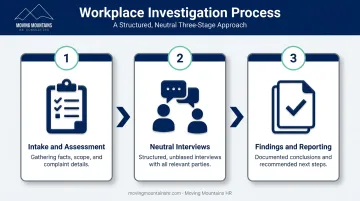
This is where Moving Mountains HR's workplace investigation services come in for healthcare organizations without dedicated in-house HR leadership. The process typically includes:
- Intake and assessment: documenting the complaint and planning the investigation approach
- Neutral interviews: speaking with all involved parties and witnesses while maintaining confidentiality and anti-retaliation protections
- Findings and reporting: delivering a summary report with recommendations leadership can act on
For organizations that keep facing the same conflict patterns, Moving Mountains HR's Fractional CHRO service pairs investigative support with ongoing compliance oversight, policy development, and workplace culture guidance. Healthcare employers get senior HR leadership without a full-time executive hire.
Combined with a proactive compliance audit, this partnership catches policy gaps before they turn into the next complaint.
Frequently Asked Questions
What are the main causes of conflict in healthcare workplaces?
Staffing pressures, unclear role boundaries, and communication breakdowns across shifts and departments are the leading drivers. Chronic resource constraints intensify all three, making conflict a near-constant feature of clinical work rather than an occasional issue.
What is the Thomas-Kilmann model of conflict resolution?
It identifies five conflict-handling styles: avoiding, accommodating, compromising, competing, and collaborating. Each style fits different situations, from urgent safety decisions (competing) to complex disputes with time to work through (collaborating).
How does unresolved conflict impact patient safety?
Team conflict disrupts communication, which research ties to a significant share of malpractice cases involving patient harm. Practically, this shows up as delayed diagnoses, duplicate testing, and unsafe workarounds when staff avoid direct communication.
When should a healthcare organization bring in HR or an outside investigator?
Bring in outside help when conflicts repeat despite internal efforts, when a power imbalance exists between the parties, or when allegations involve harassment or discrimination. Internal neutrality becomes questionable in these situations, which undermines any resolution reached.
What communication techniques help de-escalate conflict among healthcare staff?
Active listening, non-blaming "I feel" statements, and structured tools like DESC and CUS help teams address disagreements before they escalate. Keeping the conversation focused on shared goals, like patient safety, works better than debating who's right.
How can a fractional CHRO help healthcare organizations manage workplace conflict?
A fractional CHRO brings policy structure, staff training, and objective conflict resolution support without the cost of a full-time HR executive. This gives smaller healthcare organizations senior-level guidance to manage recurring conflict and compliance risk consistently.