
This guide is written for small to mid-size business owners who need their teams to work better together, communicate more openly, and deliver stronger results. You'll learn what the research says about effective team building, discover 15 proven workshop activities across three categories (visioning, reflection, and problem-solving), and understand when to run workshops internally versus hiring professional facilitation. Expect evidence, not fluff—and practical guidance you can apply immediately.
Key Takeaways
- Team building boosts collaboration, trust, and engagement, with the strongest gains in processes and relationships
- Psychological safety and clear goals come first; without trust, teams can't handle conflict or accountability
- Strong workshops mix visioning, retrospectives, and problem-solving to link past learning with future goals
- Virtual and in-person formats both work when designed well; choose based on team needs, not format bias
- Track success with immediate feedback, behavior change in 2–9 weeks, and business results the next quarter
What is a Team Building Workshop?
A team building workshop is a structured, facilitated session designed to improve collaboration, communication, trust, and performance within teams. Unlike informal social gatherings or standard training courses, workshops use intentional activities and guided discussion to help teams develop shared understanding, clarify roles, solve problems, and strengthen relationships.
The idea that workplace relationships drive performance goes back to research at Western Electric's Hawthorne plant in the 1920s. Elton Mayo and colleagues studied six relay-assembly workers between 1928 and 1933 and found that motivation included camaraderie and belonging, not just pay.
The "Hawthorne effect"—performance changing because workers know they're being observed—is a reminder to use proper controls. Still, the core insight holds: relationships shape how people work together.
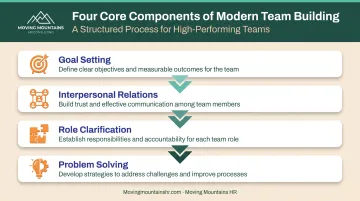
Modern team building focuses on four core components:
- Goal setting – aligning the team around clear, shared objectives
- Interpersonal relations – building trust and positive working relationships
- Role clarification – defining who does what and how roles fit together
- Problem solving – equipping teams to address challenges collaboratively
Team Building vs. Team Bonding vs. Team Training
These terms are often used interchangeably, but they serve different purposes:
| Approach | Purpose | Example |
|---|---|---|
| Team Building | Purposeful development of collaboration skills, shared understanding, and trust | Facilitated workshop to clarify roles, set goals, or improve communication norms |
| Team Bonding | Social connection and relationship-building through shared experiences | Happy hours, outings, or informal gatherings |
| Team Training | Instructional development of team-relevant knowledge, skills, and attitudes | Workshop teaching conflict resolution, project management, or technical skills |
All three have value. This article focuses on team building: workshops that intentionally improve how teams work together to achieve business results.
Why Team Building Workshops Matter: Benefits for Your Business
Enhanced Collaboration and Communication
Workshops create shared language, break down silos, and establish communication norms that carry forward into daily work. When team members participate in structured activities together, they learn how colleagues think, what they value, and how they prefer to communicate.
The result: fewer misunderstandings, faster decisions, and smoother cross-functional collaboration.
Increased Employee Engagement and Morale
Gallup's 2024 State of the Global Workplace report found that only 23% of employees worldwide were engaged, while 62% were not engaged and 15% were actively disengaged. The middle group (those doing their jobs but not bringing energy or innovation) represents the biggest opportunity.
Team building addresses this by helping employees feel connected to their colleagues, understand their role's purpose, and see how their contributions matter.
Reduced Turnover and Associated Costs
When employees feel disconnected from their team or unclear about expectations, they leave. Gallup estimates that replacing an employee costs 0.5 to 2 times their annual salary—a range they explicitly call conservative. For a 100-person company with $50,000 average salaries, annual turnover replacement costs can reach $660,000 to $2.6 million. Workshops that strengthen relationships, clarify roles, and improve communication directly address retention by making work more meaningful and teams more supportive.
For small to mid-size businesses navigating California's employment standards, Moving Mountains HR provides strategic HR support that helps build compliant, productive workplaces where employees want to stay.
Improved Trust and Psychological Safety
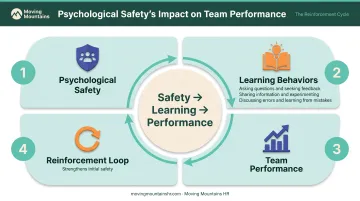
Harvard Business School professor Amy Edmondson defined psychological safety as a shared belief that the team is safe for interpersonal risk-taking. Her 1999 study of 427 people across 51 teams found that psychological safety predicted learning behavior, which in turn predicted team performance.
Learning behavior mediated the safety-performance relationship. That includes:
- Asking questions and seeking feedback
- Sharing information and discussing errors
- Experimenting with new approaches
Workshops create structured opportunities for speaking up, challenging ideas, and admitting mistakes without fear of punishment. When facilitated well, these sessions normalize candor and model the behaviors leaders want to see day-to-day.
Higher Productivity and Performance
Gallup's 2024 Q12 meta-analysis examined 183,806 business units and 3.35 million employees. It found a 23% median profitability difference between top- and bottom-quartile engagement units, along with 18% higher sales productivity, 14% higher production productivity, and 32% fewer defects.
These figures quantify the association between engagement and business outcomes, not the direct ROI of a single workshop. They still illustrate the performance upside when teams are aligned, motivated, and working well together.
Stronger Workplace Culture and Compliance
Purposeful team building reinforces compliant workplace practices by clarifying expectations, establishing respectful communication norms, and surfacing issues before they escalate. In California, where employment law standards are rigorous, workshops that build trust and open communication help organizations maintain compliance while fostering positive culture.
Critical Success Factors for Effective Team Building Workshops
Effective team building workshops share a few critical ingredients. Without them, activities stay surface-level and gains fade once everyone is back at their desks.
Trust and Psychological Safety
Patrick Lencioni's Five Dysfunctions of a Team model places vulnerability-based trust at the base of the pyramid. Without trust, teams fear conflict, avoid commitment, sidestep accountability, and fail to focus on collective results.
Workshops build trust by creating space for people to share challenges, acknowledge weaknesses, and support one another. Psychological safety is what that looks like day to day:
- Team members speak up with questions or concerns without fear of embarrassment
- People challenge ideas, including those from leaders, when they see potential issues
- Mistakes are discussed openly as learning opportunities, not punished
- Feedback flows up, down, and across the team
Facilitators build that safety by setting ground rules for confidential and respectful communication, acknowledging that discomfort is part of growth, and starting with lower-risk activities before deeper discussions.
Clear Purpose and Goals
MacMillan's High Performance Team model identifies six components: Purpose, Roles, Leadership, Processes, Relationships, and Communication. Workshops must align to real business objectives, not generic "team building."
Whether you're launching a new product, addressing conflict, or integrating a new team member, the session's purpose should be explicit, specific, and tied to measurable outcomes.
Relationships, Processes, and Shared Leadership Norms
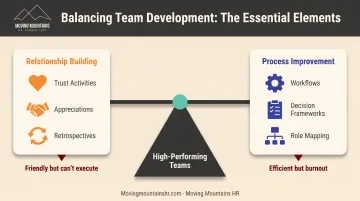
High-performing teams balance relationship-building with process improvement. Strong workshops pair connection activities (retrospectives, appreciations) with process work (role mapping, decision frameworks). Skip either one and you get friendly teams that can't execute, or efficient teams that burn people out.
Sessions should also surface leadership dynamics, communication preferences, and collaboration norms. When teams co-create agreements about how they will work together, make decisions, and resolve conflict, follow-through improves. Imposed norms rarely stick the same way.
15 Proven Team Building Workshop Activities
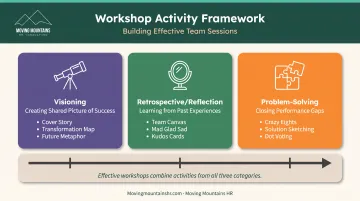
Effective workshops combine activities from three categories:
- Visioning – creating a shared picture of success
- Retrospective/Reflection – learning from past experiences
- Problem-Solving/Action-Planning – closing the gap between where the team is and where it needs to go
Select activities based on:
- Team size
- Time available
- Current team dynamics
- Specific workshop goals
A half-day workshop might include one activity from each category. A full-day session allows deeper exploration and more variety.
Visioning and Futurescaping Activities
Visioning exercises help teams define where they are headed and what success looks like in practice. These three activities turn vague aspirations into a shared picture of the future.
Cover Story
Instructions: Participants build the front page of a newspaper or magazine covering the team's biggest win 12 months from now. Add headlines, images, stakeholder quotes, and social buzz.
Benefits: Sparks energy around a shared definition of success. A mock cover makes the goal feel real and specific.
Transformation Map
Instructions: On a large canvas, set timeframes across the top (3, 6, and 12 months) and themes down the side (customer experience, product development, team culture). Map one desired achievement for each theme and timeframe.
Benefits:
- Turns long-range plans into a visible roadmap
- Keeps customer, product, and culture goals in balance
Future Metaphor
Instructions: Teams draw a metaphor for how they want to perform together—a well-oiled machine, a championship team, a symphony orchestra. Label each part and what it stands for.
Benefits: Surfaces how people picture ideal collaboration and leaves the group with a memorable reference they can reuse in later work.
Retrospective and Reflection Activities
Retrospectives turn recent work into lessons the team can use. These activities help people name what worked, what frustrated them, and what they want to protect or change next.
Team Canvas Workshop
How to run it: Facilitate a session across five themes—team goals, roles and skills, values, rules and activities, and purpose—using discussion and visual mapping. Free template at theteamcanvas.com.
Benefits:
- Aligns everyone on fundamentals
- Surfaces assumptions and misalignments early
- Leaves a shared visual reference for ongoing development
When We Are At Our Best
How to run it: Have the team identify times they delivered outstanding performance. Capture what was happening, who was involved, and why it worked.
Benefits:
- Builds on strengths through Appreciative Inquiry
- Spots success patterns worth repeating
- Boosts positive energy and confidence
Mad, Glad, Sad Retrospective
How to run it: Set up three posters—Mad (frustrations), Glad (successes), and Sad (disappointments or things you'll miss). Team members add sticky notes to each.
Benefits:
- Balances hard feedback with celebration
- Surfaces issues that need attention
- Highlights wins that might otherwise get skipped
Kudos Cards
How to run it: Each person writes short recognition notes for colleagues' contributions, successes, and support. Post the notes on a wall under each name.
Benefits:
- Strengthens relationships and morale
- Ensures everyone receives recognition
- Creates a tangible record of peer appreciation
Three Little Pigs
How to run it: Using houses of straw (shaky processes), sticks (good but improvable), and bricks (solid foundation), teams categorize current ways of working.
Benefits:
- Makes abstract assessment concrete and visual
- Uses a familiar story to lower defensiveness
- Shows what needs shoring up versus what's working
Problem-Solving and Action-Planning Activities
Run these three activities in order: generate ideas fast, develop the strongest ones, then vote on what to pursue.
Crazy Eights Ideation
Instructions: Each person folds a sheet of paper into eight sections and sketches one distinct idea per section in one-minute intervals (8 minutes total). Push past the first obvious idea.
Benefits: Produces a high volume of ideas quickly and cuts down on overthinking. Teams get past "first idea" bias and surface more creative options.
Solution Sketching
Instructions: Small groups pick the strongest ideas from Crazy Eights (their own or others'), then expand them into multi-frame sketches that show how each idea would work in practice.
Benefits: Turns abstract concepts into concrete proposals. Groups combine and build on ideas, leaving tangible options ready to evaluate.
Dot Voting for Prioritization
Instructions: After solution presentations, each person gets three votes to place on the ideas they find most compelling. Votes can be spread across ideas or stacked on one favorite.
Benefits: Surfaces team preferences fast and keeps decision-making democratic. The visual tally makes high-consensus options obvious without long debate.
Interactive and Energizing Activities
High-energy activities break the ice and get people working together under light pressure. Choose options that fit your group size, physical comfort level, and culture.
Scavenger Hunt
Instructions: Teams find physical objects, complete tasks, or solve clues leading to locations or objects. First team to finish wins.
Benefits: Gets people moving while practicing creative problem-solving and collaboration in a low-stakes setting.
Talent Show
Instructions: Team members voluntarily share talents and passions outside work—music, art, sports, cooking—in a supportive setting.
Benefits: Colleagues see each other beyond job titles. Shared interests often spark lasting connections across teams.
Team Sports Tournament
Instructions: Run brackets for volleyball, basketball, kickball, or similar sports, with rounds leading to a championship.
Benefits: Friendly competition builds camaraderie. Habits like clear communication, trust, and recovering from setbacks transfer to day-to-day teamwork.
Group Cooking or Upcycling Challenge
Instructions: Teams create a meal from set ingredients or an upcycling project from provided materials within a time limit.
Benefits: Forces creative problem-solving under constraints and ends with a tangible result. Easy to fold in sustainability themes if that matters to your culture.
Wellness and Connection Activities
Shared movement resets energy and gives people a low-pressure way to connect outside their usual roles.
Fitness Activity Session
How it works: Have the group join a yoga, pilates, aerobics, or similar wellness session together. A qualified instructor keeps it safe and inclusive for mixed fitness levels.
Why it works:
- Builds wellness into company culture in a tangible way
- Offers stress relief and a mid-workshop energy boost
- Creates a shared experience that strengthens peer connections
Best Practices for Facilitating Team Building Workshops
Plan with Clear Objectives and Agenda
Establish specific, measurable goals before the workshop. What will be different after this session? Build a timed agenda, share objectives with participants in advance, and explain why the session matters for the business.
Create Psychological Safety from the Start
Set ground rules for confidential and respectful communication. Acknowledge that discomfort is part of growth. Start with lower-risk activities (icebreakers, appreciations) before deeper discussions (conflict, performance issues).
Balance Structure with Flexibility
Have a clear agenda and timeframes but be willing to extend valuable conversations. Prepare more activities than you'll need in case some land quickly. Read the room and adjust your approach based on energy and engagement levels.
Adapt for Virtual or Hybrid Formats
A 2025 study of 478 employees in 56 hybrid teams found that a four-hour online team intervention improved social support, psychological safety, and psychosocial management, with effects persisting nine weeks. Those gains only show up when the virtual format is designed with intention, not copied from an in-person agenda.
Virtual workshop tips:
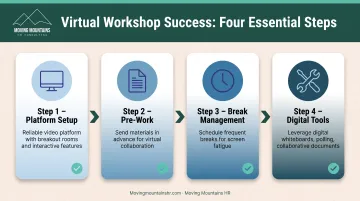
- Use reliable video platforms with breakout rooms and interactive features
- Send materials in advance for virtual collaboration
- Schedule more frequent breaks for screen fatigue
- Leverage digital whiteboards, polling, and collaborative documents
Document Outcomes and Assign Accountability
Capture key insights and commitments in writing during the workshop. Assign specific owners and deadlines for follow-up actions. Schedule a check-in meeting to review progress and maintain momentum.
Consider When to Bring in Professional Facilitation
Internal facilitation is not always the right call. Bring in outside help when:
- Power dynamics limit candor (a leader running the session often reduces honest feedback)
- The team has lived through conflict or broken trust and needs a neutral third party
- You want expert design and facilitation to get real impact from the time invested
Moving Mountains HR facilitates team development through its training programs, giving small and mid-size businesses a neutral partner when internal dynamics would hold the room back.
Frequently Asked Questions
What are the 7 C's of effective teamwork?
The 7 C's are Capability, Cooperation, Coordination, Communication, Cognition, Coaching, and Conditions. They describe the building blocks of high-performing teams. Workshops map activities to each one, from role clarity and trust to shared understanding, leadership habits, and the conditions teams need to succeed.
What are good workshop activities?
Good activities are purposeful, engaging, appropriate for team size and dynamics, and connected to real business goals. They generate insight, prompt meaningful conversation, and lead to actionable commitments. This article provides 15 proven options across visioning, reflection, and problem-solving categories.
How long should a team-building workshop be?
Duration depends on your objectives, team size, topic count, and how sensitive the issues are. A half-day works for one focused topic; a full day suits broader team development; two days fit a team reset or strategic planning session.
When should you hire an external facilitator vs. DIY?
Hire an external facilitator when leaders in the room would limit candor, when conflict or broken trust needs a neutral third party, or when you need specialized methods. DIY works when trust is strong, stakes are low, and someone internal has real neutrality and process skill.
How do you measure team-building workshop success?
Track immediate signals (feedback, psychological safety, role clarity, action-plan quality) and longer-term ones (behavior change, collaboration, retention, and project results over 3–6 months). Take a baseline, repeat the same measure after the workshop, and review progress at set check-ins.
What's the difference between team building and team bonding?
Team bonding is social connection through happy hours, outings, and informal gatherings. Team building is structured development of collaboration skills, shared understanding, and role clarity. Bonding strengthens relationships; building improves how the team works together to get results.