For many healthcare organizations, workplace violence prevention training still gets treated as a once-a-year checkbox exercise. That approach doesn't just fail employees. It creates real regulatory exposure, especially in California, where Cal/OSHA's Title 8 CCR §3342 mandates an ongoing, documented program, not a single training session.
This article breaks down what workplace violence looks like in healthcare settings, why the risk runs so high, what California and federal law actually require, and how to build a program that keeps employees safer and your organization compliant.
Key Takeaways
- California healthcare employers need a written violence prevention plan under Cal/OSHA Title 8 CCR §3342, not training alone
- Strong programs combine hands-on de-escalation, clear incident reporting, and role-specific risk training
- Regular risk assessments and visible leadership accountability outperform training-only approaches
- Underreporting undermines prevention, so a trusted, non-retaliatory reporting culture is essential
What Is Workplace Violence in Healthcare?
Workplace violence in healthcare covers more ground than most people assume. According to OSHA's definition, it includes any act or threat of physical violence, harassment, intimidation, or other threatening behavior, whether it comes from a patient, a visitor, a family member, or a coworker.
Occupational safety experts recognize four distinct categories:
- Criminal intent - the perpetrator has no legitimate connection to the facility (often committing a separate crime, such as theft)
- Client or patient-on-worker - violence directed at staff by patients, family members, or visitors
- Worker-on-worker - bullying, verbal abuse, or physical aggression between colleagues
- Personal relationship violence - a perpetrator's outside relationship with an employee spilling into the workplace
In healthcare, patient-on-worker incidents dominate. OSHA found that patient interactions caused 80% of serious violent incidents reported in healthcare settings in 2013—still the dominant pattern in the sector.
In 2021-2022, private healthcare and social assistance employers recorded 41,960 nonfatal workplace violence cases requiring days away from work, restricted duty, or job transfer. That figure is 72.8% of all such cases across private industry—even though healthcare employs only a fraction of the total workforce.
Why Healthcare Organizations Face Elevated Risk
Several factors make healthcare uniquely dangerous. Understaffing tops the list. When units run lean, especially during meal times or visiting hours, staff have less capacity to monitor behavioral changes or respond quickly to escalating situations.
Other contributing factors include:
- Long emergency department wait times that frustrate patients and families
- Patients experiencing acute pain, substance withdrawal, or psychiatric crises
- Inadequate security presence or mental health support staff
- Weak reporting cultures where employees assume nothing will change
- Poor facility design, including limited escape routes and blocked sightlines
Some settings carry higher risk:
| Setting | Why It's Vulnerable |
|---|---|
| Emergency departments | High patient volume, long waits, exposure to crisis situations |
| Behavioral health units | Direct work with patients in acute psychiatric episodes |
| Long-term care facilities | Cognitive impairment and dementia-related aggression |
| Home health services | Staff work alone, often without immediate backup |
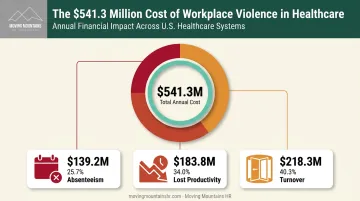
The financial toll adds up fast. A 2025 American Hospital Association hospital cost model estimates workforce-related impacts of violence at $541.3 million annually across three categories:
- $139.2 million in absenteeism
- $183.8 million in lost productivity
- $218.3 million in turnover
Those figures come from the AHA's Cost of Violence report. They exclude legal exposure and reputational damage.
California and Federal Compliance Requirements for Workplace Violence Prevention Training
Healthcare employers don't answer to just one regulatory body. State law, federal enforcement, and accreditation standards often overlap, and each carries its own training and documentation demands.
California's Cal/OSHA Workplace Violence Prevention in Health Care Standard (Title 8 CCR §3342)
California's healthcare-specific standard, operative since April 1, 2017, requires covered facilities to maintain a written prevention plan tailored to each unit's specific hazards, not a generic corporate policy pulled from a template.
Key requirements include:
- Employee involvement in developing, reviewing, and updating the plan
- A violent incident log for every incident and near-miss, noting date, location, circumstances, and perpetrator type
- Post-incident response procedures, including first aid access, trauma counseling availability, and structured debriefing
- Annual plan review covering staffing, security, and job design risks
Training timing matters as much as content:
- Deliver initial training when the plan launches and whenever an employee is newly hired or newly assigned
- Provide annual refresher training for patient-contact employees and supervisors
- Require hands-on de-escalation training for designated responders before first assignment and every year after, with time to practice physical maneuvers and debrief
Federal OSHA and General Industry Requirements
Federal OSHA doesn't have a dedicated workplace violence standard yet. Instead, it relies on the General Duty Clause under Section 5(a)(1) of the OSH Act, which requires employers to maintain a workplace free from recognized hazards likely to cause serious harm. OSHA's healthcare-specific guidelines exist, but they're explicitly advisory rather than enforceable regulations.
Joint Commission Standards (for Accredited Facilities)
Accredited hospitals face a third layer of requirements. Since January 2022, Joint Commission standards have required:
- LD.03.01.01 - a designated leader and multidisciplinary team overseeing prevention and response
- HR.01.05.03 - role-appropriate training at hire, annually, and after any program change
- EC.02.01.01 - an annual worksite analysis identifying and mitigating environmental risks
Layering state, federal, and accreditation rules is where facilities most often fall behind. Overlapping deadlines and mismatched documentation formats trip up even well-run teams.
Core Components of an Effective Workplace Violence Prevention Training Program
Strong training programs go beyond a slideshow and a signature sheet. They need to reflect the actual risks employees face on their unit.
Clear definitions and unit-specific examples beat generic "what is workplace violence" slides. Use scenarios staff actually face—a psychiatric hold gone wrong in behavioral health, or a confused patient swinging at a nursing assistant in long-term care.
Hands-on de-escalation practice should outweigh passive video watching. Have employees rehearse verbal techniques and safe physical maneuvers with real feedback, then debrief on what worked. Role-play builds muscle memory that lectures alone cannot.
Behavioral risk recognition comes next. Staff should learn early warning signs tied to the populations they serve:
- Substance use or withdrawal symptoms
- Acute pain or discomfort
- Cognitive impairment, including dementia
- Prior history of aggression
- Active psychiatric crises
Recognition only helps if people report what they see. Underreporting is still one of the biggest barriers to prevention, so training must address fear of retaliation and show that reports lead to action, not blame.
When prevention fails, staff need a clear playbook. Emergency response protocols should cover code systems, panic alert devices, and how to coordinate with security or local law enforcement.
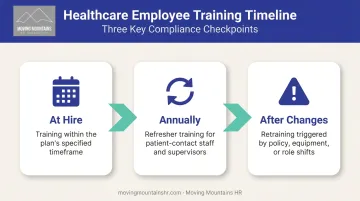
Lock in the training cadence so skills don't fade:
- At hire: within the timeframe your written plan specifies
- Annually: for all patient-contact employees and supervisors
- After changes: whenever policies, equipment, or role responsibilities shift
Building a Comprehensive Workplace Violence Prevention Program Beyond Training
Training alone won't carry a compliance program. It's one piece of a larger structure.
A complete workplace violence prevention program also needs these elements:
Regular risk assessments. Facility walkthroughs that check lighting, sightlines, alarm placement, and staffing patterns catch hazards before they become incidents.
A reporting system people trust. An accessible, non-retaliatory process only works when employees believe using it won't backfire. That trust surfaces more near-misses and helps you fix hazards faster.
Leadership accountability. Most compliance standards require a multidisciplinary safety committee with defined ownership. When staff see managers take incidents seriously, reporting rates rise.
Post-incident employee support, including:
- Access to employee assistance programs
- Structured debriefing sessions
- Return-to-work support for affected staff
Scheduled audits and updates. Regulations evolve. A plan that met requirements two years ago may have gaps today. Scheduled audits keep policies current—and this is where an outside HR compliance partner adds ongoing value instead of a one-time fix.
How Moving Mountains HR Supports Healthcare Organizations
Building and maintaining a compliant workplace violence prevention program takes more bandwidth than most healthcare HR teams have available, especially at small and mid-size organizations without a dedicated compliance department.
Moving Mountains HR brings executive-level HR expertise shaped by founder Michelle Schwanhauser's background in healthcare. That experience guides how the firm builds policy and compliance strategy for clients in this sector.
Services relevant to workplace violence prevention include:
- HR Document Audits — identify gaps between your written plan and Cal/OSHA, federal, or Joint Commission requirements
- Fresh Compliance Docs — build regulation-aligned policies and procedures when starting from scratch
- Workplace Investigations — provide neutral third-party review after incidents, including hostile work environment and coworker conflict cases
- Fractional CHRO Support — give ongoing strategic guidance so you can maintain the program without a full-time HR executive

Flexible service tiers give small and mid-size healthcare organizations access to this expertise without the overhead of a full HR department. If you're unsure where your current program stands, scheduling a free consultation is a practical first step toward closing the gap.
Frequently Asked Questions
Is workplace violence prevention training required by law in California healthcare facilities?
Yes. California mandates this training under Cal/OSHA's Title 8 CCR §3342 standard, which applies to hospitals, home health providers, EMS services, and several other healthcare settings statewide.
How often must healthcare workers receive workplace violence prevention training?
Initial training happens at hire or plan launch, with annual refreshers required for patient-contact employees and supervisors. Additional training follows any policy, equipment, or role change.
What is the difference between OSHA and Cal/OSHA requirements for workplace violence prevention?
Federal OSHA relies on the General Duty Clause and advisory guidelines rather than a dedicated standard. California's Cal/OSHA rule is healthcare-specific and far more prescriptive, requiring a written plan, incident log, and mandatory hands-on training.
What topics must be included in workplace violence prevention training for healthcare workers?
Core topics include definitions and relevant examples, hands-on de-escalation techniques, incident reporting procedures, and emergency response protocols, including code systems and security coordination.
Who is responsible for implementing a workplace violence prevention program in a healthcare facility?
Leadership and HR share primary responsibility, typically supported by a multidisciplinary safety committee involving frontline staff, security, and clinical leadership.
What happens if a healthcare facility fails to comply with workplace violence prevention training requirements?
Non-compliance can trigger Cal/OSHA citations and proposed penalties, with maximums reaching $16,285 for general violations and up to $162,851 for willful or repeat violations. It also increases liability exposure if an incident occurs afterward.