
These aren't people problems—they're symptoms of misalignment between your business strategy and your organizational structure. When your company outgrows its structure, even talented employees can't execute effectively.
This guide explains what organization design is, when your business needs it, the core elements and principles that make it work, common structure types, and how to approach a redesign without disrupting your operations.
Key Takeaways
- Organization design aligns structure, roles, workflows, and decision authority with business strategy to improve execution
- Redesign is needed during growth, strategic shifts, mergers, or when silos, slow decisions, and unclear accountability persist
- Effective design balances specialization, coordination, and flexibility to match how your work actually runs
- Start with strategy and workflows, not the org chart; change structure last
- HR connects strategy, workforce data, and change management so the redesign sticks
What Is Organization Design?
Organization design is the process of structuring roles, responsibilities, workflows, and decision-making authority to support strategic execution. It's how you deliberately align your company's internal setup with your business goals.
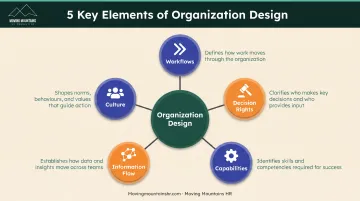
This is different from simply drawing an org chart. Organizational structure is the framework: the reporting lines and hierarchy. Organization design aligns multiple elements beyond that chart:
- Workflows across teams
- Decision rights and ownership
- Capabilities required for execution
- Information flow between functions
- Culture that shapes daily work
Design should always follow strategy. Your business goals and competitive approach determine the optimal design. A company competing on cost efficiency needs fundamentally different workflows and decision authority than one competing on rapid innovation.
Example: A public pension system reconsidered its geographic and divisional options, then selected a functional model organized around health, pensions, and investment. The redesign reduced costs and enabled new-product launches because the structure supported their strategic priorities.
Don't start by reorganizing departments. Start by clarifying what your business needs to accomplish, then build the structure that makes execution possible.
When Your Business Needs Organization Design
Certain moments demand intentional structural change—especially as small and mid-size teams grow past informal roles:
- Growth or scaling: New markets, product lines, or locations change coordination needs. What worked locally often breaks regionally.
- Strategic shifts: When you move upmarket, target new segments, or pivot your value proposition, structure has to follow.
- Mergers or acquisitions: Combining companies means combining workflows, roles, and decision rights. Without design, you inherit duplicate work and conflicting authority.
- Persistent operational problems: Unclear accountability, duplicated work, slow approvals, or information bottlenecks mean structure no longer matches the work.
- External disruptions: New technology, competitors, or regulations force you to rethink how work gets done and who decides what.
Small to mid-size businesses often outgrow the "everyone does everything" model. Wait too long and you risk missed targets, higher turnover, and a competitive gap—warning signs that usually show up months before results slip.
Core Elements and Principles of Organization Design
What to Include in Your Design
Effective organization design integrates six core elements:
- Workflows and interactions: How work moves through the company, who hands off to whom, and where coordination is required
- Roles and accountabilities: What each position owns, who is responsible for outcomes, and how roles connect
- Decision rights: Who makes which decisions, who provides input, and who must be informed
- Performance measures: How you track progress, define success, and hold people accountable
- Structure: Reporting relationships, hierarchy, and departmental groupings
- Workforce: The skills, capabilities, and headcount needed to execute
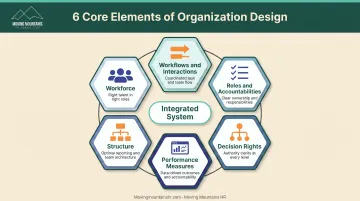
These elements must work together as an integrated system. Changing one without adjusting the others creates misalignment. If you reorganize reporting lines but don't clarify decision authority, people still won't know who decides what.
Guiding Principles for Effective Design
Once those elements are defined, these principles keep the design practical and durable:
- Align with strategy and value drivers. Design around what differentiates your business, not generic best practices. A consulting firm and a manufacturing plant need very different workflows and coordination.
- Put decision rights where the knowledge is. Empower people closest to the work. Senior leaders set direction and clear roadblocks; daily operational calls stay at the front line so execution doesn't bottleneck.
- Design for flexibility. Markets, competitors, and regulations shift. Your structure should absorb change without a full reorganization every two years.
- Start with workflows and accountabilities before structure. Form follows function. Clarify how work gets done, who owns what, and where decisions happen—then draw the org chart last.
Outside HR support can help you apply these principles objectively, especially during major transitions when internal politics and legacy relationships cloud judgment.
Common Organizational Structure Types
There is no universally "right" structure. The best fit depends on your strategy, size, industry, and culture. Most companies use hybrid models that combine elements from multiple types.
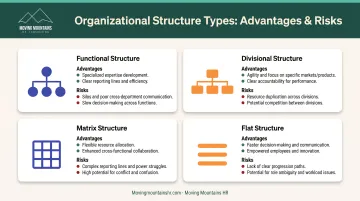
Functional Structure
What it is: Groups work by specialty—sales, marketing, operations, finance, HR.
When it works best: Companies seeking deep specialization, efficiency, and clear career paths within disciplines.
Advantages:
- Employees build deep expertise within their discipline
- Career paths stay clear inside each function
Risks:
- Functional silos slow cross-team work
- Departments compete for resources instead of shared goals
Divisional Structure
What it is: Groups teams by product, market, customer segment, or geography.
When it works best: Companies with multiple distinct offerings, regions, or customer types that require dedicated focus.
Advantages:
- Clear performance metrics by division
- Each division can move quickly without company-wide coordination
Risks:
- Resources get duplicated across divisions
- Shared services become harder to manage
Example: Honda organizes divisions around motorcycles, automobiles, and aircraft—each with its own operations, sales, and engineering.
Matrix Structure
What it is: Combines functional and project or regional reporting. Employees report to both a functional manager and a project or regional manager.
When it works best: Work that requires shared specialists across multiple dimensions—such as global companies with both regional and product priorities.
Advantages:
- Flexible staffing across projects or regions
- Specialists support multiple efforts without permanent reassignment
Risks:
- Managers pull in conflicting directions
- Employees may not know whose direction takes precedence
Example: Atrium Health adopted matrix relationships after mergers increased scale and geographic dispersion.
Flat Structure
What it is: Few layers of hierarchy. Teams are cross-functional and often self-managed.
When it works best: Smaller companies or teams where autonomy, speed, and collaboration are more important than control.
Advantages:
- More autonomy for teams
- Faster decisions and direct communication
Risks:
- Control and coordination weaken as headcount grows
- Role clarity can become ambiguous
Example: Valve operates with 400 employees and 100% self-allocated work assignments.
Hybrid Structures
What it is: Combines elements—often functional expertise with divisional autonomy or project-based coordination.
When it works best: Growing companies that need specialization in some areas and speed or local ownership in others.
Advantages:
- Adapts as strategy and scale change
- Preserves expertise without locking the whole org into one model
Risks:
- Overlapping accountability without clear governance
- Decision rights blur when two models collide
Match the structure to the work. If teams must coordinate across functions daily, don't organize purely by function. If specialization and efficiency are your edge, don't flatten the hierarchy.
How to Approach Organization Design in Your Business
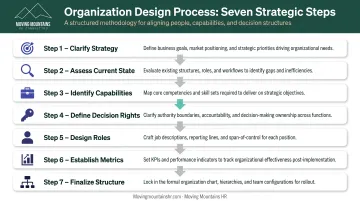
Follow a structured process to redesign without disrupting operations:
1. Clarify your business strategy and goals
What are you trying to accomplish in the next 12–24 months? What differentiates you from competitors? Your structure must support your strategic priorities, not generic best practices.
2. Assess the current state
Map how work actually flows today. Identify role ambiguity, decision bottlenecks, unclear interfaces, and redundant handoffs. Ask: What's working? What's not?
3. Identify needed capabilities and workflows
Based on your strategy, list the capabilities you need and the workflows that must improve. Pinpoint where decisions get stuck and which handoffs create delay or rework.
4. Define decision rights and accountabilities
Clarify who makes which decisions, who provides input, and who must be informed. Use a simple framework like RAPID (Recommend, Agree, Perform, Input, Decide) for recurring high-value decisions.
5. Design roles and teams
Group work logically. Define roles around accountabilities, not just tasks. Ensure each role has clear ownership of outcomes.
6. Establish metrics and feedback loops
Define how you will measure success and which early indicators will show whether the new design is working. Review those signals on a set cadence so you can adjust before problems spread.
7. Finalize structure and reporting lines
Only now should you draw the org chart. The structure should reflect the workflows, decision rights, and accountabilities you've already defined.
Before you roll anything out, keep two principles front and center:
Start small. Pilot changes in one department or function before rolling out company-wide. This tests assumptions and surfaces problems before they affect the entire organization.
Communicate early and often. Involve key stakeholders from the beginning. People need to understand why the change is happening, what it means for them, and how decisions will be made during the transition.
The Role of HR in Organization Design
HR connects strategy, people, and operational realities so the new structure works on paper and in practice. In organization design, that means facilitating the process and integrating decisions across leaders, teams, and day-to-day operations.
HR's responsibilities include:
- Analyzing current structure and workforce data to identify gaps, bottlenecks, and capability needs
- Facilitating stakeholder alignment so leaders agree on objectives and design criteria before drawing the blueprint
- Defining roles, competencies, and career paths that support the new structure
- Supporting change management and communication to build buy-in and reduce resistance
Small to mid-size companies often lack internal HR expertise for complex redesign projects. Fractional or consulting HR support can supply specialized knowledge, an outside perspective, and the bandwidth to run the work without pulling leaders away from daily operations.
Moving Mountains HR offers fractional CHRO services and HR strategy support for businesses navigating growth, operational realignment, or structural transitions. That support helps you assess staffing needs, stand up scalable HR systems, and tie people decisions to the business goals driving the redesign.
Frequently Asked Questions
What is organizational design?
Organizational design is the intentional structuring of roles, workflows, decision rights, and reporting relationships so the business can execute strategy. It aligns how work gets done with what the organization needs to accomplish.
What are the 6 elements of organizational design?
The 6 core elements are workflow and interactions, roles and accountabilities, decision rights, performance measures, structure (reporting relationships), and workforce (skills, capabilities, headcount). These elements must work together as an integrated system.
What are the 5 principles of organizational design?
Five core principles guide effective design: align with strategy, empower decision-making where knowledge exists, design for flexibility, start with workflows and accountabilities before structure, and integrate all elements holistically.
What are the 7 types of organizational structures?
The seven common types are functional (grouped by specialty), divisional (grouped by product or region), matrix (dual reporting), flat (minimal hierarchy), network (coordinated partnerships), process-based (organized around workflows), and hybrid (combining multiple forms).
What are examples of organizational design?
Honda groups divisions by product line (motorcycles, automobiles, aircraft). Valve runs a flat model where about 400 employees self-allocate work. Atrium Health moved to matrix relationships after mergers increased scale and geographic spread.
What is the role of HR in organizational design?
HR facilitates design by aligning people strategy with business strategy, analyzing workforce data, engaging stakeholders to build alignment, defining roles and competencies, and managing the change process to ensure smooth transitions.