Introduction
Gallup research found that 42% of employee turnover is preventable, yet only 29% of people who left had a meaningful career-development conversation with their manager first. Lack of advancement opportunity was a named factor for many of those exits.
For small to mid-size businesses, that gap is expensive. Replacing an employee typically costs 50–200% of annual salary—closer to 200% for leadership roles, about 80% for technical roles, and roughly 40% for frontline staff.
Most small business owners juggle HR on top of everything else, and more than 80% lack formal HR training. Desire isn’t the problem. What’s missing is a clear framework for structured development pathways.
This article gives you 7 employee development plan examples, ready-to-use templates, and a simple step-by-step framework. Use them to boost retention, close skill gaps, and tie individual growth to business goals.
Key Takeaways
- Tie career goals to business needs with milestones, timelines, and measurable outcomes
- Match the plan type to the need: performance gaps, leadership prep, career paths, or cross-functional skills
- Keep plans alive with quarterly check-ins, employee ownership, manager support, and clear success metrics
- Small businesses win with simple, repeatable frameworks tied to regular manager conversations
What Is an Employee Development Plan?
An employee development plan is a documented agreement between an employee and manager that outlines:
- Current skill levels and competencies
- Target skills or roles the employee wants to build toward
- Specific development activities (training, mentoring, stretch assignments)
- Timelines with milestones
- Success metrics to track progress
That structure is also what separates a development plan from documents managers often mix it up with.
Development Plans vs. Performance Improvement Plans
Development plans are forward-looking and growth-focused. They help employees build capabilities for future roles or responsibilities. Performance improvement plans (PIPs) address current performance gaps and usually come with corrective timelines.
Key distinction: Development plans are collaborative and aspirational. PIPs are corrective and typically mandatory.
Who Owns the Plan?
Plans work best when ownership is shared:
- Employees own their growth, drive the conversation, and execute action steps
- Managers provide coaching, resources, feedback, and accountability
- HR or leadership provides structure, program options, and access to development programs
Top-down plans created without employee input usually fail—they miss what actually motivates the person doing the work.
Why Employee Development Plans Matter for Small to Mid-Size Businesses
For small and mid-size businesses, employee development plans protect margins, raise output, and help you compete for talent without big-company budgets.
Retention and Cost Avoidance
Employees with clear development paths are less likely to leave. Gallup research shows that when managers discuss future career paths, employees stay more engaged and feel more valued. With replacement costs at 50–200% of salary, even modest retention gains deliver measurable ROI.
Performance and Productivity Gains
When employees build relevant skills, they work faster and make stronger day-to-day decisions. Organizations with leadership development at every level report 54% top-decile financial performance, versus 31% when development stops at one level.
Competitive Talent Advantage
Development opportunities attract stronger candidates. 87% of millennials and 69% of non-millennials rate career growth as important when choosing a job. For small businesses competing with larger firms, a reputation for growing people helps you win talent you might otherwise lose.
Structured development also builds internal bench strength. That cuts dependence on external hires and helps your team respond faster when the market shifts.
7 Employee Development Plan Examples (With Templates)
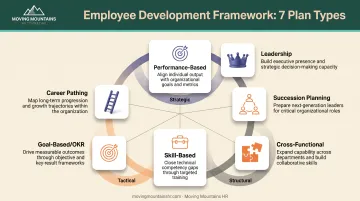
Different employees and business needs require different plan types. These seven examples cover the most common scenarios and can be adapted to any industry or role:
- Performance-Based Development Plan
- Skill-Based Development Plan
- Goal-Based (OKR-Driven) Development Plan
- Leadership Development Plan
- Career Pathing Development Plan
- Succession Planning Development Plan
- Cross-Functional Development Plan
Example 1: Performance-Based Development Plan
Purpose: Improve specific skills or behaviors that directly impact current job performance.
When to Use: An employee is meeting baseline expectations but needs to strengthen particular competencies to excel, such as a customer service rep working on conflict resolution or a sales associate improving presentation skills.
Template Components:
- Current performance baseline (where the employee is today)
- Target performance level (specific, measurable improvement)
- Skill gaps to address
- Learning activities (courses, shadowing, practice opportunities)
- Timeline with milestones
- Success indicators (manager observations, KPIs, stakeholder feedback)
Example Scenario:
A sales associate needs to improve presentation skills to close larger deals.
- Goal: Deliver confident, persuasive presentations to enterprise prospects by Q3
- Current state: Comfortable presenting to small groups; struggles with executive audiences
- Action steps:
- Complete online public speaking course by end of month
- Present at 3 internal team meetings over next 6 weeks
- Shadow senior sales rep during 2 client presentations
- Deliver 1 live prospect presentation with manager debrief
- Success metrics: Manager rates presentation confidence 4/5 or higher; closes at least 1 enterprise deal using new skills
Example 2: Skill-Based Development Plan
Purpose: Build specific technical or soft skills that support career progression or business evolution, even if not immediately tied to current role performance.
When to Use: An employee wants to prepare for a future role, or the business is adopting new tools/processes that require upskilling.
Template Components:
- Target skill and rationale
- Current proficiency level
- Learning resources (courses, certifications, books, internal experts)
- Practice opportunities (real projects, test environments)
- Completion timeline
Example Scenario:
An HR coordinator wants to learn HRIS software to prepare for an HR Manager role.
- Goal: Become proficient in Workday HRIS by Q4
- Current state: Familiar with manual spreadsheet tracking; no HRIS experience
- Action steps:
- Complete Workday certification course (12 weeks)
- Practice with test data in sandbox environment
- Lead implementation of 1 process improvement using Workday (such as automating onboarding workflows)
- Success metrics: Pass certification exam; successfully deploy 1 automated workflow; demonstrate ability to generate reports independently
Example 3: Goal-Based (OKR-Driven) Development Plan
Purpose: Align employee development with measurable objectives and key results tied to business priorities.
When to Use: Development supports a strategic initiative or the organization uses OKRs for goal-setting. (Note: OKRs work best for team objectives; individual development should focus on learning behaviors, not performance outcomes.)
Template Components:
- Objective statement (what the employee will achieve)
- 2-3 key results (quantifiable indicators of progress)
- Development activities enabling each key result
- Quarterly check-ins
- Success metrics
Example Scenario:
A marketing specialist aims to become proficient in AI-powered marketing tools.
- Objective: Become proficient in AI-driven marketing by Q3
- Key Results:
- Complete 2 AI marketing certification courses
- Launch 1 AI-driven campaign (email personalization or content generation)
- Demonstrate 15% ROI improvement on 1 campaign using AI tools
- Action steps:
- Enroll in courses by month 1
- Apply learning to a test campaign in month 2
- Launch a live campaign and track results in month 3
- Success metrics: Course completion certificates; campaign deployed and measured; documented ROI lift
Example 4: Leadership Development Plan
Purpose: Prepare individual contributors for management roles or help current managers develop advanced leadership capabilities.
When to Use: Succession planning, promoting high performers, or strengthening leadership bench.
Template Components:
- Current leadership competencies (assessment or 360 feedback)
- Target leadership level or role
- Specific leadership skills to develop (delegation, coaching, strategic thinking, decision-making)
- Development methods (mentoring, training, stretch assignments)
- Timeline and milestones
Example Scenario:
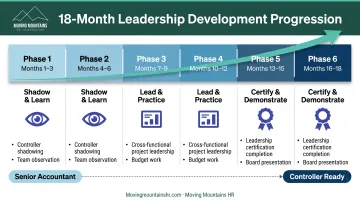
A senior accountant is being prepared for a Controller role.
- Goal: Develop leadership and strategic finance skills to step into Controller role within 18 months
- Current state: Strong technical accounting skills; limited team leadership or strategic planning experience
- Action steps:
- Shadow current Controller for 3 months (budget meetings, board prep, team decisions)
- Lead 1 cross-functional project (such as an ERP implementation)
- Complete leadership certificate program (6 months)
- Build skills in budget forecasting and team management through monthly 1:1 coaching with CFO
- Success metrics: Successfully lead project to completion; deliver 1 board-ready financial forecast; receive positive 360 feedback from team and peers
Example 5: Career Pathing Development Plan
Purpose: Map a multi-year progression through roles within the company, showing employees how to advance from their current position to a desired future role.
When to Use: Retaining high performers, building internal talent pipelines, providing clear advancement visibility.
Template Components:
- Current role
- Target role (1-3 years out)
- Required skills and experience for target role
- Gap analysis (what's missing)
- Step-by-step milestones with approximate timelines
- Decision points for advancement (performance reviews, skill assessments)
Example Scenario:
A junior designer aims for Creative Director.
- Current role: Junior Designer
- Target role: Creative Director (3-4 years)
- Progression path:
- Year 1-2: Mid-Level Designer (build portfolio depth, lead 2-3 client projects independently)
- Year 2-3: Senior Designer (mentor junior staff, manage client relationships, expand skill in brand strategy)
- Year 3-4: Art Director (oversee design team, direct creative vision for key accounts)
- Year 4+: Creative Director (strategic leadership, business development, team management)
- Action steps at each stage:
- Years 1–2: Master core design tools; lead 2–3 client projects; complete portfolio review with creative lead
- Years 2–3: Mentor one junior designer; own client relationships on 2 accounts; complete brand strategy coursework
- Years 3–4: Run creative direction for one key account; complete people-management training; present promotion case
- Success metrics: Performance ratings, portfolio reviews, promotion readiness assessments
Example 6: Succession Planning Development Plan
Purpose: Prepare specific employees to step into critical roles when current role-holders retire, leave, or get promoted.
When to Use: Mitigating organizational risk, ensuring business continuity, developing high-potential talent.
Template Components:
- Critical role to be filled
- Readiness timeline (ready now, 6 months, 12+ months)
- Required competencies for the role
- Current readiness assessment
- Targeted development to close gaps
- Contingency milestones
Example Scenario:
Preparing a Sales Manager to become VP of Sales within 18 months.
- Critical role: VP of Sales
- Current readiness: Strong in team leadership and deal execution; gaps in P&L management, board-level communication, and strategic planning
- Action steps:
- Executive coaching (monthly sessions for 12 months)
- Present quarterly sales strategy to executive team and board
- Shadow CFO to learn P&L management and financial forecasting
- Lead annual strategic planning process
- Success metrics: Deliver 2 board presentations rated "executive-ready"; demonstrate P&L fluency; successfully lead strategic plan implementation
Only 21% of HR professionals report having a formal succession plan in place, leaving many organizations vulnerable. Structured succession development reduces risk and builds leadership continuity.
Example 7: Cross-Functional Development Plan
Purpose: Build broader business acumen by exposing employees to different departments, roles, or functions.
When to Use: Preparing future leaders, increasing organizational flexibility, breaking down silos.
Template Components:
- Departments or functions for exposure
- Learning objectives for each rotation or project
- Specific assignments or shadowing opportunities
- Duration of each exposure
- How experience will be applied back in primary role
Example Scenario:
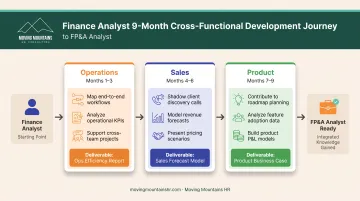
A finance analyst rotates through operations, sales, and product teams before moving into a Financial Planning & Analysis (FP&A) role.
- Goal: Build cross-functional business understanding to prepare for FP&A Analyst role
- Rotations:
- Operations (Month 1-3): Shadow operations manager; analyze cost drivers; participate in process-improvement project
- Sales (Month 4-6): Attend pipeline reviews; learn sales forecasting; build revenue-driver models
- Product (Month 7-9): Join product launch planning; understand go-to-market strategy; model product profitability
- Success metrics: Complete each rotation with deliverable (such as a cost analysis, revenue model, or product P&L); apply cross-functional insights to create integrated financial forecast
How to Create an Employee Development Plan: 4-Step Framework
Every strong development plan follows the same arc: assess where things stand, set shared goals, map actions with clear owners, and follow through. Use these four steps with any employee level or template in this guide.
Step 1: Assess Current State
Start with an honest, data-informed view of where the employee is today and where the organization needs them to go.
Activities:
- Conduct skills assessment through performance reviews, 360-degree feedback, or formal skills inventory
- Have a candid conversation with the employee about career aspirations, strengths, and development areas
- Identify organizational needs: skill gaps, succession risks, strategic priorities
- Look for overlap between employee interests and business needs
Key questions:
- What does the employee want to achieve in the next 1-3 years?
- What skills or experiences are required for that goal?
- What gaps exist between current capabilities and target role?
- How does this align with business priorities?
Step 2: Set Collaborative Goals
Work together to define 2-3 specific, measurable development goals that serve both the employee's career aspirations and business needs.
Best practices:
- Goals should be realistic given available time and resources
- Each goal should answer: Why does this matter to the employee? Why does it matter to the business?
- Avoid vague goals like "improve leadership skills." Use specific, observable outcomes instead (for example, "Lead 2 cross-functional projects and receive positive stakeholder feedback by Q4")
Example goals:
- Complete project management certification and apply skills to lead 1 client project by year-end
- Develop coaching skills to mentor 2 junior team members, with mentees showing measurable skill improvement
- Build financial modeling proficiency to independently create quarterly forecasts for Senior Analyst role
Step 3: Build Action Plan with Accountability
For each goal, document the specific actions, resources, timeline, and who owns what.
Plan elements:
- Learning activities: Courses, certifications, shadowing, stretch assignments, coaching
- Resources needed: Budget, time, access to mentors or experts, tools
- Timeline and milestones: Specific dates and intermediate checkpoints
- Success metrics: How will you know the goal is achieved? (Certifications, manager observations, project completion, KPIs)
- Ownership: Employee drives execution; manager provides support, feedback, and accountability
Schedule regular check-ins:
- Minimum quarterly for long-term plans
- Monthly for active development initiatives
- More frequently for performance-based plans
Step 4: Execute, Measure, and Adjust
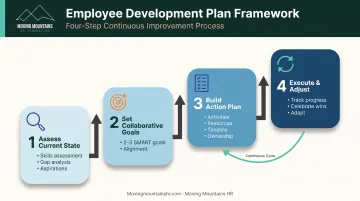
Treat the plan as changeable, not fixed. Track progress, celebrate wins, address obstacles, and adjust when priorities or pace shift.
Execution best practices:
- Track progress at each check-in using agreed success metrics
- Celebrate milestones to maintain motivation
- Adjust timelines or activities if priorities shift or the employee progresses faster/slower than expected
- Tie development milestones to performance reviews where appropriate (but don't guarantee promotions based solely on plan completion)
Accountability tip: Plans without follow-through damage trust more than having no plan at all. Commit to the check-in schedule and hold both parties accountable.
Common Mistakes to Avoid in Employee Development Planning
Even a well-designed development plan can stall when a few common mistakes creep in. Avoid these three.
Mistake 1: Creating Plans in Isolation
The problem: Managers who create development plans without employee input often miss what actually motivates the person. The result is low engagement and abandoned plans.
The fix: Make goal-setting collaborative. Ask employees what they want to achieve, then work together to align personal aspirations with organizational needs.
Mistake 2: Setting Vague Goals Without Measurement
The problem: Goals like "improve leadership skills" or "get better at communication" are too broad to be actionable or measurable.
The fix: Use specific, observable outcomes. Instead of "improve leadership," try "Complete leadership certification and successfully lead 2 cross-functional projects with positive stakeholder feedback by Q4."
Mistake 3: Failing to Follow Through
The problem: This is the most common failure point. Plans start with good intentions, but managers skip check-ins, fail to provide resources, and hold no one accountable.
The fix: Schedule check-ins when you create the plan and put them on the calendar. Treat development conversations with the same priority as performance reviews or client meetings.
Plans without execution are worse than no plans. They signal that the organization doesn't take employee growth seriously.
Conclusion
Employee development plans are one of the most direct tools small to mid-size businesses have to drive retention and performance. Effective plans don't require expensive systems or extensive HR infrastructure. They need regular conversations, clear expectations, and a genuine investment in growth.
When done well, development planning helps employees see a future within your organization. It closes critical skill gaps and builds the leadership bench you'll need to scale.
Need help building a customized development planning framework? Moving Mountains HR works with small to mid-size businesses to design practical, scalable employee development strategies and provides fractional HR leadership to support ongoing execution.
Contact us to discuss how we can help your team grow, or download free development plan templates to get started today.
Frequently Asked Questions
Can you provide some examples of employee training plans?
Training plans target skills for the current role (software, compliance, onboarding). Development plans are broader and career-focused. The seven templates in this article cover performance improvement, leadership prep, career pathing, and more.
What is an example of a development goal for an employee?
Strong development goals are specific and measurable. Examples include: "Complete project management certification by Q3," "Develop coaching skills to mentor 2 junior team members with measurable skill improvement," or "Build proficiency in financial modeling to prepare for Senior Analyst role by year-end."
What are 5 areas of improvement for employees?
Five common development areas:
- Communication — written, verbal, and presentation skills
- Leadership — delegation, coaching, and decision-making
- Technical skills — software, certifications, industry knowledge
- Time management — prioritization and meeting deadlines
- Strategic thinking — business acumen and problem-solving
How often should employee development plans be reviewed?
Review plans at least quarterly, with monthly check-ins when development work is active. Annual-only reviews miss shifting priorities and leave little room to course-correct.
Who is responsible for creating an employee development plan?
It's a shared responsibility. Employees drive goals and action steps; managers supply coaching, resources, and accountability; HR supplies structure, templates, and equitable access across the organization.