
A human resource management consultant bridges that gap. These professionals bring executive-level HR expertise to organizations that need strategic guidance, policy rigor, and risk mitigation—without the overhead of a full-time HR executive. For small to mid-size businesses navigating complex employment regulations, consultant support can mean the difference between costly litigation and sustainable growth.
Key Takeaways
- Engage an HR consultant for flexible access to compliance, policy, performance, and culture expertise—project-based or ongoing
- Cut legal risk, improve retention, and free owners to grow the business instead of firefighting HR issues
- Use a fractional CHRO for executive-level HR leadership without a full-time salary
- Hire help sooner for California employment law, workplace investigations, or rapid-growth transitions
What Is a Human Resource Management Consultant?
An HR management consultant is an external expert who advises organizations on people-management strategy, regulatory compliance, policy development, and workplace performance.
Unlike in-house HR staff who handle day-to-day operations such as payroll, benefits, and paperwork, consultants focus on higher-level strategy, specialized projects, and objective problem-solving across multiple client organizations.
Consultant vs. In-House HR
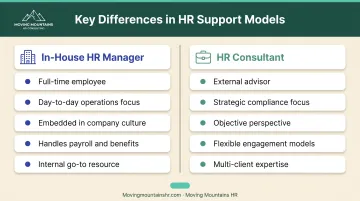
In-house HR managers are full-time employees embedded in one company. They manage ongoing operational tasks, know the culture intimately, and serve as the internal go-to for all people questions.
HR consultants are external advisors who bring:
- Strategic focus on compliance audits, organizational design, and policy frameworks
- Specialized expertise in workplace investigations, compensation strategy, or M&A integration
- Objective perspective free from internal politics or loyalty conflicts
- Flexible engagement tailored to project needs or ongoing retainer support
Fractional CHRO Model
Organizations that need executive-level HR leadership without a $200,000+ full-time CHRO often turn to fractional Chief Human Resources Officers. A fractional CHRO provides part-time strategic guidance on workforce planning, succession, organizational structure, and HR technology.
They often join leadership meetings and advise on high-stakes decisions. SHRM defines fractional leaders as executives who serve by contract or project, typically for change management, high-volume hiring, and reorganization.
Engagement Models
- Project-based: compliance audits, employee handbook creation, compensation benchmarking, or benefits-package design with defined deliverables and timelines
- Retainer-based: ongoing monthly or quarterly support for policy updates, HR meeting participation, and as-needed advisory calls
- Hourly consulting: ad hoc guidance billed per hour for specific questions or short-term issues
Industries Served
O*NET lists Professional, Scientific, and Technical Services among leading industries for HR Specialists. Healthcare, professional services, and fast-growing small businesses commonly engage consultants due to stringent compliance requirements, rapid headcount expansion, and limited internal HR capacity.
Core Responsibilities of an HR Consultant
HR consultants handle specialized work many internal teams lack the time or depth to own. Their core responsibilities usually fall into six areas that protect the business and strengthen how people are managed.
Compliance and Risk Management
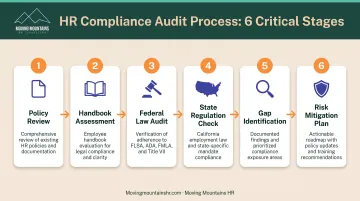
Consultants audit policies, handbooks, job applications, evaluation forms, and disciplinary procedures against federal and state labor laws.
In California, employers with 5 or more employees must comply with discrimination, retaliation, and harassment training requirements: two hours for supervisors, one hour for nonsupervisors, every two years. Federal EEOC coverage begins at 15 employees for most anti-discrimination laws.
Compliance exposure is real. The Department of Labor recovered more than $259 million in back wages for nearly 177,000 workers in FY2025, averaging $1,465 per worker. Federal OSHA penalties after January 15, 2026, reach up to $165,514 per willful or repeated violation.
Proactive compliance audits identify gaps before inspectors or plaintiffs do, reducing the risk of fines, lawsuits, and reputational damage.
Strategic HR Planning and Organizational Development
Strategic consultants assess workforce needs, design reporting structures, create succession plans, and align HR systems with business growth. SHRM guidance suggests delegating HR work around 10 employees and adding a full-time HR professional around 80-100 employees, though pace and turnover shift that threshold.
Effective planning reduces turnover costs (often 50% to 200% of annual salary for replaced employees) by improving retention, onboarding, and career development. Consultants help growing organizations scale people systems without constant firefighting.
Performance Management Systems
Consultants design goal-setting frameworks, performance-review processes, and employee-development programs. Gallup research found only 2 in 10 employees strongly agreed performance was managed in a motivating way, while employees involved in goal setting were 3.6 times as likely to be engaged.
Well-designed performance management:
- Clarifies expectations and accountability
- Increases productivity through regular feedback
- Supports legal defensibility in termination or promotion decisions
- Builds engagement when employees see growth paths
Workplace Investigations
When harassment, discrimination, misconduct, or retaliation complaints arise, external consultants serve as neutral third-party investigators. EEOC federal-sector guidance calls for prompt, thorough, impartial investigations, typically beginning within 10 days of awareness. While that guidance targets federal employers, best practice applies across sectors.
External investigators provide:
- Credibility without internal relationships or loyalty conflicts
- Fact-finding free from organizational bias
- A structured process that protects confidentiality for all parties
- Documented, consistent methodology that strengthens legal defensibility
Moving Mountains HR conducts neutral investigations involving harassment, discrimination, hostile work environment, retaliation, conflict of interest, and code-of-conduct violations, assessing claims impartially so every party is heard.
Compensation and Benefits Strategy
Consultants conduct salary benchmarking, design pay structures, and create competitive benefits packages. A 2023 peer-reviewed meta-analysis of 71,438 workers found pay-for-performance associated with job performance at rho = 0.23, while also increasing intrinsic motivation and pressure.
Payscale's 2026 dataset covering 10.2 million incumbents showed new hires in market-advantaged roles earned 3.6% more than tenured peers, while tenured employees in experience-driven roles earned 6.1% more than new hires. Consultants use this market intelligence to position compensation competitively, balancing budget constraints with talent-attraction goals.
Employee Relations and Culture Development
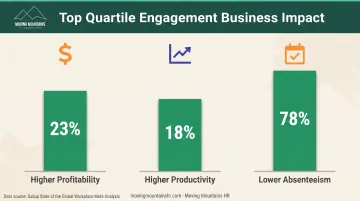
Consultants mediate conflicts, improve communication channels, and foster positive workplace cultures. Gallup's May 2024 meta-analysis covering 347 organizations, 183,806 business units, and 3.35 million employees found top-quartile engagement correlated with 23% higher profitability, 18% higher productivity, and 78% lower absenteeism versus bottom-quartile units.
Strong culture drives business performance. Consultants help organizations clarify values, strengthen manager effectiveness, and build systems that reinforce desired behaviors.
Essential Skills and Qualifications for HR Consultants
Educational Background and Certifications
BLS states HR Specialists typically need a bachelor's in HR, business, or a related field. HR Managers usually need a bachelor's plus 5 or more years of experience; some positions require a master's degree.
Key certifications include:
| Credential | Focus | Eligibility |
|---|---|---|
| SHRM-CP | Operational HR: policy implementation, daily HR functions | No degree or prior experience required; working knowledge recommended |
| SHRM-SCP | Strategic HR leadership | 3 years of strategic work, or 3 years holding SHRM-CP while moving into strategic work |
| PHR | Operational/program implementation | 1 year + master's, 2 years + bachelor's, or 4 years professional HR experience |
| SPHR | Strategic leadership | 4 years + master's, 5 years + bachelor's, or 7 years professional HR experience |
All SHRM credentials require 60 professional-development credits within three years for recertification. HRCI credentials are valid three years, requiring 60 credits (SPHR requires 15 Business credits) or exam retake.
Critical Hard and Soft Skills
Technical skills:
- Deep knowledge of federal and state employment law (FLSA, FMLA, ADA, EEOC, OSHA, state-specific regulations)
- Data analysis and HR metrics interpretation
- HRIS and HR technology proficiency
- Policy development and documentation expertise
Soft skills (SHRM BASK framework):
- Leadership and navigation
- Ethical practice
- Inclusive mindset
- Relationship management
- Communication
- Business acumen
- Consultation
- Analytical aptitude
O*NET emphasizes active listening, critical thinking, speaking, and reading comprehension as core skills, alongside HR, management, law, and training knowledge.
Industry Experience and Specialization
Consultants often specialize by industry:
- Healthcare: clinical staffing models and multi-shift workforce management
- Manufacturing: safety programs and shop-floor labor practices
- Tech startups: equity compensation and rapid-scaling guidance
That depth helps them tackle sector-specific challenges, anticipate regulatory changes, and benchmark against relevant peers.
That same principle shows up in practice. Moving Mountains HR founder Michelle Schwanhauser brings executive-level experience and deep healthcare-industry expertise, so the firm can support healthcare organizations on employment compliance and workforce issues without a full-time HR executive on staff.
Types of HR Consultants and Work Environments
Independent Consultants vs. Consulting Firms
Independent consultants enjoy flexibility, direct client relationships, and full control over service offerings and pricing. They also shoulder all administrative responsibilities (marketing, contracting, invoicing, insurance, professional development) and face entrepreneurial risk without a guaranteed client pipeline.
Consulting firms provide established client bases, team collaboration, shared expertise, and operational infrastructure. Consultants in firms often earn predictable salaries or draws, access mentorship and training, and benefit from brand reputation. They trade autonomy for stability and team support.
Client perspective: Independent consultants may offer lower fees and personalized attention; firms provide broader bench strength, backup coverage, and specialized resources.
Generalist vs. Specialist Consultants
Generalist HR consultants handle broad HR functions: compliance audits, policy development, performance management, employee relations, and basic benefits guidance. They serve clients needing comprehensive HR support without deep dives into niche areas.
Specialist consultants focus on compensation analysis, benefits strategy, compliance for specific regulations (FMLA, OSHA, multi-state employment law), M&A integration, or executive search. Specialists command higher fees and deliver targeted expertise when businesses face complex, high-stakes challenges.
When to choose:
- Generalist: Small business establishing foundational HR systems, compliance documentation, and performance processes
- Specialist: Organization designing equity compensation plan, navigating multi-state expansion, or integrating post-acquisition workforces
Fractional CHRO and Retainer-Based Consulting
The fractional CHRO model delivers ongoing strategic leadership on a part-time basis (typically 10-20 hours per month), participating in executive meetings, advising on organizational strategy, and guiding major HR initiatives. Retainer arrangements provide predictable monthly support, with defined scope and recurring access.
Moving Mountains HR offers fractional CHRO services through its Premium package, combining high-level strategic guidance with ongoing email and phone assistance.
When Your Business Needs an HR Consultant
You rarely need a full-time HR leader on day one. You do need help when growth, compliance risk, or people issues outpace what your team can handle alone.
Rapid Growth and Scaling Challenges
Warning signs:
- Hiring processes vary by manager; no standard interview guide or offer-letter template
- Policies exist informally or not at all; employee handbook is outdated or missing
- Inconsistent onboarding creates confusion and early turnover
- Managers lack training on performance feedback, discipline, or termination procedures
SHRM reports about half of small businesses handle HR in-house, and more than 80% of those HR decision-makers lack HR training, education, experience, or confidence. Growth exposes those gaps quickly.

Legal Compliance and Risk Exposure
Immediate triggers:
- Pending discrimination, harassment, or wage-and-hour lawsuits
- OSHA violation notice or workplace injury exposing safety-program weaknesses
- Expansion into California or other states with complex labor laws
- Employee complaint alleging retaliation, hostile environment, or unpaid overtime
EEOC secured almost $660 million in monetary relief in FY2025. That's aggregate victim relief, but individual employer exposure can run six or seven figures when policies fail.
Employee Relations Issues
Culture and retention red flags:
- High turnover or chronically low engagement scores
- Frequent conflicts, harassment complaints, or a toxic culture
- Managers who cannot resolve people issues without constant escalation
Gallup's engagement research shows top-quartile units experience 21% lower turnover in high-turnover industries and 51% lower turnover in low-turnover industries versus bottom-quartile peers.
Consultants diagnose root causes such as poor management training, unclear expectations, inadequate recognition, or cultural misalignment. They design interventions that improve retention and performance.
Lack of Internal HR Expertise
Businesses under 50-75 employees often assign HR work to the owner, office manager, or controller. Few of those people have HR training, so reactive crisis management replaces proactive planning.
Consultants fill the expertise gap. They build compliant systems so internal staff can handle day-to-day tasks with confidence.
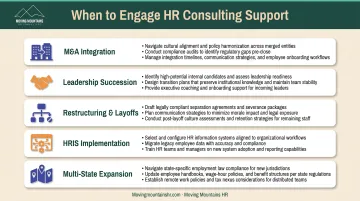
Major Organizational Changes
Transition moments that benefit from HR consulting:
- Mergers or acquisitions requiring cultural integration, benefits harmonization, and workforce planning
- Leadership changes necessitating succession planning and organizational redesign
- Restructuring involving layoffs, role redefinitions, or departmental consolidation
- New technology implementations (HRIS, performance-management platforms) needing change management
- Market expansion creating multi-state compliance complexity
Consultants bring process discipline, neutral facilitation, and change-management experience, improving transition outcomes and reducing disruption.
Career Path and Salary Expectations for HR Consultants
Typical Career Progression
Most consultants build credibility through years of hands-on HR experience before transitioning to advisory roles. Common paths include:
- HR Generalist or Specialist (3-5 years): handling recruiting, benefits, compliance, and employee relations
- Senior HR roles (5-10 years): HR Manager, HR Business Partner, or specialized roles in compensation, compliance, or talent
- HR Consultant or CHRO (10+ years): independent consulting practice, firm leadership, or executive HR positions
- Fractional CHRO or boutique firm founder: multi-client strategic work built on deep practitioner expertise
Salary Ranges and Compensation Models
BLS reports median HR Specialist pay was $72,910 in May 2024. Because BLS has no separate consultant category, this serves as an occupational proxy, not a direct consultant benchmark.
Payscale reports average U.S. HR Consultant salary of $84,764 as of July 2026. Compensation varies widely by experience, specialization, and geography.
Compensation structures:
- Hourly rates: Independent consultants set fees by experience level and specialty
- Project fees: Defined-scope work (handbook creation, compliance audit) priced per deliverable
- Retainer agreements: Monthly recurring fees for ongoing access and strategic support
- Fractional CHRO arrangements: Part-time executive leadership priced monthly or quarterly
Geographic location (California, New York versus rural Midwest) and specialization (M&A integration, executive compensation versus general compliance) drive large differences in rates.
Job Outlook and Market Demand
BLS projects 944,300 HR Specialist jobs in 2024, with 6% growth during 2024-2034 and about 81,800 openings annually from transfers and labor-force exits.
Demand drivers:
- Increasing employment regulations at federal, state, and local levels
- Focus on workplace culture, diversity, equity, and inclusion initiatives
- Remote and hybrid work complexities requiring policy updates and manager training
- Small-business growth outpacing internal HR capacity development
Frequently Asked Questions
What does a human resources consultant do?
HR consultants advise organizations on compliance, policy development, hiring strategies, performance management, and workplace culture. They serve as strategic partners to business leadership, providing executive-level expertise on a project or ongoing basis without the cost of a full-time HR executive.
How much does a human resource management consultant cost?
Costs vary by experience, specialization, engagement type, location, and project complexity. Most firms, including project- and retainer-based consultants, provide custom quotes based on your scope, budget, and timeline.
What's the difference between an HR consultant and an HR manager?
HR managers are full-time employees who handle day-to-day operations in one organization, such as payroll, benefits, employee questions, and compliance paperwork. Consultants are external experts who give strategic guidance and an objective view across clients, usually on a project or retainer basis.
When should a small business hire an HR consultant?
Consider HR consulting when facing compliance concerns, experiencing rapid growth, lacking internal HR expertise, dealing with employee-relations issues, or undergoing major organizational changes. Warning signs include outdated policies, pending complaints, high turnover, and managers uncertain how to handle performance or discipline.
What qualifications should I look for in an HR consultant?
Prioritize certifications (SHRM-CP/SCP, PHR/SPHR), 5–10+ years of hands-on HR experience, industry knowledge, and strong references from similar organizations. Also confirm business acumen, clear communication, and current regulatory knowledge.
Can an HR consultant serve as a fractional CHRO?
Yes. Many experienced HR consultants offer fractional CHRO services: executive-level leadership on a part-time or retainer basis. This fits organizations that need workforce planning, succession, or org design support without a full-time C-suite hire.
Moving Mountains HR helps small and mid-size businesses with practical, compliant HR support. Call 866-474-3575 or email questions@movingmountainshr.com to schedule a free consultation.