Introduction
You notice something's off. Projects that once moved smoothly now stall without clear reasons. Team members who collaborated freely now keep conversations guarded. Employees show up but seem disengaged, going through the motions rather than contributing ideas.
For many small business owners, these shifts signal something deeper than a bad week. They point to eroded workplace trust.
Trust forms the foundation of every high-performing team and healthy workplace relationship. Yet it's fragile. A single leadership misstep, a poorly handled organizational change, inconsistent policy enforcement, or unresolved conflict can damage what took years to build.
Research shows that employees who trust organizational leaders are 3 times more likely to be engaged. Trust in leadership also ties closely to higher job satisfaction, stronger organizational commitment, and lower intent to quit.
This article provides a practical, step-by-step framework for rebuilding trust after it's been damaged, whether the breach occurred between leadership and employees, among team members, or across departments.
Key Takeaways
- Trust erosion shows up as less collaboration, higher turnover, silenced concerns, and self-preservation over team goals
- Rebuild by naming the breach, communicating openly, owning accountability, and proving change over time
- Pair words with real action; follow-through matters more than promises
- Small businesses recover faster with transparent systems, kept commitments, and visible accountability
Step 1: Recognize and Assess the Trust Breach
Before you can repair trust, you need to understand exactly what broke it.
Identify the Specific Behaviors and Patterns
Trust rarely disappears overnight. Pinpoint whether the damage came from a single incident (a broken promise, an unfair decision, or public criticism) or from cumulative issues like inconsistent policies, chronic lack of transparency, or poor communication over time.
Document what happened, when, and who was affected.
Distinguish Between Competence and Integrity Violations
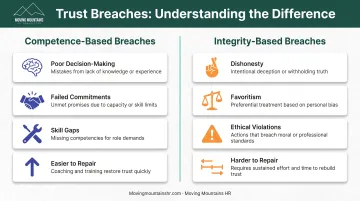
Competence-based breaches occur when leaders make poor decisions, fail to follow through on commitments, or demonstrate they lack the skills employees expected. These raise doubts about ability.
Integrity-based breaches involve dishonesty, favoritism, ethical violations, or unfair treatment. These raise doubts about integrity and are harder to repair because they question your fundamental values.
Research distinguishes these violation types and shows they require different responses. Apologies tend to work better for competence failures, while integrity violations demand thorough investigation and evidence-based accountability.
Gather Objective Information
Don't rely solely on your perception or what reaches you through the management chain. Use:
- Confidential employee surveys asking specific questions about trust, fairness, and communication
- One-on-one conversations conducted by a neutral party
- Exit interview data highlighting recurring themes
- Pulse checks measuring psychological safety and willingness to share feedback
Research shows that unmet expectations correlate strongly with lower trust (r=-.40), so look for patterns of broken commitments.
Practice Leadership Self-Assessment
Meet with your leadership team and ask hard questions:
- Where did we contribute to this problem?
- What signals did we miss?
- When did we prioritize other concerns over transparency or consistency?
Avoid defensiveness. You can't rebuild trust while denying your role in breaking it.
Consider a formal HR audit to document issues systematically and establish a baseline for improvement. Moving Mountains HR's compliance audits review policies, procedures, and employee-facing documents, identify gaps, and deliver recommendations that give you an objective foundation for rebuilding trust.
Step 2: Communicate Openly and Take Accountability
Once you understand the breach, your next move is to address it directly with affected employees.
Name What Happened and Own It
Start by acknowledging the specific incident or pattern. Don't soften the language or deflect blame. Say plainly: "We promised you input on the new schedule and then rolled it out without asking. That broke trust, and I understand why you're frustrated."
Employees are 4.3 times more likely to trust leaders who explain decisions, but explaining is not the same as excusing. Context builds understanding; excuses undermine accountability.
Use "I" and "we" statements rather than passive language. Say "I made a poor choice when I didn't consult the team before changing the policy" instead of "Mistakes were made" or "The situation got out of hand."
Spell out what you wish you had done differently so employees can see you understand the impact.
Create Safe Spaces for Employees to Share
Practice active listening by:
- Asking open-ended questions: "How did this decision affect your work?" or "What would have helped?"
- Avoiding interruptions and defensive responses
- Validating feelings even when you disagree with perceptions
- Taking notes to show you're genuinely hearing concerns
Psychological safety is the belief that people can speak up without fear of punishment. When it's missing, you won't get the honest feedback needed to repair the damage.
Commit to Ongoing Transparency
One conversation won't fix the problem. Establish regular communication cadences:
- Monthly town halls where leadership shares company performance and strategic decisions
- Weekly team meetings with open Q&A time
- Written updates explaining major changes and the reasoning behind them
Make it clear that transparency will continue long after the immediate crisis passes. Trust rebuilds through consistent behavior, not one-time gestures.
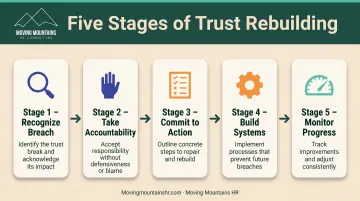
Step 3: Establish Clear Commitments and Rebuild Through Action
Employees rebuild trust based on what leaders do, not what they announce in a meeting.
Define Specific, Measurable Commitments
Vague promises like "We'll communicate better" or "We'll be more consistent" don't rebuild trust. Commit to concrete actions instead:
- "We will share monthly financial updates at the first-Friday team meeting"
- "All policy changes will be posted in the employee portal 30 days before implementation, with a feedback period"
- "Managers will conduct one-on-one check-ins with every direct report biweekly"
Make these commitments visible and measurable so employees can track follow-through.
Trust rebuilding takes sustained effort over months, not weeks. A systematic review of trust repair research shows recovery timelines vary by violation type, severity, and whether remedies are actually implemented. There is no universal "3-6 month" benchmark.
Be honest about that timeline. Tell your team: "Rebuilding trust will take time. We're committed to the work, and we'll share progress updates quarterly."
Follow Through on Every Commitment—Especially Small Ones
Even small broken promises during trust rebuilding can undo weeks of progress. If you commit to sending an update by Friday, send it by Friday. If you promise to revisit a decision after gathering input, revisit it publicly and explain what you decided and why.
Behavioral integrity—the alignment between words and deeds—directly affects trust. Kept promises build credibility; broken ones feed skepticism.
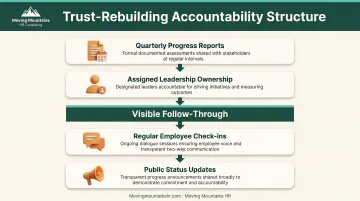
Put simple structures behind the words so follow-through is visible:
- Publish a quarterly trust-rebuilding progress report
- Assign specific leaders to own each commitment
- Hold regular check-ins where employees can ask about status
- Report openly on what's working and what's not
Celebrate Progress and Recognize Effort
Acknowledge employees who demonstrate trust by sharing feedback, collaborating across teams, or contributing ideas. Call out improved collaboration in team meetings so people see progress in real time—and that the work sits with everyone, not only leadership.
Step 4: Create Systems That Support Trust
Individual behavioral change matters, but lasting trust requires structural support.
Implement Clear, Consistently Applied Policies
Ambiguity breeds distrust. Document:
- Performance expectations and evaluation criteria
- Decision-making processes (who decides, what input is required, how appeals work)
- Procedures for addressing concerns or grievances
Apply these policies consistently across all employees to prevent perceptions of favoritism or unfair treatment. Research shows trust correlates with procedural justice (r=.61) and interactional justice (r=.65).
For small businesses building that foundation from scratch, Moving Mountains HR supports the work through compliance audits and policy development tied to regulatory requirements.
Establish Genuinely Confidential Feedback Channels
Create multiple ways for employees to raise concerns without fear of retaliation:
- Anonymous suggestion systems
- Regular pulse surveys with third-party administration
- Skip-level meetings so employees can speak with senior leaders without their manager present
- Open-door policies with clear confidentiality commitments
Make sure these channels are genuinely safe. If employees report concerns and face negative consequences, the damage to trust will be worse than having no system at all.
Build Transparency Into Daily Operations
Share information regularly about:
- Company performance and financial health
- Strategic decisions and the reasoning behind them
- How employee input influenced leadership choices
- Changes in policy or direction, with advance notice whenever possible
You still set direction as a leader. Share what affects people's work, explain the reasoning behind major decisions, and show employees their input carries weight.
Step 5: Monitor Progress and Adjust Your Approach
Trust rebuilding is not a linear process. You need ongoing measurement and the flexibility to change course.
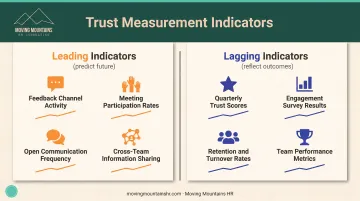
Track Leading and Lagging Trust Indicators
Leading indicators (predict future trust):
- Number of concerns raised through feedback channels
- Employee participation in meetings and input sessions
- Manager reports of open communication
- Frequency of information sharing across teams
Lagging indicators (reflect trust outcomes):
- Quarterly trust scores by leader and organization
- Engagement survey results
- Retention rates and voluntary turnover
- Team performance metrics
Use regular pulse surveys. Psychological-safety scores can shift within six weeks, so a single snapshot rarely tells the full story.
Schedule Quarterly Trust Check-Ins
Set recurring leadership reviews where you:
- Analyze trust metrics and qualitative feedback
- Identify which actions are gaining traction and which are stalling
- Adjust strategies based on evidence
- Communicate findings and next steps transparently
Treat this as an ongoing commitment rather than a one-time initiative.
Prepare for Setbacks and Regression
Trust rebuilding rarely follows a straight upward path. You may see:
- Initial skepticism even after genuine changes
- Old concerns resurfacing during new challenges
- Occasional missteps that trigger renewed doubt
These setbacks are normal. Acknowledge them honestly, take corrective action quickly, and stay committed for the long haul. A 2025 study tracking employees over two years found that trust can erode or rebuild along different paths, and setbacks can appear in either direction.
Common Mistakes When Rebuilding Workplace Trust
Even well-intentioned leaders can stall recovery. These missteps are among the most common—and the most damaging.
Rushing the Process or Declaring Victory Too Early
Trust takes time to rebuild. Announcing "We've fixed our communication problem" after one town hall will generate cynicism. Moving back to "business as usual" before trust is genuinely restored undermines your credibility the same way.
Let employees tell you when trust has improved. Don't declare it yourself.
Focusing on Communication Without Changing Behaviors
Saying "trust me" repeatedly without corresponding action breeds deeper distrust. Employees evaluate your trustworthiness based on what you do, not what you promise. A systematic review of trust repair found that effectiveness depends on whether remedies are actually implemented, not just announced.
If you communicate transparently about a new policy but then apply it inconsistently, the communication actually makes the problem worse.
Treating Trust Rebuilding as an HR Initiative Rather Than a Leadership Responsibility
HR can provide valuable expertise, facilitate processes, conduct assessments, and create accountability structures. But authentic trust rebuilding requires personal commitment from executives and managers—it cannot be delegated to a department.
Employees need to see leaders taking ownership, not outsourcing the problem. Strategic HR partners, including fractional CHRO support from Moving Mountains HR, can help structure the work—but leaders still have to stay visible and own the outcome.
When to Seek External HR Support
Consider engaging neutral third-party support when:
- Allegations involve harassment, discrimination, retaliation, or ethical violations. Internal investigations of serious claims often lack credibility when employees see leadership as compromised or protective of certain people.
- Legal or regulatory risk is involved. Protected-class discrimination and compliance matters need expertise and documentation standards many small businesses lack in-house.
- Internal rebuilding has stalled. Outside consultants can facilitate difficult conversations, add accountability structures, and restore credibility when progress has flatlined.
- Your team lacks the skills or bandwidth. Expert support helps with sensitive conversations, formal investigations, and trust-building systems so you avoid costly missteps.
Moving Mountains HR conducts formal, impartial workplace investigations involving harassment, discrimination, retaliation, conflicts of interest, and code-of-conduct violations. The process covers neutral interviews, evidence collection, confidentiality protections, anti-retaliation education, and a detailed findings report that delivers the independent credibility internal processes often cannot.
Conclusion
Rebuilding workplace trust is challenging work that requires leadership courage, sustained commitment, genuine behavioral change, and patience. There are no shortcuts. You cannot announce your way out of a trust crisis, and you cannot delegate accountability to HR or consultants.
But trust restoration is achievable. Organizations that rebuild well come out more resilient. They've built the transparency, accountability, and communication habits that make future breakdowns less likely—and easier to repair when they do happen.
Trust isn't something you fix once and leave on autopilot. It takes daily attention to authenticity, transparency, accountability, and follow-through in the decisions people actually see. Survey scores going up is progress, not the finish line—the real shift is when that discipline becomes how you lead.
If the damage runs deeper than your team can handle alone, bring in outside HR support for investigations, leadership coaching, or fractional guidance so the repair work stays credible and consistent.
Frequently Asked Questions
How can I build trust in the workplace?
Build trust by showing both competence (keeping commitments, making sound decisions) and character (honesty, fairness, integrity). Use transparent communication, follow through on promises, treat people fairly, and care about employees as people, not just resources.
What are the 5 C's of trust?
No single peer-reviewed "5 C's" standard exists, but common frameworks cite Competence, Consistency, Communication, Caring, and Commitment. Research more often anchors trustworthiness in ability, benevolence, and integrity.
How long does it realistically take to rebuild trust in the workplace?
It depends on breach severity and whether you take real action, not just make promises. Minor competence issues may improve in 3–6 months; major character breaches often take 12–18 months or longer, and full recovery is never guaranteed.
What are the early signs that trust is eroding in a workplace?
Early signs include quieter communication, withheld feedback, more gossip, resistance to change, weaker cross-team collaboration, and rising turnover or absenteeism. Unmet commitments and falling psychological safety are strong warning flags too.
Can workplace trust be fully restored after a major betrayal?
Full restoration is possible, but only with real accountability and sustained behavior change over time. Some relationships never fully recover, especially after severe or repeated ethical breaches; what matters is visible leadership change, not apologies alone.
What role should HR play in rebuilding trust after a breach?
HR can facilitate with assessments, accountability structures, fair policies, and neutral investigations when needed. Rebuilding trust still requires leaders to own the work and change behavior in plain sight; it cannot be handed off to HR alone.