
Introduction
Picture this: Your company invests $5,000 sending five employees to a two-day leadership workshop. They return energized, full of ideas, ready to transform how they manage their teams. Three weeks later, you notice nothing has changed. The new communication techniques? Forgotten. The performance feedback framework? Gathering dust. Everyone has slipped back into the same old patterns.
This scenario plays out in businesses every day. Research tracking 537 trained employees found that without systematic support, workplace application of training fades over time. With U.S. organizations spending an average of $1,283 per employee on training in 2023, the cost of forgetting is substantial.
The solution is training reinforcement. That means helping employees hold onto what they learned, use it on the job, and build those skills into lasting habits. Below, you'll find practical reinforcement strategies small and mid-size businesses can put in place to protect their training investment.
Key Takeaways
- Training reinforcement prevents knowledge loss by revisiting and applying content after the initial learning event
- Spaced retrieval, on-the-job practice, manager coaching, and job aids anchor lasting skill transfer
- Managers matter most: they create application chances, observe skill use, and give real-time feedback
- Track success with knowledge checks, workplace observations, and targeted operational metrics
What is Training Reinforcement?
Training reinforcement is the deliberate, ongoing process of revisiting, practicing, and applying training content after the initial learning event. Done well, it drives knowledge retention and lasting behavior change on the job.
Initial training introduces new knowledge and skills during a concentrated event—a workshop, course, or seminar. Reinforcement is everything that happens afterward to make those skills stick and show up in real workplace performance.
The Continuous Learning Cycle
Effective workplace learning follows a three-phase cycle:
- Pre-training preparation - Employees and managers discuss learning objectives and identify where new skills will be applied
- The learning event - The workshop, course, or training session where concepts are introduced
- Post-training reinforcement - Systematic activities that support retention, practice, feedback, and habit formation
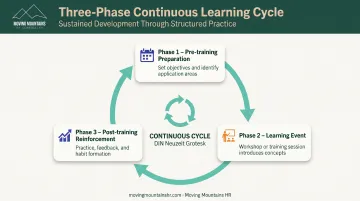
Most organizations invest heavily in phase two while neglecting phases one and three. Training often fails for that reason: the content may be solid, yet the learning cycle never gets finished.
Training is not a one-time event. It's a process that begins before the session, continues during it, and extends for weeks or months afterward. Reinforcement transforms that single exposure into durable skills that change how work gets done.
Why Training Reinforcement Matters for Your Business
Protecting Your Training Investment
American companies spent an average of $1,283 per employee on training in 2023, based on data from 498 organizations. For a 25-person company, that's over $32,000 annually. Without reinforcement, much of that investment is lost when employees fail to apply what they learned.
Training completion and participant satisfaction don't equal business results. The real measure is whether employees use new skills on the job and whether those skills improve performance. Reinforcement bridges the gap between "attended training" and "changed behavior."
How Reinforcement Drives Performance and Results
When training sticks through systematic reinforcement, businesses see measurable improvements:
- Better adherence to standard operating procedures
- More proactive problem-solving by frontline employees
- Higher employee confidence when applying new techniques
- Reduced anxiety about making mistakes with unfamiliar processes
Workplace research tracking transfer and knowledge sharing found that supervisor and peer support significantly influenced whether employees applied training and shared what they learned. Regular reinforcement creates an environment where employees feel equipped to try new approaches rather than defaulting to old habits.
Those behavior changes show up in metrics that affect the bottom line:
- Tasks completed faster or with less rework
- Fewer errors, customer complaints, and defects
- Stronger adherence to regulatory requirements and company policies
- More effective customer communication and problem resolution
- Higher retention when people feel supported and capable
Sustained reinforcement—not a single training session—is what helps employees integrate new skills into daily work.
Organizations that reinforce training well also build capable teams faster than competitors. When your people can learn a new process, technology, or technique and quickly make it how they work, you adapt faster to market changes, customer needs, and operational challenges. That agility matters especially for small and mid-size businesses competing against larger organizations with more resources.
The Science Behind Why Employees Forget
Ebbinghaus and the Forgetting Curve
German psychologist Hermann Ebbinghaus conducted pioneering memory research in 1885, measuring how quickly he forgot lists of nonsense syllables. His work showed that relearning becomes harder as time passes after initial exposure. A 2015 replication of his study confirmed the same pattern: memory for new information weakens rapidly without reinforcement.
Ebbinghaus studied artificial memory tasks, not workplace learning, but the core insight still applies: single-exposure learning is ineffective. The brain doesn't retain information it encounters only once.
Why the Brain Discards Information
Your brain is constantly deciding what to keep and what to discard. Information used repeatedly gets strengthened. Information that seems irrelevant or unused gets pruned away.
That pruning is efficient. Remembering every detail you have ever encountered would be overwhelming.
The problem is that newly learned skills from training often seem unused to your brain. An employee attends a customer-service workshop on Monday and learns a five-step conflict-resolution framework. Back at their desk, old habits take over. Without practice and retrieval, the brain treats that framework as disposable information.
The Spacing Effect: Why Repeated Retrieval Works
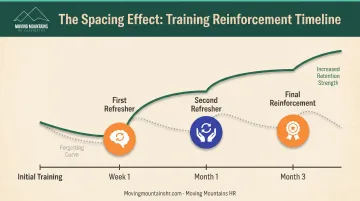
Research analyzing 839 assessments across 317 experiments found that information reviewed at spaced intervals is retained far better than information learned once. This is called the spacing effect.
When employees revisit training content at strategic intervals, their brains treat the material as important and worth keeping. Common reinforcement points include:
- One week after training
- One month later
- Three months later
Each retrieval strengthens the memory pathway, making future recall easier and more automatic. Systematic reinforcement improves retention far more than one-time training events because it matches how the brain naturally learns.
Effective Training Reinforcement Strategies
Spaced Repetition and Refresher Training
The concept: Schedule shorter refresher sessions at strategic intervals after initial training to revisit key concepts and strengthen memory before forgetting takes hold.
How to implement it:
- Schedule brief refresher sessions at 1 week, 1 month, and 3 months post-training
- Keep refreshers short (15-30 minutes maximum)
- Focus on core concepts from the original training, not everything
- Include practice opportunities—ask questions, work through scenarios, discuss application examples
- Use different formats than the original training (if initial training was lecture-based, make refreshers interactive)
Refreshers should not deliver new content. They center on retrieval practice: bringing learned information back to mind strengthens retention more than passively reviewing notes.
On-the-Job Application and Practice
The concept: Create opportunities for employees to practice new skills in their actual work environment while concepts are still fresh.
Implementation guidance:
- Assign specific tasks or projects that require using newly learned skills within the first week after training
- Make the connection explicit: "This project will let you apply the budgeting framework you learned Thursday"
- Start with lower-stakes applications before moving to high-pressure situations
- Provide a clear bridge between training concepts and real-world tasks
- Ensure employees have the authority, tools, and time needed to apply what they learned
Immediate application creates the strongest reinforcement. When employees use a new skill right away, their brains recognize it as relevant and critical to their work, making retention far more likely.
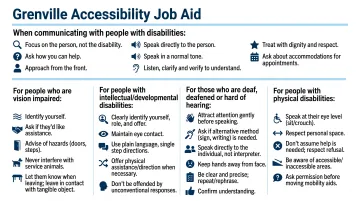
Job Aids and Reference Materials
Job aids give employees quick answers at the moment of need, without digging back through full training materials.
Useful formats:
- One-page quick reference guides
- Step-by-step checklists
- Workflow diagrams
- Decision trees
- Cheat sheets with key formulas, terminology, or procedures
Build each aid around a few practical rules:
- Keep aids to 1-2 pages maximum
- Favor visuals: diagrams, flowcharts, and clear formatting
- Highlight only critical information, not everything from training
- Focus on how-to guidance rather than theory or background
- Place them at the point of work (posted near workstations, saved in shared drives, laminated for durability)
Research on electronic performance support systems found that availability and accessibility strongly predicted whether employees used job aids. If the reference material is hard to find or access during the workday, it won't reinforce learning.
Peer Learning and Knowledge Sharing
The peer reinforcement benefit: When employees discuss what they learned with colleagues or teach concepts to others, they reinforce their own understanding while spreading knowledge across the team.
Implementation ideas:
- Schedule 15-minute team huddles where recent training participants share key takeaways
- Pair newly trained employees with mentors who can support skill application
- Create brief "lunch and learn" sessions where employees demonstrate new techniques
- Encourage informal knowledge sharing during team meetings
- Use collaboration tools (Slack, Teams) for employees to post tips or ask questions
Workplace studies on training transfer found that peer support significantly influenced whether employees applied training and shared knowledge. Reinforcement doesn't have to come only from managers. Colleagues can be powerful reinforcement agents too.
Follow-Up Assessments and Check-Ins
The accountability factor: Schedule follow-up assessments at 2 weeks and 6 weeks post-training to gauge retention and identify gaps needing additional support.
Assessment formats:
- Brief quizzes on key concepts (5-10 questions)
- Manager observations using simple checklists
- Skills demonstrations with real or simulated tasks
- Short scenarios where employees explain how they'd apply training
- One-on-one conversations about application challenges
Critical principle: Frame assessments as learning opportunities and coaching moments, not pass/fail tests. The goal is to identify where employees need more support and provide it, not to judge or punish gaps. This creates psychological safety for employees to acknowledge what they're still learning.
Microlearning Reinforcement
The microlearning approach: Deliver bite-sized reinforcement content (3-5 minutes) via email, text, or team communications at regular intervals after training.
Content ideas:
- Weekly tips highlighting one key training concept
- Common mistake reminders with corrective guidance
- Success story examples from employees using new skills
- Quick practice prompts: "Here's a scenario—how would you apply the framework you learned?"
- Short videos demonstrating techniques from training
Microlearning keeps training concepts top-of-mind without overwhelming employees. A 3-minute weekly email is far more sustainable than expecting employees to review a 50-page training manual.
The Manager's Critical Role in Training Reinforcement
Direct managers are the single most important factor in whether training transfers to job performance. Research on workplace training transfer consistently identifies supervisor support as a key driver of application and knowledge sharing.
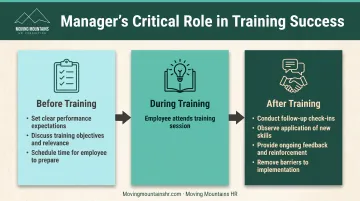
Before Training: Setting Expectations
Effective managers prepare employees before they attend training:
- Discuss what the training covers and why it matters for the employee's role
- Explain how the skills will be used in upcoming work
- Set clear expectations that the employee will apply what they learn
- Identify specific projects or tasks where new skills can be practiced
This pre-training conversation primes employees to look for application opportunities and signals that the training is important, not just a box to check.
After Training: Coaching and Feedback
Within one week of training, managers should:
- Schedule a 1-on-1 check-in to discuss key takeaways
- Ask the employee to explain concepts in their own words (retrieval practice)
- Assign work that requires using new skills
- Observe the employee applying skills in real situations
- Give specific, immediate feedback: praise correct use and coach where refinement is needed
Ongoing observation and feedback turn training concepts into workplace habits.
When managers catch correct use and name it ("I noticed you used the active listening approach we trained on. That really helped de-escalate that customer situation"), they reinforce the behavior and make it more likely to stick.
Removing Barriers to Application
Managers also need to clear obstacles that prevent employees from using new skills:
- Ensure employees have necessary tools, authority, or access
- Adjust workload so employees have time to practice
- Address skeptical colleagues who dismiss new approaches
- Modify processes that conflict with trained methods
Even the best training fails if the work environment makes application impossible.
How Moving Mountains HR Supports Manager Capability
Many organizations struggle with training reinforcement because managers lack coaching skills or systematic frameworks. Moving Mountains HR provides customized training programs for supervisors and leaders, covering performance management, coaching, feedback, and employee development.
These programs are tailored to your industry, workforce, and business goals, using practical tools and real-world scenarios managers can apply immediately. For ongoing support, Moving Mountains HR offers flexible HR consulting packages, from on-demand help to meeting participation to fractional CHRO services. That support helps managers build and sustain reinforcement practices over time.
Measuring Training Reinforcement Effectiveness
Tracking reinforcement effectiveness shows which habits stick, where people still struggle, and what to change in your follow-up plan.
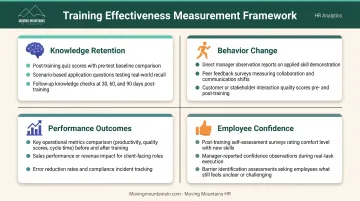
Key Metrics to Track
Knowledge retention:
- Follow-up quizzes or knowledge checks at 2 weeks and 6 weeks post-training
- Scenario-based questions that test application, not just recall
Behavior change:
- Manager observations using simple checklists (Is the employee using the new technique? Correctly? Consistently?)
- Self-assessments where employees rate their own skill use and confidence
- Peer feedback from colleagues who work closely with trained employees
Performance outcomes:
- Pre- and post-training comparison of relevant metrics (error rates, cycle time, quality scores, customer satisfaction, compliance incidents)
- Targeted operational data tied to training objectives (if training focused on reducing rework, measure rework rates)
Employee confidence:
- Brief surveys asking employees how confident they feel applying new skills
- Questions about perceived support and barriers to application
Simple Measurement Approaches for Small Businesses
You don't need sophisticated software to measure reinforcement. Start with:
- Manager observation checklists: Create a one-page form listing key behaviors from training; managers observe and check off what they see during normal work
- Brief pulse surveys: Send a 3-5 question survey to trained employees at 2 weeks and 6 weeks asking about application frequency, confidence, and obstacles
- Performance metric tracking: Pull existing data (quality scores, customer complaints, time-to-complete) before and after training to spot improvements
Using Measurement Data to Improve
Regularly review your reinforcement data to:
- Compare groups—for example, whether employees who get manager coaching outperform those who don't
- Flag concepts that keep showing up as misses on follow-up assessments
- Check whether people feel confident but lack real chances to apply skills on the job
- Shorten, space out, or reformat refreshers based on what the data shows
If you need help building a measurement framework or making sense of the results, Moving Mountains HR can provide guidance, templates, and ongoing support tailored to your business.
Frequently Asked Questions
What is the best way to reinforce learning?
The strongest approach stacks a few tactics: spaced refresher sessions, immediate on-the-job practice, manager coaching with feedback, and simple job aids people can use while they work. Combining these beats relying on any single method.
What are the 7 types of training methods?
The seven main delivery methods are instructor-led classroom training, live virtual sessions, on-the-job training, e-learning, mentoring and coaching, job shadowing or cross-training, and simulation or role-play—each of which can include reinforcement.
How long should training reinforcement last?
Plan on at least 90 days after training, with the heaviest support in the first 2–4 weeks when forgetting is fastest. Then taper the cadence while keeping help available as needed.
What is the difference between training and training reinforcement?
Training introduces new knowledge and skills in a concentrated event: a workshop, course, or program. Reinforcement is the ongoing work after training that keeps learning retained, applied on the job, and habitual through practice, feedback, and retrieval.
How can small businesses implement training reinforcement with limited budgets?
Lean on no-cost manager coaching, one-page job aids in Word or PowerPoint, short team huddles, and free calendar reminders for follow-ups. Put that effort on your highest-impact training first so limited time still pays off.
Who is responsible for training reinforcement?
It is a shared job. L&D or HR builds the framework, materials, and measures; managers coach, create application chances, and follow through; employees apply the learning and ask for feedback. Reinforcement works when all three stay aligned.
Ready to make your training investments stick? Moving Mountains HR helps small and mid-size businesses design practical training programs with built-in reinforcement, develop manager coaching capabilities, and establish measurement systems that prove ROI. Schedule a complimentary 30-minute consultation to discuss how we can support your organization's learning and development goals.