

Introduction
Ask five business owners what "HR executive" means, and you'll likely get five different answers. Some point to a Chief Human Resources Officer. Others mean a VP of HR, a Director of People, or simply "whoever handles HR."
That confusion has real consequences. Many small business owners struggle to figure out whether they even need this level of leadership, or whether an HR manager is enough.
Part of that confusion comes from how much the role has shifted. Today's HR executive is a board-relevant seat tied to growth, risk, and culture—not only paperwork and policy enforcement.
This article breaks down what an HR executive actually does, how the title compares to HR Manager, VP of HR, and CHRO, and how to decide whether your business needs one full-time or in a more flexible capacity.
Key Takeaways
- An HR executive is the senior-most people leader in an organization, typically reporting to the CEO or COO
- CHRO, VP of HR, and Chief People Officer are often used interchangeably, though scope varies by company
- HR executives focus on strategy and compliance oversight, not day-to-day operations
- Small and mid-size businesses can get executive-level HR expertise through fractional models—without a full-time hire
What Is an HR Executive?
An HR executive is the top people leader in an organization, responsible for the entire employee lifecycle. That means workforce planning, compliance, compensation strategy, and company culture all fall under this role's authority. When this role is filled well, it shapes how the business hires, pays, develops, and keeps people—and how exposed the company is to compliance and culture risk.
Industry research from the Josh Bersin Company frames the position as genuine C-suite work: business strategy, operations, productivity, and the core systems for hiring, retaining, paying, managing, and developing people. The role belongs at the leadership table, not in back-office administration.
Titles Vary, But Authority Looks the Same
You'll see this role labeled differently depending on the company:
- CHRO (Chief Human Resources Officer) — the most common title, especially at larger companies
- CPO (Chief People Officer) — often signals a stronger focus on culture and employee experience
- VP of HR or SVP of People — common at mid-size companies or as a step below CHRO
In a 2024 review of Fortune 50 companies, 23 used the CHRO title while 11 used CPO. Both are established, senior titles. Neither automatically outranks the other.
The title on the business card matters less than the authority behind it. An HR executive holds decision-making power over the full employee lifecycle and reports directly to the CEO or board—not to another HR leader.
Where This Role Sits on the Career Ladder
HR executives sit at the top of the HR hierarchy. Coordinators, generalists, and specialists handle day-to-day work such as onboarding, benefits enrollment, and employee questions.
A typical path runs from coordinator or generalist, through manager and director, then into the executive tier. We'll walk through that progression in more detail later.
What Does an HR Executive Do?
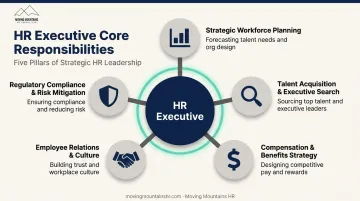
An HR executive's job spans five core areas, all tied to company-wide outcomes rather than individual transactions.
Strategic Workforce Planning
HR executives forecast hiring needs based on business growth projections and budget realities. That includes deciding when to add headcount, which roles matter most for scaling, and how workforce costs fit into overall financial planning.
Talent Acquisition and Executive Search
HR executives oversee recruiting strategy and employer branding. They also often run executive search for other C-suite hires, working directly with the CEO and board on leadership succession.
Compensation and Benefits Strategy
HR executives set market benchmarking so pay stays competitive, and they own pay equity compliance. In regulated states like California, that work is not optional:
- Employers with 15 or more employees must include pay scales in job postings since January 2023
- Private employers with 100+ payroll employees must file annual pay data reports with California's Civil Rights Department
Employee Relations and Culture
HR executives design retention programs and track engagement and turnover trends, often before those numbers become a crisis. Acting on those signals early is what keeps the function ahead of problems instead of chasing them.
Regulatory Compliance and Risk Mitigation
Labor law adherence, anti-harassment policy, and workplace investigations all fall to this role. Getting any of them wrong is expensive—fines, settlements, and lasting culture damage.
Demand for that leadership is steady. The U.S. Bureau of Labor Statistics projects HR manager employment to grow 5% between 2024 and 2034, with roughly 17,900 openings a year. Organizations still need senior HR judgment at the table as rules and workforces get more complex.
HR Executive vs. HR Manager, VP & CHRO: What's the Difference?
The core distinction comes down to strategy versus execution.
HR executives set the strategy and policy direction for the entire organization. HR managers implement that strategy day-to-day, running the processes, handling employee questions, and managing HR specialists.
| Title | Typical Scope | Key Limitation |
|---|---|---|
| HR Executive | Sets organization-wide HR strategy and policy | Scope and authority vary widely by company size |
| HR Manager | Runs HR processes, supervises specialists, executes policy | Not a strategic or board-facing role |
| VP of HR | Aligns HR practices with company goals; may be the top HR role at smaller firms | May report to a CHRO instead of the CEO |
| CHRO / CPO (Chief People Officer) | Enterprise-wide strategy, C-suite authority, board access | Title alone doesn't guarantee this authority exists |
Is a CHRO Higher Than a VP of HR?
Generally, yes. At larger organizations, the CHRO typically sits above the VP of HR, who reports into them. But at smaller and mid-size companies without a dedicated CHRO, the VP of HR often is the top HR authority.
Titles alone can mislead business owners. Responsibilities and reporting lines matter more than the label on the door. Before assuming a hire has executive-level authority, check whether they actually set policy and report to the CEO, or simply manage a team within someone else's strategy.
Qualifications, Career Path & Salary Expectations
Most HR executives hold at least a bachelor's degree, and many pursue a master's or MBA. Josh Bersin’s research found that 98% of CHROs held at least a bachelor's degree, and 9 in 10 had prior HR experience—though that path rarely looked the same twice.
Credentials and progressive leadership roles usually sit on top of that foundation.
Common Certifications
Two senior credentials often appear on executive HR resumes:
- SHRM-SCP — 3+ years in strategic HR roles, or SHRM-CP held for 3 years
- SPHR — 4 years of HR experience with a master's, 5 with a bachelor's, or 7 without either
Typical Career Progression
- HR Coordinator or Generalist — Builds core skills in recruiting, onboarding, and employee support
- HR Manager — Owns programs such as employee relations, benefits, or talent acquisition
- HR Director — Leads the HR function and ties people strategy to business goals
- HR Executive / CHRO — Sets organization-wide people strategy and advises the C-suite
What HR Executives Earn
Salary scales heavily with company size. According to Salary.com's 2026 benchmark data, average CHRO salaries range from:
- $330,991 at companies with 1-50 employees
- $350,075 at companies with 51-500 employees
- $377,953 at companies with 501-5,000 employees
- $391,380 at companies with 5,000+ employees
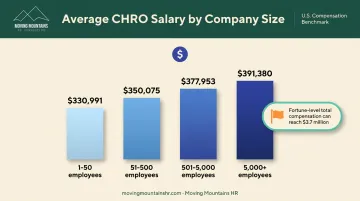
At Fortune-level public companies, total compensation (base, bonus, and stock) has averaged around $3.7 million. That package is not realistic for most small or mid-size employers, but it shows how high the ceiling goes for CHRO and Chief People Officer roles.
Years of hands-on experience often weigh as heavily as formal education. Many smaller companies also get executive-level HR through a fractional CHRO or outsourced partner instead of a full-time hire.
Does Your Business Need a Full-Time HR Executive?
For most small and mid-size businesses, a full-time HR executive salary, plus benefits, bonus potential, and support staff, is simply out of reach. That doesn't mean executive-level guidance is off the table.
Warning Signs You Need Executive HR Guidance
- Compliance gaps showing up in audits or policy reviews
- Rising turnover with no clear retention strategy
- Rapid headcount growth outpacing your HR infrastructure
- Recurring employee relations issues or complaints
- Multistate or California-specific compliance complexity
A Practical Alternative: Fractional HR Leadership
If several of those signs sound familiar, you may need executive HR input—without a full-time hire. Moving Mountains HR offers fractional CHRO support for that middle ground.
Our Premium Active & Passive Support package includes fractional CHRO services alongside:
- Regular participation in your company's HR meetings
- High-level HR strategy and compliance oversight
- Performance management support
- Workplace culture development

Unlike a full-time hire, this model gives growing businesses embedded, executive-level leadership on an ongoing basis—without the overhead of a full C-suite salary.
We also offer standalone workplace investigations (harassment, discrimination, retaliation) and compliance audits when you need targeted help rather than ongoing leadership.
Not sure where you stand? Our free California HR Compliance Checklist is a low-commitment way to spot gaps before they become expensive problems.
Frequently Asked Questions
What is executive human resources?
Executive human resources refers to the senior, strategic layer of HR leadership responsible for company-wide people strategy, compliance, and workforce planning. It sits above administrative HR work such as processing paperwork or answering benefits questions.
What does an HR executive do?
An HR executive oversees workforce planning, compensation strategy, regulatory compliance, and employee relations at a leadership level. They set direction rather than execute daily tasks.
Is a CHRO higher than a VP?
Typically, yes. CHRO is usually the top HR title in an organization, with the VP of HR reporting into them. At smaller companies without a CHRO, the VP of HR often serves as the top HR role instead.
What is the highest paid HR position?
The CHRO or Chief People Officer role generally commands the highest pay in HR. At large companies, total compensation often includes significant bonuses and stock awards.
What's the difference between an HR executive and an HR manager?
HR executives hold strategic, company-wide authority over policy and direction. HR managers handle day-to-day HR administration and execute the strategy the executive sets.
Can a small business get executive-level HR support without hiring a full-time HR executive?
Yes. Fractional CHRO and outsourced HR consulting services, like those offered by Moving Mountains HR, give small businesses access to executive-level guidance on a flexible, cost-effective basis.