For California employers, the stakes are higher. State employment law changes frequently, and the requirements often outpace what most owners have time to track — from harassment-prevention training mandates to wage-and-hour rules that don't exist in other states.
This guide breaks down what HR outsourcing actually means, which services you can hand off, the real benefits businesses see, and how to know if it's the right move for your company.
Key Takeaways
- You can outsource one HR task or hand off full HR management—scope flexes to your needs
- Common models: PEOs, ASOs, independent HR consulting, and fractional CHRO support
- Main gains: lower costs, less compliance risk, and time back for owners
- Match your partner to company size, industry, and how much control you want to keep
What Is Human Resource Outsourcing?
HR outsourcing means contracting a third-party provider to manage some or all of your HR responsibilities. That's the simple definition. The nuance is that outsourcing exists on a spectrum, not an all-or-nothing decision.
Some businesses hand off a single function, like payroll processing. Others bring in a provider for full-service HR management. Neither approach requires giving up control of your workforce or entering a shared employment arrangement.
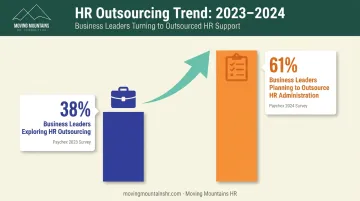
This is more common than most owners realize. In a Paychex survey of 450 U.S. business and HR decision-makers, 38% said they were likely to explore outsourcing HR functions in 2023. By 2024, as many as 61% of business leaders planned to outsource HR administration in the year ahead.
Outsourcing HR isn't a fringe strategy anymore. It's becoming standard practice for lean-staffed businesses.
Common HR Outsourcing Models
Not all outsourcing looks the same. Three models dominate the market, and they differ on control, liability, and the employment relationship:
- PEOs (Professional Employer Organizations): Co-employment that bundles payroll, benefits, and compliance. The PEO is a joint employer of record; you still control day-to-day decisions, supervision, and pay.
- ASOs (Administrative Services Organizations): Administrative support without co-employment. You stay the sole employer of record and handle your own tax filings.
- HR Consulting and Fractional CHRO Support: Full workforce control plus executive-level guidance on compliance, strategy, and investigations.
That third model is where Moving Mountains HR operates. The firm acts as an outside advisor for compliance audits, strategic guidance, and fractional CHRO support, without becoming employer of record for your team.
If you're comparing PEOs, note that the IRS treats a PEO as a third-party payer, but that does not automatically clear your employment-tax obligations. Read the fine print before assuming a PEO shifts all liability off your plate.
What HR Functions Can Be Outsourced?
You don't have to outsource everything at once. Most businesses start with one pain point and expand from there as budget and need allow.
Here's what typically gets outsourced:
- Payroll and tax administration — processing wages, withholdings, and regulatory filings
- Benefits administration — enrollment, open enrollment management, and carrier communication
- Compliance and risk management — policy audits, labor law updates, and workers' comp support
- Recruitment, onboarding, and performance management — sourcing candidates, building onboarding structures, and creating review systems
- Workplace investigations — neutral, third-party handling of harassment, discrimination, or misconduct complaints
Why Workplace Investigations Deserve Special Attention
Most standard outsourcing packages focus on payroll and benefits. Workplace investigations often get left out entirely.
California specifically recognizes the value of external investigators. The state requires that outside investigators be licensed private investigators or attorneys acting in a professional capacity.
Moving Mountains HR fills that gap. The investigation process runs through five stages:
- Intake and assessment — document the complaint and determine scope
- Investigation planning — define strategy, timeline, and interview order
- Neutral interviews — speak with the complainant, respondent, and witnesses
- Evidence collection — gather and document supporting materials
- Summary report — deliver findings and practical recommendations
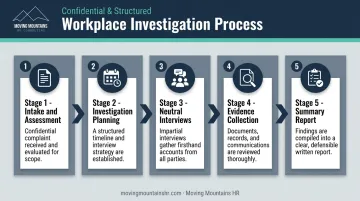
Every step stays confidential, with anti-retaliation education so employees understand their protections. An internal manager handling a harassment complaint often can't stay neutral, even with the best intentions. An outside investigator removes that conflict entirely.
Benefits of Human Resource Outsourcing
The appeal of HR outsourcing usually comes down to five things: cost, compliance risk, time, retention, and expertise.
Cost savings. A full-time HR hire stacks salary, benefits, training, and turnover on top of each other. Outsourcing delivers expert support without that overhead. NAPEO's ROI research estimates a 27.2% return for businesses using PEO services, or roughly $1,272 in estimated savings for every $1,000 spent.
Reduced compliance risk. Employment law doesn't sit still. California alone requires harassment-prevention training for employers with five or more employees, with different hour rules for supervisors and nonsupervisors. Miss those deadlines and you face a real compliance violation, not a paperwork slip.
Time savings and strategic focus. Every hour on HR admin is an hour not spent growing the business. Paychex found that 64% of surveyed companies spent over 570 hours a year on HR administration, more than 11 hours every week. Owners can put that time back into sales, product, or customers.
Improved employee retention. NAPEO found companies using PEO support saw annual turnover 10 to 14 percentage points lower than peers running HR fully in-house. Less turnover means less cash and calendar time lost to recruiting and retraining.
Access to specialized expertise. A fractional CHRO brings executive-level HR leadership (compliance programs, workplace culture, people strategy) without a six-figure full-time salary. In regulated fields like healthcare, that depth of knowledge is often the difference between staying ahead of rules and scrambling after a gap shows up.
Is HR Outsourcing Right for Your Business?
Signs It May Be Time to Outsource
A few warning signs tend to show up before businesses reach out for help:
- No dedicated HR staff, so owners or untrained managers carry the load
- Compliance tracking across local, state, and federal rules feels overwhelming or inconsistent
- Recruiting, onboarding, or employee relations keep pulling focus from growth
SHRM's rule of thumb suggests businesses typically bring on a full-time HR professional around 80–100 employees. That benchmark misses something important: California's compliance obligations kick in much earlier. Harassment-training requirements start at just 5 employees.
That leaves a wide gap between when legal duties begin and when most companies can justify a full-time hire. Outsourcing is built for that gap.
Choosing the Right HR Outsourcing Partner
Not every provider fits every business. When evaluating options, look for:
- Proven state and industry expertise: California employment law differs enough from federal baselines that generic providers can miss key requirements
- Flexible service tiers: You shouldn't have to buy a full package when you only need one piece
- Neutral investigation capability: A partner who can step in as an unbiased third party when workplace complaints arise
Moving Mountains HR structures ongoing support in flexible tiers:
- Passive Support: On-demand guidance by email or phone
- Active & Passive Support: Adds participation in internal HR meetings
- Premium: Layers in Fractional CHRO services for strategy, compliance oversight, performance management, and culture-building
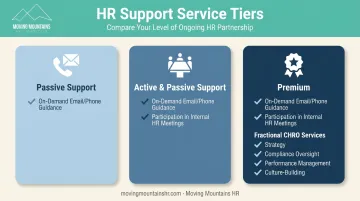
None of these tiers require co-employment.
Frequently Asked Questions
How much does outsourced HR cost per hour?
Costs vary widely by provider and service scope. Some bill per employee per month, others use hourly consulting rates. Most reputable providers, including Moving Mountains HR, offer customized quotes based on your specific needs.
Is HR being outsourced?
Yes, and adoption is growing. Paychex found 38% of surveyed business leaders planned to explore outsourcing in 2023, while a 2024 follow-up reported as many as 61% planned to outsource HR administration in the year ahead.
What do you mean by human resource outsourcing?
It means contracting an external provider to manage some or all HR functions on your behalf. That can range from a single outsourced task, like payroll, to full-service HR support.
What is the difference between HR outsourcing and a PEO?
A PEO is one specific type of HR outsourcing that involves co-employment. Broader HR outsourcing includes consulting, ASOs, and fractional models that don't require sharing employer status at all.
Which HR functions should stay in-house?
Culture-driven decisions, leadership development, and daily employee relationships usually work best when handled internally, even if you outsource compliance, payroll, or investigations.
Is HR outsourcing only for large companies?
No. Small and mid-size businesses, especially those with 10 or more employees, often benefit the most. They face the same compliance demands as larger companies without the budget for a full internal HR department.
If HR administration is eating into the time you need to run your business, or California compliance feels harder to keep up with every year, a short conversation can clarify your options. Moving Mountains HR offers a free consultation to help you figure out which level of support fits your needs.