Introduction
A harassment complaint lands in your inbox. A forklift tips over in the warehouse. An employee reports a manager for falsifying expense reports. These incidents happen at businesses of every size. How you respond often shapes legal exposure, employee trust, and whether your findings hold up later.
Investigations can look deceptively simple: talk to a few people, write up what happened, move on. But outcomes vary wildly depending on who runs the process, how quickly it starts, and whether documentation holds up under scrutiny. The EEOC's longstanding guidance calls for a prompt, thorough, and impartial investigation of harassment complaints, and courts routinely examine whether that standard was actually met.
This guide covers:
- When a formal investigation is legally required
- What to prepare before you start
- How to run a defensible process end to end
- Mistakes that weaken otherwise solid cases
- When to bring in outside help
Key Takeaways
- A documented, structured process protects your business and your employees from legal and reputational fallout
- Investigations should uncover facts and root causes, not assign blame before the evidence is in
- Neutrality, speed, and confidentiality determine whether an investigation holds up in court
- Not every incident needs a full formal investigation, but every incident needs a documented review
- Harassment claims, executive misconduct, or conflicts of interest usually call for a neutral outside investigator
How to Conduct a Workplace Incident Investigation
Step 1: Respond Immediately and Secure the Situation
The first hour matters. If it's a conduct issue, separate the complainant and the accused. If it's a safety incident, secure the physical area before evidence gets disturbed or "cleaned up."
Handle mandatory reporting and protective duties immediately:
- Federal OSHA requires reporting a work-related fatality within 8 hours, and an inpatient hospitalization, amputation, or loss of an eye within 24 hours, per 29 CFR 1904.39
- California employers face a similarly tight window under Title 8, Section 342: serious injuries or deaths must generally be reported within 8 hours of the employer learning about them
- Harassment or whistleblower claims may trigger separate mandatory reporting or interim protective measures, even before the investigation concludes
Don't wait for a "complete picture" before acting. Secure the scene, protect the people involved, and start the clock on your internal process right away.
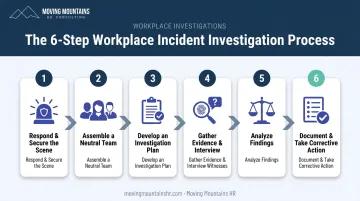
Step 2: Assemble a Qualified, Neutral Investigation Team
The person running the investigation needs zero personal stake in the outcome. That sounds obvious, but it's the single most common way investigations get challenged later.
Look for someone with:
- No reporting relationship to the accused or complainant
- Training in interview techniques and basic employment law
- Authority to actually pull records, schedule interviews, and follow the evidence wherever it leads
If the allegations involve an executive, a member of the HR team, or anyone with influence over the normal decision-making chain, an internal investigator creates an automatic credibility problem. Bring in a neutral third party at that point.
Step 3: Develop an Investigation Plan
Before a single interview happens, define:
- Scope — exactly which allegations are being investigated, and which are outside the current review
- Timeline — a target completion window, adjusted for complexity
- Witness list — everyone who might have relevant knowledge, not just the two parties involved
- Document list — emails, texts, schedules, badge access logs, prior complaints
- Confidentiality protocol — who knows what, and when
- Communication plan — how you'll update the complainant and accused without compromising the process
Skipping this step is how investigations turn into a scramble of ad-hoc conversations that fall apart under later questioning.
Step 4: Gather Evidence and Conduct Interviews
Interview the complainant, the accused, and witnesses separately, never together. Joint interviews compromise the process and have been cited in court as evidence of a flawed investigation.
Use open-ended, non-leading questions:
- "Walk me through what happened that day."
- "Who else was present?"
- "Is there anything in writing that supports this?"
Avoid questions that suggest the answer you're looking for. Document statements as close to real time as possible. Memory degrades fast, and delayed notes lose credibility.
Collect physical evidence and records alongside interviews, not as an afterthought.
Step 5: Analyze Findings and Reach a Conclusion
This is where investigations either hold up or collapse. Separate verified facts from assumptions, rumors, or hearsay. When accounts conflict, weigh:
- Plausibility — does the story make sense given the circumstances?
- Corroboration — does other evidence or testimony support it?
- Motive — does either party have a reason to shade the truth?
- Consistency — does the account hold up across multiple tellings?
Most workplace investigations use a "more likely than not" standard, not a criminal burden of proof. Demeanor alone (how confident or upset someone seemed) is not a reliable credibility indicator on its own. Weigh it against the actual record.
Step 6: Document, Report, and Take Corrective Action
Write a report that includes:
- The original allegations and investigation scope
- Methodology (who was interviewed, what evidence was reviewed)
- Findings on each specific allegation
- Recommended corrective action
Communicate outcomes to the relevant parties in appropriate detail: not every finding, but enough for the complainant to understand something was done.
Then follow through with discipline, policy changes, training, or monitoring based on the findings. Circle back weeks later to confirm the issue actually stopped.
When You Need a Formal Investigation & What to Prepare
When Is a Formal Investigation Necessary?
Not every workplace hiccup needs a full formal process. But certain triggers should always prompt one:
- Formal harassment or discrimination complaints
- Safety incidents or near-misses with injury potential
- Suspected policy violations with repeat behavior
- Whistleblower reports involving legal or regulatory concerns
Minor, isolated issues (a scheduling dispute, a one-off tone complaint) can often be handled informally with a documented conversation. Anything involving potential legal liability, a pattern of behavior, or safety risk deserves a formal, documented process instead.
What to Prepare Before Starting
Before you start, lock down three basics:
- Current policies: Handbook, anti-harassment policy, and safety program must be current—they set the standard you measure against
- Investigation tools: Interview templates, an evidence log, and a case tracking system
- Investigator readiness: Confirm the assigned person has the training, time, and independence for an unbiased process. If they lack any of the three, bring in a neutral third party
Skip this prep and you risk investigating against a policy that's three years out of date—or one that contradicts what you actually enforce.
Key Factors That Determine a Legally Defensible Investigation
The quality of an investigation, not only its final outcome, is what protects a business if the matter is later challenged in court or before a regulatory agency. How you ran the process often matters as much as what you concluded.
These factors determine whether an investigation holds up under scrutiny:
- Timeliness: Evidence and memories fade fast. Unexplained delay can be read as employer negligence and weakens the eventual conclusion.
- Neutrality and objectivity: A biased or conflicted investigator undermines the process. Perceived bias alone can support a claim that the investigation was a "sham."
- Confidentiality: Protecting all parties reduces retaliation risk and preserves trust. Breaches create liability beyond the original complaint.
- Thorough documentation: A well-documented file is often the strongest defense in an EEOC charge or lawsuit.
- Consistency with policy: Applying the same standard to every case, regardless of who is involved, avoids disparate treatment claims.
SHRM's guidance on litigation defense notes that a properly documented internal investigation can be one of an employer's best tools if a case proceeds to court. Poor records make decisions made afterward nearly impossible to defend. Inconsistent handling of similar incidents remains one of the most common bases for discrimination claims.
Common Mistakes That Undermine Workplace Investigations
Well-intentioned investigations still fail for a few predictable reasons:
- Delaying the start — evidence and witness details fade or disappear when you wait
- Using a biased investigator — even informal influence from a conflicted person taints the process
- Breaking confidentiality — leaks invite retaliation claims and shut down witness cooperation
- Jumping to conclusions — blame-first thinking skips root causes and weakens findings
A California appellate case, Mendoza v. Western Medical Center, shows how quickly process failures become legal risk. There was no written plan, no separate interviews, and an investigator who supervised both parties. The court held those defects alone could support a claim of retaliatory intent, regardless of what actually happened.
DIY Investigation vs. Hiring a Neutral Third-Party Investigator
Not every investigation should be handled internally, especially as legal risk and complexity climb.
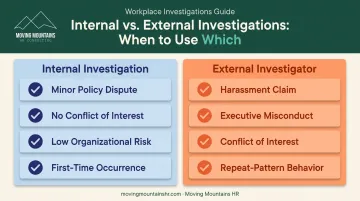
When an Internal Investigation Works
Internal investigations fit lower-risk matters where trained HR staff have no personal or professional stake in the outcome.
They usually work when:
- The issue is a minor policy or conduct concern
- No party has a reporting or personal relationship with the investigator
- Legal exposure appears limited and facts are relatively clear
When to Bring in an External Investigator
External investigators earn their keep in high-stakes situations:
| Situation | Why It Matters |
|---|---|
| Harassment or discrimination claims | Perceived bias can invalidate findings even if the outcome is correct |
| Executive-level misconduct | Internal staff often report to or work alongside the accused |
| Conflict of interest | Any personal connection to either party undermines credibility |
| Repeat or pattern behavior | Higher legal exposure demands airtight documentation |
Moving Mountains HR provides neutral, third-party workplace investigations that add credibility and reduce legal exposure for small and mid-size businesses without a dedicated, conflict-free investigator on staff.
The team follows a structured process: intake, investigation planning, separate interviews, evidence collection, and a written summary report. Throughout, they maintain confidentiality and provide anti-retaliation education to everyone involved.
The trade-off is straightforward. An outside investigator almost always costs far less than a mishandled investigation that leads to litigation, an EEOC charge, or a settlement.
Frequently Asked Questions
How do you investigate a workplace incident?
Secure the situation, assemble a neutral investigator or team, gather evidence and separate witness statements, analyze findings against a reasonable standard of proof, and document everything in a written report with corrective action.
Do HR investigations lead to termination?
Not always. Findings can result in coaching, policy updates, additional training, disciplinary action short of termination, or no action at all if the allegations aren't substantiated.
What are the 5 P's of investigation?
Some practitioners use a mnemonic of People, Papers, Physical evidence, Place, and Policies to organize evidence-gathering. It's a helpful checklist, not a formal legal standard.
How long should a workplace investigation take?
Simple matters can wrap up in days; complex cases with multiple witnesses may take a few weeks. There's no universal deadline, but unexplained delay increases legal risk regardless of complexity.
Who should conduct a workplace investigation?
Someone trained, neutral, and free of conflicts of interest. Internal HR can handle lower-risk issues; sensitive or high-stakes claims call for an outside investigator.
What happens if an employer doesn't investigate a workplace complaint?
The harm to employees continues, the company loses key legal defenses, regulatory penalties become more likely, and the odds of costly litigation rise sharply.