
Introduction
Picture this: a deadline slips, a client calls upset, and your team spends the next meeting pointing fingers instead of fixing the problem. Sound familiar? Many small business owners know this cycle well: missed handoffs, vague ownership, and teams that disengage the moment things go wrong.
Here's the misconception that derails most accountability efforts: leaders think accountability means catching people doing something wrong. It doesn't. That punitive mindset is precisely why so many training programs fail to stick.
This guide covers why accountability training matters, what actually makes it stick, and a practical framework you can use with both employees and leaders.
Key Takeaways
- Accountability training separates ownership from blame, building trust instead of fear
- Leadership behavior determines whether accountability spreads through a team or dies on arrival
- Strong programs combine SMART goals, two-way feedback, delegation skills, and psychological safety
- Lasting accountability requires ongoing coaching and reinforcement, not a single workshop
Why Accountability Training Matters for Employees and Leaders
Accountability isn't a nice-to-have soft skill. It's tied directly to business performance.
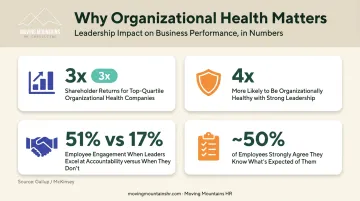
Organizations in the top quartile for organizational health deliver three times the shareholder returns of bottom-quartile peers, according to McKinsey's research on organizational health. Those with strong, decisive leadership are also over four times more likely to be considered healthy.
Accountability Is Not Blame
Blame looks backward and assigns fault. Accountability looks forward and assigns ownership. Modern training builds psychological safety so employees admit mistakes early instead of hiding them until they grow.
The Clarity Gap Is Bigger Than You Think
You can't hold someone accountable for expectations they never understood. Yet Gallup's research found that only about half of employees strongly agree they know what's expected of them at work. That gap alone explains a huge share of missed deadlines and stalled projects.
Leadership Behavior Drives (or Kills) Accountability
The manager matters more than any policy. Managers who rated their leaders as outstanding at holding people accountable were three times more likely to be engaged—51% versus just 17%—per Gallup's 2026 accountability study.
Regular feedback compounds the effect: employees who get daily rather than annual feedback are far more motivated to do great work.
The takeaway: accountability training only sticks when leaders learn to set clear expectations, give timely feedback, and model ownership themselves.
Key Components of Effective Accountability Training Programs
Comprehensive accountability training blends structure, skill-building, and culture change. A single workshop on goal-setting won't move the needle if role clarity and feedback habits aren't addressed too.
Clarity of Expectations and Roles
Ambiguity is the enemy of accountability. When two people believe they're each responsible for the same task, both quietly assume the other has it covered until nobody does.
Frameworks like RACI (Responsible, Accountable, Consulted, Informed) fix this by assigning exactly one accountable person per task. Project Management Institute guidance treats that single-owner rule as central to project success.
SMART Goals and Ownership
SMART goals—Specific, Measurable, Achievable, Relevant, Time-bound—give employees a concrete standard instead of a vague expectation. A goal like "improve customer service" invites confusion. A goal like "respond to client emails within four business hours, tracked weekly" invites ownership.
Feedback Skills and Psychological Safety
Training has to teach feedback in both directions, not just top-down critiques. Employees need to know how to raise concerns upward as well.
The American Psychological Association links regular give-and-take feedback to psychologically safe workplaces—places where people can admit mistakes without fear of humiliation.
Delegation and Follow-Through Systems
Handing someone a task without the authority or resources to complete it sets them up to fail. Effective delegation training covers:
- Defining the task and the desired outcome clearly
- Granting the authority needed to make decisions
- Setting checkpoints for progress review
- Establishing a regular check-in rhythm, weekly or biweekly for most teams
For remote and hybrid teams, this matters even more. SHRM recommends stating clearly who owns each result and agreeing on a timetable up front. Scheduled check-ins replace the hallway conversations that no longer happen.
How to Teach Accountability: A Step-by-Step Framework
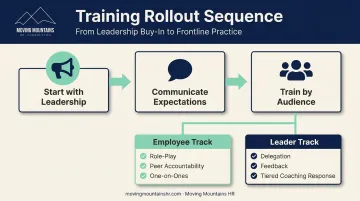
Rolling out accountability training in the wrong order sets it up to fail. Leaders need to go first.
- Start with leadership. Leaders should complete training before anyone else and visibly model accountable behavior. Employees notice fast when leaders preach accountability but don't practice it themselves.
- Communicate expectations clearly. In team meetings or one-on-ones, define what success looks like, set deadlines, and confirm employees have the resources to hit them.
- Train by audience. Employees and leaders need different practice. Use the tracks below to match the skill gaps each group faces.
Teaching Accountability to Employees
Employees learn ownership by practicing it in low-stakes settings first.
- Use role-play and real workplace scenarios so employees can rehearse ownership conversations before the stakes are high
- Build peer accountability groups where team members check in on each other's progress
- Reinforce learning in one-on-ones that tie goals to SMART objectives and recognize follow-through
Teaching Accountability to Leaders and Managers
Leader training needs a different focus: delegation, feedback delivery, and the line between accountability and micromanagement.
- Teach delegation that pairs responsibility with real authority
- Train constructive feedback that addresses behavior, not character
- Show leaders how to run consistent check-ins without hovering
- Introduce a tiered response model: coach early misses, intervene more directly on repeated ones
Gallup research supports this balance. Micromanagement strips away context, ownership, and creativity. Coaching built on trust and shared accountability improves performance.
Overcoming Common Accountability Training Challenges
Even well-designed training hits friction. Here's how to handle the most common roadblocks.
Resistance to change. Employees often fear that accountability means increased scrutiny or job risk. SHRM finds you can cut that pushback when leaders:
- Communicate the benefits of accountability openly
- Treat mistakes as learning opportunities, not blame targets
Accountability versus autonomy. Employees need clear expectations, not close supervision. Pair firm outcomes with flexibility in approach:
- Define the "what" and the deadline clearly
- Leave the "how" up to the employee whenever possible
- Step in only when results consistently fall short
Losing momentum after training. A single workshop rarely changes behavior long-term. Training-transfer research shows application rates drop from 62% right after training to 34% after one year without reinforcement. Sustained accountability requires:
- Ongoing leadership commitment, not a one-time announcement
- Recognition systems that celebrate follow-through publicly
- Regular coaching check-ins built into the calendar, not left to chance
Building Lasting Accountability with Expert HR Support
Most small and mid-size businesses don't have an in-house HR team dedicated to designing, facilitating, and reinforcing accountability training. It tends to fall to a busy owner or office manager already stretched across a dozen other responsibilities, and it's often the first thing that slips when things get busy.
This is where an outside HR partner earns its keep. Moving Mountains HR works with small and mid-size businesses across California and the broader U.S. to build performance management systems and HR strategy tailored to how a company actually operates, not a generic template pulled off the internet.
Support typically includes:
- HR document audits that review existing evaluations, policies, and procedures against current best practices
- Performance management guidance to help leaders deliver effective, consistent feedback
- Fractional CHRO support (Premium tier) for ongoing executive-level HR strategy without a full-time hire
Because accountability systems touch discipline, evaluations, and performance decisions, they need to hold up legally too. Founder Michelle Schwanhauser brings executive-level HR experience—including deep work in regulated healthcare—to help businesses build frameworks that support a healthy culture and stay aligned with California employment law.
If you're ready to move past the finger-pointing stage, a free consultation is a practical place to start.
Frequently Asked Questions
What are the key components of accountability training for employees?
Effective programs combine clarity of expectations, SMART goal-setting, two-way feedback skills, and delegation practices. Together, these give employees a clear standard to work toward and the support needed to meet it.
How do you teach accountability to employees?
Start with leaders modeling the behavior. Then use SMART goal-setting, one-on-one coaching, and real workplace scenarios so employees can practice ownership conversations in low-stakes settings.
What's the difference between accountability and blame in the workplace?
Accountability focuses on ownership, learning, and forward progress. Blame focuses on fault and punishment, which drives people to hide mistakes instead of fixing them. Accountability builds trust; blame erodes it.
How long does it take to build a culture of accountability?
No single training session creates an accountability culture. It takes months of consistent reinforcement, coaching, and leadership follow-through—not a one-time workshop.
How can leaders hold employees accountable without micromanaging?
Set clear expectations and deadlines, then give employees autonomy over how they get the work done. Support this with regular check-ins rather than constant oversight of every task.
What tools can help track accountability in teams?
Project management platforms, shared team scorecards, and structured one-on-one meeting notes all work well. The key is consistency: tools only help if they're reviewed regularly.