Introduction: The Evolving Landscape of HR Management in 2026
Small to mid-size businesses face a stark reality in 2026: HR complexity keeps growing, but most still operate without a dedicated HR department. Managing compliance, performance, and culture now falls on business owners already stretched thin.
The HR landscape shifted after 2020. Several forces reshaped day-to-day people management:
- Remote and hybrid work became permanent
- AI moved into everyday operations
- Employment rules multiplied at federal and state levels
- Expectations around flexibility, transparency, and well-being rose
California employers carry still more weight. Wage laws, leave rules, and workplace safety standards often exceed federal minimums.
This guide covers the seven most pressing HR challenges businesses will face in 2026, plus practical solutions for each. Whether you're managing 15 employees or 150, these strategies will help you stay compliant, retain talent, and build a workplace that supports sustainable growth.
Key Takeaways
- HR complexity is rising in 2026 around California compliance, retention, and tech adoption
- Proactive HR cuts legal risk, improves retention, and protects the bottom line
- Practical fixes range from fractional CHRO support to evidence-based engagement practices
- California employers face stricter state rules plus federal law, including new posting and pay-scale requirements
- Outside HR guidance often costs less than DIY fixes when turnover runs 80–200% of salary
Understanding the 2026 HR Environment
The year 2026 brings several HR pressures at once. New rules took effect early in the year and hit payroll, hiring, and classification directly:
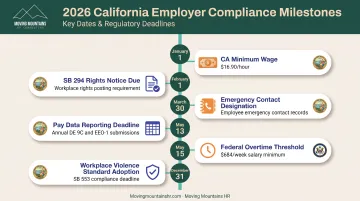
- California's $16.90/hour minimum wage became enforceable January 1
- Businesses with 15+ employees must include pay scales in job postings under SB 642
- The U.S. Department of Labor restored the federal white-collar salary floor to $684 per week effective May 15, 2026, reshaping overtime exemption classifications nationwide
Regulation is only part of the picture. AI reached operational maturity in HR, Gen Z became the largest segment of new hires, and tighter budgets pushed teams to do more with less.
Small businesses carry a heavier share of this load. 27% of NFIB small-business owners named labor quality and availability as their single most important problem in July 2026, the highest-ranking concern. Most lack compliance specialists, compensation analysts, or employee-relations teams.
California employers face still more requirements. Workplace violence prevention, indoor heat safety, pay data reporting, and annual employee-rights notices go beyond federal standards. Staying current takes ongoing monitoring and documentation.
A deliberate response limits exposure to penalties, lawsuits, and reputational harm. It also supports the growth and retention that sustain the business over time.
Challenge 1: Navigating Complex Employment Laws and Compliance
The Compliance Landscape in 2026
Federal rules alone create heavy compliance work in 2026:
- Overtime exemption salary threshold: DOL's May 15, 2026 technical amendment set the EAP floor at $684/week and the highly compensated employee level at $107,432/year
- Independent contractor classification: DOL's February 2026 proposed rule is still in rulemaking; the January 2024 six-factor economic-reality test still governs
- Joint-employer standard: NLRB's withdrawal effective February 27, 2026 removed the vacated 2023 rule; the 2020 standard remains in effect
California businesses must layer state-specific requirements on top:
- SB 294 (Workplace Know Your Rights Act): Annual rights notice due by February 1, 2026; emergency-contact designation by March 30
- SB 642 (Pay Equity Enforcement Act): Employers with 15+ employees must post pay scales, provide them on request, and keep job-title and wage-rate history through employment plus three years
- Workplace violence prevention: Cal/OSHA SB 553 duties enforceable since July 1, 2024; general-industry standard adoption deadline is December 31, 2026
- Pay data reporting: Private employers with 100+ employees: Reporting Year 2025 reports due May 13, 2026
Non-compliance carries real financial consequences. Federal 2026 maximum penalties include $2,515 for repeated or willful FLSA violations, $16,550 for serious OSHA violations, and $165,514 for willful or repeated OSHA violations. California penalties can exceed federal amounts.
Beyond fines, non-compliance exposes businesses to lawsuits, back-pay claims, and reputational damage that affects recruiting and customer relationships.
Solutions for Staying Compliant
Conduct annual HR compliance audits to find gaps in policies, procedures, and documentation. Review:
- Employee handbooks and policy manuals against current law
- Wage and hour practices (classification, overtime, meal/rest breaks)
- Required postings (federal and state)
- Employee files for completeness and retention rules
- Job descriptions and exemption classifications
Track regulatory changes at the federal, state, and local levels:
- Subscribe to DOL and state labor agency email updates
- Monitor reputable employment-law sources
- Document when you review and apply each change
Establish clear documentation practices and stick to a written retention schedule. Federal law requires payroll, sales, and purchase records for at least three years; EEOC rules generally require personnel records for one year. California often requires longer retention.
Bring in fractional HR support or legal counsel for complex compliance questions. Moving Mountains HR provides compliance audits built for California employers: policy and employee-document review, gap analysis against current rules, and an HR Compliance Review Report with prioritized next steps.
For teams without in-house HR, that outside support usually costs less than fixing violations after fines, claims, or back-pay exposure hit.
Challenge 2: Attracting and Retaining Top Talent in a Competitive Market
The Talent Challenge
The labor market remains tight. June 2026 data showed 7.4 million job openings against 5.3 million hires, with competition especially fierce for skilled positions. 69% of organizations still struggled to fill roles in SHRM's 2025 survey.
Small businesses compete against larger companies with bigger budgets, established brands, and stronger benefits packages. Candidate expectations have shifted too:
- Flexibility is non-negotiable for many
- Purpose and values matter as much as pay
- Growth opportunities often decide whether someone accepts or stays
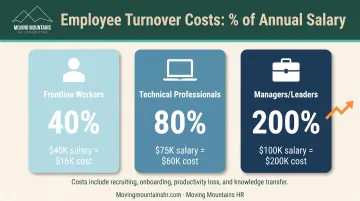
Turnover economics make talent retention a strategic priority. Gallup estimates replacement costs at about 200% of salary for managers and leaders, 80% for technical professionals, and 40% for frontline workers. For a technical role paying $75,000, one departure costs approximately $60,000 in recruiting, onboarding, lost productivity, and knowledge loss.
Strategic Solutions for Talent Acquisition
Build a strong employer brand that highlights company culture, values, and real employee experiences:
- Feature employee testimonials on your website and social media
- Showcase your mission and how individual roles contribute to it
- Share behind-the-scenes content that gives candidates a genuine sense of your workplace
- Highlight flexibility, growth opportunities, and what makes your culture distinct
Develop competitive compensation packages within budget constraints. Use BLS wage data by occupation and state-specific resources like California EDD OEWS to research salary benchmarks for your region and industry. If you can't match the highest market rates, emphasize total compensation: benefits, flexibility, professional development, and work-life balance all carry real value.
Offer flexibility as a differentiator. Organizations offering flexible work reported less recruiting difficulty than those without it (22% versus 29% in SHRM's survey). Remote options, flexible schedules, and results-focused work arrangements attract candidates who might otherwise choose larger employers.
Retention Strategies That Work
Create clear career development paths and internal mobility opportunities. Gartner found only 46% of employees felt supported in career growth, yet support was associated with up to a 19-point increase in willingness to stay. Document potential advancement routes, skills needed for progression, and how employees can access learning opportunities.
Implement regular feedback systems beyond annual reviews. Employees receiving daily feedback from their manager were 3.6 times more likely to strongly agree they were motivated to do outstanding work compared to those receiving annual feedback. Short weekly check-ins, project debriefs, and ongoing coaching conversations keep employees engaged and aligned.
Recognition culture matters as much as formal programs. Peer shout-outs, thank-you notes from leadership, and public acknowledgment of milestones reinforce desired behaviors without expensive rewards and strengthen connection to the organization.
Given that replacement costs range from 40-200% of salary, even modest investments in retention (training programs, career coaching, stay interviews) deliver clear ROI.
Challenge 3: Managing Remote, Hybrid, and In-Office Workforces
The workplace model debate continues in 2026. Some organizations returned fully to offices, others remained entirely remote, and most landed somewhere between.
About 60% of remote-capable workers prefer hybrid arrangements, one-third prefer fully remote, and fewer than 10% prefer on-site work full-time.
Common challenges include:
- Maintaining culture across distributed teams
- Ensuring equity between remote and in-office workers
- Communication gaps that slow decision-making
- Managing performance when visibility is limited
Solutions require intentional design:
- Set role-based work-location policies. Document which roles can work remotely, which need on-site presence, and why. Avoid arbitrary rules that feel unfair.
- Invest in collaboration tools for async communication, project visibility, and documentation. Pair them with clear protocols; tools alone won't fix gaps.
- Build intentional connection opportunities. Use all-hands meetings, virtual coffee chats, and periodic in-person events so remote staff get equal access to leadership.
- Train managers to lead distributed teams. Teach clear expectations, frequent communication, output-based measurement, and trust-building without physical proximity.
A 2024 six-month randomized trial involving 1,612 employees found hybrid work reduced quit rates by one-third without damaging performance. The study used coordinated hybrid schedules (fixed days in-office) and output-based evaluation. While conducted in China, the findings align with emerging U.S. evidence: well-structured hybrid work can improve retention without sacrificing results.
Challenge 4: Adapting to AI and HR Technology
AI reshaped day-to-day HR work in 2026. Common uses now include:
- Recruiting: resume screening and candidate matching
- Onboarding: chatbots that answer routine new-hire questions
- Performance tracking: productivity pattern analysis
- Employee engagement: pulse surveys and sentiment analysis
Yet adoption among small businesses lags. NFIB's 2025 survey found 24% of small employers used AI overall versus 48% among firms with 50+ employees. Barriers included cost (20% cited it as a barrier), complexity (7%), and the perception that existing technology still worked adequately (19%).
Among HR professionals, AI adoption rose from 26% in 2024 to 43% in 2025. The most common HR uses in 2026 were recruiting (27%), HR technology platforms (21%), and learning and development (17%).
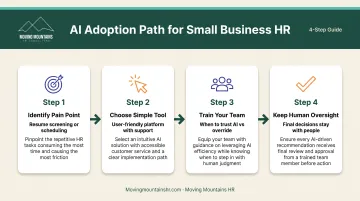
Cost, complexity, and employee resistance still slow smaller teams, and many owners simply do not know where to begin. A practical path looks like this:
- Start with one tool tied to a single pain point, such as resume screening or interview scheduling
- Choose user-friendly platforms with clear docs and real support instead of enterprise-grade complexity
- Train the people who will use the tools so they know when to trust AI recommendations and when to override them
- Keep humans accountable for hiring, discipline, and termination decisions to limit discrimination risk
Adopt AI where it clears real HR bottlenecks. That frees limited staff time for strategic work instead of administrative tasks.
Challenge 5: Employee Training and Skills Development
The Skills Gap Challenge
Employers expect 39% of key job skills to change by 2030, according to the World Economic Forum's 2025 report. That pace of change makes continuous learning a competitive necessity.
SHRM found 28% of organizations required new skills for full-time roles, 47% updated existing roles, and over one-third trained current employees for hard-to-fill positions. Training is also a retention tool: employees supported in career growth are up to 19 points more likely to stay.
Cost-Effective Training Solutions
Small businesses can't match enterprise training budgets. ATD's 2026 benchmark showed 16.7 formal learning hours per employee and $846 in direct expenditure (down from $1,254 in 2024). Effective learning still doesn't require a large budget:
- Develop internal training programs that tap senior employees' expertise. Subject-matter experts already on payroll can lead workshops, create documentation, or record video tutorials
- Use free or low-cost online learning platforms like LinkedIn Learning, Coursera, industry association webinars, and DOL's CareerOneStop training directory
- Create cross-training opportunities that build skills and improve operational flexibility. Employees learn adjacent functions and reduce single-point-of-failure risks
- Establish mentorship programs pairing experienced and newer employees for knowledge transfer, skill development, and relationship building
Document training completion and track skills gained. That record supports compliance and helps employees see their progress, which reinforces the investment you're making in their growth.
ROI shows up in higher retention, stronger day-to-day productivity, and internal mobility that cuts external hiring costs.

Challenge 6: Performance Management and Employee Engagement
Traditional annual reviews fail in 2026. Employees expect ongoing feedback, clear expectations, and recognition throughout the year, not a once-yearly evaluation disconnected from daily work.
The link between performance management, engagement, and retention is direct. Gallup's Q12 meta-analysis covering 3.3 million workers and 112,000+ teams found highly engaged teams recorded 14% higher productivity and 10% higher customer loyalty.
SHRM research shows employee experience and engagement account for 42% of turnover intent.
Solutions for effective performance management:
- Replace or supplement annual reviews with weekly one-on-ones, project debriefs, and real-time feedback
- Train managers to coach: constructive feedback, measurable goals, recognition, and difficult conversations
- Document clear success metrics for each role and review goals at least quarterly
- Reinforce desired behaviors with peer recognition, manager shout-outs, and values-based awards
Performance management shouldn't feel like a compliance exercise. Done well, it keeps people clear on expectations, recognized for good work, and less likely to leave.
Challenge 7: Health, Safety, and Employee Well-being
Workplace health and safety requirements have tightened considerably. California's SB 553 workplace violence prevention duties became enforceable July 1, 2024, with the general-industry standard adoption deadline set for December 31, 2026. Employers must maintain written prevention plans, provide training, and establish incident response procedures.
Cal/OSHA's indoor heat requirements mandate water, rest, cool-down areas, cooling methods under specified conditions, and training. Federal OSHA's nationwide indoor and outdoor heat standard remains proposed but points to where regulation is headed.
Psychological safety carries equal weight. An APA 2024 survey found 15% of U.S. workers called their workplace toxic; 89% of that subgroup reported lower psychological safety. Employees in psychologically unsafe environments disengage, perform poorly, and leave.
Solutions for health, safety, and well-being:
- Conduct regular risk assessments covering physical hazards, workplace violence, ergonomics (including remote work), and psychological stressors
- Provide mental health resources and EAPs with confidential counseling, crisis support, and work-life help
- Promote work-life balance through reasonable workloads, adequate time off, and after-hours boundaries. Managers who model constant overtime undercut those policies
- Create written prevention plans for workplace violence, heat illness, and other hazards; train employees and document completion
NIOSH guidance stresses that mental health programs should fix working conditions (excessive workload, lack of control, poor management) alongside individual support. An EAP alone is not enough if organizational practices undermine employee health.
When to Seek Expert HR Support
Several signs indicate a business needs external HR help:
- Compliance concerns: Policies may not meet current California or federal rules, or your handbook is more than a year out of date
- High turnover: Employees are leaving at rates that disrupt operations and erode institutional knowledge
- Growth phase: You're scaling rapidly and need HR systems, policies, and practices that support a larger workforce
- Legal issues: You're facing a claim, agency inquiry, or need a neutral party for a workplace investigation
- Leadership bandwidth: Owners and managers spend excessive time on HR tasks, pulling focus from core business functions
Options for external HR support include:
- Fractional CHRO: Part-time executive HR leadership for strategy, compliance oversight, and complex people issues—without a full-time hire
- HR consultants: Project-based support for specific needs like policy updates, handbook creation, compensation benchmarking, or compliance audits
- Outsourced HR services: Ongoing help with day-to-day HR operations, employee relations, and compliance monitoring
If those gaps sound familiar, a firm like Moving Mountains HR can fill them without a full-time hire. Founded by Michelle Schwanhauser, the firm brings executive-level HR experience—including deep healthcare-industry background—to small and mid-size businesses.
Support covers California-focused compliance audits, policy and handbook creation, workplace investigations, performance management, and ongoing guidance through passive, active, or premium packages.
The return shows up in four places:
- Lower risk of penalties, lawsuits, and compliance failures
- Leadership time freed for revenue-generating work
- Better retention, avoiding turnover costs of 40–200% of salary
- Workforce planning that supports steady growth
Frequently Asked Questions
What are the current issues in human resource management?
The biggest issues are compliance complexity from changing federal and California rules, intense talent competition, AI and HR tech adoption, and higher employee expectations for flexibility, growth, and well-being support.
What are the biggest HR challenges for small businesses in 2026?
Small businesses must meet compliance demands with little or no dedicated HR staff, compete for talent against larger brands, and adopt HR tools on tight budgets. Owners often juggle people issues alongside day-to-day operations.
How can small businesses stay compliant with changing employment laws?
Run annual audits of policies, wage practices, required postings, and employee files. Track DOL and state labor updates, keep clear retention schedules, and bring in an HR pro or employment counsel when rules change. Prevention costs far less than penalties.
When should a small business hire an HR professional or consultant?
Common triggers include hitting 15–20 employees, facing compliance issues or agency inquiries, high turnover, rapid growth plans, or a workplace investigation. Hire help when leadership spends more time on people problems than on running the business.
How is AI changing human resource management?
AI speeds up admin work such as resume screening, scheduling, and benefits questions, and surfaces insights on turnover and engagement. It still needs human oversight to limit bias and keep hiring and people decisions sound.
What's the difference between a fractional CHRO and a full-time HR manager?
A fractional CHRO gives part-time executive guidance on strategy, compliance, and complex org issues. A full-time HR manager runs daily work like recruiting, onboarding, and employee relations. Fractional support costs less than a full-time executive while still bringing senior expertise.
Conclusion
HR challenges in 2026 are manageable when you treat them as a connected system—not a pile of one-off fires. Compliance, talent competition, workplace models, AI, skills, performance, and well-being all compete for attention, and each one you ignore raises the cost of the others.
Proactive HR work lowers legal and financial risk, improves retention and engagement, and builds the capability your business needs to grow. Companies that get ahead of these issues run HR as a core operating function with clear owners, timelines, and metrics.
Assess your current practices against the challenges in this guide, then prioritize the gaps that hurt most—compliance exposure, turnover drivers, and outdated policies. Practical next steps include:
- Run a focused HR audit on high-risk policies and records
- Put a regular feedback cadence in place before review season
- Update your employee handbook for current federal and state rules
- Bring in outside support where you lack internal bandwidth
Moving Mountains HR offers complimentary consultations and California-specific compliance assessments to help you find gaps and build a workable plan. Contact staff@movingmountainshr.com or call 866-474-3575 to talk through what your organization needs next.