Introduction: The Hidden Cost of Promoting Too Soon
You promote your top salesperson to sales manager. Within three months, two team members resign, performance stalls, and your new manager is overwhelmed. This scenario plays out daily in small and mid-size businesses across the United States.
Technical excellence and leadership capability are different skill sets. DDI research shows that 35% of internally promoted executives are considered failures.
For growing organizations without deep leadership benches, one bad promotion can disrupt operations, damage morale, and cost approximately 200% of the manager's salary in replacement costs.
When businesses promote before assessing readiness, they trade a great individual contributor for a struggling manager. Timing and preparation decide the outcome more than raw talent does.
This guide covers how to evaluate leadership readiness, which skills separate high performers from capable managers, and how to prepare people before you promote them.
Key Takeaways
- Leadership readiness combines competencies, experience, and mindset, not technical skill alone
- Failed leadership transitions drain small businesses through turnover, lost productivity, and compliance risk
- Observable behaviors reveal readiness—owning outcomes, influencing without title, and helping others succeed
- Mentoring, stretch assignments, and targeted training accelerate readiness faster than waiting on tenure
- Assess readiness regularly during talent reviews, not just when a vacancy opens
What Is Leadership Readiness?
Leadership readiness is the combination of competencies, experience, and mindset that indicates someone is prepared to step into a leadership role. It means having the skills, behaviors, and maturity to manage people, execute strategy, and deliver results, not only perform individual tasks at a high level.
Leadership Readiness vs. High Performance
Being a top individual contributor does not automatically translate to being ready to lead others. DDI emphasizes that current performance, potential, and readiness are three distinct constructs, and confusing them creates poor promotion decisions.
High performers excel at executing their own work. Ready leaders excel at enabling others to succeed. Readiness calls for people management skills, strategic thinking, and emotional maturity beyond technical expertise.
A software engineer who writes brilliant code may still lack the communication skills to guide a development team. A star account manager may struggle with delegation, conflict resolution, or holding peers accountable.
The Core Components of Leadership Readiness
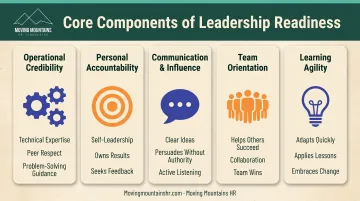
Leadership readiness includes five key dimensions observable through day-to-day behaviors:
- Operational credibility: Deep understanding of the work, earned peer respect, and the ability to guide others through complex problems
- Personal accountability: Self-leadership, ownership of results, and willingness to seek and act on feedback
- Communication and influence: Clear ideas, persuasion without formal authority, and active listening
- Team orientation: Helping others succeed, collaborating, and recognizing team wins over individual credit
- Learning agility: Adapting quickly, applying lessons across contexts, and embracing change
Different roles need different mixes of these competencies. A frontline supervisor needs strong operational credibility and communication; a director needs strategic thinking and change leadership.
Why Leadership Readiness Matters for Small to Mid-Size Businesses
Small to mid-size businesses face unique leadership challenges. They cannot afford long leadership vacancies, costly bad hires, or the disruption of unprepared managers. With leaner teams and fewer management layers, every leadership gap hits harder and spreads faster.
The Financial Impact of Poor Leadership Transitions
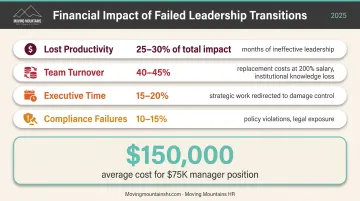
The costs of promoting someone who isn't ready include:
- Lost productivity during ramp-up: New managers spend months learning on the job instead of leading effectively
- Team turnover: Weak management drives exits—42% of voluntary leavers say their manager or organization could have prevented their departure
- Senior-leader time on damage control: Executive attention shifts from strategy to fixing avoidable problems
- Compliance and operational failures: Inexperienced managers mishandle documentation, policy enforcement, and employee relations
Gallup estimates replacing a leader or manager costs about 200% of salary. For a $75,000 manager, that's $150,000 in recruitment, onboarding, lost productivity, and institutional knowledge.
Those costs hit smaller organizations harder because each manager covers more of the business. Readiness work pays off on the other side of the ledger: organizations using deliberate, data-driven development are 3.7x more likely to convert internal potential into performance-ready leadership.
How Leadership Readiness Protects Business Continuity
A bench of ready leaders keeps transitions steady when you grow, someone resigns, or you restructure. You spend less time on panic promotions and expensive outside searches after an unexpected departure.
Yet only 20% of HR leaders report having leaders ready for critical roles, and internal candidates can immediately fill just 49% of critical positions. This gap forces businesses into reactive hiring, extended vacancies, or risky promotions.
The Compliance and Risk Management Connection
Unprepared managers raise compliance risk through weak documentation, uneven policy enforcement, and mishandled employee relations. EEOC guidance establishes that an employer is automatically liable when supervisor harassment results in a negative employment action.
Prepared leaders understand their legal responsibilities around performance documentation, accommodation requests, disciplinary processes, and protected-class considerations. They create safer, more compliant work environments by applying policies consistently and escalating issues appropriately.
The Most Common Leadership Readiness Gaps
Most businesses hit the same leadership readiness gaps. Once you name them, you can close them before they stall growth.
The "Promote on Technical Skill" Trap
Organizations default to promoting their best technician, salesperson, or operator without evaluating people management capability. Gallup research indicates that about 1 in 10 people naturally possess the talent to manage—meaning technical achievement alone doesn't predict leadership success.
This trap costs you twice: you lose a strong individual contributor and gain a struggling manager. Newly promoted leaders often:
- Do the work themselves instead of coaching others
- Micromanage because they know how the job should be done
- Fail to delegate effectively
Lack of Early Leadership Development
Waiting until someone is promoted to provide leadership training creates a steep learning curve and avoidable mistakes. High-potential employees need development opportunities before they take on formal leadership roles.
Gartner reports that traditional seminars and lectures can have a negative development effect when managers are already overwhelmed. Training disconnected from real work doesn't transfer. Embed development into daily work instead through:
- Mentoring
- Stretch assignments
- Ongoing feedback
How to Assess Leadership Readiness in Your Organization
You don't need expensive tools to assess leadership readiness. Intentional observation and structured evaluation are enough.
Identify Observable Leadership Behaviors
Look for these behaviors in team meetings, cross-functional projects, and daily interactions:
- Shares knowledge freely, mentors peers, and celebrates team wins
- Persuades through logic and relationships, not positional power
- Owns mistakes, follows through on commitments, and seeks feedback
- Considers broader business impact and connects daily work to strategy
DDI recommends objective assessments of current skills and how strengths or gaps may translate to future roles. Don't rely on gut feel or assumptions.
Use Structured Conversations and 360-Degree Feedback
Gather input from peers, direct reports (if applicable), and managers to get a complete picture. Ask specific behavioral questions rather than general impressions:
- "Describe a time this person helped resolve a team conflict."
- "How does this person respond to constructive feedback?"
- "Give an example of how they influenced a decision without formal authority."
CCL frames multi-rater feedback as a way to surface strengths, competency gaps, goals, and action plans. Confidentiality and role-relevant norms still matter. Use 360-degree feedback as one developmental input, not a stand-alone promotion verdict.
Create Leadership Readiness Profiles for Key Roles
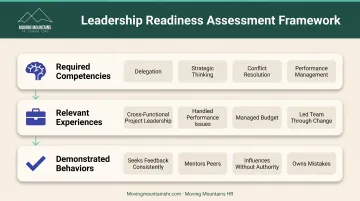
Define what "ready" looks like for specific roles in your organization—team lead, department manager, director. Profiles should include:
- Required competencies (e.g., delegation, strategic thinking, conflict resolution)
- Relevant experiences (e.g., managed cross-functional project, handled performance issue)
- Demonstrated behaviors (e.g., consistently seeks feedback, mentors peers)
Evaluate employees against those requirements through assessments and talent reviews, as DDI outlines in its succession planning guidance. This approach replaces subjective judgment with role-specific criteria.
Test Readiness Through Stretch Assignments
Give high-potential employees project leadership, cross-functional responsibilities, or interim management roles to reveal their capabilities. CCL recommends unfamiliar or broader work that involves change, cross-boundary influence, or diverse stakeholders.
Stretch assignments provide both assessment data and development experience. Add reflection, feedback, and support so the assignment builds capability instead of just exposing gaps.
Evaluate Readiness Regularly, Not Just During Vacancies
Conduct annual or biannual talent reviews to keep readiness assessments current. Waiting until a role opens to assess readiness leads to rushed, poorly informed decisions.
Track who is ready now, who could be ready in 6–12 months with development, and who has long-term potential. Update assessments as employees gain new experiences or demonstrate new competencies.
5 Strategies to Build Leadership Readiness
These practical, cost-effective strategies work for small to mid-size businesses without large training budgets.
Provide Early Leadership Training
Offer leadership fundamentals training to high-potential employees before promotion. Gallup research found trained managers improved their own engagement by up to 22%, while their teams saw engagement gains up to 18% and 21–28% less turnover.
Core topics should include:
- Communication and active listening
- Giving and receiving feedback
- Delegation and accountability
- Managing performance conversations
- Conflict resolution
When internal bandwidth is limited, outside support can close the gap. Moving Mountains HR delivers leadership development through virtual or in-person workshops, series, and coaching tailored to your industry and goals.
Pair Emerging Leaders with Mentors
Assign experienced leaders as mentors to provide real-time coaching and guidance. The Center for Creative Leadership (CCL) defines mentoring as an intentional developmental relationship and links it to learning, leadership opportunities, retention, and stronger pipelines.
Mentorship accelerates readiness by giving emerging leaders real-time guidance through challenges they have not faced before. Formal programs work best with clear objectives, defined roles, and shared expectations so both sides know what success looks like.
Use Stretch Assignments to Build Skills
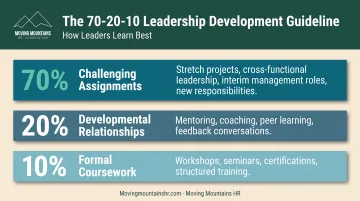
Give emerging leaders a project to own, a cross-functional initiative to run, or a temporary manager seat when someone is out. Those stretch assignments build practical leadership skill. CCL's 70-20-10 guideline emphasizes 70% challenging assignments, 20% developmental relationships, and 10% coursework.
Include regular feedback and support so assignments develop capability rather than just test it. Debrief what worked, what didn't, and what the person learned.
Create a Culture of Feedback and Accountability
Ongoing feedback, both positive and constructive, helps emerging leaders understand their strengths and development areas. DDI reports high-potential leaders are 2.7x more likely to leave in the next year when their manager does not regularly provide growth and development opportunities.
Model and expect accountability for results and behavior at all levels. Leaders who see accountability practiced consistently are more likely to adopt it themselves.
Build Leadership Development into Succession Planning
Effective succession planning pairs named successors with development actions that close readiness gaps. Track metrics that show whether the pipeline is working:
- Named successors for critical roles
- Internal promotion rates
- Development progress against readiness gaps
- Time to fill key positions
If internal HR capacity is limited, consider working with a fractional CHRO or HR consultant to design and implement a structured leadership pipeline. Moving Mountains HR provides fractional CHRO services and strategic HR guidance to help small and mid-size businesses build sustainable talent systems.
How to Create a Leadership Development Plan That Works
A development plan turns readiness assessment into action. The US Office of Personnel Management defines an individual development plan as a tool that helps employees achieve personal and professional development goals.
When you build the plan, include these components:
- Name 2–3 priority competency gaps from the readiness assessment
- Choose learning activities such as training, reading, job shadowing, or industry events
- Add stretch work: project leadership, cross-functional roles, or interim responsibilities
- Pair the person with a mentor or coach and set regular check-ins
- Set target dates for milestones and overall readiness
- Schedule monthly or quarterly progress reviews
Individualize each plan around that person’s gaps and career goals. A high performer who struggles to delegate needs different development than one who struggles with strategic thinking.
Accountability keeps the plan alive. Manager or mentor reviews confirm progress and give you room to course-correct when something is not working.
Frequently Asked Questions
What is the 30-60-90 rule in leadership?
The 30-60-90 framework maps a new leader’s first three months: learn and listen (days 1–30), build relationships and set priorities (days 31–60), then deliver early wins and credibility (days 61–90). This blueprint helps new managers stabilize operations and build momentum.
What are the 5 P's of effective leadership?
One leadership-analysis framework includes person (individual traits and style), process (methods and systems), position (authority and role), product (outcomes and results), and purpose (mission and direction). This framework from The Open University helps analyze leadership from multiple angles, though it is not a universal validated model.
How long does it take to develop leadership readiness?
Timelines usually run 6–24 months of intentional development, depending on current skill, role complexity, and how intensely someone is developed. DDI frames readiness against a specific future role, separating "ready now" talent from those who can get there with targeted work.
What is the difference between leadership potential and leadership readiness?
Potential is the capacity to grow into leadership over time, relative to future-role requirements. Readiness means someone is prepared to step into a leadership role now with minimal risk. Current high performance proves neither potential nor readiness; each needs separate evaluation against role-specific success criteria.
Can small businesses afford leadership development programs?
Yes. You don’t need a large budget: stretch assignments, mentoring, peer learning, feedback, and focused coursework are proven, lower-cost ways to build leaders. Internal mentoring, project leadership, and targeted training go a long way for small teams.
When should you start assessing leadership readiness?
Assess readiness as part of regular talent reviews at least annually, and anytime you identify high-potential employees, not only when a leadership seat opens. Only 20% of HR leaders report having leaders ready for critical roles, largely because assessment happens reactively. Early, ongoing assessment allows time for development before a role opens.