

Now imagine this instead: The session opens with a recent industry lawsuit that cost a similar company $2 million. Employees discuss real scenarios from their own work, practice handling situations through role-play, and leave with tools they can use immediately.
The difference? The second approach respects how adults actually learn. For HR professionals and business owners, understanding adult learning principles isn't academic—it directly impacts training ROI, employee performance, and whether your investment in development delivers real results.
Key Takeaways
- Knowles' six adult learning principles form the foundation of effective workplace training
- Training transfer averages only 32.76% in recent workplace studies, making design choices critical
- Flexible delivery, scenario-based exercises, and peer learning improve how adults apply training on the job
- Training aligned to these principles drives higher engagement, on-the-job application, and retention
What Is Adult Learning Theory?
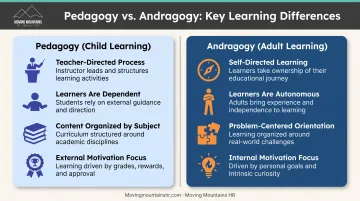
Adult learning theory, or andragogy, is a framework for understanding how adults learn. It differs from pedagogy, the traditional model used to teach children, in several important ways.
Key Differences:
- Pedagogy assumes learners are dependent, the teacher directs the process, and content is organized by subject
- Andragogy assumes adults move toward self-direction, prefer autonomy, and learn best through problems rather than subjects
Malcolm Knowles and the Development of Andragogy
Malcolm Shepherd Knowles (1913–1997) was a central figure in US adult education. He didn't invent the term "andragogy," but he popularized and refined it throughout his career, consolidating his framework in the 1980s. Those principles still shape how many organizations design professional development.
That history matters on the job. Adults need to stay competitive and adapt to fast-changing job demands. Traditional lecture-based training often fails because it ignores how experienced professionals process information. Andragogy gives HR teams a practical framework for designing programs employees will actually use.
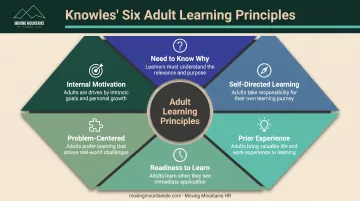
Malcolm Knowles' Six Core Principles of Adult Learning
Principle 1: Adults Need to Know Why They're Learning
Adults consider why they are learning and how it will benefit them before they engage. Without clear relevance, even well-designed training falls flat.
Workplace Example:
Instead of jumping straight into harassment-prevention rules, start with statistics: "Last year, workplace harassment claims cost US employers an average of $125,000 per case, plus legal fees and reputation damage. This training helps you recognize early warning signs and respond appropriately."
When employees understand the stakes, both organizational and personal, they're far more likely to pay attention.
Principle 2: Adults Are Self-Directed Learners
Adults prefer autonomy over their learning path and pace. Mandatory, rigid schedules can breed resentment and disengagement.
Workplace Example:
Rather than forcing all employees into a single scheduled session, offer a library of on-demand modules covering leadership, compliance, and communication. Let employees choose when and what to learn based on their current role needs and development goals.
Google's employee-led g2g (Googler-to-Googler) program shows this principle in action. Employees voluntarily design and teach courses on sales, Python, negotiation, and leadership, building a culture of self-directed peer learning.
Principle 3: Adults Bring Valuable Prior Experience
Accumulated knowledge and experience are powerful learning resources. Ignoring them wastes opportunity and can alienate learners who feel their expertise is dismissed.
Workplace Example:
During a customer-service training, ask participants to share a challenging client interaction they handled well. Use those real stories as case studies, letting employees learn from each other's successes and mistakes. This approach draws on the room's collective wisdom instead of relying solely on the instructor.
Principle 4: Adults Are Ready to Learn When They Need It
Readiness to learn is triggered by real-world needs, role changes, or immediate challenges. Training delivered too early or too late misses the moment when motivation peaks.
Workplace Example:
Offer just-in-time training for employees being promoted to management. Instead of generic leadership courses months in advance, deliver targeted sessions on delegation, performance conversations, and conflict resolution exactly when new managers step into their roles and face those challenges daily.
Principle 5: Adults Have a Problem-Centered Orientation to Learning
Adults prefer learning that helps them solve immediate, practical problems rather than absorbing theoretical content for future use.
Workplace Example:
Instead of lecturing on company policies, create scenario-based simulations where customer-service reps practice handling angry customers, processing returns, and escalating issues. PwC's 2020 VR inclusive-leadership program used immersive rehearsals of difficult workplace situations, allowing new managers to practice responses in realistic scenarios.
Problem-centered training sticks because it mirrors the actual challenges employees face.
Principle 6: Adults Are Motivated by Internal Factors
While external rewards matter, adults are primarily driven by intrinsic motivators like career advancement, self-esteem, and quality-of-life improvements.
Workplace Example:
Connect training programs to clear career paths. Show employees that completing a leadership development program puts them in line for promotion, or that a skill certification opens new project opportunities. People invest effort when learning advances goals they already care about.
Why Adult Learning Principles Matter in Workplace Training
The Connection Between Adult Learning and Training Outcomes
Understanding how adults learn directly improves engagement, retention, and application. Yet training transfer (the application of learned knowledge and skills on the job) remains a persistent challenge.
A 2024 workplace study reported mean transfer of only 32.76% in its 51-person follow-up study, meaning less than a third of what employees learned was actually used at work.
Across 335 independent samples, a 2017 leadership-training meta-analysis found that well-designed programs produced meaningful effects on reactions, learning, transfer, and results. Programs that incorporate adult learning principles outperform those that don't.
The Business Impact
Organizations invest heavily in training. According to ATD's 2025 report, based on 539 talent-development professionals, 2024 averages were:
- $1,054 direct learning expenditure per employee
- $165 per learning hour used
- 13.7 formal learning hours per employee
When training doesn't transfer to on-the-job behavior, companies waste that spend and miss opportunities to improve performance, reduce turnover, and strengthen organizational culture.
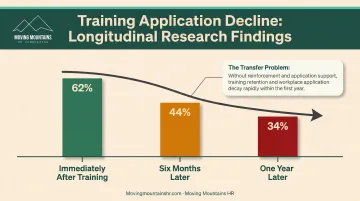
A 2006 longitudinal survey of 150 organizations found that employee application dropped from 62% immediately after training to 44% at six months and 34% at one year. Adult learning principles help close that gap by keeping training relevant, practical, and reinforced over time.
Common Challenges Adult Learners Face in the Workplace
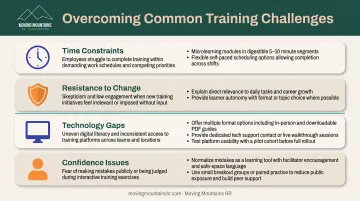
Adult learners bring experience and drive to training, but workplace realities get in the way. These four challenges show up most often—and each has practical fixes.
Time Constraints
Employees juggle full-time work, personal responsibilities, and learning demands. ATD's 2024 benchmark shows only 13.7 formal learning hours per employee, barely more than one hour per month.
Strategies to Accommodate:
- Microlearning: Break content into short modules; ATD's 2025 survey found 93% of organizations now use it
- Flexible scheduling: Offer on-demand modules employees can complete when it fits their workflow
- Just-in-time delivery: Provide short training bursts exactly when employees need specific skills
Resistance to Change
Established work habits and skepticism about new methods create barriers. Employees who have "always done it this way" may resist unfamiliar approaches.
How to Address This:
- Explain relevance clearly: Show how new methods solve problems employees already face
- Provide autonomy: Let people choose how to apply new skills instead of dictating rigid steps
- Create psychological safety: Involve employees in the change; Gartner research links this to up to 46% less change fatigue
Technology Gaps
Not all employees are equally comfortable with digital learning tools. Comfort tracks individual experience, not generation. Peer-reviewed research from 2020 found generational stereotypes lack scientific support, so assess digital skill, access, and confidence one person at a time.
Strategies for Inclusive Training:
- Offer multiple formats: classroom, virtual, and hybrid
- Provide tech support and short tutorials for digital platforms
- Ensure mobile access for remote and field employees
Confidence and Self-Doubt
Many adult learners fear appearing incompetent, especially in group settings. Impostor syndrome hits experienced professionals across industries.
How to Build Safety:
- Normalize mistakes as part of learning
- Use small-group discussion instead of putting people on the spot
- Invite questions with genuine humility
- Make people feel seen and heard so candor feels safe (Harvard Business School)
Applying Adult Learning Principles in Your Organization
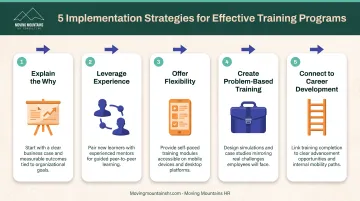
You do not need a full L&D overhaul to put adult learning principles to work. Use these five approaches to design training people finish—and actually apply on the job.
Design Training That Explains the "Why"
Start every course with the business case. Explain real consequences and benefits, and connect training to employee goals.
- Open with a compelling statistic or case study that demonstrates the problem
- State what employees will be able to do differently after training
- Show how the skills support career advancement or make daily work easier
- Preview the session structure so learners know what to expect
Leverage Employee Experience and Expertise
Draw on the expertise already inside your organization through peer learning and mentorship.
- Let experienced employees teach new hires or share specialized skills
- Use real company examples and have teams analyze and solve them together
- Pair less-experienced employees with seasoned colleagues for ongoing guidance
- Build internal wikis or forums where people document processes and best practices
Google's g2g program saw facilitator participation double in six months after simplifying entry and adding program-specific requirements—evidence that lower barriers boost employee-led learning.
Offer Flexible, Self-Directed Learning Options
Give employees control over when, where, and how they learn.
- Curate microlearning modules employees can finish in 10–15 minutes
- Make training available on smartphones and tablets for remote or field workers
- Let employees move through self-paced modules at their own speed
- Offer optional advanced tracks for people who want to go deeper
ATD's 2024 survey of 519 working Americans found that 54% preferred one of the flexible formats studied, while only one-third preferred traditional live classroom training.
Create Problem-Based, Practical Training
Design learning around real challenges employees face, not abstract theory.
- Present realistic workplace problems and let employees practice solutions
- Have employees role-play difficult conversations or customer interactions
- Tie training to current work projects so learning and application happen together
- Use actual company situations (anonymized if needed) as interactive case studies
PwC's 2020 VR leadership study found that immersive scenario rehearsals completed training three times faster than classroom sessions after setup, with participants reporting up to 275% greater confidence and four times more focus than e-learners.
Connect Training to Career Development
Link learning to professional growth so employees see a clear payoff.
- Map which courses or certifications lead to specific roles or promotions
- Offer recognized credentials employees can add to their résumés
- Build promotion-readiness tracks for high-potential employees
- Create individual development plans tied to each person’s career goals
Research published in 2020 found that internal hires and high performers were less likely to quit, with high-performing internal hires especially unlikely to leave—supporting the value of visible internal mobility and development.
How Moving Mountains HR Can Help
Moving Mountains HR designs Training & Development Programs that use adult learning principles and tie directly to your business goals. We customize leadership, compliance, and workplace-risk training for your industry, workforce, and culture—delivered virtually or in person through workshops, coaching, or learning resources.
Programs emphasize practical tools and real-world scenarios employees can apply right away. Contact us to discuss stronger training outcomes for your team.
Frequently Asked Questions
What are the principles of adult learning?
Malcolm Knowles identified six principles of adult learning. Adults need to know why they're learning, prefer self-direction, bring prior experience, learn when the need is real, focus on problems over subjects, and respond best to internal motivators like growth and self-esteem.
How is adult learning different from traditional learning?
Adult learning (andragogy) centers on autonomy, relevance, and experience. Traditional teaching (pedagogy) is teacher-directed and subject-based. Adults learn best when they control the pace, know the purpose, and apply knowledge to real problems.
What are the biggest challenges in training adult employees?
Time constraints, resistance to change, and balancing diverse learning needs across varying digital skill levels are the most common barriers. Flexible delivery, clear relevance, and psychological safety help overcome these challenges.
Why should HR professionals understand adult learning theory?
It leads to more effective training design, better employee engagement, improved retention of knowledge, and stronger ROI. Programs built on adult learning principles produce measurable improvements in on-the-job application.
What are some examples of adult learning principles in action?
Common examples include microlearning modules staff open when needed, scenario-based compliance training that mirrors real situations, peer mentoring that taps employee expertise, and leadership tracks tied to clear promotion paths.
How can small businesses implement adult learning principles with limited resources?
Start with peer learning: employees teaching each other costs nothing. Add free or low-cost microlearning tools and problem-solving workshops built on real company challenges. When you need structure, an HR consultant can design tailored training without a large budget.