
Introduction
Many growing businesses face a familiar dilemma: they need senior HR leadership to build compliant systems, navigate complex regulations, and support a scaling team. They still can't justify the $200,000-plus annual cost of a full-time Chief Human Resources Officer.
The result? HR strategy gets deprioritized, compliance gaps widen, and people issues escalate until they demand costly attention.
A fractional CHRO offers a practical alternative. This model puts executive-level HR expertise on your leadership team part-time, with flexible scope. You get strategy and compliance oversight, plus help building the people systems that support growth, without a permanent C-suite hire.
Below, we break down what a fractional CHRO does, who benefits most, and how to tell if the model fits your business.
Key Takeaways
- Get part-time, executive-level HR leadership without full-time salary and benefits costs
- They join your leadership team and drive ongoing strategy—not one-off consulting projects
- Fit best for companies with 20–100 employees, major transitions, or complex compliance needs
- Typical engagements run 1–3 days per week for 6–18 months; some continue ongoing
What Is a Fractional CHRO?
Many growing companies need senior HR leadership but cannot justify a full-time executive salary. A fractional CHRO is a part-time or contract-based Chief Human Resources Officer who fills that gap with flexible, senior-level guidance.
According to the Society for Human Resource Management (SHRM), fractional leaders are accomplished executives who serve part time on a contractual or project basis. They step in to address defined issues, lead change, or pursue specific goals.
How Fractional CHROs Differ From HR Consultants
The difference comes down to integration and accountability. Harvard Business Review emphasizes that fractional leaders should sit on the leadership team, join key meetings, and hold ongoing executive accountability.
HR consultants typically finish a project and step away. Fractional CHROs embed into your operations, attend executive meetings, and give continuous strategic guidance.
Typical Engagement Models
Fractional CHRO arrangements take several forms:
- Retainer-based: A set number of days per week or month (e.g., every Tuesday and Wednesday)
- Project-based: Focused engagement with defined deliverables and timeline
- Hourly: Flexible hours scheduled as needed for meetings and strategic work
Most engagements involve 1-3 days per week (8-24 hours), though arrangements scale based on business needs and can increase during critical periods.
Core Responsibilities
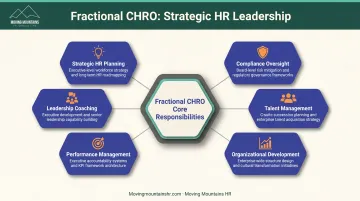
According to Deloitte's research on CHRO roles, modern CHROs have evolved beyond employment and compliance. In 2024 CHRO job postings, business management appeared in 64%, business operations in 54%, and business strategy in 49%. A fractional CHRO typically handles:
- Strategic HR planning aligned with business objectives
- Compliance oversight and regulatory gap analysis
- Talent management and workforce planning
- Organizational development and culture building
- Performance management frameworks
- Leadership coaching and development
Fractional CHROs work at the strategic level, not the operational one. They complement existing HR managers or coordinators with executive guidance while day-to-day tasks stay with operational staff.
For companies with no HR function yet, a fractional CHRO can build the foundation first: policies, systems, and frameworks, before you hire operational staff.
Benefits of Hiring a Fractional CHRO
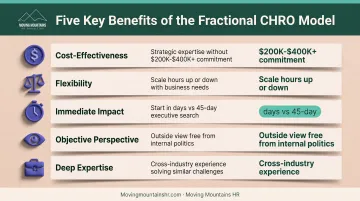
Hiring a fractional CHRO gives growing companies senior HR leadership without a full-time executive seat. The gains show up in cost, timing, judgment, and depth of experience.
Cost-Effectiveness
Salary.com reports that the average U.S. CHRO salary in 2026 is $349,918, with a typical range of $316,632 to $380,502. Those figures are base pay only; benefits, bonuses, and equity push total annual cost much higher.
A fractional CHRO at roughly two days per week covers the strategic work at a much lower outlay, with no benefits package or long-term employment commitment.
Flexibility and Scalability
You can match HR leadership hours to what the business actually needs:
- Ramp up during growth, M&A, or major compliance projects
- Scale back in stable periods when strategy work is lighter
- Avoid a permanent hire you only need part of the year
That keeps expertise available without locking you into full-time overhead.
Immediate Impact
SHRM's 2026 benchmarking data shows a median time-to-fill of 45 days for executive roles. A fractional CHRO can often start within days, with little onboarding.
They arrive having already handled similar problems in other companies, so they can put working approaches in place quickly instead of building everything from scratch.
Objective Outside Perspective
Fractional CHROs assess HR practices without sitting inside company politics. They can raise hard gaps with leadership and push for changes that an internal leader might hesitate to own.
Work across multiple organizations also gives them pattern recognition an in-house team may not have yet.
Deep, Specialized Expertise
You get operators who have already worked through tough situations: complex compliance environments, rapid scaling, and organizational restructuring, often across more than one industry. That range raises the odds they've seen a version of your problem and know what fixed it.
Fractional CHRO vs. Full-Time CHRO: Key Differences
Both roles lead people strategy. The differences show up in hours, cost, and how much day-to-day HR they own.
Time Commitment and Cost Structure
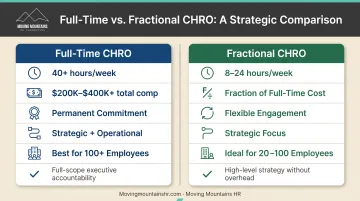
Full-time CHRO:
- Works 40+ hours per week
- Total compensation of $200,000–$400,000+ annually (salary, benefits, bonus, equity)
- Permanent headcount commitment
- Handles both strategic and operational HR
Fractional CHRO:
- Works 1–3 days per week (8–24 hours)
- Monthly retainer or hourly rate—typically a fraction of full-time total cost
- Flexible engagement that can be adjusted or ended
- Focuses on strategic HR, not daily ticket-taking
Focus Areas
Full-time CHRO:
- Splits time between strategy and daily operations
- Joins executive meetings and still handles employee issues
- Owns the full HR stack end to end
Fractional CHRO:
- Stays on strategy: systems, compliance gaps, leadership development
- Builds frameworks internal staff or an HR generalist can run
- Leaves routine employee relations to operators on the ground
When Each Makes Sense
Full-time CHRO is appropriate for:
- Companies with 100+ employees
- Organizations with complex, ongoing HR needs requiring daily attention
- Businesses with budget for a permanent executive-level hire
Fractional CHRO is ideal for:
- Growing companies (20–100 employees) building HR infrastructure
- Organizations with specific projects or defined timelines
- Businesses navigating transitions (M&A, restructuring, leadership changes)
- Companies establishing HR foundations before a full-time hire
When Should Your Business Consider a Fractional CHRO?
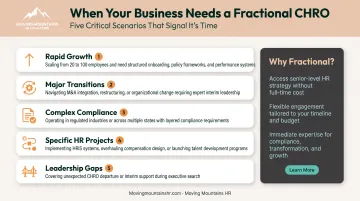
Rapid Growth Phase (20-100 Employees)
Your company is scaling quickly and needs to establish HR infrastructure (policies, performance frameworks, compensation structures)but isn't ready for a full-time executive. A fractional CHRO can build these foundations while you grow into a permanent hire.
Major Organizational Transitions
You're navigating significant change:
- Mergers and acquisitions requiring cultural integration
- Leadership transitions or succession planning
- Restructuring initiatives
- Preparing for outside investment or acquisition
These periods demand executive HR expertise but may not justify permanent headcount.
Complex Compliance Requirements
Your industry or location creates regulatory complexity that requires expert guidance. California employment law, for example, imposes training requirements at 5+ employees, pay transparency rules at 15+ employees, and WARN obligations at 75+ employees.
Healthcare and other regulated workplaces add further rules, including OSHA bloodborne pathogen standards that demand exposure-control plans and annual training. A fractional CHRO helps you interpret these thresholds and build compliant programs before gaps become liabilities.
Specific HR Projects With Defined Timelines
You need executive-level oversight for:
- Implementing a new HRIS system
- Designing compensation structures
- Developing leadership training programs
- Conducting culture assessments
- Building performance management frameworks
Unexpected Leadership Gaps
Your HR leader departed unexpectedly, and you need immediate strategic coverage while conducting a permanent search. A fractional CHRO can maintain momentum and prevent critical initiatives from stalling.
Ready for Fractional CHRO Support
Moving Mountains HR provides fractional CHRO support for small and mid-sized businesses, with strong focus on California employment law. Through its Active & Passive Support package, you get strategic HR leadership, participation in company HR meetings, and on-demand email or phone guidance without committing to a full-time executive hire.
How Much Does a Fractional CHRO Cost?
There is no single standard rate for fractional CHRO services in the U.S. Fees are almost always custom-quoted and shift with a few core variables:
- Experience level: Senior CHROs with proven track records command higher rates
- Geographic location: Regional cost of living and local market demand shape pricing
- Scope of engagement: Complexity, deliverables, and hours per week drive the total
- Industry specialization: Healthcare, financial services, and other regulated fields often cost more
- Engagement model: Retainers, project work, and hourly consulting price differently
Full-time CHRO pay is still a useful benchmark when you weigh fractional cost against a permanent hire.
Cost Comparison Framework
Salary.com data shows average CHRO salaries by company size:
| Company Size | Average CHRO Salary (2026) |
|---|---|
| 1-50 employees | $330,991 |
| 51-500 employees | $350,075 |
| 501-5,000 employees | $377,953 |
| 5,000+ employees | $391,380 |
These figures are base salary only. They exclude benefits, bonuses, and equity, which push total compensation higher.
A fractional CHRO at roughly two days per week can deliver senior strategic leadership without full-time executive overhead, a benefits package, or a long-term employment commitment. Most firms quote retainers or project fees against that scope rather than a published menu rate.
How to Work with a Fractional CHRO
Getting strong results from a fractional CHRO depends on how you set up the relationship. Clear scope, real leadership access, and a short priority list keep limited hours productive.
Establish Clear Scope and Expectations Upfront
SHRM recommends defining deliverables, reporting structure, check-ins, and decision rights at the outset. Document in writing:
- Specific goals and success metrics
- Time commitment (days per week, meeting attendance)
- Communication frequency and channels
- Decision-making authority
- Timeline and milestones
Integrate Them Into Your Leadership Team
Harvard Business Review stresses treating fractional leaders as part of the leadership team. That includes:
- Including them in executive meetings and strategic discussions
- Granting access to key stakeholders, data, and systems
- Treating them as strategic partners, not external vendors
- Holding at least weekly CEO accountability sessions
Make the Most of Their Limited Time
Protect their capacity for work only they can do:
- Focus them on high-impact strategic work, not tasks your staff can own
- Decide promptly so delays don’t burn through their hours
- Let them direct operational staff instead of executing every detail
- Limit the agenda to 2–3 priorities so attention stays concentrated
Frequently Asked Questions
What is fractional HR?
Fractional HR is part-time, senior-level HR leadership on a flexible schedule—often a few days per week or month. A fractional CHRO is the executive-level version of that model: embedded with your leadership team for ongoing strategy, not a one-off project.
What is the typical CHRO salary?
Full-time CHROs in the U.S. often earn roughly $150,000–$400,000+ per year, depending on company size, industry, and location. A fractional CHRO delivers comparable strategic leadership on a flexible arrangement, without full-time salary and benefits overhead.
What is the difference between a fractional CHRO and an HR consultant?
A fractional CHRO joins your leadership team with ongoing accountability—joining executive meetings and owning HR outcomes over time. An HR consultant usually delivers a defined project (a system rollout, training, or audit) and then exits. One is embedded leadership; the other is outside advice for a scoped engagement.
How many hours does a fractional CHRO work?
Fractional CHROs typically work 1-3 days per week (8-24 hours), though arrangements vary based on business needs. Hours can scale up during critical periods like M&A activity, restructuring, or rapid growth, and reduce during stable periods when strategic needs are lighter.
Do I need a fractional CHRO if I already have an HR manager?
A fractional CHRO can complement existing HR staff by providing senior strategic leadership while your HR manager handles day-to-day operations. The fractional CHRO focuses on high-level planning, compliance oversight, and organizational development while your manager executes operational tasks and manages routine employee matters.
How long does a fractional CHRO engagement typically last?
Engagements typically last 6-18 months for specific initiatives like building HR infrastructure, navigating a transition, or completing major compliance projects. Some relationships continue on an ongoing basis for companies needing continuous strategic HR leadership without justifying a full-time hire.
Conclusion
A fractional CHRO gives growing businesses executive HR expertise without a full-time C-suite hire. That flexibility matters whether you're scaling quickly, tightening compliance, building HR from scratch, or steering through a major transition.
You get seasoned leadership and an outside perspective, plus frameworks that work—without locking up the budget small and mid-size companies need. For teams in the 20–100 employee range, or employers facing heavy rules in healthcare or states like California, fractional CHRO support fills the gap between day-to-day HR and full executive capacity.
Ready to see how fractional CHRO services could fit your organization? Contact Moving Mountains HR at 866-474-3575 or staff@movingmountainshr.com to learn how our executive-level HR support can match your needs and budget.