These aren't just statistics—they're warning signs. Hybrid schedules leave teams disconnected. Cross-generational workforces communicate past each other. Rapid organizational change creates friction and burnout. Team building training has shifted from optional to essential, but not all activities deliver results. This guide explains which approaches work, how to implement them, and how to measure their impact on your organization's performance and culture.
Key Takeaways
- Team building with active practice and debriefing improves teamwork (d = 0.683) and performance (d = 0.919)
- Match activities to team needs (goals, roles, trust, problem-solving), not generic socializing
- Give hybrid teams equal digital participation so remote staff are not left on the sidelines
- Run brief icebreakers weekly, deeper exercises monthly, and full health checks quarterly
- Measure behavior change via handoffs, speaking balance, conflict time, and cross-functional delivery
Why Team Building Training Matters in 2026
The pandemic permanently altered how teams work. Microsoft's collaboration study documented that remote work reduced cross-group connections by about 25%, shrinking networks and reinforcing silos.
Gallup's latest data shows engagement at a decade low: only 20% of workers worldwide feel engaged, costing the global economy an estimated $10 trillion in lost productivity. Those gaps are measurable drains on organizational performance.
Modern teams face three compounding challenges:
- Physical distance that eliminates spontaneous collaboration
- Generational differences in communication preferences
- Relentless organizational change
Gartner's survey of 180 HR leaders found 82% of managers unprepared to lead change, while 77% of employees report change fatigue. Against this backdrop, intentional team building is the infrastructure that keeps distributed, multi-generational teams aligned and productive.
Strategic vs. Superficial Team Building
A meta-analysis of 72 controlled interventions covering 8,439 participants found that structured teamwork training significantly improved both teamwork behavior and team performance. The key distinction: workshops, simulations, and team reviews drove results, while lecture-only training did not.
What worked was active practice, immediate feedback, and facilitated debriefing that connects the activity to real work challenges.
Superficial "fun" activities such as trivia games, pizza parties, and generic icebreakers create momentary goodwill but rarely change workplace behavior. Strategic team building targets diagnosed needs:
- Goal-setting exercises when priorities are unclear
- Role-clarification activities when handoffs fail or authority overlaps
- Trust-building practices when conflict or disconnection undermines collaboration
- Problem-solving simulations when teams struggle to coordinate under pressure
Psychological Safety as Foundation
Google's Project Aristotle studied 180 teams and identified psychological safety (the shared belief that the team is safe for interpersonal risk-taking) as a foundational element of effectiveness. Teams with stronger psychological safety showed lower turnover risk, greater use of diverse ideas, higher revenue, and better executive ratings.
A 2022 Norwegian study of 1,150 leaders in 160 management teams found psychological safety significantly connected to task performance through behavioral integration.
Psychological safety doesn't emerge from forced vulnerability or physical trust falls. It grows when leaders model candor, teams practice structured listening, mistakes are treated as learning opportunities, and participation is voluntary. Strategic team building creates these conditions through carefully designed exercises that balance challenge with choice.
Types of Team Building Training Activities
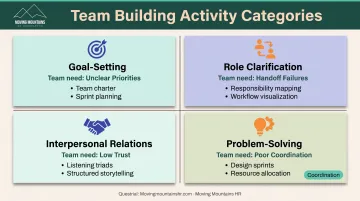
Team building activities fall into four evidence-based categories, each addressing distinct organizational needs:
| Category | Team Need | Example Activities |
|---|---|---|
| Goal-Setting | Unclear priorities or success criteria | Team charter creation, shared-outcome workshops, sprint planning |
| Role Clarification | Handoff failures, authority confusion | Responsibility mapping, cross-functional scenarios, workflow visualization |
| Interpersonal Relations | Low trust, conflict, weak support | Listening triads, structured storytelling, communication practice |
| Problem-Solving | Poor coordination under constraints | Design sprints, resource allocation, escape-room debriefs |
How you deliver the activity matters as much as which category you choose. In-person, remote, and hybrid formats each change participation, trust-building, and facilitator control.
In-Person Team Activities
In-person settings make body language, turn-taking, and immediate feedback easy to observe. Activities like Back-to-Back Drawing, listening triads, and facilitated simulations work best when physical presence lets you watch communication patterns up close.
Shared physical experience builds trust. Facilitators can also spot nonverbal cues that signal discomfort or disengagement.
In-person advantages include spontaneous side conversations that deepen relationships, easier reading of group energy, and faster pivoting when an activity isn't landing. The trade-off: scheduling complexity and exclusion of remote team members unless hybrid-specific design is used.
Remote Team Activities
Virtual teams need activities that counter isolation and create equitable participation. Use video breakout rooms, anonymous voting tools, shared digital whiteboards, and structured templates. Atlassian's remote Team Health Monitor recommends independent voting so quieter voices are heard and groupthink drops.
Effective remote formats:
- Virtual scavenger hunts with work-safe prompts
- Anonymous issue-clustering on a shared board
- One-on-one video speed networking with structured prompts
- Retrospectives using digital sticky notes and voting
- Listening triads in breakout rooms with timed rotations
The key constraint: screen fatigue. Keep remote activities to 10-20 minutes or break longer sessions into multiple short segments with clear start/stop times.
Hybrid Team Activities
Hybrid teams face the highest risk of creating two-tier participation—engaged in-room employees and passive remote observers. Bridge the divide by putting every participant into the same digital workspace, regardless of physical location. Use equal turn-taking, breakout rooms that mix remote and in-office staff, and simultaneous documentation on shared screens.
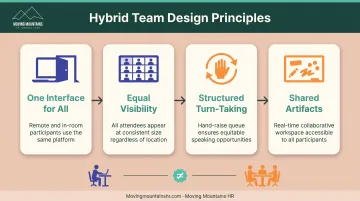
Hybrid design principles:
- One interface for all (if three people are remote, everyone uses the video platform)
- Equal visibility (remote participants appear on-screen at the same size as in-room colleagues)
- Structured turn-taking (call on remote participants first to prevent in-room dominance)
- Shared artifacts (documents, whiteboards, and action plans visible to all)
Industry-Specific Considerations
Match the activity type to how the team works day to day:
- Customer-facing teams: empathy and communication exercises that mirror client interactions
- Technical teams: problem-solving simulations with real constraints
- Leadership groups: trust-building and candid retrospectives
- Cross-functional project teams: role clarification and handoff practice
Healthcare teams may use TeamSTEPPS, an evidence-based system for improving communication and teamwork. Product teams can adapt Google Ventures' (GV) Design Sprint, a five-day structured process for mapping problems, generating solutions, building prototypes, and testing with users. Tailor the activity's complexity, disclosure level, and business context to match your team's maturity and daily work.
Essential Team Building Activities for Every Organization
The right activity depends on what your team needs most right now: faster trust, clearer communication, or sharper problem-solving. Use the options below by goal and timebox, then adapt group size and debrief focus to match your workplace.
Quick Icebreakers (5-10 Minutes)
Two Truths and a Lie Each person prepares two true statements and one false statement about themselves. The group guesses which is the lie. Keep topics work-safe and allow participants to pass if uncomfortable.
One-Word Check-In Ask each person to describe their current state, the team's biggest challenge, or their week "in one word," then optionally invite brief explanation. This surfaces mood and priorities quickly without requiring long stories.
Speed Networking Pair participants for short (3-5 minute), repeated conversations using work-relevant prompts: "What's one process that frustrates you?" or "What's a skill you want to develop?" Rotate pairs three to four times.
Trust-Building Exercises (15-30 Minutes)
Personal Stories Circle Offer a bounded prompt such as "a time you took a professional risk" or "a work failure you learned from," and invite voluntary stories. Establish that listening without judgment is the only response; no probing follow-up questions. This builds interpersonal knowledge without forced vulnerability.
Listening Triads Assign three roles and rotate so each person experiences every position:
- Speaker: Shares a work challenge for 3-4 minutes
- Listener: Paraphrases and asks clarifying questions
- Observer: Tracks paraphrasing, interruptions, and nonverbal attention
Problem-Solving Challenges (30-60 Minutes)
Design Sprint Challenge Adapt the Google Ventures five-day Design Sprint into a shortened workshop:
- Define the problem and target
- Sketch solutions individually
- Select and storyboard as a group
- Build a rough prototype and gather feedback
Use a real work challenge (a process bottleneck, customer pain point, or team conflict) so the exercise stays relevant.
Resource Allocation Exercise Give teams a fixed budget, timeline, and people constraint. Require a documented allocation across competing priorities. Teams present their rationale, then debrief trade-offs, decision-making processes, and how they resolved disagreement.
Communication Activities (15-30 Minutes)
Back-to-Back Drawing Pairs sit or connect without seeing the same image. One person describes a simple diagram while the other draws based only on verbal instructions. After 15 minutes, compare the original and the drawing, then discuss what communication worked and what caused confusion. Materials: paper, pens, and printed images.
Telephone Chain with a Twist Pass a brief work instruction through a chain of four to five people without writing it down. Compare the final message to the original, then repeat the exercise allowing clarification questions. Debrief which clarification strategies worked best.
Virtual Team Builders (10-20 Minutes)
Virtual Scavenger Hunt Provide a short list of work-safe items—"something you learned this month," "a tool that saves you time," "a photo from your first job." Small teams locate or photograph items and explain their choices. Debrief coordination and time management.
Online Collaboration Board Use a shared digital whiteboard with a template for silent voting, clustering issues, brainstorming solutions, and assigning owners and dates. Atlassian's Team Health Monitor provides a 90-minute, eight-trait example adaptable to most teams.
Remote Retrospective Use digital sticky notes to answer "What went well?" "What didn't?" and "What will we change?" Participants write independently, then the group clusters similar themes, votes on priorities, and assigns one action owner.
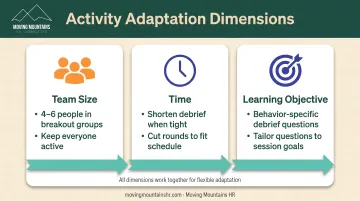
Activity Adaptation Note: Tailor any exercise along three dimensions:
- Team size: Scale breakout groups to 4-6 people so everyone stays active
- Time: Shorten the debrief or cut rounds when the clock is tight
- Learning objective: Aim debrief questions at the specific behavior you want to reinforce
How to Implement Effective Team Building Training
Diagnose Before You Design
Don't choose activities based on what sounds fun. Diagnose the observable problem first:
- Conduct anonymous pulse surveys asking what blocks collaboration
- Observe meetings for speaking balance, interruptions, and clarification questions
- Review handoff failures, rework cycles, or conflict-resolution time
- Ask team members what they need, not what activity they want
Map the problem to one of the four intervention categories (goal-setting, role clarification, trust-building, or problem-solving), then select an activity that directly rehearses the needed behavior.
Create a Team Building Calendar
Integrate team development into existing rhythms rather than treating it as a special event:
- Weekly or bi-weekly: 5-10 minute icebreakers at the start of team meetings
- Monthly: 15-30 minute communication or trust exercises during longer team sessions
- Quarterly: 60-90 minute team health reviews or problem-solving workshops
- Annually: Half-day or full-day strategic planning with role clarification and goal-setting
Atlassian specifically recommends quarterly Team Health Monitors to track attributes such as trust, collaboration, decision-making, and communication, with action commitments reviewed at the next session.
Debrief Every Activity
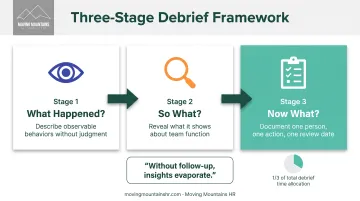
The activity itself is practice; the debrief creates learning. Reserve at least one-third of your total time for reflection. Use the What? So what? Now what? framework:
- What happened? Describe observable behaviors without judgment
- So what? What does it reveal about how the team works?
- Now what? What one behavior will we change, who owns it, and when will we review?
End every debrief with a documented commitment: one person, one action, one review date. Without follow-up, insights evaporate.
Secure Leadership Buy-In
Frame the business case around measurable costs. Calculate the ROI using organization-specific variables:
Example ROI Calculation:
- Retention: 2 fewer avoidable exits at $50,000 replacement cost each = $100,000 annual benefit
- Productivity: weekly hours saved per person × loaded labor cost (salary + benefits ÷ 2,080)
- Conflict: manager hours saved on resolution each quarter × manager loaded cost
- Program cost: facilitator fees + participant time + materials + platform subscriptions
- Net ROI (%) = (Total Benefits − Total Costs) × 100 ÷ Total Costs
Present both quantitative metrics (retention rates, cycle times, error reduction) and qualitative indicators (trust, psychological safety, cross-functional relationships) that can't be cleanly monetized.
Best Practices for Successful Team Building Programs
Do's and Don'ts
Do:
- Match activity complexity to team maturity: simple icebreakers for new teams, deeper trust work for established ones
- Establish safety rules upfront: voluntary participation, confidentiality, no personal attacks, permission to pass
- Offer equivalent participation options for different comfort levels (share a work story instead of a personal one)
- Debrief immediately while observations are fresh
- Assign follow-up owners and review commitments at the next meeting
Don't:
- Force personal disclosure or surprise participants with physical contact
- Choose activities that disadvantage remote employees (physical games, location-based scavenger hunts)
- Skip the debrief because you "ran out of time"
- Confuse enjoyment with effectiveness—laughter is nice, but behavior change is the goal
- Use one-size-fits-all activities without diagnosing what the team actually needs
Measure Team Building Effectiveness
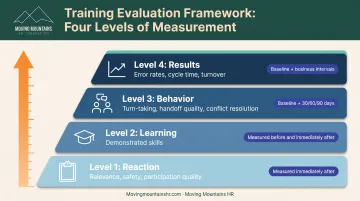
Use a multi-level measurement framework:
| Level | Metric | Timing |
|---|---|---|
| Reaction | Relevance, safety, participation quality | Immediately after |
| Learning | Demonstrated skill in listening, feedback, role clarity | Before and immediately after |
| Behavior | Turn-taking, clarification questions, handoff quality, conflict resolution | Baseline plus 30/60/90-day follow-up |
| Results | Error rates, cycle time, cross-functional delivery, turnover | Baseline and agreed business interval |
AHRQ provides a 35-item teamwork-perception survey and a Team Performance Observation Tool for structured behavior tracking. Use both self-report and observed behavior; participation rates and enjoyment scores alone don't prove effectiveness.
Sustaining Team Building Culture
HR and leadership share responsibility for building team development into everyday operations:
HR role:
- Define psychological-safety safeguards and facilitator standards
- Provide measurement templates and follow-up processes
- Allocate regular budget and protect time on calendars
- Integrate collaboration behaviors into performance frameworks (not event attendance)
Leadership role:
- Model vulnerability and active participation without dominating
- Reinforce practiced behaviors in daily work ("Let's use clarification questions like we practiced")
- Review action commitments publicly and celebrate behavior changes
- Normalize learning from failure rather than punishing mistakes
When you want help turning these practices into a repeatable program, Moving Mountains HR works with small and mid-size businesses on training that ties directly to workplace challenges such as leadership, communication, conflict resolution, and performance management.
Each program is tailored to your industry, culture, and goals, with tools teams can use right away. Delivery is virtual or in person through workshops, leadership series, or coaching that fits your schedule and budget.
Frequently Asked Questions
What are the key principles of effective team building training for employees?
Effective team building starts by diagnosing a real need (unclear goals, role confusion, low trust, or poor coordination), then choosing activities that rehearse the missing behavior. Prioritize active practice, voluntary participation, psychological safety, work-tied debriefs, and follow-up. Fold brief exercises into regular meetings and run deeper sessions quarterly instead of one-off events.
What are some examples of team building training activities?
Quick: Two Truths and a Lie, One-Word Check-In, Speed Networking. Trust: Personal Stories Circle, Listening Triads. Problem-solving: Design Sprint Challenge, Resource Allocation Exercise. Communication: Back-to-Back Drawing, Telephone Chain. Virtual: Online retrospective, shared-board issue clustering, virtual scavenger hunt.
How often should organizations conduct team building activities?
Use 5–10 minute icebreakers weekly or bi-weekly at the start of meetings. Add 15–30 minute trust or communication exercises monthly, and run 60–90 minute team health or problem-solving workshops quarterly. Build goal-setting and role clarification into annual planning.
What are the most common mistakes organizations make with team building?
Common mistakes include treating team building as a one-off event, skipping needs diagnosis, forcing disclosure that undermines psychological safety, and cutting the debrief. Other pitfalls: activities that sideline remote staff, a mismatch with team maturity, and measuring fun instead of behavior change.
How do you measure the ROI of team building training?
Track retention, productivity (hours saved × loaded labor cost), conflict time, error rates, and cycle time against pre-training baselines, plus 30/60/90-day follow-up. Pair with qualitative signs such as psychological safety and stronger cross-functional collaboration. ROI = (Monetary Benefits − Program Costs) × 100 ÷ Program Costs.
What team building activities work best for small businesses with limited budgets?
Strong low-cost options include One-Word Check-In, Listening Triads, Back-to-Back Drawing, work-safe Two Truths and a Lie, free digital retrospectives, and simple spreadsheet team health checks. You only need paper, markers, a timer, and existing video tools. Facilitation quality and consistent practice matter more than budget or venue.