
Yet many companies run leadership training without ever defining what success looks like. Sessions get scheduled, certificates get handed out, and six months later, nothing has actually changed in how leaders manage their teams. The budget gets spent. The behavior doesn't.
This article breaks down the core objectives every leadership training program should target, how to measure whether they're working, and how to adjust them for your organization's size, industry, and stage of growth.
Key Takeaways
- Effective leadership training objectives connect directly to retention, engagement, and decision quality, not just skill acquisition
- Strong programs pair foundational skills like communication and emotional intelligence with strategic capabilities like change management
- Right-fit objectives change with company size, industry, and a leader’s career stage
- Treating training as a one-time event—not an ongoing process—is the fastest way to waste the investment
What Are Leadership Training Objectives and Why Do They Matter?
Leadership training objectives aren't the same as leadership training topics. A topic might be "conflict resolution." The objective is the measurable change you want to see afterward, such as fewer escalated HR complaints or faster resolution times when disputes come up.
Setting real objectives starts with identifying the gap between where your leaders are and where your business needs them to be. That gap looks different depending on your situation:
- A fast-growing startup might need managers who can delegate and decide without constant approval
- An established, compliance-heavy organization might need leaders who document consistently and apply policy fairly
- A healthcare organization might need both, plus a sharper focus on patient safety culture
Leave that gap undefined, and you can't prove the training worked. When budget season comes around, you have nothing concrete to show. Clear objectives create the accountability that turns training from a cost center into something you can defend to a CFO.
Core Objectives of an Effective Leadership Training Program
Think of these objectives as layered, not standalone. Foundational skills like communication and self-awareness create the base that strategic capabilities like decision-making and change management are built on. Skip the foundation, and the advanced stuff tends to fall apart under pressure.
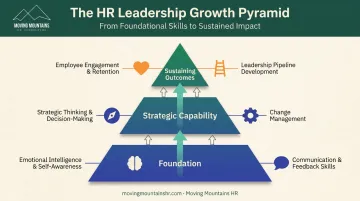
Build Emotional Intelligence and Self-Awareness
This objective focuses on helping leaders recognize their own emotional triggers and read what their team members actually need, not just what they say they need.
The business case is well documented. A meta-analysis published in the Journal of World Business found leader emotional intelligence had a corrected effect size of .48 on subordinate task performance, a relationship that held up even after controlling for personality and cognitive ability (Miao, Humphrey & Qian, 2018). Translation: emotionally intelligent leaders get measurably better work out of their teams.
Outcome to expect: fewer workplace conflicts, stronger trust between leaders and direct reports, and fewer situations that escalate into formal complaints.
Strengthen Communication and Feedback Skills
Leaders need to set clear expectations, listen without immediately jumping to a response, and deliver feedback that people can actually act on. This sounds basic, but it's where most leadership training gaps show up first.
When communication breaks down, teams work off assumptions instead of instructions. That leads to:
- Rework because tasks weren't scoped clearly the first time
- Slower project execution as people wait for clarification
- Feedback that either never happens or lands as criticism instead of coaching
The objective here is straightforward: leaders who communicate well create teams that move faster with fewer misunderstandings.
Enhance Strategic Thinking and Decision-Making
Once leaders can communicate clearly, the next gap is judgment. New and mid-level managers are often promoted because they were great individual contributors, not because they've had to weigh trade-offs under uncertainty. Strategic thinking training closes that gap.
This objective trains leaders to connect their daily decisions to bigger company goals, and to make sound calls even when they don't have complete information. The payoff shows up during growth spurts, market shifts, or budget crunches, exactly the moments when bad decisions cost the most.
Develop Change Management Capability
Strategic decisions rarely stay on a spreadsheet—they show up as real change for teams. Restructuring, new software rollouts, leadership transitions, mergers. Every organization hits change eventually, and how leaders handle it determines whether teams adapt smoothly or dig in and resist.
This objective prepares leaders to:
- Communicate the "why" behind a change, not just the "what"
- Address concerns from the team before they turn into rumors
- Keep productivity from cratering during the transition period
Organizations that build this capability into their leadership bench adapt faster and lose less momentum during disruption.
Improve Employee Engagement and Retention
Leaders who know how to motivate, coach, and genuinely support their teams keep people longer. That matters more than most business owners realize once you look at the actual cost of turnover.
Gallup estimates that replacing an employee costs roughly 200% of salary for leadership and manager roles, 80% for technical professionals, and 40% for frontline employees (Gallup). A single manager who leaves because they never got support in the role can quietly cost a business twice their annual pay to replace.
That is why organizations working with Moving Mountains HR often fold leadership training into a broader retention strategy instead of treating it as a standalone initiative. Training leaders to coach and support their teams is not a soft benefit—it is a direct hedge against one of the biggest hidden costs in any business.
Build a Sustainable Leadership Pipeline
The final objective looks beyond current leaders to future ones. Mentoring programs and succession planning identify who's ready to step up before you're scrambling to fill a vacancy.
Organizations without this objective get caught flat-footed when a key leader leaves. Organizations with it have someone ready to step in, already coached and already familiar with the role's expectations.
How to Measure the Success of Leadership Training Objectives
Objectives without measurement are just good intentions. You need before-and-after data to know whether anything actually changed.
Start with a baseline. Before training begins, capture current numbers: engagement scores, turnover rate, 360-degree feedback results, or the metric tied to your objective. Measure the same thing again 3-6 months after training wraps up.
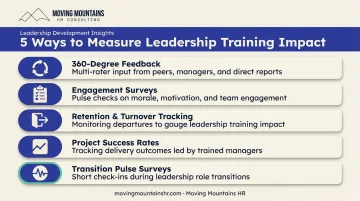
Specific measurement methods worth using:
- 360-degree feedback — shows how peers, direct reports, and supervisors rate behavior change over time
- Employee engagement surveys — track whether teams feel more supported and heard
- Retention and turnover tracking — the clearest financial signal that leadership improved
- Project success rates and adaptation timelines — useful for decision-making and change-management goals
- Pulse surveys during transitions — short check-ins during a restructure or rollout to catch resistance early
A widely used framework for structuring this evaluation is the Kirkpatrick Model, which assesses training across four levels: reaction, learning, behavior change, and business results. Most organizations stop at level one (did people like the training?) and never reach level four (did it move business results?). Push evaluation all the way through.
The evidence for well-designed leadership training holds up at scale. A 2017 meta-analysis in the Journal of Applied Psychology, covering 335 studies and over 26,000 participants, found leadership training produced meaningful gains in on-the-job behavior and organizational outcomes (Lacerenza et al., 2017).
Consistent measurement gives you proof for the next budget conversation—not a hunch. For small and mid-size teams, that clarity is what separates training you renew from training you quietly drop.
Common Mistakes That Undermine Leadership Training Objectives
Even well-intentioned programs fail when they fall into a few predictable traps.
Treating training as a one-time event. A single workshop rarely changes behavior long-term. Leaders need reinforcement, coaching, and follow-up over months, not a single afternoon session that gets forgotten by Friday.
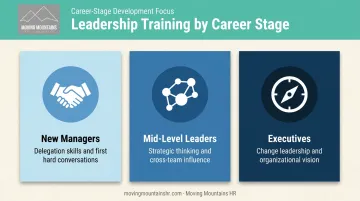
Using identical objectives across every leadership level. A brand-new supervisor and a VP face completely different challenges. Training that treats them the same wastes time at every level:
- New managers need help with delegation and having their first hard conversations.
- Mid-level leaders need strategic thinking and cross-team influence.
- Executives need change leadership and organizational vision.
Over-relying on theory. Leaders don't build skills by hearing about them. Role-play, real scenarios pulled from your actual workplace, and on-the-job application are what make training stick. A program that's all slides and no practice rarely changes how anyone leads on a Tuesday afternoon.
Aligning Leadership Training Objectives With Your Organization's Needs
Objectives should never be copy-pasted from a template. What "effective leadership" looks like depends heavily on where your company stands.
Company size and stage matter. Needs shift as you grow:
- Small businesses with a handful of supervisors usually need foundational skills first: delegation, basic feedback, and conflict resolution
- Mid-size firms that have already covered the basics typically need strategic leadership development and succession planning
Regulated industries need an extra layer. Healthcare organizations face heightened scrutiny around people management. Leadership objectives should reinforce compliance awareness and risk mitigation alongside standard skills. A documentation gap or mishandled complaint can carry legal weight other industries rarely see.
Most small and mid-size businesses don't have a full-time HR executive to design and oversee this kind of tailored program. That's the gap fractional CHRO support fills.
Moving Mountains HR works with growing organizations to define leadership training objectives, close policy gaps, and align development plans with compliance requirements and business goals, without the overhead of a full-time HR leader.
Frequently Asked Questions
What are the typical objectives of leadership training?
Typical objectives include improving communication, decision-making, emotional intelligence, and change management, along with strengthening employee engagement. Each should tie to a measurable business outcome, not just skill exposure.
What is objective leadership?
Objective leadership means making decisions based on facts, data, and consistent criteria rather than personal bias or subjective "fit." It focuses on fairness and impartiality in how leaders manage and evaluate their teams.
What are the 5 levels of leadership training?
There's no single universal standard, but training is often structured around career stages: emerging leaders, frontline managers, middle managers, high-potential leaders, and executives. Each stage requires different objectives and skill focus.
What are the 7 C's of leadership?
Frameworks vary by source. One common version includes character, courage, commitment, competence, communication, credibility, and collaboration, while other models swap in traits like compassion or curiosity. Treat these as a guide, not a fixed rule.
How often should leadership training objectives be reviewed?
An annual review cycle works well for most organizations. This keeps objectives aligned with changing business priorities, workforce expectations, and any new regulatory requirements that emerge.
Can leadership training really improve employee retention?
Yes. Leaders who communicate clearly and support their teams reduce voluntary turnover. That matters financially—replacing employees, especially managers, is expensive.