The retention crisis isn't just about wages. Research from SHRM reveals that 61% of HR professionals identify insufficient career development and advancement as one of the top three reasons employees leave. Meanwhile, 71% of small firms with 1-499 employees report that retention is somewhat or very difficult.
The good news? Strategic investment in training and development programs can significantly reduce turnover while building a more capable workforce—without breaking the bank.
Key Takeaways
- Companies with strong development cultures retain employees twice as long
- Effective development covers skills training, mentorship, cross-training, and career pathing—not just promotions
- Small businesses can implement cost-effective programs with measurable ROI
- Manager involvement is the single most critical success factor
- Track retention rates, engagement scores, and performance metrics to prove impact
The Direct Link Between Training, Development, and Retention
Why Employees Need Growth Opportunities
Employees have fundamental psychological needs for growth, purpose, and career progression. When these needs go unmet, they start looking elsewhere, even if the pay is competitive.
Development shows employees that the organization values and invests in them. That investment builds commitment a paycheck alone cannot buy. A peer-reviewed study found that training increased retention by up to 14%, rising to 18% when the training was perceived as credible and well-designed.
How Development Hits the Bottom Line
Retention gains show up in hard numbers:
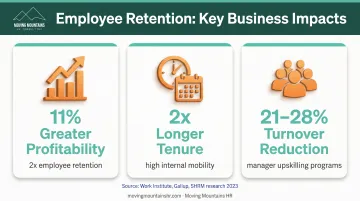
- Organizations making strategic development investments reported 11% greater profitability and were twice as likely to retain employees
- Companies with high internal mobility retained employees for twice as long
- Manager upskilling programs reduced turnover by 21-28% and improved performance outcomes by 20-28%
Addressing the "Training Employees to Leave" Fear
Many small business owners worry that investing in training will just prepare employees for their next job elsewhere. Research shows the opposite: engagement plus development equals retention.
When you develop employees while also fostering engagement through meaningful work, recognition, and clear career paths, you create loyalty. The employees who leave are typically those who receive neither development nor engagement. They take your recruiting and onboarding investment with them.
Benefits of Investing in Employee Development
What Employees Gain
Strong development programs give employees clear, personal returns:
- More confidence in day-to-day decisions and problem-solving
- Higher job satisfaction as they master new skills
- Visible paths to advance inside the organization
- Broader skill sets that make them more versatile
- A stronger sense of purpose tied to professional growth
What Employers Gain
Employers see gains that go well past retention alone:
- Productivity rises as people apply new skills on the job
- Work quality improves with greater competence and confidence
- Teams innovate more when they learn fresh approaches
- Culture strengthens around continuous improvement
- Hiring and delivery both get easier when your people can grow in place
The Succession Planning Advantage
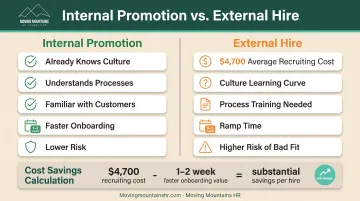
Developing internal talent creates a ready pipeline of future leaders at a fraction of the cost of external recruitment. The average recruiting cost was nearly $4,700 per hire in 2022. That figure still leaves out onboarding time, lost productivity, and the risk of a bad fit.
Internal candidates already know your culture, processes, and customers. They step into leadership faster and with less risk than outside hires.
Creating an Effective Employee Development Program
An effective development program is a system, not a perk list. Build it around how people actually grow, who owns coaching day to day, and how learning ties to business needs.
Define Development Beyond Promotions
Development isn't just about climbing the corporate ladder. Many high performers don't want management responsibilities, but they still want continuous learning and skill enhancement.
Effective development means:
- Understanding individual talents and building on strengths
- Providing opportunities to deepen expertise in current roles
- Expanding skills horizontally across different functions
- Creating pathways for contribution that don't require promotion
Establish a Continuous Learning Culture
Culture starts at the top. Leaders must model commitment to learning and embed development in company values, policies, and daily operations.
Communicate your development commitment through:
- Employee handbooks with clear professional development policies
- All-hands meetings that highlight learning achievements
- One-on-one conversations between managers and team members
- Recognition programs that celebrate skill growth
Secure Leadership Buy-In and Resources
Executive commitment backed by budget allocation is essential. Development belongs with leadership as a business priority, not only with HR.
Building the business case for leadership:
- Calculate current turnover costs using the 50-200% salary replacement benchmark
- Project retention improvements based on industry studies (14-18% gains)
- Quantify productivity increases from upskilled teams
- Show how development strengthens talent attraction in competitive markets
Involve Managers as Development Coaches
Managers play the most critical role in employee development. They identify growth opportunities, provide targeted feedback, and connect employees to learning resources.
Why manager coaching matters: Only 16% of nearly 15,000 employees described their last manager conversation as extremely meaningful. Yet 80% of those who received meaningful feedback in the prior week were fully engaged.
Train your managers to:
- Clarify individual goals during regular conversations
- Identify strengths and build development around them
- Provide specific, actionable feedback
- Create accountability for growth commitments
- Link employees to relevant learning resources
Moving Mountains HR offers customized supervisor development programs delivered virtually or in person to build these coaching skills.
Align Development with Business Goals and Individual Aspirations
Effective development balances what the company needs with what employees want to learn.
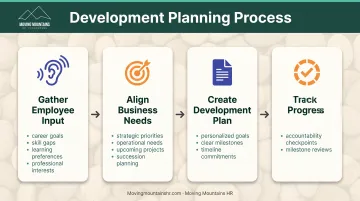
Gather input from employees about:
- Career goals and long-term aspirations
- Current skill gaps they've identified
- Preferred learning formats and styles
- Interests they'd like to explore professionally
Then tie development activities to:
- Organizational objectives and strategic priorities
- Daily operational needs and efficiency improvements
- Upcoming projects that require new capabilities
- Succession planning for critical roles
Create personalized development plans that document both company needs and individual growth aspirations, with clear milestones and accountability.
Design for Accessibility: Short, Frequent, and Varied
Modern employees prefer self-paced, on-demand learning over lengthy formal programs. Microlearning research shows that brief, focused sessions fit better into busy work schedules.
Apply these design principles:
- Keep sessions short: 15-30 minute modules beat half-day workshops
- Make it frequent: Weekly touchpoints sustain momentum better than quarterly events
- Offer variety: Mix online courses, lunch-and-learns, mentorship, and peer learning
- Enable self-direction: Let employees choose their path within defined boundaries
- Integrate with workflow: Schedule learning during work hours, not after
Types of Employee Training and Development Programs
Formal Training Programs
Structured external learning is still one of the clearest paths to specialized skills and certifications.
Options include:
- Online courses through platforms like LinkedIn Learning or Coursera
- In-person workshops for hands-on skill building
- Industry conferences for networking and trend awareness
- Professional certifications that validate expertise
- Customized programs designed for your specific needs
Cost considerations: Organizations averaged $846 direct expenditure and 16.7 formal learning hours per employee in 2025. Small businesses should benchmark by industry and size rather than copying this average.
Moving Mountains HR builds customized training on leadership, communication, performance management, compliance, and respectful workplace practices, shaped around your industry and delivered in the format your team can actually use.
On-the-Job Development
Real work is still one of the best classrooms. Employees stretch their skills while finishing work the business already needs done.
Effective approaches:
- Stretch assignments that push employees slightly beyond current capabilities
- Job rotation to build cross-functional understanding
- Cross-training that creates backup capacity and broadens skills
- Special projects tied to strategic initiatives
- Acting roles that test leadership readiness
These options cost little beyond management time but deliver high impact when well-designed.

Mentorship and Coaching Programs
Mentoring and coaching give employees personalized feedback and practical insights that are hard to get in a classroom. Done well, they also build confidence and shorten the time it takes to get productive in a new skill or role.
Structure formal mentorship by:
- Pairing experienced employees with developing talent
- Setting clear goals and expectations for the relationship
- Providing guidelines and conversation starters
- Scheduling regular check-ins (monthly minimum)
- Measuring outcomes through participant feedback
Manager coaching should:
- Happen in regular one-on-one conversations
- Focus on strengths-based development
- Include specific, actionable feedback
- Create accountability for growth commitments
Peer Learning and Collaboration
Knowledge-sharing among colleagues builds both skills and workplace relationships.
Implement through:
- Lunch-and-learn sessions where employees teach each other
- Communities of practice around specific topics or functions
- Team-based learning through collaborative problem-solving
- Internal newsletters highlighting lessons learned
- Cross-departmental shadowing days
Peer learning costs almost nothing and strengthens both skills and day-to-day working relationships.
Self-Directed Learning
Support employees who pursue independent study by removing barriers and providing resources.
Enable self-directed growth through:
- Learning stipends of $500-$1,000 annually per employee
- Subscription access to online learning platforms
- Dedicated learning time built into work schedules
- Resource libraries with books, podcasts, and webinars
- Recognition for completed certifications and courses
Even light support here sends a clear message: growth is part of the job, not something employees squeeze in after hours.
Overcoming Common Implementation Challenges
"We Don't Have the Budget"
Low-cost options still move the needle:
- Internal knowledge-sharing sessions cost only employee time
- Free online resources (YouTube, industry blogs, webinars) provide quality content
- Lunch-and-learns require minimal expense
- Cross-training uses existing employees as teachers
- Mentorship programs need only structure and commitment
Small businesses can start with a $500–$1,000 annual investment per employee and still reduce turnover risk.
"We Don't Have the Time"
Micro-learning fits development into the week you already have:
- Replace one weekly meeting with a 15-minute learning module
- Schedule learning during slow periods or downtime
- Integrate development into existing processes (project debriefs become learning moments)
- Make it self-paced so employees control timing
- Protect a recurring 30-minute block by linking it to avoided replacement costs
When managers understand that 30 minutes weekly prevents $20,000–$100,000 in replacement costs, they find the time.
"We're Not Sure What to Train On"
Work backward from skills gaps and business objectives:
- Survey employees about perceived skill gaps
- Ask managers what capabilities would improve team performance
- Review strategic goals and identify needed competencies
- Analyze performance review data for common development themes
- Check exit interview feedback for patterns
If those inputs conflict or feel incomplete, an outside review helps. Moving Mountains HR can run an HR strategy assessment to pin down highest-priority development needs tied to retention and business goals.
Measuring the Impact on Retention
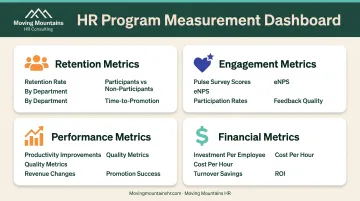
Track these metrics to show how training affects retention, prove ROI, and refine your approach:
Retention metrics:
- Overall retention rate, tracked quarterly
- Retention by department and role
- Retention of development program participants versus non-participants
- Time-to-promotion for different employee segments
Engagement metrics:
- Regular pulse survey scores on development-related questions
- Employee Net Promoter Score (eNPS)
- Participation rates in voluntary development opportunities
- Manager feedback quality ratings
Performance metrics:
- Productivity improvements in trained teams
- Quality metrics before and after skill development
- Revenue or customer satisfaction changes
- Internal promotion success rates
Financial metrics:
- Total development investment per employee
- Cost per training hour delivered
- Turnover cost savings versus investment
- ROI of monetary benefits versus program costs
Numbers alone rarely explain why people stay or leave. Pair the metrics above with direct conversations.
Exit and Stay Interviews
Exit interviews should specifically ask about development and growth opportunities, supervisor relationships, and feedback received. But don't wait until employees leave.
Conduct stay interviews to proactively identify development needs:
- What do you look forward to each day at work?
- What are you learning here?
- What would you like to learn?
- What might tempt you to leave?
- What can we do to keep you engaged?
Research shows that 51% of exiting employees said no manager or leader had discussed their satisfaction or future during the prior three months. Regular conversations prevent surprises.
Frequently Asked Questions
How does training and development affect employee retention?
Training and development meet employees' need for growth and show the organization is investing in them. Clear career paths raise commitment and can cut voluntary turnover, with studies showing 14-18% retention gains from well-designed programs.
What are the 5 C's of employee retention?
Common retention models include Compensation, Culture, Career development, Connection, and Care/Recognition. Development supports Career (skill growth), Culture (learning environments), and Care (investment in people).
What is the 70-20-10 rule for employee development?
The 70-20-10 rule from the Center for Creative Leadership says 70% of development comes from on-the-job experiences, 20% from coaching and mentoring, and 10% from formal training.
What are the 5 stages of training and development?
The standard ADDIE model includes: Analyze (assess needs and gaps), Design (create learning objectives and structure), Develop (build content and materials), Implement (deliver the training), and Evaluate (measure effectiveness and ROI).
How much should companies budget for employee development?
Industry benchmarks suggest $846-$1,500 per employee annually, though small businesses can start smaller with cost-effective options like mentorship, cross-training, and free online resources. The key is consistency and alignment with business goals, not spending a specific amount.
What types of development programs work best for small businesses?
Mentorship, cross-training, stretch assignments, and internal knowledge-sharing deliver strong results without large budgets. Subscription learning platforms and short virtual workshops are cost-effective alternatives to multi-day programs.
Ready to reduce turnover and build a stronger team through strategic employee development?
Moving Mountains HR offers customized training programs, performance management systems, and fractional CHRO services for small to mid-size businesses. Schedule a complimentary 30-minute consultation at 866-474-3575 or staff@movingmountainshr.com.