

Key Takeaways
- In-house training builds employee skills with internal experts instead of outside vendors or off-the-shelf courses
- Companies gain tighter cost control and training tailored to their processes, culture, and goals
- Best fit covers company-specific skills, onboarding, compliance, and multi-employee development needs
- Success depends on capable trainers, updated content, and outside perspectives that prevent knowledge silos
- Pair clear objectives and hands-on practice with delayed follow-up to confirm skills transfer on the job
What Is In-House Training?
In-house training is employee development designed and delivered inside your organization, using internal people, expertise, and facilities.
Instead of sending staff to outside workshops or third-party courses, you build learning around your tools, processes, and culture—usually led by managers, subject-matter experts, or designated trainers.
How in-house training differs from external training:
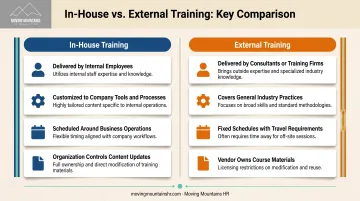
- Delivery: In-house programs use your employees as facilitators; external training uses consultants or training firms.
- Customization: Internal programs target your tools, processes, and challenges; external courses cover general industry practices.
- Location and timing: In-house sessions run on-site or on company platforms around your schedule; external training often means travel or fixed course dates.
- Content ownership: You control and update in-house materials; external providers own their course IP.
Evolution of In-House Training in the Modern Workplace
The pandemic reshaped how organizations deliver internal training. Classroom sessions still matter, but in-house programs now also include live virtual classes, self-paced e-learning, and hybrid formats that mix real-time and on-demand learning.
Training magazine's 2024 Industry Report found that delivery methods now include 34% online/computer-based, 27% virtual classroom/webcast, 27% classroom instructor-led, and 24% blended formats. For in-house programs, that mix lets you train dispersed teams consistently—without travel costs—while keeping content tailored to your business.
Common In-House Training Scenarios
Typical uses include:
- Onboarding: Orientation on culture, policies, systems, and role-specific processes. SHRM notes effective onboarding integrates people into the culture and equips them to contribute, often with manager and peer support for up to 12 months.
- Compliance: Required training on harassment prevention, safety, data security, or industry rules—kept internal so policy details and past incidents stay confidential.
- Skills workshops: Hands-on training on proprietary software, equipment, service standards, or leadership, built around real company examples employees already know.
Benefits of In-House Training
In-house training gives organizations control that external programs rarely match—from cost and scheduling to culture and confidentiality. These are the advantages teams cite most often.
Cost-Effectiveness and Budget Control
In-house training shifts expenditure from external vendor fees and travel expenses to internal labor and materials development. While ATD's 2024 research shows organizations spent $1,283 per employee on average for all workplace learning, this figure includes both internal and external costs across 498 participating organizations.
Where internal delivery creates savings:
- Eliminates per-person external course fees that typically range from $500 to $3,000+ per participant
- Removes travel and accommodation costs for offsite workshops and conferences
- Enables reusable materials that can be delivered to multiple cohorts over time without additional vendor charges
- Provides budget predictability since costs are primarily internal staff time and one-time material development
However, internal costs remain real. ATD's 2022 report found that 62% of direct learning expenditure went to internal services, with trainer salaries, design time, administration, facilities, and technology all representing material investments.
Smart organizations model these internal costs against external alternatives rather than treating employee-created training as "free."
Customization and Relevance
Generic external courses cover industry-wide concepts that participants must translate back to their specific workplace. In-house training starts with organizational reality.
CDC's Quality Training Standards emphasize identifying specific learners, delivery barriers, goals, and training methods appropriate to content and audience before development begins. This audience-first approach allows internal programs to:
- Address the exact software, equipment, processes, and terminology employees use daily
- Incorporate actual company data, client scenarios, and operational challenges as case studies
- Reference past organizational incidents, successes, and lessons learned that external trainers cannot access
- Adjust content during delivery based on real-time participant questions and emerging business needs
For example, a retail company training staff on customer service can use recordings of actual customer interactions, discuss specific product lines, and role-play scenarios involving the company's return policy. An external generic customer-service workshop cannot match that relevance.
Convenience and Minimal Disruption
External training requires employees to block full days or weeks away from work, coordinate travel logistics, and adjust to unfamiliar learning environments. In-house delivery reduces friction.
Teams often gain the most from:
- Training at company facilities, which eliminates commute time and overnight stays
- Sessions scheduled around operational peaks, shift patterns, and team availability
- Shorter, focused modules spread over time, which cut absence impact versus multi-day external courses
- Familiar environments and technology that reduce learner anxiety and technical troubleshooting
While CDC research notes that location is one barrier to examine when designing effective training, convenience alone doesn't guarantee engagement. The comfort factor matters most when combined with well-designed content and skilled facilitation.
Team Building and Collaboration
Training entire teams together, rather than sending one or two people to external courses, creates shared language, strengthens working relationships, and surfaces cross-functional perspectives.
In practice, collaborative learning helps when:
- Participants discuss challenges and solutions with colleagues who understand organizational context
- Cross-departmental sessions reveal different perspectives on shared processes and build networks
- Group problem-solving during training mirrors real collaboration needs back on the job
- Shared learning experiences reinforce company culture and values
Research on team cohesion and performance found that task-focused cohesion relates to stronger team performance, though the study did not establish that group training directly causes cohesion. Still, bringing teams together for relevant skill development creates natural opportunities for relationship-building that individual external attendance cannot.
Confidentiality and Security
Some topics require discussing sensitive organizational information, competitive strategies, or compliance incidents that should not be shared beyond company walls.
When confidentiality matters most:
- Compliance training addressing past harassment complaints, safety incidents, or regulatory violations
- Strategic planning sessions involving proprietary product roadmaps, market positioning, or competitive intelligence
- Process improvement workshops analyzing operational failures, client losses, or quality issues
- Leadership development discussing specific employee performance challenges or succession planning
External training environments mix participants from different organizations, creating information-leakage risk. In-house delivery keeps sensitive discussions internal and allows realistic scenario-based learning without sanitizing examples.
Alignment with Company Culture and Values
Every organization has unwritten rules, communication norms, leadership expectations, and cultural values that shape how work gets done. In-house training embeds these explicitly.
Cultural reinforcement opportunities:
- Internal trainers model desired behaviors, decision-making approaches, and leadership styles
- Training materials incorporate company mission, vision, and values as applied principles, not abstract statements
- Examples and case studies show what "good" looks like in this specific organizational context
- Content can challenge misalignments between stated values and observed practices in a safe learning environment
For instance, a company prioritizing transparency can design leadership training that explicitly addresses when and how to share difficult information with teams. External leadership courses usually treat that kind of customization only at a generic level.

Challenges and Considerations of In-House Training
Resource and Expertise Limitations
Developing quality training demands significant time from employees whose primary job is not instructional design or facilitation.
Common resource constraints:
- Subject-matter experts have deep technical knowledge but lack teaching skills, instructional design experience, or presentation confidence
- Creating engaging materials, assessments, and exercises requires hours beyond initial content drafting
- Small businesses may not employ anyone with expertise in emerging technologies, industry innovations, or specialized technical domains
- Staff assigned training responsibilities must balance development and delivery with their regular workload
CIPD's 2023 survey of 1,108 learning professionals found increased L&D workload pressure, reinforcing that internal training carries real capacity costs. Organizations should identify qualified internal facilitators and provide train-the-trainer support. They also need a realistic read on whether internal expertise exists before committing to in-house development.
When internal HR capacity is the bottleneck, outside help can cover design and compliance without abandoning an in-house model. Moving Mountains HR works with small and mid-size teams to build training that fits business goals and employment-law requirements, so delivery stays internal without a full HR department.
Risk of Limited Perspectives
Internal trainers teach what they know, which may not include latest industry trends, emerging best practices, or innovative approaches developing outside the organization.
Echo chamber risks:
- Training reinforces existing company methods without questioning whether better approaches exist
- Participants miss exposure to how other organizations solve similar challenges
- Internal trainers may not be aware of new technologies, methodologies, or regulatory changes emerging in the broader industry
- Employees may perceive internal trainers as less credible than recognized external experts, particularly for advanced technical topics
This limitation matters most for topics where external perspective drives innovation—leadership development, change management, emerging technology adoption—and less for company-specific systems and processes where internal expertise is authoritative.
Maintenance and Update Requirements
Training content requires ongoing revision to remain accurate, compliant, and relevant.
Continuous maintenance needs:
- Regulatory changes demand updates to compliance training materials and documentation
- Process improvements, system upgrades, and organizational changes require content revisions
- Employee feedback and performance data should drive iterative program improvements
- Materials developed years ago may become outdated, requiring periodic refresh
CDC's Quality Training Standards require evidence-based, current content with timely updating or removal, making content review and subject-matter-expert input recurring costs. Organizations must allocate ongoing resources for program maintenance, not treat content development as a one-time project.
In-House vs External Training: Choosing the Right Approach
Choosing in-house or external training comes down to your objectives, audience size, content type, and internal capability.
When In-House Training Makes the Most Sense
In-house works best when you need:
- Company-specific skills: Training on proprietary software, equipment, processes, policies, or systems unique to the organization
- Large or repeated audiences: Onboarding programs, compliance refreshers, and skills training delivered to multiple cohorts over time
- Confidential content: Topics requiring discussion of sensitive organizational information, incidents, or strategies
- Cultural integration: Programs that reinforce company values, norms, and expectations
- Ongoing development needs: Programs you deliver continuously and update as the business changes
When External Training Is More Appropriate
External training fits better when you need:
- Highly specialized technical skills: Emerging technologies, advanced certifications, or niche expertise unavailable internally
- Professional certifications: Credentials requiring accredited providers, standardized curricula, or authorized instructors
- Small groups or one-time needs: Single-person development or topics unlikely to repeat, making internal development uneconomical
- Industry-wide best practices: Leadership development, change management, or strategic topics benefiting from cross-industry perspective
- Credibility and networking: When outside experts and peer networking add clear value
The Hybrid Approach
Most companies get the best results by running core training in-house and using external programs for specialized development.
Balanced training portfolio:
- Core onboarding, compliance, and systems training delivered internally
- Advanced technical certifications and specialized skills developed through external courses
- Leadership development blending internal coaching and mentoring with external executive education
- Industry conferences and professional associations providing networking and trend exposure
Use this comparison to weigh the trade-offs:
| Criterion | In-House Training | External Training |
|---|---|---|
| Cost | Internal labor, design, and facilities; reusable across cohorts | Per-person fees ($500–$3,000+), plus travel; often better for small or one-off groups |
| Customization | Tailored to your processes, tools, and culture | Generic industry content you adapt back to the workplace |
| Convenience | Scheduled around operations; little to no travel | Fixed schedules; often offsite and multi-day |
| Expertise | Limited to internal knowledge | Access to specialists and current best practices |
| Networking | Builds cross-functional internal relationships | Connects people with peers at other organizations |
| Confidentiality | Full control over sensitive information | Mixed-company settings can risk information leakage |
How to Implement an Effective In-House Training Program
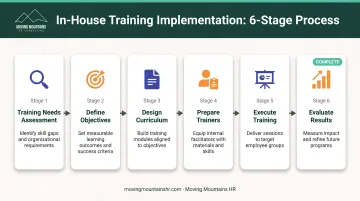
A strong in-house program follows a clear sequence: assess real skill gaps, set measurable objectives, design the right mix of methods, prepare trainers, deliver with solid logistics, and evaluate results. Skip a step and you get training that checks a box but does not change performance.
Conduct a Thorough Training Needs Assessment
Effective training starts by identifying actual knowledge and skill gaps, not assumptions about what employees need.
CDC recommends using existing data review, key-informant input, surveys, and interviews to determine whether training is necessary and what specific competencies require development.
Assessment methods:
- Review performance evaluations, quality metrics, and incident reports for recurring skill deficits
- Interview managers and supervisors about team capability gaps affecting business objectives
- Survey employees about their perceived development needs and confidence in required competencies
- Analyze business goals to identify skills necessary for strategic initiatives or operational improvements
Critical question: Is the performance gap caused by lack of knowledge/skill (training can fix) or by unclear expectations, inadequate tools, or insufficient time (training cannot fix)?
Define Clear, Measurable Training Objectives
Vague goals like "improve customer service" or "develop leadership skills" make program design and evaluation impossible.
CDC's Quality Training Standards require SMART objectives—Specific, Measurable, Achievable, Relevant, and Time-bound—that define exactly what participants will know or do after training.
Strong objective examples:
- "After training, supervisors will conduct performance feedback conversations using the 5-step model, as demonstrated through role-play assessment."
- "Warehouse staff will identify and report the 8 required forklift pre-operation checks before each shift, achieving 100% checklist completion."
- "Customer service representatives will resolve billing inquiries within 3 minutes using the new CRM workflow, measured through system logs."
Clear objectives guide content design, delivery methods, practice activities, and post-training evaluation.
Design the Curriculum and Select Training Methods
Match training format to content type, audience, and learning objectives rather than defaulting to classroom lectures.
Delivery method options:
- Instructor-led workshops: Best for complex topics requiring discussion, group exercises, and immediate Q&A
- Virtual instructor-led training: Interactive group learning for dispersed teams without travel
- E-learning modules: Knowledge transfer, compliance content, and self-paced learning on the employee's schedule
- On-the-job training: Essential for equipment operation, software proficiency, and hands-on skill development
- Mentoring and coaching: Leadership development, cultural integration, and individualized skill-building
- Blended approaches: E-learning for foundations plus live practice and on-the-job application
ATD research finds classroom, online, on-the-job training, coaching, and mentoring among the most common internal methods—with coaching and mentoring the most used on-the-job approaches.
Design principles:
- Include job-relevant practice, role-plays, and realistic scenarios during training, not just information delivery
- Break content into digestible modules rather than marathon single-day sessions
- Build in opportunities for peer discussion and problem-solving that surface different perspectives
- Create job aids, quick-reference guides, and tools employees can use after training
Identify and Prepare Internal Trainers
Subject-matter expertise does not automatically translate to effective teaching. Internal trainers need preparation, materials, and support.
Trainer selection criteria:
- Deep knowledge of the content and credibility with the target audience
- Willingness and availability to prepare thoroughly and deliver consistently
- Comfort with facilitation, group management, and handling challenging questions
- Alignment with company values and desired culture (trainers model expected behaviors)
Preparation requirements:
- Train-the-trainer development covering instructional techniques, facilitation skills, and adult learning principles
- Detailed facilitator guides with timing, key points, discussion questions, and activity instructions
- Practice delivery sessions with feedback before live rollout
- Technical support for virtual delivery platforms, multimedia, and interactive tools
For regulated topics, apply the standard's specific qualification requirements. For example, OSHA requires forklift trainers to have knowledge, training, and experience sufficient to train and evaluate operators in the employer's workplace. Organizations should verify and document trainer qualifications to meet compliance and audit standards.

Execute the Training with Strong Logistics
Even well-designed content fails without thoughtful execution.
Logistics checklist:
- Schedule sessions at times that minimize operational disruption and maximize attendance
- Communicate clearly with participants about objectives, pre-work, schedule, location, and technology requirements
- Ensure proper facilities with adequate space, seating, temperature control, and minimal distractions
- Test technology, equipment, and materials before each session to prevent delays and technical failures
- Create an engaging learning environment that encourages questions, participation, and psychological safety
For virtual delivery, provide technical setup instructions in advance, use breakout rooms for small-group discussion, and incorporate polls, chat, and interactive activities to maintain engagement.
Evaluate Effectiveness and Gather Feedback
Training completion is not training success. Effectiveness requires measuring learning outcomes, workplace application, and business impact.
CDC recommends comparing pretest with posttest results to assess immediate learning, then using delayed follow-up to measure whether participants successfully apply skills back on the job.
Evaluation methods:
- Knowledge assessments: Pre- and post-training tests or quizzes measuring content retention
- Skill demonstrations: Observations, role-plays, or simulations showing competency during training
- Behavioral change: Manager observations and performance data tracking on-the-job application 30-90 days after training
- Participant feedback: Surveys capturing satisfaction, perceived relevance, and suggestions for improvement
- Business metrics: Changes in productivity, quality, customer satisfaction, safety incidents, or turnover linked to trained competencies
CDC's framework also checks whether time, resources, supervisor support, or relevance blocked application. Training only sticks when workplace conditions support it.
Partner with HR Experts for Program Development
Businesses without internal HR expertise benefit from external guidance on compliance requirements and training best practices.
Moving Mountains HR helps small to mid-size businesses design training for California employment compliance, leadership development, performance management, and employee relations.
Programs run virtually or in person through workshops, coaching, or custom learning resources, so you can build internal capability without hiring full-time HR staff.
Best Practices for Maximizing Training ROI
Ensure Leadership Buy-In and Visible Support
Executive sponsorship and manager participation increase training adoption and application.
Leadership actions that drive results:
- Executives communicate why training matters, how it connects to business goals, and what they expect participants to apply
- Managers attend training alongside their teams, model desired behaviors, and reinforce learning in daily interactions
- Leaders protect time for training attendance and practice, signaling that development is a business priority, not an optional activity
- Budget and resource allocation treats training as a strategic investment, not a discretionary expense
When employees see leaders actively engaged and holding people accountable for application, training becomes embedded in culture rather than treated as a checkbox exercise.
Create Opportunities for Practice and Application
Information retention and skill transfer require hands-on practice during training and immediate workplace application afterward.
Practice strategies:
- Use role-plays and simulations that mirror real job challenges, not abstract scenarios
- Assign real-world projects during or immediately after training where participants apply new skills with support
- Provide safe opportunities to practice and receive feedback before high-stakes application
- Build in time for participants to identify specific situations where they will apply each new skill
The CDC defines learning transfer as successful application after employees return to work and recommends delayed follow-up as the best way to assess it. Practice during training plus structured on-the-job application afterward make that transfer far more likely.
Build in Follow-Up and Reinforcement
One-time training events produce short-term knowledge spikes that decay rapidly without reinforcement.
Reinforcement tactics:
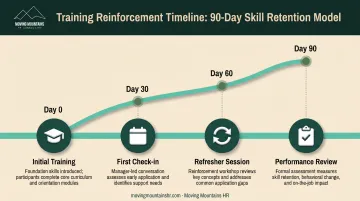
- Schedule follow-up check-ins 30, 60, and 90 days after training to discuss application successes and challenges
- Offer refresher sessions or short modules that revisit key concepts and address emerging questions
- Pair participants with mentors or coaches who provide ongoing support and accountability for skill application
- Create peer learning groups where participants share experiences, problem-solve obstacles, and reinforce each other's development
- Integrate trained competencies into performance evaluations, goal-setting, and recognition systems
Sustained behavior change requires ongoing reinforcement, manager support, and workplace conditions that enable people to apply what they learned.
Frequently Asked Questions
What does in-house training mean?
In-house training is employee development designed and delivered internally using an organization’s own resources, trainers, and facilities. Companies use it to build learning tailored to their processes, culture, and business needs instead of relying on external providers.
What are the types of training methods used in in-house training?
Common methods include instructor-led workshops, on-the-job training, e-learning modules, mentoring and coaching, blended learning, and peer-to-peer knowledge sharing. Most organizations mix formats based on the content and learning goals.
How much does in-house training typically cost?
Costs vary by program scope and delivery method. ATD found organizations spent an average of $1,283 per employee on workplace learning in 2023, covering both internal and external training. Internal programs are usually more economical than external courses when you train groups repeatedly.
What types of training are best suited for in-house delivery?
In-house training fits company-specific content best: onboarding, proprietary systems, internal processes, confidential compliance topics, culture and values, and role-specific skills using real scenarios. Specialized expertise, professional certifications, and industry networking are often better handled externally.
How do you measure the success of in-house training programs?
Track success with participant feedback, pre/post knowledge checks, manager-observed behavior changes 30–90 days later, competency metrics, and business outcomes such as productivity, quality, or retention. CDC recommends delayed follow-up to separate workplace application from immediate learning.
Can in-house training meet compliance and certification requirements?
Yes, when programs are properly documented and aligned with regulatory standards. OSHA permits qualified workplace trainers for forklift operator training, but credentials like OSHA Outreach 10- and 30-hour cards require authorized trainers. Verify your industry’s rules and keep detailed records for audits.