Introduction
Workplace incivility costs U.S. employers real money. Every incident drains an average of 37 minutes and nearly $20 in lost productivity, according to SHRM's Q4 2024 survey of more than 1,600 U.S. workers.
Extrapolate those minutes across a workforce where 76% have witnessed or experienced incivility in the past month, and the annual toll on engagement, retention, and output adds up fast.
The EEOC reported 88,201 new discrimination charges in FY2025 and secured almost $660 million in monetary relief. Those figures cover enforcement actions alone, not the full legal and operational costs employers face when workplace tensions escalate.
In 2026, conflict resolution is a mission-critical HR competency. Hybrid work, multigenerational teams, and rapid technology adoption create friction points that didn't exist a decade ago. Businesses without a structured approach pay the price in turnover, litigation, and lost focus.
This guide walks through practical conflict resolution strategies HR leaders can use to address disputes early, cut legal risk, and keep teams productive.
Key Takeaways
- Effective conflict resolution protects employee relationships, maintains productivity, and shields organizations from costly litigation
- Hybrid work and multigenerational teams create friction that demands updated HR strategies
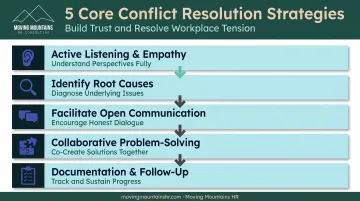
- Five core strategies anchor every successful resolution: active listening, root-cause analysis, open communication, collaborative problem-solving, and follow-up
- Mediation is voluntary and works for interpersonal disputes; formal investigations are mandatory for harassment, discrimination, and retaliation claims
- Small businesses can implement conflict policies and use external HR consultants without hiring full-time HR staff
What Is Conflict Resolution in Human Resource Management?
Conflict resolution in HRM is the systematic process HR uses to identify, address, and resolve workplace disputes between employees, teams, or staff and management. Done well, it protects fairness and productivity while keeping the organization aligned with employment law.
Primary goals include:
- Protecting working relationships and team morale
- Maintaining productivity during and after disputes
- Preventing legal exposure from unresolved discrimination, harassment, or retaliation claims
- Fostering a culture where employees raise concerns early and constructively
Types of Workplace Conflicts HR Handles
HR professionals regularly manage five broad categories:
- Interpersonal disputes – personality clashes, communication breakdowns, or work-style differences
- Team conflicts – competing priorities, unclear roles, or resource allocation disagreements
- Employee-manager disagreements – performance feedback disputes, authority clashes, or perceived favoritism
- Policy-related disputes – disagreements over policy interpretation, application, or fairness
- Discrimination, harassment, and retaliation claims – legally protected complaints requiring formal investigation
Why Conflict Resolution Has Evolved in 2026
Hybrid and remote work arrangements blur boundaries and complicate real-time collaboration. Gallup reports that 48% of leaders struggle with communication in hybrid settings, while 48% of hybrid workers say their team has never discussed a collaboration plan. Without agreed-upon norms for schedules, response times, and escalation, small misunderstandings compound.
Multigenerational workforces add another layer. SHRM cautions against stereotypes, yet notes that preferred channels, response expectations, and technology comfort can differ by age group. Deloitte’s 2025 survey found 86% of Gen Z and 85% of Millennials rate soft skills (communication, empathy, leadership) as important—so interpersonal fluency is a workplace requirement, not a nice-to-have.
Business Impact of Effective Conflict Resolution
When conflicts are addressed early and fairly:
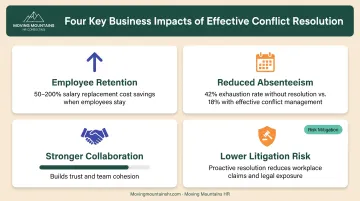
- Employee retention improves – SHRM estimates replacement costs at 50%–200% of annual salary; unresolved conflict is a known driver of exits
- Absenteeism drops – CIPD research found 42% of workers in conflict often felt exhausted, versus 18% without conflict
- Collaboration strengthens – teams that work through disputes report higher trust and less passive-aggressive behavior
- Litigation risk falls – fair, consistent processes create a defensible record if a dispute becomes a formal claim
5 Essential Conflict Resolution Strategies for HR Professionals
Workplace disputes rarely resolve on instinct alone. These five strategies give HR a repeatable way to slow the conflict down, find what is actually driving it, and close it out without taking sides.
Strategy 1: Active Listening and Empathy
Active listening means giving each party full attention and working to understand their perspective. You respond without judgment and retain the details you will need later.
Stay empathetic and neutral:
- Paraphrase what each person shares: "It sounds like you're frustrated because deadlines weren't communicated clearly. Is that right?"
- Validate emotions without endorsing positions: "I can see this situation has been stressful for both of you."
- Avoid outcome promises or side-taking during intake
Strategy 2: Identifying Root Causes vs. Surface Issues
The complaint you hear first is often not the real problem. A line like "She interrupted me in the meeting" can mask unclear role boundaries, resource competition, inconsistent management feedback, or exhaustion from overload.
Techniques for uncovering root causes:
- Conduct individual interviews before joint discussions
- Ask probing questions: "When did you first notice this pattern?" or "What would need to change for this to feel resolved?"
- Review team structure, workload distribution, recent policy changes, and leadership turnover
CIPD research points to excessive workload, exhaustion, and pressure as common drivers of workplace conflict, not only interpersonal friction.
Strategy 3: Facilitating Open Communication
HR sets the conditions for a usable conversation. Establish ground rules up front: respectful dialogue, no interruptions, focus on specific behaviors rather than character attacks, and confidentiality within agreed boundaries.
Encourage direct communication:
- Guide parties to address each other, not only HR: "Can you share with Alex directly what you need from him going forward?"
- Balance airtime so quieter voices are heard and dominant voices do not run the room
- Coach "I" statements to cut defensiveness: "I felt excluded when I wasn't copied on the email" instead of "You always leave me out"
Strategy 4: Collaborative Problem-Solving
Interest-based problem-solving moves people off rigid demands ("I need a different desk") and onto underlying needs ("I need quiet time to focus in the afternoon").
Steps HR can facilitate:
- Separate core interests from stated positions
- Brainstorm several options before judging any of them
- Score options on mutual benefit, feasibility, and policy fit
- Push for practical compromise: rotating schedules, shared resources, or clearer communication norms
Strategy 5: Documentation and Follow-Up
If it is not written down, it is hard to defend and harder to learn from. Documentation protects the organization and creates a record you can improve on.
What to document:
- Date and nature of the conflict
- Parties involved
- Fact-focused summary of each perspective
- Agreed resolution with actions, owners, and deadlines
- Follow-up schedule
Follow-up best practices:
- Check in at 2 weeks and again at 1 month
- Watch for retaliation, renewed tension, or missed commitments
- Adjust the agreement if conditions change or it proves unworkable
- Record follow-up outcomes so the file actually closes
Step-by-Step Guide: How HR Should Mediate Workplace Conflicts
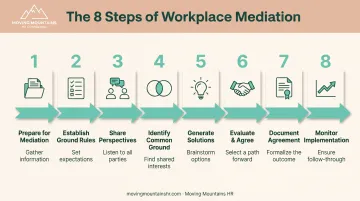
Mediation is a voluntary, facilitated process where HR guides the conversation as a neutral party and does not decide the outcome. It's appropriate for interpersonal disputes, communication breakdowns, and working-style clashes. It is not appropriate for allegations of harassment, discrimination, retaliation, threats, or serious policy violations, which require formal investigation.
Small businesses without trained investigators often bring in a neutral third party for those formal cases so impartiality holds up under scrutiny.
Step 1: Prepare for Mediation
Solid prep keeps the session focused and fair.
Preparation tasks:
- Gather background information from both parties separately
- Review relevant policies (performance standards, code of conduct, anti-harassment)
- Identify potential power imbalances (manager vs. employee, tenure differences)
- Select a neutral, private location
- Set time expectations (typically 60–90 minutes)
Step 2: Establish Ground Rules and Set the Tone
Open the session by explaining HR's role: "I'm here to help you work through this, not to decide who's right or wrong."
Ground rules to establish:
- Respectful language and tone
- No interruptions: each person gets uninterrupted time
- Confidentiality within agreed limits (HR may document for record-keeping)
- Focus on resolution, not blame
- Either party can request a break if needed
Step 3: Allow Each Party to Share Their Perspective
Give each person 5–10 minutes to explain their view without interruption.
What HR should listen for:
- Facts vs. emotions (both matter, but clarify which is which)
- Patterns or recurring behaviors
- Underlying needs (respect, clarity, autonomy, fairness)
Restate each perspective to confirm understanding: "So you're saying the main issue is inconsistent feedback on project priorities. Correct?"
Step 4: Identify Common Ground and Mutual Interests
Even in heated disputes, parties often share baseline goals: "We both want projects to run smoothly" or "We both want clear expectations."
Finding common ground:
- Ask, "What do you both agree on?"
- Highlight shared interests: "You both value transparency. How can we build that into your workflow?"
- Use those shared points as the base for solutions
Step 5: Facilitate Solution Generation
Guide parties to brainstorm options without immediate critique.
Open-ended prompts:
- "What would a good outcome look like for you?"
- "If you could change one thing about how you work together, what would it be?"
- "What's worked well in the past that we could do more of?"
Encourage creativity: flexible schedules, communication protocols, role clarifications, or regular check-ins.
Step 6: Evaluate Solutions and Reach Agreement
Review each proposed solution against both parties' core needs.
Evaluation criteria:
- Does this address the root issue?
- Is it realistic and within policy?
- Can both parties commit to it?
Negotiate compromise where needed so both sides own the final agreement.
Step 7: Document the Agreement and Establish Follow-Up
Put the agreement in writing, including:
- Specific actions each party will take
- Deadlines and milestones
- Who owns each commitment
- Follow-up dates (typically 2 weeks and 1 month out)
Have both parties review and confirm the agreement before leaving the session.
Step 8: Monitor Implementation and Maintain Confidentiality
Follow up at the scheduled intervals to ensure the agreement is working.
Monitoring tasks:
- Check in with both parties individually
- Ask if commitments are being honored
- Be available if new issues arise
- Keep mediation discussions confidential
- Document outcomes in HR records for legal protection
Common Workplace Conflicts and How to Address Them
Most workplace conflict falls into a few repeatable patterns. Spot the type early, then match your response so small friction does not become a formal complaint.
Most Frequent Conflict Types
CIPD's 2024 UK survey is a useful external benchmark. Among workers who experienced conflict, 48% reported being undermined or humiliated, 35% cited heated arguments, 34% reported verbal abuse or insults, and 20% faced discriminatory behavior.
In U.S. small to mid-size businesses, the patterns HR sees most often include:
- Communication breakdowns: misunderstood emails, missed updates, inconsistent feedback
- Personality clashes: different work styles, communication preferences, or conflict tolerance
- Competing priorities and resources: budget limits, colliding deadlines, or unclear decision rights
- Performance strain on the team: one person's underperformance shifting work onto others
- Work-style gaps: remote vs. in-office expectations in hybrid teams
Early Warning Signs HR Should Watch For
Conflicts rarely explode without notice. Watch for:
- Decreased collaboration or teammates working in silos
- Repeated complaints (formal or informal) about the same people or teams
- Employees avoiding each other or leaving colleagues out of meetings
- Drops in productivity or quality
- Passive-aggressive behavior: sarcasm, ignored emails, or public criticism
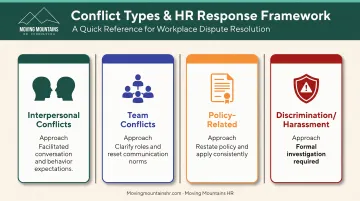
Tailored Approaches by Conflict Type
| Conflict Type | HR Approach |
|---|---|
| Interpersonal | Hold a facilitated conversation; set clear behavior expectations and follow up in writing |
| Team | Clarify roles and workload, reset communication norms, and agree on decision rights |
| Policy-related | Re-state the policy, gather facts if disputed, and apply the rule consistently |
| Discrimination/harassment | Open a formal, impartial investigation promptly and document corrective action if substantiated |
Whatever the type, document what you observed, what you did, and when. Escalate to a formal investigation as soon as protected-class issues, retaliation risk, or serious misconduct appear.
Implementing a Conflict Resolution Policy in Your Organization
Every organization, regardless of size, should have a written conflict resolution policy that employees understand and trust.
Key Policy Components
Your policy should include:
- Clear definition of what constitutes workplace conflict (interpersonal disputes, policy disagreements, team friction)
- Step-by-step process employees should follow:
- Attempt direct conversation with the other party
- Involve immediate supervisor if direct resolution fails
- Escalate to HR if supervisor involvement doesn't resolve the issue
- Timelines for each stage (e.g., employees should escalate within 5 business days if unresolved)
- Confidentiality protections covering what stays private and what may need disclosure
- Non-retaliation assurances so employees know they won't face punishment for raising concerns in good faith
Training Employees and Managers
A policy is only as good as the training that supports it.
Training methods:
- Onboarding modules that explain the conflict resolution process
- Annual refresher workshops using real-world scenarios and role-play
- Manager-specific training on de-escalation, active listening, documentation, and when to involve HR
Ensure everyone knows their rights (to raise concerns without retaliation) and responsibilities (to engage constructively in resolution).
How Moving Mountains HR Can Help
Moving Mountains HR helps small to mid-size businesses develop conflict resolution policies tailored to their industry, culture, and compliance requirements.
California employers face extra stakes. Companies with 5 or more employees must provide harassment and abusive-conduct prevention training every two years (1 hour for nonsupervisors, 2 hours for supervisors).
Compliance audits, policy packages, and training programs from Moving Mountains HR help your conflict framework meet legal standards while supporting a healthy workplace culture.
When to Seek Professional HR Support
Not all conflicts can or shouldbe resolved internally. Recognize when it's time to bring in outside expertise.
Indicators You Need Professional HR Consulting
Bring in a neutral third party when:
- The conflict involves potential legal claims (discrimination, harassment, retaliation)
- Power imbalances prevent fair internal mediation (such as employee vs. senior executive)
- The same individuals are involved in repeated conflicts despite prior interventions
- The conflict is affecting multiple teams or departments
- Your organization lacks trained HR staff to conduct impartial investigations
Benefits of Neutral Workplace Investigators
Independent investigators provide:
- Objective fact-finding – no internal loyalties or career concerns
- Bias-free interviews – skilled questioning without preconceived conclusions
- Defensible recommendations – findings that protect the organization from legal liability
- Confidentiality and professionalism – reducing retaliation risk and employee anxiety
Fractional HR Services for Complex Workplace Dynamics
Small to mid-size businesses and healthcare organizations often face complex workplace dynamics without the budget for a full-time HR executive. Fractional HR services, including support from Moving Mountains HR, deliver executive-level conflict resolution on a retainer or project basis.
Typical engagements cover:
- Formal workplace investigations
- Customized training on conflict resolution and communication
- Active participation in HR meetings to address emerging tensions before they escalate
Frequently Asked Questions
What is conflict resolution in human resource management?
Conflict resolution in HRM is the structured process HR uses to identify, address, and resolve workplace disputes while maintaining fairness, protecting employee relationships, and ensuring compliance with employment laws.
What are the main conflict resolution strategies in human resource management?
Core strategies include active listening, mediation, root-cause analysis, collaborative problem-solving, clear policies, employee training, and consistent follow-up.
What are the steps in conflict resolution in human resource management?
Acknowledge the conflict, gather facts from all sides, identify the root cause, facilitate open dialogue, explore solutions, agree on a resolution, document it, and follow up to confirm it holds.
When should HR get involved in workplace conflicts?
HR should step in when employees cannot resolve conflicts directly, when conflicts involve potential policy violations or legal issues (harassment, discrimination, retaliation), when there are power imbalances (employee vs. manager), or when conflicts are affecting team productivity and morale.
How can small businesses implement conflict resolution policies without a full HR department?
Write a simple conflict resolution policy, train managers as first-line resolvers, and partner with external HR consultants for complex cases. Many small businesses use fractional HR services for expert guidance without a full-time HR hire.
What's the difference between mediation and arbitration in HR conflict resolution?
Mediation is a facilitated process where a neutral third party helps employees reach their own voluntary agreement. Arbitration involves a third party hearing both sides and making a binding decision. Mediation is collaborative; arbitration is more formal and decisive.
Final Thought
Workplace conflict is inevitable. Unresolved conflict is not. In 2026, organizations that thrive treat conflict resolution as a core skill. Whether you run a small business facing your first dispute or a mid-size company managing hybrid teams, a fair, documented process protects your people, culture, and bottom line.
Moving Mountains HR helps California businesses and organizations nationwide build conflict resolution policies, run impartial workplace investigations, and train teams in communication and de-escalation. Call 866-474-3575 or email questions@movingmountainshr.com for a complimentary consultation.